Wednesday, 28 October 2015

WHO REVIEW: 9-6) The Woman Who Lived

It's been a funny week for Doctor Who. Big Finish have announced that, in what's surely the culmination of their gaining the rights to the new series, that David Tennant and Catherine Tate are returning as the Doctor and Donna for a special set of Tenth Doctor audio adventures next year. Meanwhile, in less expected news, Bob Baker is bringing back the Doctor's robot dog in a movie called K-9: Timequake, set for release in 2017. It's set to pit K-9 against the legendary Gallifreyan villain Omega, another character created by Bob Baker and his co-writer Dave Martin. To be honest, I'll be pleasantly surprised if this actually materialises, but it could be wonderfully batty if it does. Before all this, the BBC interrupted its succession of spooky and exciting stories for this idiosyncratic, philosophical and talky episode.

"The Woman Who Lived" is the second half of a sort-of-kinda-two-parter, but is so tonally different to its predecessor "The Girl Who Died" that it's hard to consider it as anything other than a separate story. Not to mention that it takes place eight hundred years later, is written by a different author and one of the previous episode's main characters is almost entirely missing. Catherine Tregenna, having written some of the more emotionally mature and interesting episodes of Torchwood (plus "Meat," but never mind that), is a good choice for this episode, and she excels at giving interesting dialogue to the Doctor and Ashildr - now referred to, and even credited, as "Me." The character's complete inability to remember her original name and barely having any recollection of her life is entirely believable, and equally heartbreaking. There's some fine characterisation here, with Ashildr presented as naive, forthright yet unsure of herself, and immensely likeable, while the centuries older Me is both utterly beaten down and supremely self-confident, yet, at least initially, not very pleasant at all. The parallels with the Doctor are, of course, obvious. That the Doctor refuses to take her with him precisely because they are so similar works perfectly, furthering the notion that he needs a human companion, not a godlike immortal, to keep him focused on the little picture. It's also quite right that he feels guilty for not being there for Ashildr/Me, but never once expresses regret at saving her life, in spite of the consequences.
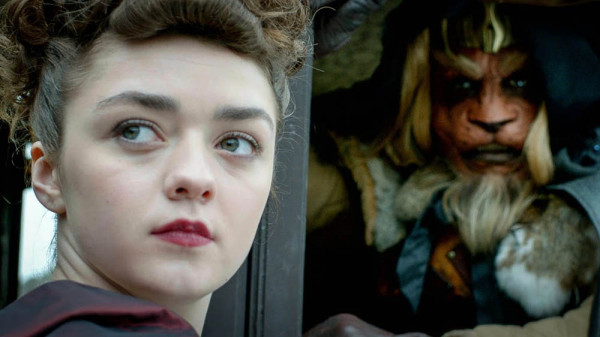


The first half of the episode is almost a two-hander between Capaldi and Williams, and even with the best writing, couldn't work without their acting talents. As good as Capaldi is, it's Williams who makes this episode, managing the very difficult task of making Me both extremely removed from, and recognisably the same person as, Ashildr. As much as I'm a Clara defender, I didn't miss her in the slightest in this episode. Clara's presence would have overloaded it, when it needed to focus on the relationship, or lack thereof, between Me and the Doctor. (Not me and the Doctor. Me and the Doctor, if you follow.) That said, it's another episode that justifies its later timeslot by being unsuitable for younger children, this time by virtue of being extremely talky and largely uneventful. I like slow-paced television, but it's hard to see many children getting a lot of entertainment from this episode.

Where it falls down is in the material that doesn't focus solely on the Doctor and Me. In spite of being played by the reliably funny comedy actor (and huge Doctor Who fan) Rufus Hound, Sam Swift is a dull and ineffective character. Speaking as a man who adores terrible puns, I can appreciate the joy of ending an episode with a pundown, but the hangman scene fell flat. The jokes needed to be worse! The old ones are the best, as H.P. Lovecraft used to say, but god, that scene needed some original material. The comedy guards and deaf manservant were even less effective, but at least they didn't outstay their welcome. The opening scene was pretty good, but even then, the prevailing thought was "Blackadder did it better." On the adventure side of things, we had some unusually inept action scenes, including a poorly choreographed fight between Me/the Knightmare, and Sam. I realise that bout of fisticuffs was supposed to be inept, but surely it should be watchable. Leandro the lion man was also unispiring, a terribly generic villain who brought little to the story bar an obvious last-minute threat.

Some people have called this episode boring, disliking it for its verbosity and slow-pace. Too much talking, not enough action. For me, though (not Me, but me), it's the opposite. Where "The Woman Who Lived" worked best was in its quiet, dialogue-heavy scenes. I'm looking forward to seeing Maisie Williams's character again, but I'm not too enthused about Sam Swift joining her.


Continuity Corner: The Doctor claims the Great Fire of London was caused by the Terileptils, a reference to the 1982 serial The Visitation, in which the fifth Doctor teamed up with another highwayman, Mr. Richard Mace. He's fibbing a bit, though: it was actually he himself who dropped the torch that started the fire.

He also talks about travelling with another immortal, Captain Jack Harkness, although this is a bit of a stretch. His travels with Jack took place before the Time Agent became immortal, and he promptly dumped him when it happened. This left Jack as a "fixed point in time," a phrase which has since recurred in all manner of scenarios and doesn't seem to mean anything anymore, so it's no surprise we don't hear it applied to Ashildr.

Stargazing: Leandro is from Delta Leonis. Also known as Zosma and Duhr (not the best name, that last one), it represents the hip of the constellation of the lion, and lies around 58 light years away. It's not too different from our Sun, a little bigger and older.

Best line: "What could be worse than losing your children?"
"I keep that entry to remind me not to have any more."

Worst line: "T'is black as night." Hun, it is night.


How d'you like them apples?


Sunday, 25 October 2015

REVIEW: The Flash 2.1 - 2.3

THE MAN WHO SAVED CENTRAL CITY

Having enjoyed The Flash immensely during its first season, I'm now committing to reviewing the second run. (Run is probably the appropriate term for a period of this show.) The first series hit the ground running (I'll stop now), but this time, it's had a rather uneven start. Of the first three episodes, only one has really succeeded.

"The Man Who Saved Central City" has the unenviable task of resolving last year's catastrophic cliffhanger, which saw  Central City on the verge of being swallowed up by a black hole, as well as follow up on the emotional revelations that led to that event. It does so in a bizarrely roundabout way, joining a depressed Barry Allen six months after he saved the city from the anomaly. We gradually receive glimpses of what happened that day, with Barry not only shouldering guilt for the death of Eddie in last year's finale, but also Ronnie, who's bumped off in a disappointingly perfunctory manner in the act of closing the singularity. We already suspected he was going to leave, what with his being replaced as half of Firestorm in the upcoming Legends of Tomorrow series, but there must have been a better way to tackle it. In any case, we never see a body, so I'd be very surprised if we don't see him again somewhere down the line.

Firestorm's other half, Professor Stein, remains a joy, replacing the villainous Harrison Wells as the elder statesman of the series, acting as something of a father figure for Barry and Cisco. The problem being that Barry really doesn't need another father figure, especially with the astonishingly unlikely events in this episode. Evil old Wells/Thawne leaves a video will confessing to the murder of Barry's mother. His dad is free! Then he leaves! For no well explained or believable reason! It's a shockingly poor way of severing last season's ongoing plot threads and frankly comes across as lazy. 

I did, however, enjoy the juxtaposition of Barry's guilt and Central City's celebration of him with "Flash Day," and his subsequent return to form. The villainous Atom Smasher was dealt with rather more quickly than his pre-series hype suggested, but worked reasonably well as the freak-of-the-week, and the new plot thread dealing with a parallel Earth was seeded in nicely. But can STAR Labs really continue to operate after almost destroying the Earth with a runaway disaster like a black hole? That's hard to credit.

FLASH OF TWO WORLDS

This is more like it. "Flash of Two Worlds" embraces The Flash's comicbook roots with the same joyful exuberance as it did last season. Calling back to the classic Flash issue that spawned Earth-Two and the entire comicbook multiverse that defines DC's mythology (and that of many of its competitors), this is full of cheeky little nods and gleeful winks. There's a lot introduced here - Earth-Two, Jay Garrick as the other Flash, the villainous Zoom, interdimensional rifts, Iris's mother revealed to be alive, Harrison Wells alive on the other Earth - it's chocka. However, it's all done with confidence and panache and it works, far better than the previous week's efforts at tidying up. 

I like Teddy Sears as Jay Garrick. He's heroic in a more old-fashioned, square-jawed way than Barry's millennial speedster. He has great chemistry with Caitlin, who seems to be getting over her husband Ronnie rather quickly (in fairness, he was dull as they come). Another nice addition to the cast is Shantal VanSanten as Patty Spivot, who has a wonderful rapport with Barry and is just as unashamedly nerdy. It's getting harder to support Joe, though, who comes across as obtusely stupid this episode. Are parallel universes really so hard for the average guy to grasp these days? And couldn't Cisco have just explained it to him with a movie metaphor like he did with time travel before? It's also strange that he's so resistant to letting the clearly talented Patty onto the metahuman taskforce. Also, it's a shame that Patty had to get herself into a cliched hostage situation so early on.

Overall, though, this is episode is just wonderfully good fun, from the sandy metahuman villain to the glimpses of Zoom (with Tony Todd providing his gravelly tones) to that glorious shot of Jay an Barry calling back to a classic comic cover. This is what The Flash excels at: cheesy, over-the-top fun.

FAMILY OF ROGUES

Episode three is frustrating one, too concerned with setting up the players for Legends of Tomorrow than in telling its own story. Wentworth Miller gives the arch performance we've come to love from his Captain Cold, but he seems bored with this material. Sure, it's cool to see Michael Ironside as his abusive father, but it's all rather trite and uninteresting. Lisa, the Golden Glider, is not my favourite character, but she has good chemistry with Cisco and she's become genuinely sympathetic, although she's cursed with some terrible dialogue this episode. Mostly, though, what works in this episode is the rapport between Barry and Snart/Cold, as two enemies who nonetheless share a certain respect. It's all leading to Snart's eventual redemption as part of the Legends team, as he's a villain who clearly does have some compassion in him. On the other hand, Stein's illness - clearly a result of his sudden loss of his duller half - is an uninteresting storyline altogether, although it's presumably leading to meatier stuff next week.

It was fun seeing Barry get an obvious kick from playing the villain to get in with the Snarts. However, the science on this show drives me mad sometimes. I realise super-speedsters are nonsense, but when you intersect with real science you have to play by the rules a little more. Visible security lasers is a bugbear of mine - that just isn't how they work. The whole point of them is that you can't see them and know when to work round them. In this episode, Captain Cold uses his "cold gun" to freeze the laser beams. It's so utterly stupid I can only surmise it was put in there to deliberately piss nerds like me off.

The other major thread of this episode deals with the Wests, and I'm really warming to Iris after not particularly liking the character last year. It's good to see Joe come to terms with the fact that she's an adult now and that continually lying to her, regardless of his good intentions, is just a shitty thing to do. We'll see how this develops as the series moves on. More fun is the reveal that Earth-Two Harrison Wells has a "Speed Cannon" and can travel between worlds. So, is he Zoom? Surely that would be too obvious, not to mention repetitive, for the production team to run. Plus, as far as we know this really is Wells, not Thawne wearing a Wells-suit. My feeling is that this is a huge herring. The current theory at my place is that Zoom is actually Earth-Two's version of Barry. That would be fun.

Tuesday, 20 October 2015

WHO REVIEW: 9-5) The Girl Who Died

While I'm pleased to have longer, more languidly paced stories back this season, it's a pleasure to have a brisk, comical romp like this to break things up. After the grim pair of stories that made up the year's first four episodes, the delightful and often silly The Girl Who Died is, in spite of its title, the most light-hearted episode so far this year. It's also refreshingly small scale, for while the Doctor frets about the potential affect to history should he interfere too much, the stakes here amount to no more than the population of a very small village. This is just how it should be; not every episode should have the Earth or the entire universe hanging in the balance. It's good to have an episode which reminds the Doctor just how important a single human life is.

The script is accredited to both Jamie Mathieson and Stephen Moffat, and while it's impossible to say how much of each writer's work makes up the finished product, it feels more like Mathieson's previous episodes, particularly Mummy on the Orient Express. It's a fine balance between the silly and the soulful. None of it is particularly plausible, either historically or scientifically. These are storybook Vikings fishing for storybook electric eels. The comedy is broad, but effective, and with Capaldi showing a lighter side as the Doctor this year, works perfectly. Everything's pitched dead on.  It's a little hard to credit the terrifying reputation of the Mire to a group of spacemen who can be defeated by being threatened with an embarrassing video on YouTube (or it's 11th century intergalactic equivalent). However, it's such a joyfully funny and triumphant scene that it really doesn't matter. Yet there are some real moments of pathos here. When it was introduced in the equally comical Closing Time, the Doctor's ability to "speak baby" felt trite and overindulgent. Here, though, it's used for a moment of genuinely affecting emotion, making the Doctor appear more alien and poetic than he has been in years.


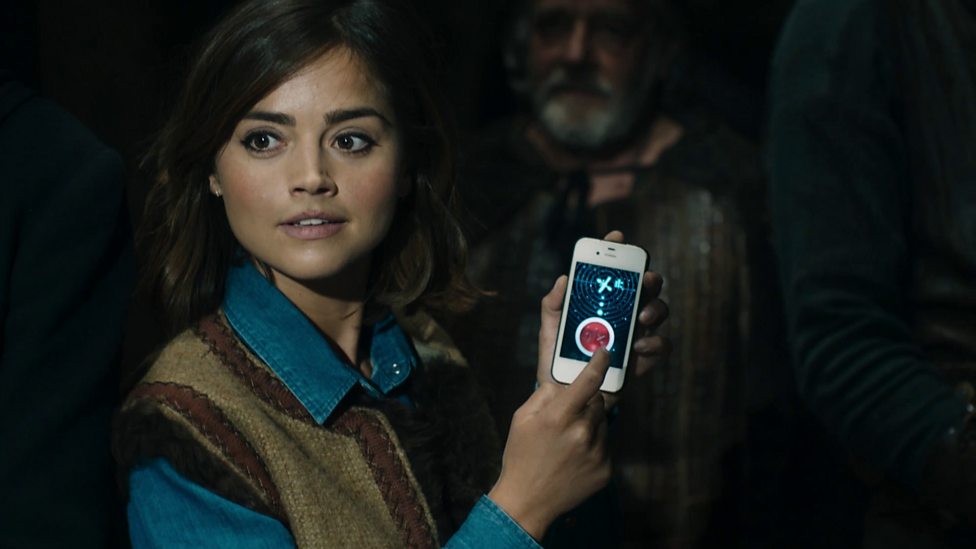
It all looks wonderful as well, from the implausible Viking costumes to the blocky spacesuits of the Mire. The alien creatures are a pretty flimsy set of villains, including the false Odin who leads them, but they look good and serve their purpose in the story, so it seems churlish to complain. Having them so completely obscured by their technology works well, setting up both their power and their weakness. It's unusual to have an episode of Doctor Who which is so anti-technology, and to have the Doctor reduced to the most basic of technology (aside from a handy mobile phone) before calling him to task makes a big difference. Capaldi is, of course, excellent here, swinging between sardonic humour and worldweary sorrow with ease. It's a characterisation of the Doctor that works so well; someone who has simply lived too long and lost too much. Jenna Coleman also gets some good material after being poorly used last week. Although she is quite minor to the actual plot here, her increasingly Doctorish behaviour against threats, and her spurring him to action in defense of the villagers, plays to the strengths of both the actress and character.


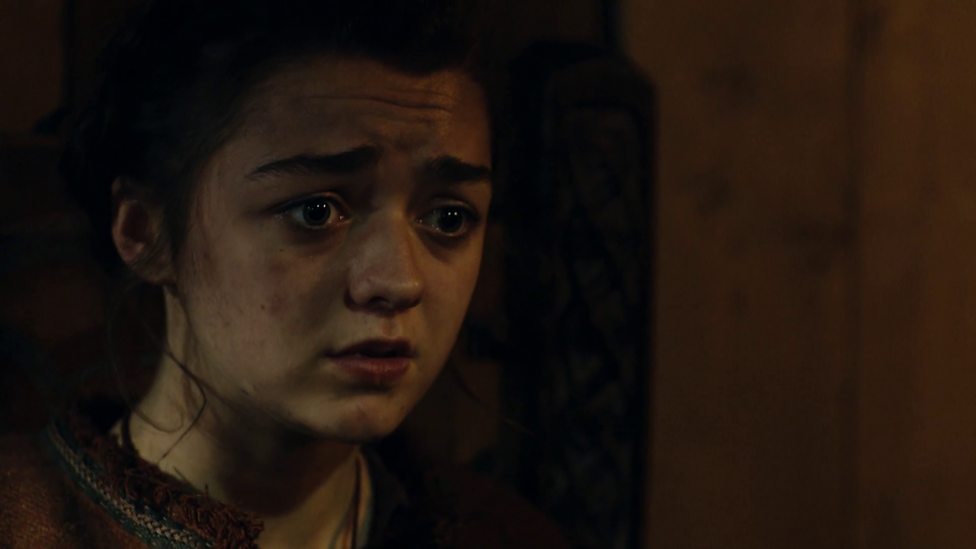
In the end, though, this episode belongs to Maisie Williams. It was perhaps inevitable that she'd be typecast to a certain extent, but Ashildr is quite different to Arya Stark. An astonishingly confident young woman who's unique ability is her skill as a storyteller, she's a wonderful match for the Doctor, and it's easy to see why he is so powerfully affected by her death. She'll be back next week, of course, playing what looks to be a very different take on the same character. It'll be interesting to see how she handles such a role. I'd be very surprised if that is the last we see of her; her importance to the arc plot (presumably much of Moffat's contribution, along with the flashback to The Fires of Pompeii) is hinted at heavily. That's the strength of this episode: a silly, low stakes romp that is simultaneously a moving and vitally important story.


Continuity Corner: The most obvious thing to point out is that the Doctor finally recognises where he got his face from, with flashbacks to 2008's The Fires of Pompeii. It's not just a callback, though; there's a genuinely clever reason given, with the Doctor subconsciously choosing a face that will remind him of a time when he chose to flout history and save lives. A nice way of making use of a bit of recasting.

The Doctor previously tangled with Vikings in his first life, in the serial The Time Meddler. We saw him engage in swordplay in, off the top of my head, The Crusade, The Sea Devils, The Androids of Tara, The King's Demons and The Christmas Invasion.

The first Doctor previously impersonated a deity in The Myth Makers, in which case he was mistaken for Zeus. Before this, his companion Barbara was mistaken by The Aztecs for the deified reincarnation of their high priest Yetaxa.

The Doctor describes Ashildr as "Immortal, barring accidents," how he described his own people in 1969's The War Games. This is the second time we've seen an associate of the Doctor receive immortality, of course. Maybe she'll bump into Jack in a few hundred years. A more similar situation arose in the excellent DWM comic stories The Road to Hell and The Glorious Dead, in which the eighth Doctor saved the life of the Japanese warrior Katsura Sato, with the result of making him immortal.

Hanky Panky in the TARDIS: So, it seems that they've quietly settled that Clara is bi. That's nice.

Best line: "Mother, I hear thunder. Mother, I hear shouting. You are my world, but I hear other worlds now. Beyond the unfolding of your smile, is there other kindness? I'm afraid."


Thursday, 15 October 2015

TREK REVIEW: Star Trek Continues: Divided We Stand

I rather enjoyed this one, in spite of its being squarely aimed at the core American audience of Trek fans. It's not, to be fair, terribly original in its content: Kirk and McCoy are seemingly sent back in time to the American Civil War, although it's very quickly revealed to the audience that they have been infected by a virus that has caught them in a shared dreamscape. There's no mystery to it, nor much interest in the Enterprise-based subplot of curing the two friends. No, this is all about how Jim and Bones cope in this environment, believing it to be viscerally real and apparently without hope of rescue.

The original Star Trek played with Earth's history on numerous occasions, so much so that it seems odd that it wasn't repurposed as a time travel show. Whether it was actual trips into the past, bizarre alien recreations or planets that seem to have developed along Earthlike lines due to interference or sheer coincidence. So this excursion to 19th century America feels very in keeping with the series that it's seeking to emulate, without taking the path of previous episodes and indulging in heavy continuity. Not that there's anything wrong with heavy continuity in a fan series, but it's a pleasure to have something a little fresher after a run of sequels and callbacks. In fact, I can only think of one nod to the series' history, that being the name of the probe that delivers the virus: Friendship Three, presumably a successor to the eponymous probe from the Voyager episode Friendship One.

The strength of the episode lies in the recreation of the American battlefields. I presume the production team called on the services of some historical reenactment enthusiasts, since the battle scenes are populous and convincing (not that I'm any expert on the period, never having had a particular interest in the American Civil War). The decision to use Kirk and McCoy was a wise one. The strength of their friendship keeps them going through the bloody horrors of a very real war, far from the usually sanitised conflicts seen in Trek (although the original series was bloodier than people remember). Their respective backgrounds put Kirk and Bones on opposing sides in the war, with Kirk cast as a Union soldier and McCoy as his prisoner. It unfolds predictably, but nonetheless effectively, with both Vic Mignola and Chuck Huber working extremely well together here. A particularly effective installment from an always impressive fan production.


Watch the episode here.

Wednesday, 14 October 2015

WHO REVIEW: 9-3 & 9-4: Under the Lake/Before the Flood

With Being Human, Toby Whithouse brought together vampires, werewolves and ghosts, along with such elements as time travel, to remarkable effect. In Doctor Who, he's already had a stab at vampires, and now he's utilised both time travel and ghosts in a story with a fascinating set-up. It's a very clever idea, splitting the story across two time zones, so that characters can, in theory, meet their own ghosts in the future. It never quite runs with this idea, though. The concept of being able to not only see but actually speak with your ghost is compelling, but beyond a brief interaction between the Doctor and his ghost (revealed to be nothing of the sort in any case), the idea isn't explored. The fact that the ghosts are essentially incapable of communication rather ruins it anyway; they're not characters but sinister set dressing and hazards. It's undeniably effective, but it's the less interesting option. Equally, the Fisher King, is well designed and realised - at least in the underlit interior scenes, not looking quite so creepy stomping about in daylight. However, since he does little more than rant and murder people off screen, he's a very hollow and uninspiring villain. 

Huge respect for the inclusion of the talented Sophie Stone as Cass, a deaf actress playing a deaf character, unapologetically included not as a token to disabled sensibilities but simply as a strong, interesting character who brings a somewhat different perspective to adventure. Around the country, deaf children will be watching Doctor Who and seeing a deaf person in a heroic role, not only leading the guest characters but enthusiastically told by the Doctor that she is the smartest person in the room (barring himself, of course). It's a wonderfully positive move on the part of the series' creators. Oddly enough, the Doctor doesn't know sign language; a strange omission for the man who knows fifty million languages, even if the script did make a joke about it being deleted to make room for semaphore. It's understandable in real life terms, of course; very likely, Peter Capaldi doesn't know sign, and in any case, having Cass's signs translated makes it possible for the bulk of the audience to understand her lines. However, I watched Before the Flood in the company of a fluent signer who was translating along with the episode, and I can therefore say that any viewer who can sign will get more out of the it than one relying on the interpreter. 

The remaining guest cast are all very good indeed, although in many cases rather wasted in the parts they have. Zaqi Ismail is perfectly good as Lunn but lacks a great deal in character as written; Arsher Ali seemed at risk of the same during the first episode, but he, as Bennett, came into his own in the second part once he had something to play other than spooked. Paul Kaye, rightfully recognised now as a highly talented actor, is amusing as the snivelling Prentis, but is so quickly killed off that there was never really any chance to appreciate him. The same goes for Steven Robertson and, most of all, Colin MacFarlane; talented actors whose characters are given virtually no screen time before being bumped. Yes, they then get to do their best as hollow-eyed phantoms, but that's still a waste of genuinely fine acting talent. Most galling is the killing of O'Donnell, who, particularly in the second episode, develops into an infectiously likeable and entertainingly bloody-minded character before being killed off to give the male characters the necessary angst. I'm not making a vehement feminist point here; the best character in the story was female (Cass, of course), and since much of my upset at O'Donnell's death is that I fancy the pants off Morven Christie, I'd be pretty hypocritical. Nonetheless, it grates.

Capaldi shines, as always, even though, to be honest, he didn't have very strong material to work with this time, Nonetheless, he's an interesting enough actor to make any of his scenes compelling. Clara, though, is rather uninteresting in this story, and Jenna Coleman makes less of an impression than usual. Perhaps it's a good thing she's leaving this year; there doesn't seem to be much left to do with her character. 

Ultimately, the script is packed with potentially great ideas and characters that, for the most part, it fails to explore to full effect. For all its atmosphere - and I think we need more slow-paced, unsettling stories - it's a disappointing tale, relying on rather a dissatisfying interpretation of time travel that lacks real drama.

Casting Call: Sophie Stone is the first deaf actress in the series, but not the first deaf actor. That was Tim Barlow, who played Tyssan in 1979's Destiny of the Daleks. Barlow lost his hearing in a military incident, although has since recovered much of it through the use of a cochlear implant.

Nitpick: Why didn't the base crew try switching the lights to permanent day mode, so that the ghosts wouldn't be able to materialise? I realise that the ghosts took control of the day/night systems during the episode, but you'd have thought they'd at least try this rather obvious idea.

Continuity Corner: The future parts of the story are set in 2119, and it seems that not only are UNIT still operating, but the Doctor is still well known - enough that O'Donnell knows of him and his exploits, at least. We haven't really seen much of this period in the series; The Rebel Flesh/The Also People was set in the 22nd century, presumably the earlier part, since The Dalek Invasion of Earth essentially ruined human society from the 2150s onwards. Other stories set around this time include Nightmare of Eden and possibly some other outer space stories (Doctor Who tends to go for a generic spacey future in the classic series), but we see very little of Earth in this time. The ninth Doctor considered the year 2105 "a bit boring" in The End of the World. The existence of an alien ship doesn't seem to be a huge surprise to the base crew.

The Doctor's cheat cards include one that says "I should've known you didn't live in Aberdeen," a reference back to where he left Sarah Jane Smith, according to Whithouse's first Who episode, 2006's School Reunion.

Prentis is a Tivolian, a species introduced in the form of Gibbis in another Whithouse script, 2011's The God Complex. He notes that they were conquered by the Arcateenians, another species created by Whithouse, for the Torchwood episode "Greeks Bearing Gifts." They're one of the very few species to turn up in both that series and The Sarah Jane Adventures.

The Doctor ponders whether the ghosts are Flesh avatars (right period, as noted above), Autons (Spearhead from Space, et al) or digital copies in the Nethersphere (Dark Water/Death in Heaven).

Doctor fanatic O'Donnell references Rose, Martha and Amy, and refers to the 1980s being pre-Harold Saxon (The Sound of Drums) and "pre-the Moon exploding and a bat coming out" (Kill the Moon). She also mentions a Minister of War, but what this means is as yet unknown.

The Doctor once met Shirley Bassey. At least, he thinks he did; it might have been Iris Wildthyme in her Bassey-like second incarnation.