Showing posts with label Who Book-Quest. Show all posts

Sunday, 8 December 2013

Who Book-Quest #11: Nothing O'Clock by Neil Gaiman

Bringing us right up to date – it references revelations from The Name of the Doctor and everything – is the final instalment in Puffin's series of eleven 'eshorts.' This is new-fangled terminology for downloadable novelettes, although the full collection has now been released in a physical volume under the title Eleven Doctors, Eleven Stories. Bringing together a number of well-regarded children's authors, Puffin has created a series of stories featuring all the Doctors, one of several ventures for the fiftieth anniversary year. They've been a mixed bag, beginning with Eoin Colfer's risible first Doctor story A Big Hand for the Doctor, but there have been some fine entries, including Charlie Higson's simple yet cleverly told ninth Doctor tale The Beast of Babylon.


The eleventh and final story draws special attention due to its author. A Doctor Who book by Neil Gaiman isn't as exciting as it might once have been. We've had two TV episodes from him now, the excellent The Doctor's Wife and the okay-ish Nightmare in Silver, and so the announcement of some Gailman Who prose isn't the huge news it would have been a few years ago. Still, it's a perfect match. Gaiman's strongest work is in the short story format, and his children's fiction has rightfully drawn acclaim. He's a natural fit for this sort of project.


Nothing O'Clock is full of ideas and displays Gaiman's whimsical prose style, but it's a trifle messy in its execution. Perhaps this is due to the length; there's not the room for exploration of its subject that a novel would allow, but neither does this story length allow for the snappiness of a short story. Gaiman runs with his strengths, though, building on the series' mythology while piling on the spookiness. The story features the Doctor and Amy, early on in their travels together, face the Kin, an entity/entities that were once imprisoned by the Time Lords for the great threat they pose to the stability of the universe. The Kin is a fantastic creation, and much of the story's short word count is given over to presenting the horrifying creature.


The Kin's natural form is so utterly horrifying that it keeps itself hidden behind masks. Unlike the sort of super-lifelike disguise used by the Master or Scaroth of the Jagaroth, the Kin use hastily constructed masks and psychically impress their victims into seeing them as they want to be seen. It's an intensely visual idea, yet one that would be impossible to portray convincingly on television. There's an exquisite moment in which Amy is speaking to what she thinks is a little girl, only to realise that it is, in fact, the Kin, hidden behind a pathetically unconvincing drawing of a girl's face. It's creepy as hell, and Gaiman's evocative prose sells it well.


The Kin is a clever concept for a villain worthy of a Time Lord, hopping back and forth through time, both an individual villain and a whole alien race. Gaiman has a good grasp of the eleventh Doctor's foibles, and although Amy is a little sketched in, she's recognisable as her bolshy self. Naturally, this format of story is over quickly, and that leaves little room for plot. Ideally it needs to be tighter than this. However, with a short piece, it's all the more important to make a strong impression, and Gaiman certainly does that. Nothing O'Clock is something of a case of style over substance then – but that style.

Friday, 22 November 2013

Who Book-Quest #10: Beautiful Chaos by Gary Russell

Donna Noble proved to be one of Doctor Who's most popular companions, but she got pretty short shrift in the novel line. While Rose spanned the ninth and tenth Doctor's eras, and Martha enjoyed an extended run of adventures with the tenth, Donna's time was cut short. 2008's earlier batch of three BBC hardbacks featured Donna, but the latter set, released on Boxing Day, comprised The Story of Martha, a flashback to series three, The Eyeless, a solo adventure for the tenth Doctor, and this, Donna's final adventure on the printed page.


Series four had left viewers reeling from Donna's painful forced departure, and left the Doctor adrift, alone save for occasional, one-off companions. So it's not surprising that this story takes a retrospective, mournful look at Donna's time with the Doctor. The prologue and epilogue are, in fact, set after the events of Journey's End, framing the adventure and putting it in perspective. This was how good Donna could be, with the Doctor to bring out the best in her, but now those days are over.


Gary Russell is a tried and trusted author, having written numerous novels for both Virgin and the BBC, as well as having edited Doctor Who Magazine in the nineties and run Big Finish for its first seven years. Following the publication of Beautiful Chaos, he script-edited David Tennant's final three episodes. This man knows his stuff. While Russell's novels are rarely considered the best of their ranges, he consistently writes solid, readable adventures. Beautiful Chaos is one of his best efforts.


The BBC novel range had settled unto its stride by 2008, and while the best was still to come, the output was generally high quality children's fiction. Maybe not His Dark Materials, but certainly on a par with the best of the Targets and better than the bulk of media tie-in prose. The best novels took what was set up in the TV series and built upon it, as Russell does here. Beautiful Chaos features the Doctor returning Donna to her home in Chiswick on the anniversary of her father's death. A sense of mortality hangs over the story, reminding us that our time on this world is brief and that we should make the most of it while we can. This is emphasised not only by the significant death toll of the novel, but also developments concerning Donna's family.


Sylvia, Donna's frequently disagreeable mother, is presented as barely holding on through her grief following the death of her husband. Her daughter's sudden, poorly explained absences don't make things any better. Sylvia, although still sniping and angry, is a far more sympathetic character than she got much chance to be on TV. More central to the plot is Wilfred Mott, grandfather of the Noble household. The time spent up on his allotment with his telescope has not gone unrewarded; he's discovered a new star, and got it named after him him to boot. What's more, he has a new lady friend: the delightful Netty, a confident, no nonsense woman who's come through everything life can throw at her. Only now, life is taking its toll, and Netty has developed Alzheimer's. The passages in which Wilf relates the difficulties in caring for Netty, and the knowledge that he will one day lose her, are heartbreaking. To his credit, Russell doesn't succumb to the temptation to grant Netty some miraculous sci-fi cure. Alzheimer's is presented as it really is: progressive, unstoppable, and devastating.


While the relationships between the characters are at the heart of the novel, they are explored through an engaging sci-fi plot. Gary Russell has never been one to shy away from continuity matters, and while he's no Craig Hinton, Beautiful Chaos revels in its status as part of the Doctor Who universe. For starters, it's an unabashed sequel to The Masque of Mandragora, featuring an updated version of the Mandragora Helix menacing the Doctor once more. Russell then proceeds to acknowledge all the other sequels to that serial, just to make certain that we understand they still happened, but that this is the big one. There are a handful of other cheeky asides, and it works both ways: Netty gets a namecheck in Tennant's swansong The End of Time.


For once, the Doctor doesn't come off especially well. While Donna and Wilf are quick to defend and praise him, we can see why Sylvia hates him so much. His attitude to family life is skewed, from a human perspective, he's quite capable of manipulating his friends in the pursuance of his goals, and he admits that it was he who accidentally brought the Helix to Earth in the first place.


Beautiful Chaos is a pacy adventure that still finds time to include quieter moments of introspection, matching the tone and verve of the later Tennant episodes but remaining thoughtful throughout. One of Gary Russell's better novels, and one of the strongest of the tenth Doctor adventures.

Wednesday, 30 October 2013

Who Book-Quest #9: Only Human by Gareth Roberts

After sixteen years of the novels being the major line of Doctor Who material, the return of the series to TV screens caused an inevitable change in the status quo. While we expected the novels to become more standalone, playing second fiddle to the TV series, what we got was still a massive comedown. From monthly novels that, for the most part, told strong, mature Doctor Who stories, the range was cut to a mere six books a year, released in batches of three. What's more, despite denials from BBC Books that the range would dumb down, the Doctor Who novels were shortened, become more standard TV tie-in affairs, and at first seemed to be aimed strictly at the eight-to-ten-year-old demographic. Not there's anything wrong with writing for that market, but with the new TV series balancing the adult and child audiences so well, the ninth Doctor books were a missed opportunity.


Except for one, a single novel out of the six that came close to matching the standard set by the NAs and EDAs. Only Human is by far and away the best of the ninth Doctor releases, marrying genuinely funny comedy with an engaging adventure that, unlike its stablemates, actually feels like it's a part of the TV series that it accompanies. Were it not for the enormous budget required, it would be easy to imagine Only Human being adapted for television, starring Eccleston, Piper and Barrowman.


Gareth Roberts was, strangely, overlooked when it came to the initial round-up of writers for the revived TV series. While Russell T. Davies recruited his fellow New Adventurers who had moved onto greater things, Roberts, author of some of the best regarded of the Virgin novels, was overlooked. In time, he wrote for The Sarah Jane Adventures and some supplementary material for the series, before finally getting onto the regular writing staff in time for Moffat's tenure as showrunner. To begin with, though, he provided Only Human, and it's hard not to see it as something of an audition piece for his TV Who work.


Perhaps part of the reason for his not being included from the off is that he is often regarded as one of the more old-fashioned authors in the range. His particular talent when writing for Virgin was recreating the Tom Baker era of the late 1970s in prose, only improving upon and updating it. However, his New Adventures generally tried new things, and even the ones that weren't particularly successful were at least interesting. And anyway, Mark Gatiss got a gig, and he's even more old-fashioned.


With Only Human, Roberts writes to his strengths. There's a strong core concept here – two, in fact – around which he hangs a funny, diverting tall tale. As part of the second trio of new series novels, Only Human features the ninth Doctor, Rose and Jack, a TARDIS team we never really got to see on TV (in The Empty Child Jack was a pseudo-villain being introduced to Doctor Who, in Boom Town Mickey was part of the team, and in the finale, the characters were forcibly separated for most of the run time). While we do get some good moments for the trio at the beginning, Jack is soon separated from the other two and given his own strand of narrative. This works well, since the Doctor and Rose's plot would have struggled to support him as well. Perhaps this goes to show that a regular Doctor Who adventure doesn't have room for both Jack and the Doctor.


All three characters are perfectly recreated on the page. It's one of those books that speaks with the characters' voices, with no effort required to fill in the gap between page and screen. The initial hook is the unexplained presence of a Neanderthal man in modern Bromley, which is batty enough juxtaposition to be both a perfect example of a new series concept and a Roberts one (Roberts's first book, The Highest Science, featured a double decker bus stranded on an alien planet, a concept he resurrected for Planet of the Dead). The Neanderthal in question, Das, is the triumph of the book, a fully fleshed-out, believable character. Unable to return home due to the deadly nature of the “dirty rip” time engine that brought him to the future, Das has to make a new life in 21st century Britain. Roberts chooses to relate this through diary entries, both those of Das and of Jack, who is assigned to help him assimilate. These provide some of the funniest moments of the book, and easily the most poignant, as Das slowly learns to be happy in the modern world.


The Doctor and Rose, meanwhile, travel back 28,000 years to find out how Das was thrown forward, and discover the other big concept for the book. The stone age has become a base camp for a group of humans from somewhere around the year 438,000. an unexplored part of the vast expanse of human history in Doctor Who, people from this era have no access to electric technology and have instead become masters of biology. In a plot strand that would later be co-opted for the episode Gridlock, people of this time suppress their negative emotions with a cocktail of drugs, with the exception of a few stubborn “Refusers.”


The actual plot is fairly perfunctory, with an ingenious mastermind creating a species of mutated human predators called Hy-Bractors, as a replacement for the human race. While the Hy-Bractors are pretty generic, the plot does the job of getting the Doctor and Rose into a series of misadventures that keep the story moving. The Doctor gets to converse with the n while she explored his brain, while Rose fares even worse, finding herself married to a hunky if distressingly primitive cave boy, before getting her head lopped off. She gets better though.


That's just the sort of weird imagery that this book is full of. Scenes that will stay in your head for days, ready to jump back in front of your eyes and make you smirk when you least expect it. Not many authors could get away with the Doctor wandering about in a drugged stupor, and still have him manage to outsmart the villain, or handle Jack's smutty adventures with nothing more than a mildly suggestive comment that leaves no doubt to what he got up to. Meanwhile, Roberts uses the interaction between the various subgroups of humankind to make some harsh observations about the human capacity for hatred and cruelty. While it's hard to believe that Neanderthals were quite as unfailingly good-natured as they are portrayed here, the Homo sapiens involved, prehistoric, contemporary and future, do not come of well in comparison. Yet, Only Human manages ultimately to become a story about different sorts of people finding a way to live together, if not harmoniously, then at least with the minimum of conflict, and shows that human beings really are capable of being quite incredible when we have a mind to be. The Doctor despairs of humans throughout the novel, but at the end of the day, we're still his favourite species.


Only Human was the novel that showed that the Doctor Who books still had something to say, and proved they were worth keeping alongside the new series.

Wednesday, 11 September 2013

Who Book-Quest #8: The Scarlet Empress by Paul Magrs

Paul Magrs provides a wonderful afterword to this, his first novel for the Doctor Who range, that's just as poignantly beautiful as the best parts of the story that preceded it. He talks about how, for him and his little brother, Doctor Who was always more about the books than the telly.

For me, coming to the series in the Wilderness Years (which must be capitalised), it was much the same. Doctor Who was, for me, books and videos. Big Finish were only just starting up, and it would be a couple of years before I would discover their audios. I didn't have a lot of spare cash, so, to begin with, I searched through the shelves of secondhand shops and libraries, looking out for tapes and battered paperbacks. Even though most of the serials had been released on VHS by that point, the long, slow publication rate meant that there rarely seemed to many about, and often it would be the same few stories that showed up, again and again. The books though, they were something else. Occasionally I'd strike lucky and find some New Adventures in a charity shop or an overflow cheapie store, but rarely, and they had a different quality, something between the Target novelisations which I was also discovering, and the new novels the BBC were publishing. The Virgin novels were, although only a few years old, evidently something of the past; the BBC books were still coming out, all the time.

My local library held a good dozen of them, and they were slowly rotated round the branches, bringing a few more in every so often. The first two I read were Lance Parkin's The Infinity Doctors, about which I rattle on elsewhere, and Chris Boucher's Last Man Running. Parkin's book was astonishingly good; Boucher's wasn't. Thankfully, I read the good one first, and cemented my burgeoning love of Doctor Who. Looking at the release schedule, Last Man Running and The Scarlet Empress must have been released together. They are each the fifteenth release of their respective ranges, Past Doctor Adventure and Eighth Doctor Adventure respectively. The EDAs definitely got the best deal that month. I returned to the library and picked up a handful more BBC novels, and Empress was among them. I opened it as soon as I got home, and within a few pages, I was captivated.

The Scarlet Empress was qualitatively different to the other Doctor Who novels I'd found. For a start, it wasn't science fiction. It was unabashedly, unashamedly fantasy. The usual Doctor Who trappings were there - he arrived on the world of Hyspero in his TARDIS, with his companion, Sam, and went on an adventure. There was talk of Time Lords, and regeneration, and Skaro and whatnot, all of which I lapped up, learning more about this peculiar universe I'd finally found my way into. Yet it was a wholly different sort of adventure to the likes of Bodysnatchers, or Vampire Science, or Legacy of the Daleks. Hyspero was a world of alligator men and bearded ladies, where cyborgs mingled with mages, where queens were pickled in jam jars and stored beneath their palace for all eternity. And most importantly, The Scarlet Empress, unlike those other books, featured Iris Wildthyme, a character as charming, adventurous and entertaining as the Doctor, only not half as serious.

Coming back to it now for my little book-a-thon must be the fifth time I've read this, I think, including the one immediately after the first, when I read it aloud to my sister. Altogether too old for bedtime stories, she still listened to me read to her, exploring my new love for Doctor Who. First I read her Doctor Who and the Pyramids of Mars, making my voice as deep as possible for the fourth Doctor's lines (which is to say, not very deep). Then Legacy of the Daleks, which wasn't amazing, but was good fun and let me scream at her in a Dalek voice, and was, as far as I was aware at the time, the sequel to the Peter Cushing movie (oh, the naivety!) Then I went in with the dense, lyrical, wonderful Empress, renewing it over and over so we'd have time to reach the end.

The Scarlet Empress was published in 1998, the first Doctor Who novel to feature Iris Wildthyme, but not the first novel - that was Marked For Life, a work in the magic realist genre that introduced a distinctly Time Lordy character who would only later cross into Doctor Who. In fact, Iris made her Who debut in the short story 'Old Flames' not long before Empress was published. This, though, was when she crashed her time-travelling bus right into the Doctor's world. A chain-smoking, hard-drinking, barmy old mare who was more than a match for the freshly regenerated eighth Doctor. A woman who claimed to have had all of the Doctor's adventures herself, and what's more, had the write-ups to prove it. It was impossible not to love her.

The Scarlet Empress itself is a beauty of a book. Flitting with ease between first and third person, it has no one core protagonist, with the Doctor, Sam and Iris sharing the limelight with Gila the alligator man, Major Angela the bearded lady, and Cassandra, the Scarlet Empress herself.  Magrs cheerfully references as many adventures in the Doctor's life as he can muster, reinforcing that this is, indeed, a Doctor Who adventure, even if it is unlike any that you have read before. That is, of course, how it should be. Once, fifty years ago, the Doctor stumbled from one genre to another, the story changing every few weeks. Only later did Doctor Who  become its own genre. And by referencing Lungbarrow, or The Dying Days, or whichever story you spot, Magrs gleefully sends up the notion of canon, for all the while, Iris is laying her own claim to the Doctor's adventures and sneering at the very idea of consistency. The sequel, The Blue Angel, would take this approach even further, but wonderful though it is, it's The Scarlet Empress that is by far the better adventure. It's a long, leisurely, meandering journey across a world of marvels and horrors, where magic is more important than logic and story is more important than truth. And it contains one of my favourite ever regeneration scenes, and if that doesn't make it top Doctor Who, I don't know what does.


The Iris image above is by June Hudson.

Wednesday, 21 August 2013

Who Book-Quest #7: Original Sin by Andy Lane

 For six years in the nineties, the New Adventures were Doctor Who. There were sixty New Adventures featuring the seventh Doctor, travelling the universe with Ace, Benny, Roz and Chris. Original Sin, published in June '95, is the thirty-ninth novel in the series, and introduces Roz and Chris into the Doctor's world.

Initially, having two hardnut cops in the TARDIS seems like a terrible idea. It's the sort of butch, macho nonsense that was ubiquitous in genre works in the nineties. Oh, so gritty, so cool. Yet, somehow, Roslyn Forrestor and Christopher Cwej work far better as characters than, say, their predecessor, 'New Ace' did. Sure, they're tough, they're fighters, they're not averse to firing a blaster, but they work as characters because they actually have character, as opposed to be being the generic toughies they could have been.

Having Andy Lane create them via this novel helps of course. Now best known for his 'Young Sherlock Holmes' novels as Andrew Lane, he has a long history with Doctor Who tie-ins and spin-offs stretching back to the early NA Lucifer Rising(co-written with the equally good Jim Mortimore) and the excellent Who/Holmes crossover All-Consuming Fire. Lane has a talent for handling convoluted, mystery laden plots that balance well-written action scenes with fine characterisation. Here, he builds on the future history of the NAs that had begun with Lucifer Rising and its stablemates, creating the dystopian thirtieth century from which hale the two Adjudicators - think Megacity One's Judges, only not quite so violent.

Make no mistake, though - this is a violent novel. A wave of madness is spreading out from Earth across the Empire, its origin a mystery, its consequences bloody and horrific. This is the sort of thing the New Adventures became notorious for, but, excepting the occasional 'we're so grown-up' bit of gratuitous nastiness, this is well-written stuff that exists to further character development and plot. In this environment, where aliens from conquered worlds live on terrestrial slums, while the elite inhabit floating Overcities, it's easy to understand how both Roz and Chris became the people they are.

Roz, part of an aristocratic family of ancient, noble Xhosa stock (a nice inversion of twentieth century racial stereotyping in fiction), is an ageing Adjudicator, who has become hardened to the violence, death and corruption in the service, and is therefore reacts practically and incisively once a conspiracy at the heart of the Guild of Adjudicators is uncovered. She's already disillusioned, so hasn't far to fall. Chris, on the other hand, the square-jawed young recruit, has the idealism and the enthusiasm needed to spot the corruption in the first place. Along with their mutual, nicely understated attraction, their opposing but complimentary temperaments make them into a fine partnership.

Both Roz and Cwej are illustrated on the cover and within the book by Tony Masero, but somewhat deceptively, for Cwej spends most of the novel looking like a 6'6'' teddy bear. This peculiar trait is a result of 'body bepple,' a fashionable excess popular in the late 2900s, whereby people can alter their cellular structure and temporarily take on different forms. It's a neat way of satirising the contemporary west's attitude to foreign cultures; on the future Earth, aliens are demonised, but the alien has an overpowering allure.

Original Sin is full of wonderfully bizarre images and concepts, from the space marine captain who has chosen to model himself after the Hindu god Ganesh, to the prison planet Dis, hidden inside the photosphere of a dying sun. There are downtown eateries for alien expats, patchwork planets made from lattices of different environments, an aged Empress plugged into the datacore of the Empire, disenfranchised gastropods with names like Homeless Forsaken Betrayed and Alone. It's a grand ideas book, with our heroes being dragged through a strange and unfamiliar world.

The novel never loses its focus, however, devoting equal time to the new and old regulars. Benny manages to avoid being overshadowed by the two trainee companions. By this stage, she is fully the identification figure for the reader, despite being from the future herself, by dint of being closer to us - in time and temperament - than the Adjuducators or the Doctor. The Doctor himself goes through the ringer emotionally, losing his TARDIS and foolishly entering a philosophical debate with the terrifying murderer Zebulon Pryce. He fails to win the argument, unable to justify his own dicisions regarding life and death, finally admitting that nothing gives him the right to choose who live and dies and how history unfolds. It's a sudden, sharp insight into the guilt and indecision of a character otherwise defined as 'Time's Champion.'

Perhaps most satisfying is the sudden continuity headrush in the closing chapters, whereby the identity of the mastermind behind the grand conspiracy is revealed. I shan't spoil it here, for those who haven't read the book, but if you're a fan of the classic series, it can't fail to raise a smile, while remaining perfectly consistent with the tone and content of the novel. Original Sin is one of the most straightforwardly enjoyable New Adventures in the range, and I've read most of them. Definitely worth a look if you can dig it up.

Sunday, 21 July 2013

Who Book-Quest #6: Grave Matter by Justin Richards


“You may not like me. You may not like what I do, what I shall have to do. But I’m here to help you, and it may be that I’m the only help you have.”

So says the sixth Doctor in Grave Matter, perhaps the perfect rejoinder to this incarnation’s detractors and a fine moment for his fans. Grave Matter is a 2000 entry in BBC Books’ Past Doctors range, written by Justin Richard, then range consultant. He remains the creative director for Doctor Who novels, and has over twenty such works under his belt, plus more for spin-off characters such as Bernice Summerfield, and series of his own creation. Richards is certainly prolific, but his work rarely gets heaped with praise by fans. He’s a solid sort of writer, the Terrance Dicks of the modern era, producing decent, meat-and-potatoes stories rather than ground-breaking works.

Grave Matter is a case in point. It’s solidly traditional, going for the Hammer Horror styled spooky atmosphere of the Hinchcliffe era of the TV series rather than the bombast of the sixth Doctor’s period. There’s an air of mystery throughout the early part of the book, as the Doctor and Peri arrive on the island of Dorsill, unaware of their location in time or space and confused by the anachronistic elements in this Victorian community. This is a red herring on the author’s part, but a genuine mystery unfolds as the travellers explore the isolated settlement, and it becomes apparent that an alien influence has entered into the islanders’ lives.

While there are moments that may have translated better to screen - the action-packed climactic scenes, particularly – Richards has a way with the chills, creating an unsettling atmosphere from the Doctor and Peri’s early encounter with a raving, bedraggled figure, through the increasingly unearthly goings on in Dorsill. As the punning title suggests, Grave Matter deals with the unrestful dead, and although it never becomes an all-out zombie thriller, it has its share of shambling corpses. An ad hoc exhumation turns into a deadly encounter, while later, masses of unfeeling human slaves – not dead, but certainly zombified – form an unstoppable force for the Doctor to try to overcome.

At the heart of the goings on is a thoroughly old-fashioned alien infection plot, in the mould of Invasion of the Bodysnatchers or Quatermass 2, but brought up to date with some interesting speculation on the possibilities of the computational powers of DNA. This gets mangled into an ordinary tale of scientific zeal leading to a nefarious end, as the regenerative properties of the infectious Denarian material lead a group of geneticists on a misjudged quest for immortality for the human race. While it stops short of the sort of horror that Torchwood later explored in its Miracle Day series, the impossibility of death for the infected leads to some horrific scenes that outstrip the traditionalist era it’s based on, including the repeated attempts by one character to commit suicide by increasingly violent means.

There are some fine horror moments, from the clichéd walking dead to the more inventive, such as an alarming sequence in which Peri finds herself face to face with a flock of possessed seagulls – a scene which made me shiver, as I hate the vicious things. Despite a storyline and atmosphere that suggest an update of Tom Baker’s gothic horror era, Richards makes it work perfectly for the sixth Doctor and Peri, both being accurately reproduced without ever falling into the trap of becoming insufferable, as they occasionally did on TV. The Doctor, in particular, is very well characterised: arrogant, impatient and short-tempered when the stakes are high, yet charming and sweetly tolerant when in more relaxed company. Particularly effective is a sweet scene in which he takes time to walk the elderly local gossip home and provide her with some much-needed conversation, remembering what it was like to be old and faced with impatient younger people.

There’s nothing spectacular on offer here, nothing that will make the reader rethink Doctor Who or the characters within. Instead, it’s a straightforward, if reasonably complex tale of paranoia told in a classic horror background. A good, old-fashioned sort of read.

Thursday, 6 June 2013

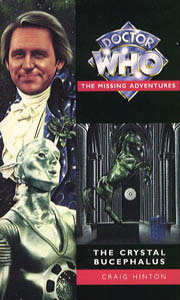
Who Book-Quest #5: The Crystal Bucephalus by Craig Hinton

Ah, Craig Hinton, the late, great master of continuity porn. Forever to be remembered as the originator of the word fanwank, a charmingly enthusiastic presence on the old Continuity Cops mailing group, and as an author of some of the most enjoyable Doctor Who fiction of the long wilderness. That was the great thing about Craig: he loved continuity, live and breathed it, but he still knew how to create a rollicking good story. Continuity fetishism is usually stifling to creativity, but Craig had the imagination necessary to avoid this trap.

The Crystal Bucephalus was Craig’s first novel, published in 1994. It doesn’t have the sheer continuity overload of some of his later works like the sixth Doctor PDA The Quantum Archangel, so it’s a little more accessible to the more casual fan. But then, how many casual fans were picking up Virgin’s Missing Adventures line in the mid-nineties? I’m against continuity in place of creativity, but when it comes attached to a story like this, it’s the icing on a delicious cake.

The Crystal Bucephalus is a time-travelling restaurant built on an abandoned planet. Shades of The Restaurant at the End of the Universe in there, of course, with the great, the good and the rich of the Galaxy meeting to dine at this most exclusive of locales. However, rather than serving food itself, the Crystal Bucket (as it has affectionately become known) instead sends it patrons to the greatest eateries throughout history, where they can interact with the locals, disguised and unable to alter the flow of time. Which is all well and good, of course, until things go wrong.

The Doctor, along with Tegan and Turlough, had been happily enjoying a meal in 18th century France until accidentally being drawn into the Bucephalus’ time fields due to the presence of two of its patrons, one of whom is none other than Maximillian Arrestis, the head of the Elective, the greatest crime syndicate in galactic history and a man of unparalleled personal vision. His murder raises a few problems, with the Doctor, as usual, being accused. Two things get him off the hook here: firstly, he owns the Bucephalus (something he isn’t proud of) and secondly, Arrestis’s murder doesn’t stick. What follows is an adventure that revolves around the Bucephalus but impacts on locations throughout time and space.

The novel is based primarily in the eleventh millennium, a period of history that Craig chose due its being barely explored in the original series. It’s a period of delicate peace between the remains of the Federation, the criminal Elective, and the Lazarus Intent, a vast religious organisation that numbers its followers in the quadrillions. The Intent is at the heart of the events of the novel, with many decisions revolving around characters’ faith in its teachings or their abuse of its power. At first, it seems that Craig is attacking religion, particularly the Christian Church (the Intent is basically a galactic Holy See), but in time it becomes clear that he is supportive of faith and the good that organised religion can do, but wary of the harm that it can be used for if perverted.

That’s not to say this is a deep, philosophical novel. First and foremost, it’s a soap opera, with much of the drama coming from the tortured relationships of the Bucephalus’ creator, Alexhendri Lassiter, and his ex-wives and fellow temporal physicists, Monroe and Matisse. This triangle, which extends to include Arrestis, is the catalyst for events throughout the tale. Add to the heartache and backstabbing plenty of violence, murder and temporal anomalies and you have a cracking, if occasionally contrived, adventure.

Craig nails the central TARDIS trio. His fifth Doctor – who experiences a lengthy side trip in which he sets up his own restaurant and is adopted by a furry alien couple in the 63rd century – is particularly well captured, his grit and resolution coming through despite his recognisable soft exterior. Tegan’s characterisation strikes the right balance between her frequent bolshiness and her often forgotten softer side, and she strikes up a strong, believable friendship with Tornqvist, an important figure within the Lazarus Intent. Turlough gets less time to shine, but nonetheless hits the right notes between the self-centred scoundrel he begins as and the slightly less self-centred near-hero he ends up as. Craig also makes a point of getting the TARDIS crew out of their uniform-like costumes and into some fancy clothes, although both Turlough and the Doctor are back in their usual togs by the end of events.

The continuity points are ever-present, but not intrusive. Rather, they’ll bring a smile to the face of anyone who has followed Doctor Who both on television and during the early years of the Virgin novel line. The Bucephalus’ time projection is maintained by Legions, the multidimensional beings that appeared in the New Adventure Lucifer Rising, while other species such as the Alpha Centaurians, Chelonians and Silurians appear in cameos. There are plenty of cheeky hints along the way too; not only is it insinuated that Turlough’s world of Trion was colonised by the Gallifreyans, it is also strongly implied that New Alexandria, the planet on which the Bucephalus is based, is in fact the long-dead corpse of Gallifrey. Then there are the numerous Star Trek references for fans to spot, and Lazarus knows what else I’ve missed…

The novel builds to one hell of a climax, in which the author not only manages to bring the various temporally separated protagonists together but even finds a decent and believable use for shapeshifting pseudo-companion Kamelion. Much of the climactic finale takes place within the belly of the TARDIS, building a far more evocative picture of the death knells of a timeship than the recent TV episode Journey to the Centre… and even leading into the brand new shiny console room that debuted in The Five Doctors.

The Crystal Bucephalus is a grand read for any died-in-the-wool Who-head. Arguably, Craig Hinton never really managed to craft a story as well as he did here, often slipping a little too far into the excesses of continuity fetishism. Nonetheless, I’d love to see what he would made of the mass of mythology that has built up in the years since his death in 2006. The marvellous geek.


Wednesday, 1 May 2013

WHO BOOK-QUEST #4: Festival of Death by Jonathan Morris


For the fourth instalment in my Doctor Who book-a-month series, I’ve gone for the first novel by Jonathan Morris, who has, since the publication of this in 2000, become one of the more prolific and popular of the spin-off authors. He’s added a further three Who novels, dozens of audioplays – including the fourth Doctor instalment of the Destiny of the Doctor series – and several short stories, as well as a stint as the chief writer for the DWM comic strip. Yet this is my first reading of his inaugural work, and I come to it now on the fond recommendation of fellow fans. It’s also just been republished as part of BBC Books’ anniversary range, which certainly didn’t hurt. I downloaded it in Kindle format, fearful that buying just one of the paperbacks would lead inevitably to my buying the whole set, including the                        ones I already own in the old editions.

Festival of Death is a faithful take on Season Seventeen, the one year of Doctor Who that was script edited by Douglas Adams, and featured two half-stories by him (one co-authored with Graham Williams, and the other scripted but only partially filmed). Morris’s admiration of Adams and The Hitchhikers’ Guide to the Galaxy is by now well-documented, and it’s no surprise that his first novel, set as if it were a ‘lost’ Adams production, follows the legendary author’s tone. That’s not to say that Festival is an Adams pastiche (you’ll want to look at Morris’s later novel The Tomorrow Windows for that), but it does have a very similar style. There’s also a similarity to some of the earlier works of Who-scribe Gareth Roberts, but this is primarily because Roberts was mining and celebrating the same period of the series’ history as Morris.
There’s a definite Hitchhikers feel to the world Morris creates here. The Beautiful Death, in which people flock to a machine that kills them for half an hour in order to experience the wonders of the afterlife, has something of the Total Perspective Vortex about it, or the ultimate disaster tourism of the Restaurant at the End of the Universe. The tourists engaging in the Beautiful Death include group of hippies – orange hippy lizards, to be precise – who inevitably come back again and again for what is, naturally, the ultimate trip. To have such mind-boggling concepts as the Arboretans, a plant-based species who exist in a loop in time, reliving their lives again and again, in a story that also includes a down-in-the-mouth Beautiful Death employee and a desperate documentary maker with an overinflated self-opinion, matches with Adams’s style very well. The cosmic and the mundane rubbing shoulders is a very Doctor Who thing to do, but is also a particularly Adams thing to do.

As Morris himself points out in his forward to the new edition, he beat Stephen Moffat by years with a truly timey-wimey story. It wasn’t quite unheard of back in 2000; Justin Richards created a complex temporal saga in his 1996 Missing Adventure The Sands of Time, and the TV series dabbled with as far back as 1965’s The Space Museum. Festival of Death uses the trick particularly effectively, though, taking what is, at heart, a very ordinary, linear plot about a mad scientist using his expertise to serve an evil force from the beyond, but telling it in a non-linear fashion to make it seem fresh. The Doctor and Romana arrive at the scene again and again, each time arriving a little earlier, gradually learning more about the situation they have found themselves in. The fact that the Doctor is apparently destined to die is another trick Moffat would later use, although Morris actually follows through with the threat, if only for a bit.

For all the cleverness on display, Festival of Death isn’t especially well written, although I suppose the workmanlike prose could be praised as a Terrence Dicks-styled triumph. Morris certainly improved as a writer as her went on, even if some of his best ideas were used up in this novel. There’s certainly plenty going on (I haven’t even mentioned the killer spider monsters). It’s also not quite as funny as it really needs to be – but then, neither was much of Season Seventeen. Morris also writes in a very visual way, and often his stories give the impression that they’d work better on screen than on paper; it’s no surprise that he has such a talent for scripting comics. Nonetheless, I can see why Festival of Death is so highly regarded. A very enjoyable, fun, witty read.

Wednesday, 27 March 2013

WHO BOOK-QUEST #3: Last of the Gaderene by Mark Gatiss


Mark Gatiss works primarily in nostalgia. His Lucifer Box trilogy pastiches adventure stories from the Edwardian era, the roaring twenties, and the Bondian fifties; his debut novel, the Doctor Who New Adventure Nightshade was a meditation on nostalgia and a Quatermass pastiche to boot. His Doctor Who episodes are among the most straightforwardly evocative of the show’s past, and include a Dickensian yarn and a story set around the coronation and the beginnings of television. He has presented series on the evolution of horror cinema and has had a Victorian laboratory built in his house. Mr Gatiss likes to live in the past.

With Last of the Gaderene, Gatiss’s last Who work until the series’ return to television in 2005, he takes this to its logical limit. The 2000 BBC novel is a clear attempt to reproduce his favourite era of Doctor Who in prose. Last of the Gaderene was chosen by BBC Books to represent the third Doctor in their new celebratory set of reprints, and it’s easy to see why. This is the purest example of Pertwee era Who you can find in print. In fact, it’s so Pertwee it’s even more Pertwee than the series was on telly.

So, no, Last of the Gaderene is not an attempt to do something new and interesting with Doctor Who, but Gatiss has never really been interested in that in his own work. Even his New Adventures had the air of someone trying to get a show back to its roots, away from the direction it had careened into in its later years. This is the ultimate nostalgia piece for anyone who grew up with Pertwee as the Doctor. This is a flaw as much as a benefit, of course. Seventies nostalgia just isn’t going to work that well on someone who was born in 1984. Admittedly, it is entirely possible to have nostalgic feelings for something that one never directly experienced; we are saturated in the past, and it can often feel that we were present for events that occurred before our birth.

This exposes another flaw in this approach, however. Gatiss presents this novel not merely as an evocation of Pertwee’s era on television, but also as a reproduction of the Doctor Who novelisations that he grew up with. I love the Target novelisations, but by the time I began reading them they were collectors’ pieces, not the everyday face of Doctor Who between TV seasons. The reason, of course, was that by then the series was readily available on video and was being repeated on UKTV Gold. Now, of course, the entire Pertwee canon is available on DVD and more readily available than ever. There’s not really any need for a book to recreate this era of the show, any more than there was in 2000.


Still, Gatiss is a great writer. One of my favourites, in fact. He may not be notable for experimentation or literary merit, but he writes bloody good adventure tales in clear, enjoyable prose. Gaderene is less well written than some of his work, but then it is clearly trying to reproduce the classic Target style, which is more-or-less the style of Terrence Dicks. That is to say, straightforward, breathless and pacy with the occasional moment that makes you stop and think: ooh, nice. Right down to the chapter titles, which include the obligatory ‘Escape to Danger’ (still being used by authors even now – I’m thinking of you here, Mr Wolverson) and the supremely puntastic ‘A Fate Worse Than Death,’ which made me give a little cheer out loud.

The plot is as straightforward as the prose, concerning a Body Snatcher-styled invasion force – the eponymous Gaderene – that have entered a small village and begun to take over the inhabitants, as a spearhead to a worldwide infiltration. The use of Legion International, a military-industrial airline, gives the story something of a Quatermass­-feel, which in turn makes it feel very Who season seven in places. Otherwise, this is pure Pertwee, from the claustrophobic village, the characterful locals, the UNIT presence, the Brigadier up against petty bureaucrats, the token visit to an alien world and, of course, the revelation that the Master is behind all of it. Gatiss is great at character work, and all his incidental cast are well-realised. Alec Whistler, late of the RAF, is a delight to read, a proper officer and a gentleman who would have made a perfectly good hero in his own right if he wasn’t required to be overshadowed by the Doctor. The Brigadier, Jo, the Master and the Doctor himself are all perfectly recreated. You can hear Courtney, Manning, Delgado and Pertwee speak every line.

There are a few nods to ongoing character development which fit with the novel’s placement at the end of season ten. Jo is realising that soon she will have to leave the Doctor and the Time Lord is himself spending more and more time away from Earth, albeit with the realisation that he has come to think of the planet as his home. A specific placement isn’t really the point, of course; this is the Pertwee era writ large. The Doctor even gets to fly a Spitfire, and wouldn’t that have looked amazing on telly? Well, no, they’d have used some really shonky CSO, wouldn’t they? Still, it would have been great in the Target novelisation…


Saturday, 16 February 2013

WHO BOOK-QUEST #2: The Menagerie by Martin Day


So, for our second Doctor choice, we’re stepping back ten years to 1995, for an entry in Virgin’s Missing Adventures series. I’ll be chopping and changing ranges a bit for this series of reviews. I can’t say I really knew anything about The Menagerie, Martin Day’s first Doctor Who novel. It’s a bit of a forgotten entry from the latter days of Virgin’s remit. So I can’t really say I was expected anything in particular from this novel, so I guess in that sense I wasn’t disappointed – but I can see why it’s been forgotten.

The Menagerie is set right at the end of the second Doctor’s TV era, just before the grand finale of The War Games, not that this makes any particular difference to the story. Day is not an author who strives to recreate the era he’s invoking. This is a Virgin novel through and through, more like the New Adventures than the TV series in style and content. There’s plenty of violence and sex, the latter being something that you certainly wouldn’t expect to find in a Troughton serial. That’s not to say I’m against such an approach. A faithful pastiche is only one approach to a missing adventure, and putting familiar characters in entirely unfamiliar situations and story styles can be just as rewarding, indeed more so. For the most part, Day manages to capture the three regular characters well, and although the Doctor and Zoe can lapse into dreary technobabble exposition occasionally, Jamie is note perfect. Plus, after saving dozens of young ladies on TV, he finally gets his just rewards and gets his end away, so good for him.

It’s just a shame that in general the novel is such a mediocre effort. It rattles along briskly enough, but the prose is uninspiring, with some truly dreadful lapses into portentous dialogue and banal simile. There are some interesting ideas, but none of them are well explored; the world the TARDIS crew visits is based on religion and a belief in magic, with science outlawed as heretical, but there’s little conception of how a society like this might actually work. Day creates a variety of alien species to populate the novel – four races that make up the Menagerie of the title – and while any one of them might have made for an interesting point of focus, none of the four is given any development beyond a few surface details. Instead, a great deal of time is spent politicking between rather uninteresting characters with bizarre names, saying things like “The Way of Kuabris will not be destroyed!” and “They will feel the true might of the Brotherhood of Rexulon!” and other cod-fantasy nonsense.

The only part that really stood out for me were Zoe’s adventures, during which she is put through the hellish experience of imprisonment, followed by being sold into slavery and eventually ending up as part of a travelling freakshow. There’s a great deal of colour to these sequences, although it’s fairly unbelievable that Zoe gets over her horrible experiences just as soon as she’s met a few decent folks and has problems to solve, turning quickly into the walking computer she was in her weaker moments on television.

Sometimes you pick up a book you’re unfamiliar with, and it’s an unexpected delight, other times, you wished you’d never found it. The Menagerie is, thankfully, not as bad as all that, but it’s a very disjointed, underwhelming affair.