Showing posts with label paleontology. Show all posts

Wednesday, 6 January 2021

Mary Anning Rocks

 There are only eight days left to fund the Mary Anning Rocks campaign, raising funds to give the great fossilist the memorial she deserves by building a statue in her honour in her home town of Lyme Regis. 

Designs are completed for the statue, which will, if funded, sit in the Jurassic Coast of Lyme Regis, Dorset. If you'd like to help commemorate one of the greatest palaeontologist of all time, still so unfairly overlooked by history, then click here to read more and donate. (Look, David Attenborough has backed it, and you can't argue with him.) 


Wednesday, 1 July 2020

2020 Dinosaur News (May/June)

TROODON NO MORE?


I'm clearly behind the times, because it look like Troodon, a well known and beloved genus of theropod, has been declared an invalid genus. And this was deduced back in 2017, apparently! Still, it only seems to be making its way into public consciousness now. While it's a stinger, it's not really too surprising. Troodon has been a mess since it was first named in 1856, based on nothing but a serrated tooth. Originally classified as a lizard, then a megalosaurid (like almost every predatory dinosaur at one time or another), in 1924 it was considered that Troodon was a carnivorous pachycephalosaurid. I'm old enough to remember books still calling it a unique meat-eating ornithischian, even though this was pretty much thrown out by 1945 (books on dinosaurs tended to take a long time to bring themselves up to date). Of course, now omnivorous ornithischians are accepted in the early development of the order. 

Stenonychosaurus was a quite well known theropod in the 80s and 90s, before being considered a junior synonym of Troodon (the same thing happened with the family Saurornithoididae and Troodontidae). In 2017 it was suggested that the original specimen of Troodon being just a tooth, was undiagnostic, and referred all species back to Stenonychosaurus, although since, some have been pulled to a new genus, Latenivenatrix. This has been challenged, though, by others stating that Troodon formosus, the type specimen, should be the valid name, considering that Stenonychosaurus went unused for so many years. In either case, it seems that the family Troodontidae, and even the subfamily Troodontinae, are going to remain the favoured names.

ARCTIC EDMONTOSAURUS


Edmontosaurus (formerly also Anatosaurus and Anatotitan) is one of the best-known ornithopods from the late Cretaceous, known from two species: the earlier E. regalis and the end-of-Cretaceous E. annectens. Now, an international team has concluded that the Alaskan genus Ugrunaaluk is a third species, E. kuukpikensis. Edmontosaurus was already known to have ranged far and wide across North America, but this pushes it further north than generally supposed, into what was already the Arctic north. While it wasn't as cold in the Arctic in the late Cretaceous as it is now, it still shows that Edmontosaurus was able to adapt to a variety of different habitats. The Japanese genus Kamuysaurus is a closely-related hadrosaur that spread into Asia on similar latitudes, showing that Edmontosaurus and its closest relatives were a hugely successful group of herbivores and among the most common dinosaurs of the period. "The caribou of the Cretaceous" at SciTech Daily

TRANSITIONAL CERATOPSIDAE

Two transitional genera of chasmosaurine ceratopsids have been identified from fossils in New Mexico, bringing light to the evolution of this branch of late Cretaceous dinosaur diversity. The two new genera show a clear pattern of development from the well-known Pentaceratops known from 75.3 million years ago, which had notably tall frill with a distinct, deep notch in its centre. An as-yet-unnamed example from 100,000 years later shows the frill notch deepening, while 100,000 years later still the new Navajoceratops sees the frill close up over the notch. By 74.6 mya, Terminocavus sees the frill begin to close up fully, and it finally heals over in Anchiceratops at 71.5 mya.

The precision of dating the genera is remarkable and illustrates a clear lineage. I wonder, though, it the new genera will be folded into Pentaceratops and Anchiceratops following further analysis. Sci-News.com


RUNNING IN CROCS


South Korea, the prehistoric tracker's heaven, has revealed an array of fossil tracks over the years, but a recent discovery has upturned established facts about crocodylomorphs. A group of tracks that clearly show bipedal locomotion - and were originally hypothesised to be from a large pterosaur - have been re-identified as the ichnogenus Batrachopus, a genus reserved for crocodile-related tracks. While there are many bipedal genera of croc relatives known from the fossil record, they all date back to the Triassic period, dying out in the mid-to-late Triassic in a major extinction event. Before this, crocodylomorphs were the dominant reptile group, with a huge variety of forms, but after the max extinction most were replaced in their niches by dinosaurs. 

These tracks however date back 113 million years to the early Cretaceous, over 100 million years after we'd expect to find them. While the exact genus of croc that left the tracks isn't known, it shows that more diverse crocs survived in some regions far later than originally thought. Scientific American Nature (for more detail)

MONSTER EGGS

Back in 2011, Chilean scientists discovered a strange, ovoid fossil in the Antarctic rocks. It was nicknamed  The Thing, but after years of analysis, it has been conclusively identified as the egg of a marine reptile. Julia Clarke of the University of Texas was the one who finally deduced it was a soft-shelled egg, of the type lain by lizards and snakes. At 11.4 by 7.9 inches it's absolutely huge and the first fossil egg to be unearthed in Antarctica. It's larger than any dinosaur egg save for that of the elephant bird, and even that was only slightly larger and much thicker-shelled. Clarke and her fellow palaeontologists has deduced it's egg of a mosasaur, a gigantic marine lizard, which explains the similarity to modern lizard and snake eggs, but it's far larger than nay soft-shelled egg ever seen before. It's also a surprise since it was hypothesised that mosasaurs gave birth to live young, an idea now thrown into doubt. The formations where the egg was found have previously turned up fossilised mosasaurs and plesiosaurs of various stages of development, so it seems it may have been a sort of marine reptile birthing ground and nursery. 

The mosasaur egg has been given the taxonomic name Antarcticoolithis bradyi. Syfy Wire

Saturday, 2 May 2020

2020 Dinosaur News (Jan to April)

Quite a few interesting bits of palaeontological news have crept out during the last couple of months, and since I haven't done a palaeo post for a while, let's have a look.

SPINOSAURUS

Spinosaurus aegyptiacus is one of those dinosaurs that has had major revisions in its reconstruction since it was first unearthed in 1912. As with most large dinosaurs, remains of Spinosaurus tend to be very incomplete, so the species has been reconstructed using elements from related genera, gradually being refined as more Spinosaurus remains are discovered. (The type fossil getting destroyed in WWII bombings didn't help much either.) Over the years, the largest theropod has been re-envisaged as a crocodile-like predator that ate mostly fish, comfortably walked on all fours and lived a semiaquatic lifestyle, although this was style pretty hypothetical.

However, recently unearthed fossils show the Spinosaurus tail for the first time, and this shows not the slender, tapering tale known from most theropods but a great big fish-tail. The tail bones show a deep, paddle-like appendage, like that of an eel or newt. As Samir Ziouhri, who heads a team at Casablanca's Hassan II university says, "This tail is unambiguous. This dinosaur was swimming." The full Nature article goes into a little more depth, but this is a major breakthrough in our understanding of dinosaurs, and continues to illustrate just how diverse non-avian theropods were.


S. aegypticiacus econstruction by Mario Lanzas

DAKOTARAPTOR


Something I hadn't realised at all until I saw an Instagram post the other day by palaeontologist Emily Keeble (Deinonychusfloof) is that the huge and rather popular dromaeosaurid Dakotaraptor steini is a chimaera. To explain: in palaeo terms, a chimaera is a fossil that's actually cobbled together from a mix of animals' remains. Sometimes they're deliberate fakes, but usually they're happenstance combinations of remains. It appears that part of the holotype fossil for D. steini is actually from a turtle, which throws the whole analysis of the species into question.

Dakotaraptor has been described as one of the last of the dromaeosaurid dinosaurs, living at the very end of the Cretaceous in the same ecosystem as Triceratops and T. rex. It's also one of the largest, coming close to the biggest of the dromaeosauridae, Utahraptor and Achillobator. It's been tricky to pin down its exact relationship to other dromaeosaurids though, and this could explain why. It's already been suggested it's actually synonymous with Acheroraptor, which was named slightly earlier, so it's possible Dakotaraptor will be scrapped as a valid genus in any case.


OCULUDENTAVIS


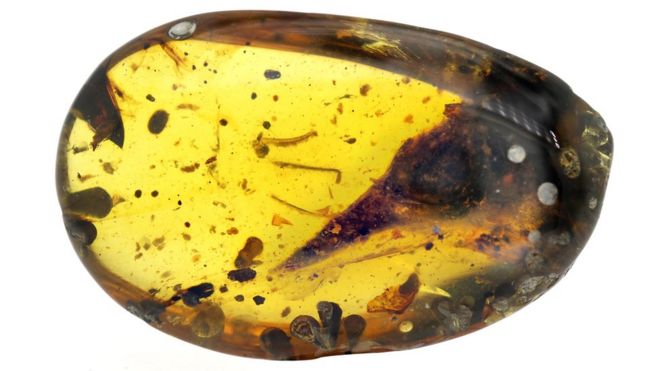
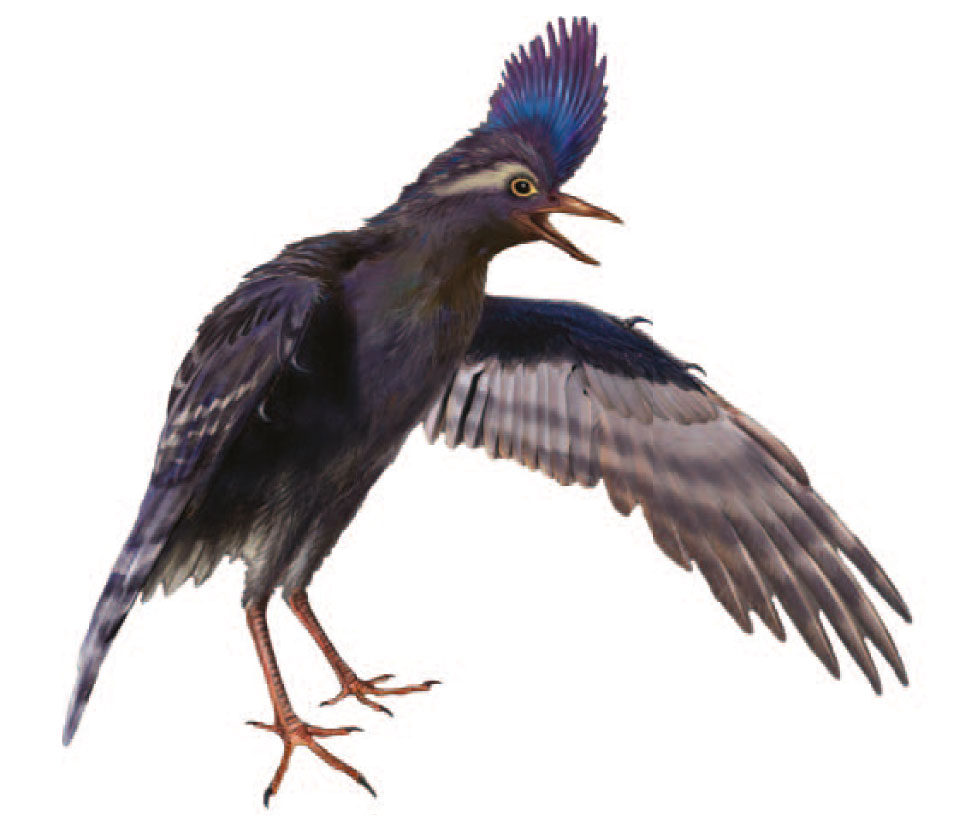
This one was a snappy news story: the tiniest ever dinosaur outside of Aves, the true birds. Oculudentavis khaungraae was found as a complete skull, only half an inch in length, preserved in Burmese amber. Initially it was described as a basal avialan, which is to say, a bird in the broadest sense (how exactly to define a bird is a tricky question), only slightly more advanced than Archaeopteryx (which I still consider closer to the dromaeosauridae than avialae in any case). If it was a bird-like dinosaur, it would have been about the size of a bee hummingbird, which is the smallest bird, and therefore smallest dinosaur, known.

However, as soon as the description was published, a number of palaeontologists pointed out that the odd mix of primitive and advanced features didn't so much look like an unusual bird but a lizard-like reptile, throwing the whole thing into question. A lot of living and extinct lizards have evolved bird-like skulls, and Oculudentavis seems to lack some of the features that define theropods. So sadly, as interesting a find as this is, it's almost certainly not a wee little dinosaur.

MASSOSPONDYLUS

Everyone loves a baby animal, even a long dead one, so here's a piece on the European Synchroton Radiation Facility and their X-ray of a dinosaur nest. The sauropodomorph Massospondylus carinatus left a nest of eggs 200 million years ago, and now we can see the tiny little baby dinos. The embryos were about 60% through their development, and appear to develop in much the same way as both modern reptiles and birds.


Saturday, 15 September 2018

Now available - "The Fossilist"

My latest bit of fanfic is now available at The Doctor Who Project. The Fossilist is my third short for the site, the second written with my talented friend James P. Quick. I'm really rather pleased with this one.

The Fossilist features the TDWP Ninth Doctor and Silver, along with the noted amateur palaeontologist Mary Anning. I previously wrote for the Basil Rathbone-inspired Ninth Doctor in City of the Dragon - his penultimate adventure and my first contribution to TDWP. Anning is something of a hero of mine and I hope we did her wonderful story some justice with this silly adventure.

If you enjoy it, there are some notes at the end which give you a little insight into how James and I work together and how the story developed.

Also, there are dinosaurs in it. Lots of them.


Thursday, 11 May 2017

There is no dino, only Zuul

How's this for a news item that combines my interests? Palaeontologists in North America have released their newest discovery, an astonishingly complete ankylosaurid dinosaur fossil that they have named Zuul in honour of the monstrous Terror Dog from 1984's Ghostbusters. The find is exciting because complete dinosaur fossils are rare enough, but a complete ankylosaur is virtually unheard of. Zuul has the first complete skull and tail club ever found for an ankylosaurid, and includes many osteoderms - the lumps of bone that were embedded in the skin and used as armour. These usually wash away over time due to being disconnected from the main skeleton.

Given the resemblance of the ankylosaur's skull to the horned face of the Ghostbusters monster, the discoverers named the species Zuul crurivastator. The specific name does not mean "ankle biter," as some outlets are reporting (for a start, this thing was huge), but "shin destroyer," in reference to that great tail weapon. 

The LA Times has a video of Dan "Ray Stantz" Aykroyd with the fossil.


Sunday, 28 June 2015

A week of things

And so this week, I remain unemployed, but still keeping terribly busy.

I have spent most of the week with my sister Rebecca, who's doing tremendously cool stuff at Eton College and is shortly to be promoted to Museums Officer. (It may be clear to you that my siblings are rather more successful than I am.) Bec sorted some voluntary work experience for at the Eton Natural History Museum. We worked on a collection of fossils from the Mazon Creek Shale in Illinois, a fascinating area that has preserved soft-bodied organisms from approximately 300 million years ago in the Pennsylvanian Epoch. We worked on both plant and animal fossils, but it's the fauna that interests me more. We were cataloging and securing the remains of animals, hundreds of millions of years old. We saw Tully Monsters (Tullimonstrum gregarium), an invertebrate something-or-other that doesn't appear to be related to anything alive today, along with "H-animals" (Etacystis communis), which are even more obscure, Essexella medusae, and tiny horseshoe crabs and myriapods. Fascinating little organisms.

Saturday was spent in the less sensible pursuit of crass entertainment, when we teamed up with a bunch of Becca's friends for an eighties sci-fi movie fest. After much discussion (I cannot believe we vetoed Back to the Future) our rather long shortlist was reduced to Robocop, Cyborg, Dune, The Running Man, The Thing and The Terminator. You may notice that these are not all classics. It was a fun day (six films, over nearly twelve hours), with much wonderful food (Bec is a cracking cook). The 80s sci-fi drinking game was less dangerous than we feared. Knock one back every time there's an explosion (double for an exploding head), a classic line, a cracking pun, a flash of boob or bum, a toxic waste event, stop-motion animation, or virtually anything we thought was worthy of a drink. It was a sophisticated weekend.

A nice little week, altogether.

Wednesday, 17 June 2015

Park Attractions: Velociraptor

The first in a series of articles on the animals featured in the Jurassic Park franchise. The JP films are monster movies and not intended to be wholly accurate, but it's fun to look at the real dinosaurs that inspired them and see how they compare.

Appearances: Jurassic Park, The Lost World, Jurassic Park III, Jurassic World
Mounted skeleton of the Velociraptor

While T. rex is the big draw of the franchise, the Velociraptors are the real stars. Not terribly well known before Jurassic Park, Velociraptor is now one of the most notorious and popular dinosaurs. The word "raptor," originally an old Greek word meaning thief, predator or plunderer, used to be used primarily to refer to birds-of-prey. Nowadays, when someone says "raptor" they're almost invariably referring to Velociraptor or one of its close relatives.

The raptors in the films are particularly exaggerated for dramatic effect. The real Velociraptor was a medium-sized predator, about two metres/seven feet long and half a metre/a foot-and-a-half tall. The raptors in the films are over twice the size of this, standing eye-to-eye with humans. The movie versions are in fact more similar to Deinonychus, a related genus (both are part of the dromaeosaurid family). The Deinonychus was larger, although not quite as large as the JP raptors, and had a deeper muzzle more akin to the movie versions. Part of this is down to when Crichton wrote the original novel; at the time, Deinonychus was considered another species of Velociraptor. The iconic fossil being excavated at the beginning of the story is found in Montana, in the range of Deinonychus fossil sites, while the Velociraptor is only found in Asia. So really, what we're seeing in the JP films is a Deinonychus, not a Velociraptor.

The somewhat amended JP3 raptor.
In 1991, another related American genus was discovered: the Utahraptor, an even bigger dromaeosaurid with proportions more similar to the raptors already being developed for the first film. Utahraptor gave the JP raptors a credibility boost and has become one of the most popular dinosaurs itself. Dromaeosaurids are considered some of the most intelligent dinosaurs, characterised by pack behaviour and large brain cases for their body size. However, it's all relative; raptors probably weren't much more intelligent than an average bird species today.

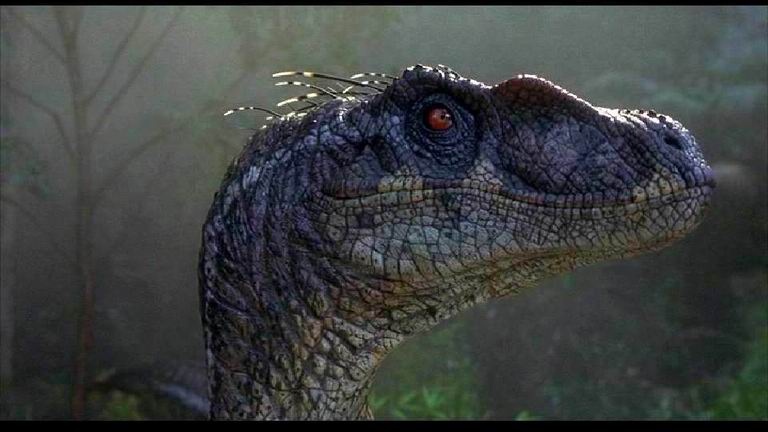
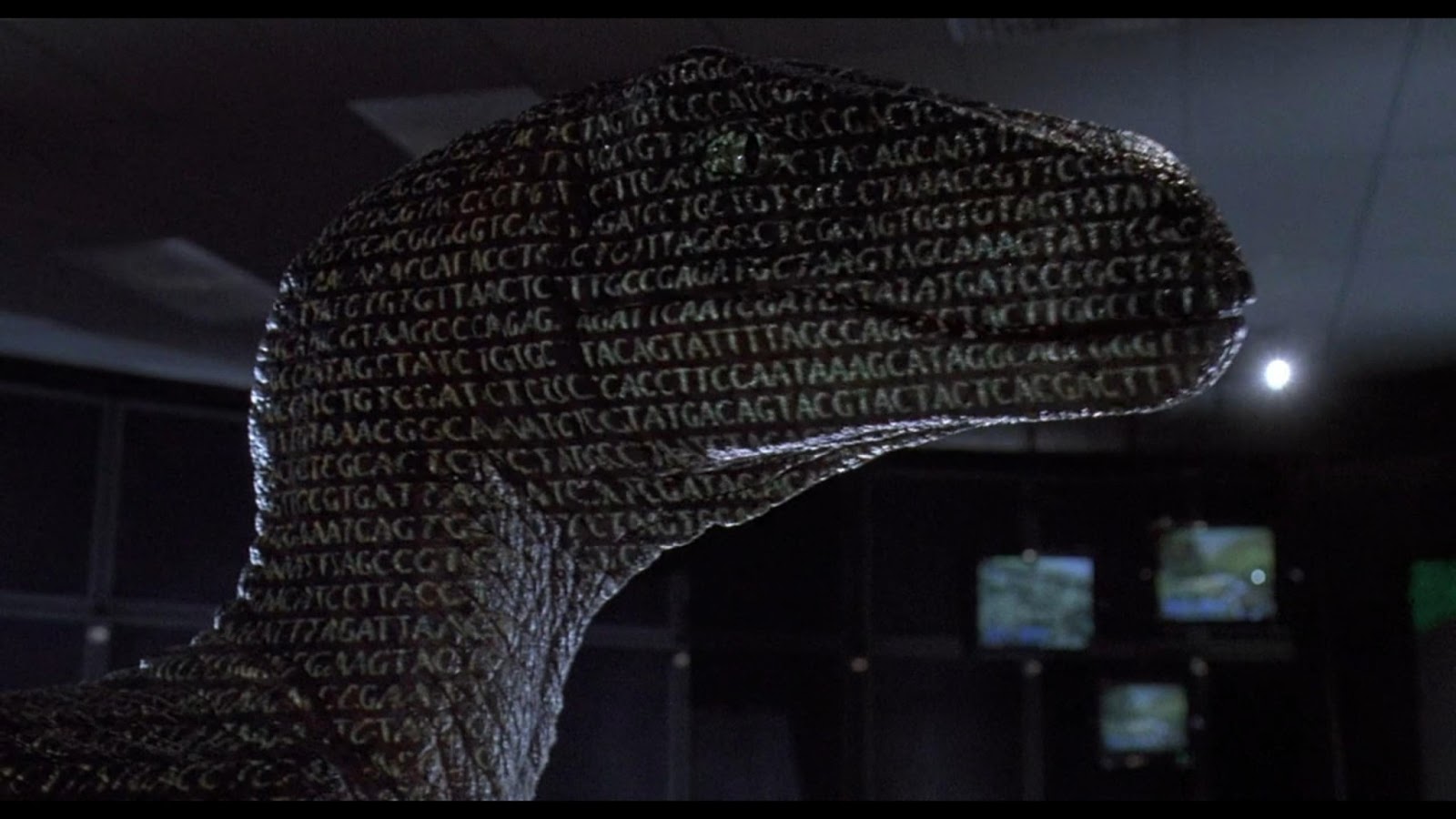
The most significant difference between the real Velociraptor and the JP raptors is in their appearance. When Jurassic Park was being filmed, the appearance of the dinosaurs was, with some dramatic licence, close to contemporary scientific knowledge. Over the following few years, however, a rush of excellently preserved fossils has shown that most coelurosaurian dinosaurs had feathers for warmth and/or display, with some, including the dromaeosaurids, having well developed feathers akin to modern flight feathers. Dr. Alan Grant had to confront a kid whining about the Velociraptor skeleton looking more like a six-foot turkey. He was more right than he knew (and a six-foot turkey sounds pretty terrifying to me). By 2000, the feathered dinosaur was becoming recognised enough that some limited quills were added to the heads of the scaly raptors of JP3, but they've been returned to a fully scaled look for Jurassic World. Part of this is for easier audience recognition, and mostly just because the filmmakers think it looks cooler. There is a handy line in JW covering the discrepancy, though: Dr. Wu points out that all the dinosaurs at the park are hybridised with other species, and that in nature they would "look quite different." Plenty of fans have theorised that the frog DNA used to patch the codes, which was such a major plot point in the first story, made the raptors bald. It would have been a nice touch if, by the time of Jurassic World, they'd started using duck DNA instead because it was a closer match. And it would have stopped them changing sex...

Another myth to be busted: the terrifying image of the Velociraptor slashing open its prey's belly, leaving the guts to flop out. No one is certain, but simulations with sculpted claws and pork bellies make it unlikely that the claw was sharp enough or curved correctly to slice open flesh that way. What seems more likely is that packs of raptors would team up on larger prey, using their sickle claws to pierce the flesh and hang on while they used their razor-sharp teeth to viciously bite at the flesh. The prey would most likely have died of blood loss even if they had managed to shake the raptors off. Much of the time, Velociraptors would have preyed on smaller animals, either around their own size (such as with the famous battling dinosaurs fossil of a Velociraptor and Protoceratops in a clinch), or much smaller, and they would also have scavenged. Not that this makes a pack of raptors any less of a terrifying prospect.

A classic shot from the first JP


For all the changes made for the books and films, one thing Crichton was dead right on was stressing how bird-like the Velociraptor was. It's clear now that the dromaeosaurids were very closely related to the earliest birds; indeed, some definitions include them as birds (it's very much a matter of semantics). Early dromaeosaurids were tiny animals, extremely bird-like, some of them, such as the abundant Microraptor, with feathers sufficiently adapted for gliding or posibly even powered flight. The sickle claw seems to have initially evolved as a climbing aid for aboreal species, later being becoming weaponised as some branches of the family re-adapted to a terrestrial, predatory lifestyle.

Finally, I'm afraid that the wing-like forelimbs of the Velociraptor mean that it most certainly would not be able to move its hands in such a way to open a secured door.


Thursday, 28 May 2015

2015 in Palaeontology (so far)

Yi qi

This is the most fantastic discovery this year. Yi qi is a frankly bizarre flying dinosaur that displays features of both birds and bats, an entirely new method of flight adaptation to anything seen before. A member of the scansoriopterygidae, or epidendrosauria, Yi's relatives are extremely birdlike, with complex feathers, but with extended fingers that suggested, at first, that they were arboreal animals, adapted for climbing. Yi is so well preserved, however, that the fossil has revealed skin impressions, including webs of thin skin between the fingers. At first glance, illustrations of Yi look like archaic illustrations of pterosaurs, but this is a genuinely new form of dinosaurian flight - a combination of batlike wings with birdlike feathers. It's unknown if fellow epidendrosaurs shared this feature, but it seems quite likely. It's a fascinating sideline on the evolution of the flight of modern birds.

Microscopic analysis of the Yi fossil has revealed the presence of melanosomes - pigmentation organelles. The dinosaur was mostly coloured black, with yellow or brown feathering to its head. Yi is thought to have inhabited a subtropical environment, and shared it with pterosaurs such as ChangchengopterusArboroharmiya, a tree-dwelling mammal, and archaic salamanders. Yi also has the distinction of having the very shortest generic name of any dinosaur; indeed, its full specific name, Yi qi (meaning "strange wing"), is as short as is permitted by taxonomic rules.

Chilesaurus

This is an odd one. Supposedly, Chilesaurus is a basal tetanuran, roughly ancestral to the group that led to carnosaurs, coelurosaurs and megalosaurs. And yet, it has features from all sorts of different dinosaurian groups. While its features are mostly theropodal, its teeth clearly indicate herbivory. Its pelvis points backwards, as in the Ornithischia, another adaptation for herbivory - more room for a big, fermentory gut. Several theropod families adapted to that lifestyle and developed the bird-like pelvis, including therizinosaurs and, of course, birds themselves. Chilesaurus had strong arms with a large, sharp primary claw, which is found in many "prosauropods." In fact, just looking at it, I'd guess it was a basal sauropodomorph, which are very similar to basal theropods, but the timing is wrong. It's a Tithonian species, late Jurassic... all most odd.

Archaeornithura


An ancient bird, Archaeornithura existed 130 million years ago in the early Cretaceous, and is the earliest example of the Ornithura, the clade of "true birds" that includes all modern birds and many extinct lineages. Although it retained many archaic features, such as clawed fingers, it also displayed several modern characteristics including fan-shaped tail feathers, a familiar wishbone, and an alula - the highly adapted thumb that aids in avian flight. Indeed, it seems to have been an adept flyer, while its long legs and foot structure suggest it also lived as a wader. The discovery of the beautifully preserved fossils of Archaeornithura has necessitated another rethink of bird evolution, since such advanced characteristics were not thought to have arisen so early.

Nebulasaurus

A rather lovely name for a dinosaur, Nebulasaurus. A basal eusauropod, albeit only represented by a partial skull, there's not a great deal it can tell us about early sauropod development. However, it does increase the diversity of sauropod findings in China, the Yunnan region being a particularly fossil-rich part of Asia. Nebulasaurus lived around 170 million years ago in mid-Jurassic.

Carnufex

With a cracking name (meaning "butcher"), Carnufex was a beast of a croc, ten feet long and five feet tall (and not even fully mature at that size). An near-complete skeleton was found in North Carolina, in the Carnian stage of late Triassic rock. An early crocodylomorph, Carnufex is more advanced than the brutish rauisuchians that ruled the early Triassic, but still basal to true crocodilians. It had a long, narrow snout full of serrated teeth, with a skull covered in bumps and grooves that may indicate some kind of horns or other adornment.

Cartorhynchus

An early marine reptile, ancestral to the icthyosaurs, that lived in shallow waters in the early Triassic. Unlike later, true icthyosaurs, Catorhynchus was a small, probably amphibious animal with legs adapted into flippers not unlike those of seals. It had dense bones, that would have helped weigh it down and allowed it to feed on the bottom of shallow coastal waters. It is surmised that it was a suction feeder, hoovering up soft-bodied prey from the seabed. The most primitive animal that can confidently be called an icthyosaurimorph, it helps shed light on the development of the Icthyosauria, which otherwise appear out of nowhere in the fossil record following the catastrophic Permian extinction event.

Yoshi garevskii

In spite of the name, this is not a dinosaur. It's not even a reptile. They used the name Yoshi for a fossil and they didn't keep it for a dino? There should be a rule against that. Yoshi garveskii was a big cat, a Metalurine felid, one of the "false sabretooths" like the more famous Dinofelis. Previusly included in the genus Metalurus, Yoshi was a mid-sized animal, larger than a lynx but not as big as a cheetah, so fairly diminutive for the family. Unlike true sabretooths, which had oversized, blade-like teeth, Metalurines had what might be called medium-sized fangs, conical like modern cats' but significantly larger. The best thing to imagine would be a particularly toothy clouded leopard.

Aegirocassis

I love anomolocarids. Half a billion years ago, the lands were empty but the seas were full of bizarre creatures which have left no descendants. The anomalocarids might have been related to arthropods, like insects and crustaceans, but have so many weird features that no one is really sure what they are. One thing we do know is that they dominated the oceans of the Ordovician period, gigantic predators for their time. Aegirocassis lived 480 million years ago, descended from earlier hunters like Anomalocaris itself and had adapted itself to filter feeding. At over two metres long, it may not sound like a particularly huge beast (although I wouldn't want to meet one on the beach), but it was probably the biggest animal in the world at the time. It was essentially the Ordovician equivalent of the blue whale, only with a shell and tentacles. What a wonderful creature.


Wednesday, 8 April 2015

Bring Back Bronto?

Hitting the science news pages this week is the proposal, by Emanuel Tschopp of Lisbon University and his team, that Brontosaurus be reconsidered as a valid taxon, independent of Apatosaurus.

The story of Brontosaurus, and how it no longer technically exists, is one of the most well-known palaeontological tales. Back in the late 19th century, the so-called Bone Wars raged between rival scientists hoping to make names for themselves in the developing field of palaeontology, particularly with regards to the Dinosauria. As part of this, numerous genera were discovered, but many were in fact duplicates - multiple specimens of the same genera, granted several names. In taxonomy, with some very rare exceptions, the names of taxons are given seniority by publication order. The great bone pioneer Othniel Charles Marsh discovered Apatosaurus ajax in 1877, only for him to rediscover it two years later from a slightly different fossil, which he named Brontosaurus excelsus. Neither specimen was complete, although the second fossil was quite substantial, and both lacked a head. Over time, analysis of the two specimens concluded that, in spite of some differences, they were similar enough to be considered part of the same genus, albeit granted separate species. Apatosaurus was named first, so it had priority, and so Brontosaurus excelsus became Apatosaurus excelsus.


A modern reconstruction of the Apatosaurus, showing Diplodocus-like skull and spines.


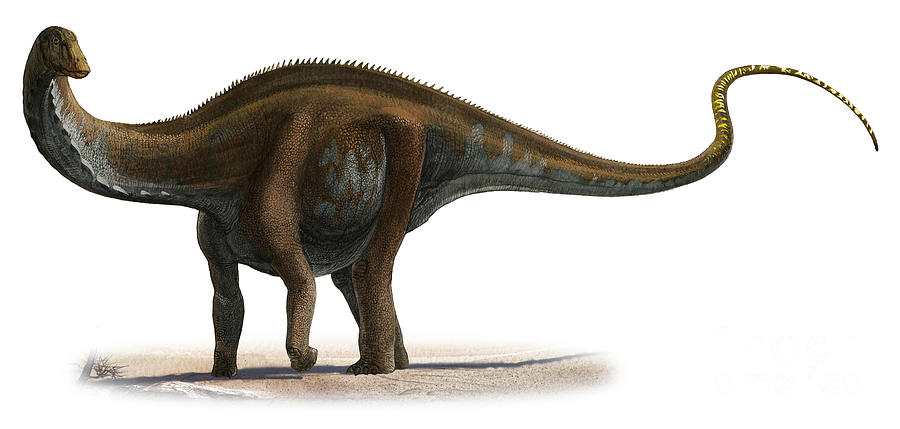
However, Brontosaurus is by far the superior name for a dinosaur, and it is not surprising that it caught on in a way that Apatosaurus never has. Aside from the simple sound of it, the meaning is far more stirring. Apatosaurus has the rather wishy-washy translation of "deceptive lizard," while Brontosaurus has the far more fitting meaning of "thunder lizard," as befits such a mighty beast. When mounting the second specimen at the American Museum of Natural History, Henry Fairfield Osborn labelled it Brontosaurus, perpetuating the name. Brontosaurus became a hugely famous dinosaur, appearing in many textbooks and popular media, in spite of the fact that, according to scientific consensus, it never technically existed. The lack of a skull also caused problems. The creature was far stockier than its close relative Diplodocus, and was reconstructed with a heavy, boxlike skull based on that of the more distantly-related sauropod Morosaurus (itself later recognised as a junior synonym of Camarasaurus). It was years before the correct skull was considered to be similar to the gracile, almost snakelike head of the Diplodocus. Over the years, three more species have been reliably assigned to Apatosaurus: A. louisae, A. parvus and A. yahnahpin.


An outdated reconstruction of the Brontosaurus


Nonethless, Brontosaurus, boxy head or no, has remained a hugely recognisable dinosaur, far more so than the correct name. It even maintains an influence in palaeontological circles. The genus Eobrontosaurus, meaning "dawn thunder lizard," was suggested as an ancestral form, but has itself been absorbed into Apatosaurus (and now Brontosaurus). The Diplodocoidea, the sauropod clade that contains the families most closely related to Apatosaurus, is often referred to as "the brontosaurs" by palaeontologists, purely colloquially. It's an evocative name, and everyone can imagine a brontosaur.

After all this time, however, Tschopp's team's analysis has suggested that there are indeed enough differences between A. ajax and A. excelsus that the latter be removed from the genus and reassigned to its own, resurrecting the name Brontosaurus for scientific use. A similar move occurred a number of years ago when the species Brachiosaurus brancai was removed from the genus and assigned to its own, Giraffatitan. Under the proposal, A. louisae remains, while the other two species are reassigned to become B. parvus and B. yahnahpin.

I remain on the fence; as I've stated before, I'm not keen on the tendency to split similar fossils into dozens of genera, when modern animals feature many species, often with major differences, in the same genus. As this article states, it's really an issue of semantics rather than science. Tschopp's paper is available here and does list a number of differences between the species, and exhaustive analysis that should be applauded. Wiipedia, while never the most reliable of sources, has already moved the species concerned to a new Brontosaurus article, which is a good indication of the direction popular opinion will go. 

Friday, 14 November 2014

Are we losing Dimetrodon?

Another installment in the great taxonomical debate that is rocking palaeontology, or at least, gently shaking it. Bathygnathus borealis is the name given to the very limited remains of an animal discovered on Prince Edward Island in 1854. It was lauded as being the first dinosaur found in Canada, before being passed around the 19th century zoological community and re-identified as a pelycosaur in 1905. The pelycosauria has since been abandoned as an order, although it is used informally to describe the sail-backed creatures of the Permian period. Nowadays, Bathygnathus is considered a sphenacodont, like the very popular genus Dimetrodon. Dimetrodon is also erroneously called a dinosaur all over popular culture - it turns up in cheapy plastic toy dinosaur sets all the time - and is one the beasts that people tend to think of if asked to visualise a prehistoric animal.

In 1940, it was suggested by Romer and Price that Bathygnathus and Dimetrodon were one and the same. Given that all that remains of Bathygnathus is one upper jaw, and that Dimetrodon is known from dozens of fossils and has numerous species, no one was really worried about Bathygnathus. However, recent reviews of the 1940 materials suggest that Romer and Price were correct, and that the two genera are synonymous. Which is a bugger, because Dimetrodon wasn't described until 1878, twenty-four years after Bathygnathus. If it is concluded that they are the same animal, Bathygnathus has naming priority. If this comes to pass, I suspect the ICZN will be petitioned to keep Dimetrodon as the name, much like they were for Tyrannosaurus, which was identified as synonymous with the earlier Manospondylus. As in that case, prevailing usage is clearly with the newer name, it has distinct cultural clout, and the earlier sample is so fragmentary as to be somewhat useless in the face of the later finds.


Friday, 5 September 2014

Laniakea and Dreadnoughtus

Blimey, this is an exciting time for science geeks. Two pretty amazing discoveries were published in the last couple of days that I have to share here. BIG discoveries.

Firstly, a whopper of a dinosaur. Dreadnoughtus schrani is the newly named BIGGEST DINOSAUR EVER. Well, at least, the largest dinosaur for which we have decent remains. Most of the truly gigantic sauropods leave only a few bones, from which size is estimated based on other, better skeletons. This can, of course, lead to some major disagreements and arguments and a bit of extreme guesswork. However, the skeleton of the new dinosaur is remarkably complete, and palaeontologists are able to estimate its length and mass far more reliably than usual. And they've picked a fantastic name - Dreadnoughtus. Just yells "I am a big dinosaur!" Much data here.

Dreadnoughtus was a titanosaur, which weren't always as vast as they sound but did include some of the most enormous dinosaurs of all. The sample appears to have been 26 metres long (85 feet), and according to the bone growth patterns, it wasn't even fully grown. While some slenderer genera such as Diplodocus grew longer, and some such as Antarctosaurus may have been larger overall, Dreadnoughtus, being so well documented already, gets the crown as the big, fat king of the dinos.


But if that isn't big enough for you, check out Laniakea. Astronomers at the University of Hawaii have charted the distribution of matter throughout the universe and used this data to map the large-scale structure of the universe. Amazingly, they've actually managed to map the galactic supercluster in which our galaxy lies. We've identified distant superclusters before, but charting the part of the universe we're actually in is naturally more difficult. Yet now the bods at Hawaii have done so, and identified precisely where we are in the supercluster, which they have named Laniakea, from the Hawaiian words for "immeasurable heaven." Vaka rangi.

The Local Group is attracted to the nearby (in supergalactic terms) Virgo Cluster, and it and the many other galactic clusters spiral around the Great Attractor, aka the Norma-Hydra-Centaurus Cluster. Laniakea is estimated to contain 100,000 galaxies and is over 500 million light years across. It's gradually drifting towards the Shapley Supercluster, in the whole gigantic system of galaxies stretching across billions of light years. IFL Science has a rundown of the discovery and a gorgeous video of our place in the supercluster.

Friday, 14 February 2014

Baby fish-lizards

A quite amazing fossil of an early ichthyosaur that died in the process of giving birth has been unearthed by palaeontologists in China. The fossil shows an adult specimen of the genus Chaosaurus, a baby that has just been born, one still in the body, and another that appears to have died midway through the birthing process. The palaeontologist examining the find, Ryosuke Motani, believes that the first baby may have been stillborn, with the mother then dying from complications in the second birth. Although naturally we cannot be certain, this is thought to be the best explanation for the positions of the bodies.


While we tend to consider reptiles as egg-laying creatures, viviparous reptiles are not unknown. The common lizard, Zootoca vivipara, is found all over Europe, even in the chilly climes of southern England, and is well known to be viviparous. It is the most northerly found reptile, and its viviparity is considered to be an adaptation to the colder weather; more southerly populations remain oviparous. Viviparous reptiles are well known in the fossil record, particularly among aquatic species. An egg-laying reptile would have to come to shore to produce young, in the manner of today's sea turtles, exposing herself and her young to considerable risk.


What's interesting about the Chaosaurus specimen is that it is seen to be giving birth to its young head first. This is common among terrestrial species, but not in aquatic forms. It is also the earliest example found of viviparity in a reptile, being a good ten years younger than the previous youngest, another ichthyosaur fossil. The most well-known such fossil, an impressive specimen of Stenopterygius, shows a live birth interrupted. Hundreds of Stenopterygius fossils have been found in Europe, in various stages of maturity, giving a great deal of insight into the ichthyosaurian life cycle. The latest know ichthyosaur fossils, found in North America, also show some evidence of live birth, and further adaptations to make the process more efficient. All of these later forms show the mother giving birth to its baby tail first.


A tail first birth is likely an adaptation that helps prevent the baby drowning while partway out of the birth canal. It's clear evidence that the birth process of the ichthyosauria evolved over time into one more suitable for marine life. It could even show that the viviparity originally developed in the ichthyosaurs' terrestrial ancestors, with their head-first approach being retained to begin with and later adapting to a safer, tail-first approach. This is uncertain, of course, but the evidence is suggestive. Chaosaurus is so primitive that it is sometimes not even considered a true ichthyosaur, but rather just outside the ichthyosauria in the basal ichthyopterygia, the ancestral grouping. It was a particularly small example, only a metre to 170 cm long, in comparison to the other genera that got considerably larger, including the only slightly younger Shonisaurus, which reached at least 21 metres.


Viviparity is also known in other marine reptile groups, including the plesiosaurs and the huge marine lizards, the mosasaurs. It does not appear to have developed in the crocodilia and their relatives. It clearly developed several times in unrelated lineages, an example of parallel evolution in animals adapted to the same environment. It is even possible, although not evidenced, that the more advanced ichthyosaurs could have developed placantae; the Zootoca lizard is known to have one in its viviparous populations, albeit very basic in type.

As an aside, the correct term for a baby ichthyosaur is apparently a pup. Which is nowhere near as good as a baby pterosaur, which is called a flapling.

Further reading:

Viviparity in Ichthyosaurs, Map of Life
Sex Determination in Sea Monsters, Thoughtomics
Full article on the find, Tech Times

Tuesday, 19 November 2013

Flight of the Microraptor

A very interesting study performed by a team from the University of Southampton, involving a full-scale mock-up of a Microraptor gui, using real feathers, in order to find out how it would have flown. The conclusion seems to be: not terribly well.

Also, the Microraptor is called Maurice.

The full write-up is over at Tetrapod Zoology, on the Scientific American site, or you can skip directly to the paper itself.


Tuesday, 12 November 2013

Theropoda News

November has already brought us two fascinating discoveries in the world of theropod palaeontology, one concerning a new genus and the other a well-established but little understood one.

Deinocheirus arms at the NHM in London.
Deinocheirus mirificus, the 'weird-looking terrible hand,' has been a bit of a mystery since it was first discovered in Mongolia back in 1965. All that was discovered, save a couple of scraps, was a pair of gigantic arms ending in hugely clawed hands. These mighty forelimbs baffled palaeontologists for years. They were clearly theropodan, but all known large theropods had small forelimbs (the tiny arms of Tyrannosaurus rex being the most obvious and pronounced example). Eventually, it was pointed out that the arms of Deinocheirus bore a significant resemblance to those of the ornithomimosaurs, aka the 'ostrich dinosaurs' - generally large, but not gigantic, fleet-footed theropods.

Since then, there has been a huge wealth of discovery and rethinking regarding theropod diversity, including descriptions of the therizinosaurs, the 'scythe lizards,' similarly large theropods with huge claws on their hands. Unlike the traditional view of theropods being solely carnivorous animals, the therizinosaurs seem to have been adapted for herbivory. Examination of the ornithomimosaurs suggests they too were omnivorous or herbivorous.

That first find was incomplete because the poor old Deinocheirus had been eaten by a Tarbosaurus (aka Tyrannosaurus bataar, the 'Asian T. rex), as evidenced by distinctive teeth marks on scraps of rib bones found. However, Korean palaeontologists have now made a second, much more complete find, which finally gives some clue as to the overall body plan of the beast. And, while the find confirms that Deinocheirus was indeed a gigantic ornithomimosaur, it turns up some unexpected new information. For a start, this animal was definitely largely or solely herbivorous, as evidenced by the presence of gastroliths, stones swallowed to aid the digestion of plant matter. These are common in herbivorous dinosaurs with weak or entirely absent teeth. Not so surprising, that, but a contentious point until now.

The most amazing find is the animal's backbone. The middle verterbrae of Deinocheirus were elongated upwards, creating tall spines, not unlike those of the sail-backed Spinosaurus or the ornithopod Ouranosaurus. This is totally unexpected - no spine-backed coelurosaurs have ever been discovered before. The jury is open as to whether Deinocheirus had a fleshy sail or a hump, although a hump would have been useful for a large animal in an arid environment. It seems that Deinocheirus was not entirely unlike the therizinosaurs: large, heavy-bodied theropods adapted to a slower-paced, herbivorous lifestyle.

Aggravatingly, bone thieves made off with the head and feet of the skeleton, meaning that there is still a great deal unknown about Deinocheirus. Still, this is a huge discovery that illuminates much on this mysterious creature. National Geographic has a decent article on the find, albeit with an outdated reconstruction illustration, while the Paleoexhibit blog goes into more technical detail and has an captivating reconstruction of a feathery, hump-backed Deino.


Thursday, 31 October 2013

Sauropod Gigantism

There's a fascinating paper available at PLOS Collections exploring the physiology and lifestyle of the largest sauropod dinosaurs. The sauropods included the largest terrestrial animals that have ever lived, from the Jurassic diplodocids, through the late Jurassic/early Cretaceous brachiosaurs to the Cretaceous titanosaurs, some of which may even have exceeded the famously huge blue whale in length. The sheer size of such animals raises problems when we consider how they lived. Early theories, such as a submerged lifestyle in swamps, have long been discredited, but the issues remain unresolved. Just how did such vast creatures feed, breed and move around?

The paper is available for download in PDF format and explores the problems of sauropod physiology and motion through various disciplines, with input from a number of specialists. In the overview it explains that:

This new PLOS Collection discusses major efforts by evolutionary biologists and
paleontologists to understand sauropods as living animals and to explain their evolutionary
success and uniquely gigantic body size. The articles address these questions from the
widest selection of disciplinary viewpoints, including those of ecology, engineering,
functional morphology, animal nutrition and palaeontology.

It's quite some reading, but anyone interested in dinosaur evolution would benefit from taking the time to go through it.


Friday, 18 October 2013

Dmansi Man

A new cache of hominin fossils is causing quite a stir in palaeontological circles. Read at The Independent.

The 1.8 million-year-old fossil hominins at Dmansi in Georgia might be late surviving examples of Homo erectus, or possibly even a variant of Homo habilis (or Australopithecus habilis, your mileage may vary). The five specimens show enormous variations in form that would have likely led to them being labelled as separate species had they been found at different sites.

There's been a lot of talk on this subject over the years, particularly with recent finds such as the Denisova man and the Flores 'hobbits' shaking up the formerly reasonably clear-cut human family tree. The fact of the matter is that in palaeontology, with sparse remains and little in the way of ecological data, fossils are frequently assigned to new genera and species as a method of clear labelling. Many related species of animal could, in fact, be examples of the same species at different ages or of different sexes. There's also congenital defects and simple individual variation to take into account.

The sudden proliferation of hominin species over a short period of time, geologically speaking, suggests that we need to rethink how we classify these fossils. As the article above says, there is huge variation across the human population today, and while a smaller community in prehistoric times might not display quite as much variance, it should be taken into account.

Thursday, 30 May 2013

DINO SORE: The Dawn Bird

There's a bit of news going around the interwebz today regarding the phylogenetic positioning of Archaeopteryx and its recently discovered relative, Aurornis, the 'dawn bird.' The basic problem boils down to this: is Archaeopteryx a bird or not?

I'm still a bit on the fence here, but I'm mainly with the 'not quite a bird' camp. When Archie was first discovered in Germany in the nineteenth century, it was clearly the most birdlike fossil ever seen (disregarding those that were straightforward, clear cut modern birds). It had beautifully preserved feathers, including what were clearly flight feathers forming broad wings. Yet it was, skeletally, very much like a small theropod dinosaur. It was clear cut: this was the first bird, and its closest relatives were small, predatory dinosaurs like Compsognathus.

Archaeopteryx lithographica

Later discoveries complicated matters. Indisputable bird fossils kept being found that pushed their lineage further back, encroaching on the 'first bird's' territory. The dinosaur renaissance helped bolster the idea that birds are specialised dinosaurs, particularly Bakker's studies on the Deinonychosauria. Sickle-clawed predators like Deinonychus, Velociraptor and Troodon became clear as the most birdlike of all non-avian dinosaurs. That birds are dinosaurs is no longer really in question, except for some iconoclastic paleos with funny ideas. It's the exact structure of the family tree that's the problem. Archaeopteryx is in danger of losing its crown as first bird; indeed, it may not be a bird at all.

I'm pretty much in agreement with Xu Xing, whose 2011 analysis removed Archie from the direct line to birds and placed it elsewhere in the paravian lineage. To me, just looking at the fossil with an amateur's eye, Archaeopteryx looks for all the world like a troodontid: small, slender, feathered and with a sickle-claw on each foot. While the exact positioning is questionable, it looks like it belongs somewhere in the Deinonychosauria, outside of the Avialae, which is to say, birds (the exact definition of bird is always a bugger anyway).

It's possible to retain this positioning and keep Archie as a bird, but that would require expanding the Avialae  to include the Deinonychosaurs. It's easy to keep pushing back like this, but with more and more birdlike features becoming apparent in theropods, it risks making theropod and bird mere synonyms, and therefore pretty useless as terms in the argument. There are some issues with this, including that it implies that powered flight evolved twice; alternatively, it was secondarily lost in some Deinonychosaurs. There are shades of the anti-dinobird argument here, in that Deinonychosaurs are essentially being referred to as flightless birds; however, there is no claim that they don't belong in the Dinosauria.

Aurornis xui

This year's analysis of the recently found Aurornis fossil muddies the waters again. Pascale Godefroit and his group find Aurornis to be earlier in the bird lineage than Archie, in a phylogenetic analysis that restores it to true birdhood.  It removes Archaeopteryx from the Deinonychosauria, bu makes Troodontidae a sister group to the Avialae. I'm not entirely convinced, but it is compelling. A good reshuffling could allow the best of both worlds regarding Archie. In this new phylogeny, Archie is not the first bird. That honour, presuming we accept that Avialae=birds, goes to Aurornis. This system avoids the need for two origins of powered flight, and tidies up the temporal spread of the Paraves.

There are some issues. Luis Chiappe disagrees with the analysis of Aurornis, suggesting that its features are not birdlike enough to support its positioning as a true bird. It also buggers about with the epidendrosaurs (Scansoriopterygidae), but they are an unusual group whose position in the Avialae is debatable. Nonetheless, it's a compelling argument, if not wholly convincing.

Links:

BBC News article
Nature article preview
Wiki entry on Aurornis

Monday, 13 May 2013

The Evolution of Feathers

Here's a great little video from ed.ted.com briefly outlining the current understanding of the evolution of feathers, from early theropods to modern birds.


Tuesday, 26 February 2013

DINO SORE: Iguanodon, Iguanodon't

Sketch of the original K. tilgatensis jawbone


I happen to live in quite an interesting place, as far as paleontology goes. The science was basically invented in England, and a lot of discoveries happened in the south-east, down my way. Piltdown, home to the notorious hoax the Piltdown Man, is just a few miles east of me, while the south coast provided a host of fossils that were important to the developing field.

However, my favourite Sussex paleontological fact is the discovery of Iguanodon, in 1820, by Gideon Mantell (or possibly his wife, but that's a matter for debate and very old gossip). Iguanodon was discovered in Cuckfield, specifically in Whiteman's Green on the edge of Tilgate Forest. I, along with most of the people I went to school with, was born in Cuckfield, which is very, very close to where I live. Well, that original find, and even the slightly better one later in Maidstone, Kent, which was named Iguanodon anglicus, was some pretty scrappy material. Not much use for describing Iguanodon, so the type species, used as the basis for its description, was changed to Iguanodon bernissartensis, a later, much better, European find (it's the whole herd of them found in an old Belgian coalmine, which puts the English finds to shame).

Not how it actually looked.
This left I. anglicus in a bit of a funny position, and it's now considered a bit of an anomaly, and not really counted as 'proper' Iguanodon, even though it was the original discovery. Not good enough I say, but them's the breaks. I. anglicus is officially nomen dubium, although I will always consider Iguanodon to be the Cuckfield dinosaur. It was also only the second dinosaur scientifically named and described, after Megalosaurus and before Hylaeosaurus, the three genera which formed the basis for Richard Owen's new grouping, the Dinosauria.

However, sometime after I. anglicus was found, Mantell returned to Tilgate Forest found some more bones and teeth, but never got round to analysing them. So they sat in a museum storeroom for 150 years till some paleontologists got round to looking at them properly. They were almost certainly Iguanodon bones, but the 2010 scientists (Andrew MacDonald, Paul Barrett and Sandra Chapman) decided they couldn't name it as part of the now dubious I. anglicus. So they created a new genus for it, something which happens rather too frequently in paleontology. However, I just adore the name they chose for this genus and species: Kukufeldia tilgatensis. So Cuckfield is still recognised, back-translated to a thousand-year-old Middle English version, as the name of this version of Iguanodon. Which I think is pretty cool.

Thursday, 9 August 2012

Life on Earth

I'm sure it won't have escaped your attention, but the Earth is under the yolk of an all-pervading, domineering influence. No nation in the world is free from its reach. It's called the London 2012 Olympics. Actually, I'm not really sure how much the rest of the world is behind it. Are you all watching it daily, in the United States, in Canada, in Romania and the Gambia and Guam? I only see the all-encompassing Olympic presence in the UK. Actually, I'm rather enjoying it all. I wasn't bothered at first; I'd got very bored with it during the long, tedious build-up, especially at the bookies, a non-sporty person working in a sport-obsessed environment. Still, it's hard not to feel a dash of national pride when we're doing so well, when the crowds are getting behind our athletes and sailors and cyclists and so forth. And it does give me something to watch through the quiet bits of the working day, particularly welcome considering my ever-lengthening working hours these days. I've got quite into it now. It's good to see the people of various nations pretending they don't hate each other, forgetting about each other's various atrocities and just getting on with some fun and games.


There was, however, a significant anomaly during the beginnings of the events. I'm not alone in having noticed this of course. We all saw the tenth Doctor, David Tennant, light the Olympic flame back in 2006. Now that we've finally reached 2012, there was no sign of him. A severe continuity error, and one that has prevented my enjoying the full experience. To be honest, I wasn't to bothered about the Olympic opening ceremony. People were raving about it, but I'm content to pick out the odd interesting bit on YouTube or wherever. And they cut the Doctor Who bit anyway.