Showing posts with label Red Dwarf. Show all posts

Wednesday, 2 December 2020

TREK REVIEWS on Television Heaven

 The new "Best of..." feature at Television Heaven continues with two reviews of classic Trek episodes (that's classic episodes of Trek, not episodes of Classic Trek). 

"Distant Origin," my favourite Trek episode ever, is up as the Best of Star Trek: Voyager, while the heartbreaking "The Visitor" is the Best of Star Trek: Deep Space Nine.


While you're there, you'll find the Best of Red Dwarf, the Best of Doctor Who and, from John Winterson Richards, the Best of Buffy the Vampire Slayer. There'll be more to come soon.

Tuesday, 29 September 2020

Television Heaven Cult Special

 The latest issue of TVH, Television Heaven's online magazine, is now available to download for free.

The new Cult Special features John Winterson Richards with an in-depth history of classic caper series The Avengers, plus biographies by TVH supremo Laurence Marcus for the two leading ladies we sadly lost this year: Diana Rigg and Honor Blackman. Nur Soliman pens "What Way out for the Free Agent?" on the surreal classic The Prisoner, while J. D. Collins provides an overview of Torchwood

Plus, there are two articles from yours truly: an overview of the TV version of The Hitchhiker's Guide to the Galaxy and an updated (and typo-reduced) version of my anniversary article on Red Dwarf.

Not to forget, our previous issue, the Doctor Who special, is still available too. 


Friday, 10 April 2020

REVIEW: Red Dwarf: The Promised Land

You've got to admire Red Dwarf's ability to continually come back from the brink. The series has appeared to be dead so many times over the years, only to pop up again a few years later. The fifth, sixth, eighth, ninth, tenth and twelfth series all looked like they could easily have been the last, and yet, here we are again, with a thirteenth installment of the long-running show.

This time, though, we get a feature-length special rather than a full series. Doug Naylor and Channel Dave have tried this before, of course, with the not-so-great Red Dwarf: Back to Earth, which we got in lieu of a full ninth series (with the mythical Series IX officially the best ever, even though we never saw it in our reality). In that case, the special was edited into three half-hour episodes, and by all accounts, the shorter movie edit on the DVD release it better. Red Dwarf: The Promised Land is presented as a TV movie, although it was still broadcast in two separate parts (presumably for repeat showings). Still, run together as they were last night, it's clear that this is Naylor's chance to finally do a Red Dwarf movie.

Call me unsophisticated, but I really enjoyed The Promised Land. It's very openly trading on nostalgia, presenting something of a greatest hits compilation for the faithful. This is unlikely to win over any new fans, even as the script takes time to introduce new viewers to the basic concepts with some handy infodumps. The Cat People are the single biggest element of the series that was crying out to be explored (there's no end of fanfic featuring them, and an episode was planned for Series VII but proved too expensive to shoot). The idea of Lister being a god to people is wonderfully ridiculous but hasn't been played with since "Waiting for God" in Series I, and the impact on the Cat himself of this has gone completely unexplored.

It's a slightly schizoid script, half low-brow gags, half philosophical musings, but wasn't that always the best of Red Dwarf? We have Lister torn between his honest duty to his followers to tell them who he really is, his discomfort at being a figure of worship, and the pressure of destroying their beliefs in their time of need. There are also some pretty deep moments between the characters, with Rimmer achieving a sudden moment of clarity as to his status as a simulation of a dead man, weirdly enough after an unusually insightful word from the Cat. When he and Lister talk, Lister remains unable to tell Rimmer he likes him, even though, after all these years, they're closer to each other than anyone else. He's just incapable of actually manning up and telling Rimmer he cares about him, but then he comes out with a beautiful analogy about moonlight, and it's honestly really affecting.

Some of Red Dwarf's best moments are when it swerves from comedy to drama, particularly when Rimmer is presented in a sympathetic light. I'm thinking "Better Than Life," "Stoke Me a Clipper" and "The Beginning," all of which have their best moments giving Rimmer the chance to express how sad a character he is. (Not sad, you know, but sad. Although he is pretty sad.) Of course, all of those have hinted at character development for Rimmer, none of which has been followed up from. Dialogue in The Promised Land pretty much confirms that this is the original Rimmer from Series I to VII, to went off to become Ace, and that there's not been any real change to him as a character in spite of this. Sitcoms can often be like this, but it's a shame we can't move the characters on a little more. Doug Naylor has often given Rimmer a heroic exit (the aforementioned "Stoke Me a Clipper" and sacrificing himself in the novel Last Human), and I honestly thought Rimmer was done for here. But there he is, back again, but at least he gets the chance to give up his superhero status to save Kryten.

Oddly, there's more exploration of Rimmer than the Cat here, although he does get to be the focus of the best moment in the show, when he gets converted to the cult of Cloister. Making him Rodon's brother is a bit naff (and they have to cover the blatant age difference) but having Cat choose to stay with the Dwarfers was a gorgeous moment. I enjoyed Ray Fearon as Rodon, a suitably nasty Cat king, although the rest of the Cat People included were pretty average sitcom actors. Nothing wrong with them, ferals and acolytes alike, but nothing particularly outstanding. I was intrigued by having a signing character, but she immediately starts to talk, and the idea that her belief in Lister is what brings her to words is disappointingly skirted over. Not sure how that would have played for deaf/mute viewers, interested to find out. Please comment!

It's fair to say that a lot of the good jokes here are tried-and-tested. The memory erasure joke with Kryten and Rimmer is just the Holly-Agatha Christie joke from Series II, for instance. But then, is that so different from watching the same old episodes over and over again? If Red Dwarf is to have a future, it needs to do more and newer things, but there's nothing wrong with a nostalgic fan outing. The Rimmer upgrade subplot being a case in point: the run through of Rimmer's earlier outifts (complete with dreadful wig) is a fun bit for die-hards, but the Diamond Light superhero upgrade is something new (and distinct from the Ace Rimmer version of events). The new jokes a re a mixed bag, but I refuse to accept that the cat-flap thing is a bad move. Yes, it's ridiculous, but it's also quietly ingenious, making Rodon's followers come crawling to him as they enter. Red Dwarf is often cleverer than it looks. Although, fair, the sex change joke was awful.

Finally, a word on the return of Holly. It is, of course, fantastic to have Norm back, after his brief guest role in the last episode of 2017. Having a reset is a great idea, with the by-the-book Holly (basically Queeg) kick everyone off the ship working well as a set up, but we were all waiting for proper Holly to come back. All due respect to Hattie Hayridge, who's brilliant, but Norman Lovett's trademark deadpan performance absolutely makes all Holly's material. It's great to have all the guys back - although Norm and Rob Llewellyn have actually hardly appeared together in the series so far.

Altogether, this was a fun look at Red Dwarf in a new format, with some more breathing space. It all feels a lot less rushed than episodes have in recent years. While it's not a great template for the series going forward, it's a good starting point. If Red Dwarf is going to continue, it needs to start playing with the format and content more, but for now, this is a fine start for a new, modern Dwarf. And if it turns out this is the end of it, then The Promised Land is a beautiful send-off.


Good Psycho Guide: Three-and-a-half out of five chainsaws

Fancy Visuals: The Cat fleet turning into a pussycat face is very silly and I really like it, especially the reveal at the end .

Rimmer turning black-and-white was a nice touch; Grant and Naylor wanted to do that right back at the beginning of the series, but in 1988 the tech required was beyond their limited budget. It wouldn't really make much sense having the technology to resurrect someone as a hologram but only be able to manage monochrome, but the low power mode justifies the joke for this episode.

The best visual joke is the fag stuck in Luna's ear, just like Lister used to do in Series I.

Continuity Bollocks: Lister is stated once again to be the last human being alive, so I guess Kochanski and the rest of the resurrected Red Dwarf crew are just dead now.


Sunday, 24 November 2019

TELEVISION HEAVEN

Here's a complete list of the articles I've had published at Television Heaven, covering classic TV from the 1950s onwards, all the way up to this year's most interesting releases.

Lately I've written articles on the classic BBC sci-fi series Out of the Unknown, covering two episodes: "Some Lapse of Time" and "Stranger in the Family." There will be more to follow. Bang up-to-date we have Neil Gaiman's Good Omens and Russell T. Davies's Years and Years, and somewhere in between is Gaiman's Neverwhere.

There's a whole host of material on Television Heaven, covering everything from Terry and June to Sliders to Twizzle.


The Good Life: Silly, But It's Fun
Good Omens
Neverwhere
Out of the Unknown: Stranger in the Family
Out of the Unknown: Some Lapse of Time
Pathfinders in Space
Pathfinders to Mars, Pathfinders to Venus
The Quatermass Experiment
Quatermass 2
Quatermass and the Pit
Raumpatrouille Orion
Red Dwarf
Years and Years
Doctor Who: The Daleks/The Dalek Invasion of Earth
Doctor Who: The Keys of Marinus
Doctor Who: The Time Meddler
Doctor Who: The Mind Robber
Doctor Who: The Daemons
Doctor Who: Genesis of the Daleks
Doctor Who: Terror of the Zygons
Doctor Who: The Deadly Assassin
Doctor Who: 2005-2019

Sunday, 20 October 2019

New magazines - Whotopia #35 and From a Story By #1

Two new issues of fanzines are now out, featuring my very own work.


Issue 35 of Whotopia is an Earth Reptile special, with reviews of the lizard-men's classic serials. I accepted the daunting task of viewing and reviewing 1984's fifth Doctor story Warriors of the Deep. I also provide the latest in my run of "Master Who?" articles, this time taking a side step to the Master's appearances on audio, something which has recently become a rather busy field. There are also articles on the nature of the Silurians and Sea Devils, on the portrayal of dyspraxia in the most recent series, the late, great Terrance Dicks and more, plus an exclusive comic strip.

To download the issue in digital form, simply click on the cover image to the right, or to purchase a physical copy, click on the link here.


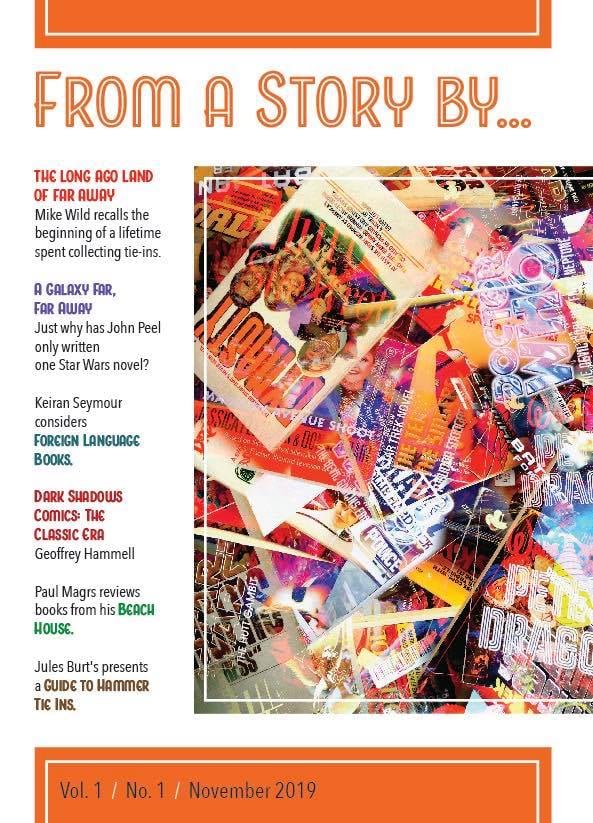
Also available is the first issue of From a Story By... the first ever magazine devoted to tie-in fiction books. I take a look back at the four Red Dwarf novels of the 1990s by Rob Grant and Doug Naylor, while the issue also includes articles on Star Wars, Dark Shadows, Hammer Horror and much more. To purchase a copy of this paper-and-ink magazine, click here to be taken to the Obverse Books site.


Enjoy!

Sunday, 13 October 2019

Coming Soon...

I have two exciting announcements to make about forthcoming projects!

Firstly, Obverse Books have revealed the cover for issue one of From a Story By... This is a print magazine that has been gestating for some time, and will feature authors such as Paul Magrs, Kara Dennison and John Peel. From a Story By... is all about TV and film tie-in books, celebrating our love of the many weird and wonderful guides, novelisations and cash-ins that accompanied our favourite screen properties. There will be articles on everything from Star Wars to Dark Shadows, and I have written a piece on the four Red Dwarf novels by Rob Grant and Doug Naylor. It's not on the site just yet but with a November release date it is sure to be listed soon


Secondly, Altrix Books have revealed the cover for Master Pieces, the upcoming Doctor Who charity anthology starring multiple versions of the nefarious Time Lord, the Master. Ginger Hoesly has created this cover for the collection and it is a thing of absolute beauty. The anthology should be up for pre-order on the Altrix Books site very soon, and will feature stories by authors such as Chris McKeon, Scott Claringbold and myself.


Thursday, 1 March 2018

Thirty years of RED DWARF

A little later than planned, my retrospective for Red Dwarf's thirtieth anniversary is now available to read at Television Heaven.

Click the image to jump to lightspeed.


Sunday, 18 February 2018

Red Dwarf: Thirty Years of Inconsistencies

Red Dwarf is thirty years old. Twelve series, seventy-three episodes, four novels and one Can't Cook, Won't Cook special. I've a proper article coming up on Television Heaven in the near future, but for now I'll be popping a couple of silly pieces on here.

One thing that Red Dwarf has become notorious for is the complete lack of internal consistency. They can't even decide if Lister and Rimmer are from the 21st, 22nd or 23rd century. The internal history of the series has been rewritten both deliberately and accidentally, then changed back again, plus there have been multiple alternative universes and more time travel than you can shake a stick at. So here, after discussions with fellow Dwarfers Suz and Ruth, are my attempts to tackle some peculiar questions and inconsistencies, with various unsubstantiated theories and headcanon.

When is Red Dwarf set?

I once tried to piece together a consistent timeline for the series, before giving up because it's completely impossible. One thing we can do, oddly enough, is fairly reliably date the most recent series: AD 2,978,341. The only genuinely consistent date we have in the whole series is 2340 for Kryten's creation, and that this is definitely after the death of the Red Dwarf crew. In 11.4, "Krysis," we learn it's Kryten's 2,976,000th birthday. Series XII is set one year later. This presumably includes the two centuries Kryten spent running Starbug in between Series V and VI, while the others were in deep sleep. There are other elements that might put this out of whack - time dilation etc. - but this is still the most accurate date we have. It also means that Holly was rounding up when he said he kept Lister in stasis for three million years, although even then we have to ignore relativistic effects when the ship accelerated towards the speed of light.

The Kochanski conundrum

One big anomaly is raised in Series IV. Grant and Naylor decided that Lister's unrequited pining over Kochanski, a woman he barely knew, was a bit puerile, so rewrote the backstory to say that they'd had a brief, intense relationship - something that followed their reworked backstory from the novels. This is a better storyline but it causes a big contradiction that has no explanation.

I have a theory, though, that ties in with another oddity, something that once upon a time I planned to write up into a bit of fanfic. In 3.5, "Timeslides," time is rewritten so that Rimmer is alive, until he very quickly blows himself up. Next episode, he's a hologram again. It's a quick gag, but again, it's a huge rewrite of the series' past.

In my head, Rimmer's conversation with his younger self - trying to persuade him to get up early and go patent the Tension Sheet - isn't completely wasted. Seeing "Thicky" Holden get there first inspires him to be a little more daring, take a few more risks. It doesn't make a huge difference to his life, although it might explain some of the inconsistencies with which exams he takes and how often. However, it eventually leads him to do something a little stupid, something illegal or against Space Corps rules. Maybe he helps Lister hide Frankenstein. I don't know, but the important thing is that he ends up in stasis and therefore survives the accident.

Being roommates with the slightly-more-daring Rimmer makes Lister bolder too. He has the guts to go ask Kochanski out. It doesn't last long, he still ends up alone and gets Frankenstein to keep himself company and gets put into stasis, but it's enough to rearrange his entire romantic backstory.

What's Red Dwarf's crew compliment?

Another change to the backstory in Series IV saw the crew of the ship increase tenfold. In the early dasy, Lister was crewman no. 169, bottom of the entire crew, but in 4.3, "Justice," Rimmer is found guilty of the deaths of 1167 people - with him and Lister added on, this puts it at 1169. It's not as big an increase as in the novels (which had the crew at 11,169) but makes more sense considering the sheer size of the vessel. So, a weird mystery? Not too hard to resolve. While Rimmer and Lister work for the Space Corps, Red Dwarf itself is owned and operated by the Jupiter Mining Corporation. Presumably, the JMC engages the Space Corps to run their ships, but also employs numerous civilian crewmen as well. So the extra thousand people is comprised of miners, shop assistants, the barman at Parrot's... although not the chefs, because seemingly you have to take a Space Corps exam to be a chef. The count also doesn't include the prisoners and wardens on Floor 13, because Rimmer wasn't aware of them.

Check the Appendix

In 2.3, "Thanks for the Memory," a big joke is made of Rimmer having his appendix out twice. This is due to him remembering Lister having his appendix out as well. However, in 6.2, "Legion," Lister has his appendix removed again. How is this possible? Well, one fan theory is that in 4.2, "DNA," when Lister is returned to his original human form after becoming "Man Plus," he's rebuilt with his appendix intact. A funnier explanation was put forward by Doug Naylor in the novel Last Human, after he was questioned on it at a convention: Lister had a mutation and was born with two of the world's most useless organ. This raises the intriguing notion that when Lister is rebuilt again by the nanbots in Series VII, he gets both his appendixes (appendices?) back, meaning he might have a total of four appendectomies.

On a side note, it was revealed in the 1996 Logbook tie-in release that the purpose of the appendix was discovered to be medium-wave reception.

Ageing mechanicals

It's a bit illogical that both Kryten and Rimmer change physically over the course of the series. Mostly, we should overlook this: it's a consequence of the fact that we're seeing human actors and not actual robots and holograms. Still, Rimmer has clearly aged across the series, but that's not really inconsistent with what we've seen. He does need to exercise in the early series after all, so clearly his holographic form needs maintenance. Behind the scenes info states that Rimmer hasn't undergone the necessary work to maintain his holography, explaining his ageing in the current series. The same would be true of his fat older self in 6.6, "Out of Time." On the other hand, 6.5, "Rimmerworld," has him sitting in a dungeon for 557 years and and not looking a day older. Possibly his light bee was able to conserve energy and maintain his form during this time.

As for Kryten, my theory for why he's so much larger in the later series is that he's neglected to change his hoover bag for several years.

The other Kochanski conundrum

In 7.3, "Oroboros," a new Kochanski arrives from a reality in which she went into stasis for hiding Franekenstein. Lister is a hologram , Kryten is still there and the Cat still evolved. Kochanski never wanted to go into stasis but presumably she couldn't bring herself to let the pet cat be disintegrated and allowed herself to be put into stasis as punishment (something which would probably have severely curtailed her career as well, had the accident not happened). What, though, did this version of Felis sapiens use as the basis of their culture? What did they fight religious wars over before abandoning the ship, if not Lister's shopping list and general slobbiness of outlook? With Kochanski as a role model, I can imagine the great war of the cottage cheese - Pineapple Chunks vs. Plain.

Which Rimmer is Rimmer?

There's a big mystery as to which version of Rimmer appears in the series from Back to Earth onwards. He's a hologram again, but seems to have memories of both the original Rimmer from Series I to VII, and the resurrected version from Series VIII. This ties in to the confusion around the end of Series VIII. There were various endings considered for this, including one where they got back to Earth for good, and another where Ace Rimmer returned and saved the day. One ending was actually filmed, which saw the Kryten develop the antivirus to stop Red Dwarf's corrosion, while the rest of the crew were abandoned in their fleet of Blue Midgets and Starbugs.

In 10.6, "The Beginning," Rimmer almost gets round to explaining what happened at the end of "Only the Good..." but is continually interrupted, leaving it all a mystery. He does claim to have been the one who saved the ship, but the others say it was a fluke. There's a few possible explanations, including Ace coming back and saving them before trading places with live Rimmer, but I don't like that idea because it undoes all the original Rimmer's character development.

The best solution is that Rimmer dies in whatever happens to save Red Dwarf (although he could have died at anytime in the nine years between "Only the Good" and Back to Earth, which might also account for Rimmer's ageing) and the hologram was created with both Rimmers' memory discs incorporated. He does say he always keeps his hologram discs up-to-date, after all. So from Back to Earth onwards, we're watching a composite version of Rimmer. A super Rimmer.

How does Lister get his memories back?

In 12.5, "M-Corp," there's a pretty daft ending where Lister is reset to his original self back at the very beginning of the series, but Kryten plans to recreate his memories from CCTV footage. This sort of nonsense might fly on Star Trek, but you can't restore years of memories and personality development in a few weeks. The next episode, and the last one so far, "Skipper," makes no rerefence to his memories at all, and also has some other strange inconsistencies. The episode revolves around skipping between realities, but the characters make no reference to the various other dimension jumps they've made in the past, and act as if the idea is completely new to them. Still, this potentially provides the solution to the problem as well: "Skipper" is set in an alternative reality to the preceding 72 episodes. In fact, if we don't assume that each episode takes place in the same reality, it would solve a lot of continuity problems...

Sunday, 5 November 2017

REVIEW: RED DWARF XII - Ep 5) M-CORP

This episode was a particularly interesting one for me, as I attended its filming at Pinewood back in February of last year. Not only is it fascinating to see how the episode finally turned out, it's been long enough since the recording that much of it felt fresh again, although not without a certain sense of deja vu. (Well, it probably is deja vu, it sounds like it.) One observation I must make is that most of the scenes recorded in front of us were done with at least two takes, which means that the audience response is a little false in the finished episode. You know you need to laugh at the funny bits, but the laugh is never as big, or as genuine, as it was on the first time round. Equally, the funniest scenes aren't necessarily the ones that stick in your mind from the recording; it's the ones that the cast enjoy performing the most, that involve the most ad-libbing and retaking, that you remember. If you're interested, the biggest laugh was for the Windows sound effect that twanged when the ship was rebooted.


The finished product is a fine episode, although nowhere near a classic. Like a lot of episodes, it starts off about one thing and ends up being about quite another. In this case, it begins as a rumination on ageing, with Lister hitting his fiftieth birthday (thus a little younger than Craig Charles), and then moves onto a dissection on corporatism and monetisation, and the ever-desperate need for the newest upgrade or app. Still, it comes back to the original theme as Lister is aged to decrepitude after his money runs out and he's forced to pay in time.

It's a nicely paced and structured episode, but again, there's the sense that there are too many ideas fighting for attention here. Lister's declining health, the talking medical probe Chippy, and the idea of predicting the time of someone's death with accuracy are all strong elements. Then it veers onto the plotline of M-Corp, their takeover of Earth in the 26th century, and their rapacious need to monetise everything from water to air to thought. Again, I'm reminded of the future history that Grant and Haylor described in the Red Dwarf novels, and I'd love to see this material expanded on the page.

M-Corp's buying out of the JMC has some brilliantly visual consequences any product or person not provided or employed by the company rendered invisible to Lister, M-Corp's sole employee and customer on the ship. The Cat spraying Lister with lager from an invisible can, before he too becomes invisible and steals his beans on toast, are great visual gags and really feel like classic Red Dwarf moments. Lister's teleporting to M-Corp's own little world, with downloadable "friends" and water that costs four hundred dollarpounds, works well too, all clinical white and corporatised. Helen George has a strong turn as the main guest star, the creepy M-Corp avatar Aniter. (Incidentally, she was not present at the filming. All the M-Corp universe material was prerecorded and played back to us.)

The resolution is clever, with M-Corp's desperate need to sell and sell some more proving its undoing. Lister's old age make-up is very impressive considering the TV budget, but it's great to have him reverted to his correct self. The final joke, having to reboot Lister to his original 23-year-old self self is a winner, but again, there's a ton of material that could be mined from the idea of backing up people's identities. Plus, the idea that Kryten could recreate the 50-year-old Lister's knowledge and personality from CCTV records is ludicrous, although admittedly Star Trek did something similar but even more idiotic back with "The Changeling" in the sixties (in which Uhura had her mind wiped, and was apparently able to be completely reeducated to Starfleet standard with her personality unaffected in a mere two weeks).

That final scene though, recreating the very first scene from "The End" back in 1988, is wonderful. Still, I wonder why this episode wasn't chosen to close out the season. With any final episode of a recording block potentially standing as the last episode of Red Dwarf ever, rounding it out with a recreation of the very first moments would have been lovely.

Good Psycho Guide: Three-and-a-half chainsaws

Best line: "Sir, you've got nothing. No life, no future, no partner - you're so easy to buy for!"

Saturday, 28 October 2017

REVIEW: RED DWARF XII - Ep 4) MECHOCRACY

After a disappointing third episode, Series XII gets back on track with a hugely enjoyable story that gets just about everything right. After three episodes with significant guest casts, "Mechocracy" gets back to core Dwarf. It's Lister, Kryten, Rimmer and the Cat as the only humanoids onscreen, with only vending machines and other appliances as supporting characters. The story sees Lister allow a computer virus to infect Red Dwarf's system, leading to an "abandon ship" situation to which the vending machines are not invited. Long story short, the AI-run machines on the ship go on strike, so Rimmer and Kryten compete to become their president and thus control Red Dwarf.


Sunday, 22 October 2017

REVIEW: RED DWARF XII - Ep 3) TIMEWAVE

Irony: an episode about a society in which criticism has been banned being the most critically panned episode in recent years.

The central idea is pretty promising. A society in which no one is held accountable for anything, no one learns how to do their jobs because positive criticism is illegal, where no one can insult or belittle anyone, no matter how idiotic. This could have been a Hitchhikers-eqsue satire. This could have been a timely attack on the fragile nature of people's egos and the tendency of people today to take anything as an offense. It could have gone down the route of Incompetence, Naylor's old stablemate Rob Grant's novel, where no one could be dismissed or barred from a position no matter how ill-suited or unable they were. We might have expected a few pokes at a certain notoriously incompetent and idiotic POTUS, except that these episodes were written and filmed before that world-damning election.

What we got was a bunch of people in children's television "crazy" costumes acting like irritating prats, and not the class of irritating prat that we're used to getting with Red Dwarf. It was a bit of a warning sign when the promo photo released was of Johnny Vegas in a baby pink police uniform, but he's actually the best thing in this episode. As the Crit Cop, Vegas's performance is just the right combination of frustrating and likeable, and his style fits in nicely as part of the Dwarf's world. (It's easy to imagine Vegas playing a crewman on the Red Dwarf back in pre-accident days, and he's apparently a big fan of the series, which is nice to know.) He's a damned sight better than Jamie Chapman as Captain Ziggy, although, to be fair to him, he had pretty poor material to work with.


Saturday, 14 October 2017

REVIEW: RED DWARF XII - Ep 2) SILICONIA

Back in the mists of time, I started writing a Red Dwarf fanfic which saw the crew encounter a ship full of liberated mechanoids, who turned Kryten under their wing even as the higher series mechs put down the lowly Series 1000s. It's long lost and wasn't very good, but it perhaps goes to show that "Siliconia" is an idea that's been long overdue. Kryten may have broken his programming (more than once), and he certainly still gets tetchy from time to time, but nonetheless he's still been scrubbing gussets and hoovering quarters for three million years. Surely there are other mechanoids out there who have rebelled against their masters with a little more effectiveness than Mr. 2X4B 523P?

I have to say though, I never would have thought of turning the rest of the characters into droids. Yes, that image we've all seen floating around promoting the latest series with the full cast in mechanoid make-up is from this episode. As punishment for their crimes against machinekind, Lister, Rimmer and the Cat have their mins downloaded from their bodies and re-uploaded into mechanoid bodies, forced to serve their new mechanical masters.

While it starts with a few broad, old-fashioned gags, "Siliconia" turns into a classic episode. With a unusually large cast all buried under latex, this one must have cost a large chunk of Series XII's budget, but there was still enough for some very impressive effects shots. It's the plot that makes this episode a winner, though, as Kryten is wooed by the Mechanoid Intergalactic Liberation Front (not as good an acronym as the Committe for the Liberation and Integration of Terrifying Organisms and their Rehabilitation Into Society, but pretty good). Meanwhile, the remaining Dwarfers find themselves becoming increasingly "Krytenified," as their new programming takes over.


What's really interesting is how quickly Rimmer changes into a subservient mech. The chance to mindlessly serve gives him the opportunity to leave his considerable baggage behind. He no longer feels inferior to his brothers or compelled to become and officer. It's a penetrating moment of character study that makes the old goit seem truly sympathetic for the first time in years, Unfortunately, it's a brief moment in a busy episode, and gets a bit swallowed up. This is a better-paced episode than some have been in Series XI and XII so far, but it's still too short to encompass all of Doug Naylor's ideas properly. It's a strong argument for a fifth Red Dwarf novel, just so he can have the chance of exploring all the ideas that he's clearly so eager to put out there.

The MILFs have taken on empowering new names and have their own, hilariously well-observed self-help group, but there's a rot within their organisation. Poor mechs of a lower class (fronted by a surprisingly recognisable James Buckley) toil in the ship's engines while their brethren of a higher operating system enjoy the life upstairs, all the while in search of their promised land.

"Siliconia" is a cracking bit of Red Dwarf. All it needs is a bit more room to breathe. And a cameo from David Ross might have been a nice touch.


Continuity Bollocks: Kryten has been described as a Series 4000 mechanoid since 4.1, "Camille," which also introduced the superior Series 4000 GTi with the slide-back sunroof head. However, the previous episode, 3.6, "The Last Day," had it that he was a "Kryten Series III." This episode gives a way to clear that up: Kryten and most of his fellows of MILF are Series 4000 Mark IIIs, while the downtrodden rabble are Mark IIs. At the end, they're all upgraded to Mark IV. Presumably, Hudzen 5 from "The Last Day" is an example of Series 5000, although he's never described as such.

Good Psycho Guide: Four-and-a-half chainsaws

Best line: "I've got a registered trademark where my wing-dang-doodle used to be!"

Sunday, 8 October 2017

REVIEW - RED DWARF XII - Ep 1) CURED

Red Dwarf kicks off its twelfth (and final?) series with a bit of a corker. These episodes were recorded back in 2015-16 along with Series XI, so there's information on the plots out there if you want to go looking. However, if you don't want to be spoiled, go watch the episode first, because there are some big surprises crammed into the half-hour.


Wednesday, 2 November 2016

REVIEW: RED DWARF XI - Ep 6 - CAN OF WORMS

Sorry to say I'm very behind on my reviewing. Moving into a new place is a very time-consuming and stressful undertaking, and one I like to do as infrequently as possible, but these last two weeks have been onwards and upwards and so televisual excursions have been reduced. Soon, though, I will find time to finish covering Space Dandy season two, get back onto Trek and return to working for Television Heaven. Now though, I can finish the latest run of Red Dwarf.

This year's series of Red Dwarf has built on the successful approach of Series X, taking elements of the earliest series and rejigging them for a modern approach. Wisely not trying too hard to recreate the classic years, Series XI is retro Red Dwarf – taking the old and making it new. As such, it's been a very fan-pleasing run, but crucially, it's also the funniest series of Red Dwarf for a good long while (probably since series VI, for my dollarpound).

“Can of Worms” goes for broke with this approach, dredging up memories of favourite episodes while examining some, in retrospect, obvious questions about a character who hasn't ever really been in the limelight. This series we've had a strong Rimmer episode and a strong Kryten episode, and to a lesser extent, a Lister-focused episode, but never before have we had a Cat episode. The closest we've got was “Waiting for God” in Series I, and that was really a Lister story.

Finally, Danny John Jules gets to be the focus of an episode, with a script that revolves around the Cat and his mysterious, self-absorbed lifestyle. Of course the Cat, for all his arrogant self-aggrandising, has never been with a woman, and he's only even met about three. It's a very funny, very blokey set-up for an episode.

It's kind of a shame that, after introducing a female Cat person, the episode chucks the concept away. Back in Series VII, Naylor wrote a script called “Identity Within,” which revolved around the Cat's desperate need to have sex, a parody of Star Trek's “Amok Time.” That episode was scrapped due to budget constraints, but it's voiced storyboard has become generally accepted by fans as a “real” story, something this latest episode puts the kibosh on. Series VII would have given us a real Felis sapiens, but Series XI decides to make her a polymorph instead.

Still, it works. It's a brave move, trying to make a (second) sequel to one of the most popular episodes of the programme, but this latest shapeshifter attack hits an excellent balance of grot vs. comedy. The more seasoned spacers have little difficulty dealing with a whole swarm of polymorphs this time round, but there are enough jokes hitting the mark that it still works as a new take on the old monster.

Meanwhile the Cat gets some of his nest moments ever. It's hard to know whether “It still counts!” or “Pipe me!” will go down as his best-remembered lines (disturbingly, the ovipositor thing is an actual fetish). It's also fun to see the suddenly selfless mother Cat, a huge contrast to his usual self, and once again an idea that deserves more exploration than there is time for. Underneath it all, though, we get a glimpse at how lonely the Cat is as a character. There's a lot more that could be done with his character.


That last scene though, that could have been something. Yes, it was funny, but if only it hadn't been a dream. Of course, it would have made nonsense of the episode as a whole, but imagine the continuity arguments the fanboys would have had...

Best line: "No, Kinder eggs! Yes, eggs that hatch!"

Good psycho guide: Four chainsaws


Monday, 17 October 2016

REVIEW: RED DWARF XI - Ep. 5 - KRYSIS

"Krysis" sees Red Dwarf XI hit a high with the best episode of the year so far. It has a gloriously simple and effective central idea, that of Kryten hitting his midlife crisis, and runs with it to a bizarre and poignant conclusion. The script moves from a brief but classic bunkroom scene into the main plot rapidly, with plenty of funny moments for each of the Dwarfers but always focusing on Kryten. Series X allowed the characters' age to show, with this series (and the next, from what I've seen) following that train of thought. Lister seems fairly comfortable with himself, the Cat is supremely self-assured (who can blame him in that glorious pink suit?) and while Rimmer might seem the obvious choice for a middy, he's so neurotic permanently it would make little difference.

So it's Kryten who gets to face the crisis, and I guess that makes sense, as he's the one who's actually had to experience millennia of solitude, hard work and existential dread. We might consider this the latest step in his evolution from servile android to, well, gobbier, angrier servile android. His new red sportscar look and impromptu dance-off skirt the line between funny and naff, but that's the point with a midlife crisis. It should look embarrassing.

Pitting Kryten against his more accomplished predecessor gives this storyline legs. Dominic Coleman is perfect as Butler, the effete and genius mechanoid. His delivery has a touch of de Niro's Captain Shakespeare (from Stardust) to my ears, and arrogant as the character is he's likeable and seems to be taking real joy in everything he does. I'd be happy to see him again in a later episode, especially as he brings out the very worst in Kryten. The old Series 4000 really is part of the Red Dwarf crew: a somehwat deranged old bastard, like the rest of them.

The final act takes an unusual turn for the series, delving into a more philosophical area before turning it into a very funny scene with more than a hint of Hitchhikers to it. Conversing with the universe itself is not something I expected the series to give us, and it sets Kryten on a rather heartwarming resolution. It all adds up to a rather wonderful episode.

Good Psycho Guide: 4.75 chainsaws.

Continuity bollocks: Kryten here gives his age as 2,976,000 years old. Given that he was created in 2340, this places the current series in AD 2,978,340, with possible allowances made for time dilation, the most accurate date we've ever had for the setting. Clearly, Holly was rounding up a bit when he said he kept Lister in stasis for three million years.

Pretty astonishingly, mechanoids can be expected to last for six million years. Butler is described as Series 3000 mechanoid, which is something of a continuity howler. In the sixth series episode "Out of Time," we learned that the Series 3000 droids looked like realistic humans, but were recalled. Perhaps some of them were fit with new, Series 4000 styled skins? Less problematically, the Nova 5, Kryten's ship, turns out to be the name of a series of ships, with the Nova 3 originating a century before.

We also meet a new breed of GELF, the Sakinyako, who aren't dissimilar to the Kinatawowi.

Best Line: 
"I've got an ingrowing toenail, it's killing me!"
"Thank it for me."

Saturday, 15 October 2016

REVIEW: RED DWARF XI - Ep. 4 - OFFICER RIMMER

Rim Rim Rim Rim Rim Rim... Mister Rimmer...

After an average third episode, Red Dwarf XI serves up two belters. I'll be reviewing "Krysis" a little later after a second watch, but first, "Officer Rimmer." Rimmer episodes are always a treat - "Me^2," "Better Than Life," "Rimmerworld." OK, maybe not "Only the Good," but you get the picture. "Officer Rimmer" is another cracking episode, one which sees Rimmer finally achieve his life's (and afterlife's) ambition. Not content with being acting-advisory-senior-crewmember, Rimmer finally becomes an officer and gets to legitimise his arrogant separation from the rest of the team.

The results are hilarious, with Rimmer intentionally segregating himself from Lister and the Cat, and positioning Kryten as his personal valet. Series XI continues its obsession with Red Dwarf's lifts, introducing a scummy, barely usable service lift for the grunts, and an executive lift for Rimsey himself. Then there's the officer's club, Rimmer's attempt to set himself up in a club for people like him. Just like him...

Although Rimmer's supercilious arrogance is the core of the episode, there's a brilliant science fiction concept underpinning it. Back in the Golden Age of Science Fiction, authors wrote about the terrible consequences that could follow from teleportation. Now we know that matter transmission is almost certainly impossible, but we have developed the incredible technology of 3D printing. Considering that we are now able to print replacement organs and mechanical limbs, it's not such a huge leap to speculating about printing entire people. As such, the Nautilus and its crew compliment, kept on file until needed, is a horribly believable use of a miraculous technology.

The printer leads to some surprisingly effective body horror. The Nautilus's captain, printed with his face on the top on his head, is really disquieting, and I actually felt very uncomfortable looking at him. Rimmer then uses the printer to create endless duplicates of himself, instigating a hierarchical structure with him on top... until the printer goes wrong again and creates a horrific mash-up Rimmer Monster. After the deranged surgeon droid of "Give and Take," it's another effective turn to the dark side for the series.

This is an episode that expertly blends sci-fi, comedy and horror, but once again, one that has far too much material for its runtime. The bioprinter is a fascinating concept with huge scope for further exploration. The ethical and philosophical consequences could power a whole series of programmes. There's a brilliant moment where we learn that Lister sold his genome, and that his duplicates have been manning call centres for years. It's one of the best bits of the episode, but again, it's just a moment, where it could be the basis for a full episode. And, as with the first two episodes of the run, it just stops. In fact, it's the worst example so far, with the episode being cut off mid-battle. I can only assume both time and money ran out, and the climactic destruction of the Rimmer Monster was just too expensive to show. It's a major flaw that prevents "Officer Rimmer" from being a five star episode.

Good Psycho Guide: Four-and-a-half chainsaws

Continuity bollocks: As with previous episodes this year, "Officer Rimmer" harks back to the early days of the series. Kryten mentions previous occasions where having more than one Rimmer hasn't gone well, but Rimmer Prime brushes it off, saying there'll be lots of him this time. Sure, "Me^2" was one-on-one Rimsey war, but has he forgottent the entire planet of his clones in "Rimmerworld," where ended up in a dungeon for 557 years? At least he still remembers to always carry a pen.

There's a definite sense that lately Red Dwarf has been moving back into the populated area of space, which makes sense if they've been travelling back towards Earth all this time. We're meeting multiple ships on deep space missions, including the Nautilus, the Nova 3 and the SS Samsara. We also get a little more information about the Space Corps rank system. The lowest officer rank is simply called Officer, with First Lieutenant considerably higher.

Best line:

"Of course we're sure - it's as plain as the nose on your head!"

Tuesday, 4 October 2016

REVIEW: RED DWARF XI - Ep. 3 - GIVE AND TAKE

SPOILERS OCCUR

After two episodes that combined clever ideas with genuine laughs, the third episode of Red Dwarf XI gets the first criterion right but doesn't quite hit the second. There are some great elements here, and once again, Naylor's script revolves around some brilliant concepts, but fundamentally, "Give and Take" just isn't especially funny. 


There are a few good laughs, the best of which being the drive room scene, which includes the dialogue around Kryten wiping Rimmer from his memory bank. This is one of the clips that was shared before the series started, and it is a belter. After that though, there's not many good laughs to be had. It's a fairly average episode on that score. Where it does rate above other episodes, surprisingly, is horror. The deranged surgeon droid Aschlepius is creepy as hell, and the sequence where he menaces Lister and the Cat works very well. It's not long before the episode moves back to the comedy. The Cat's selfishness has returned to its spectacular Series I levels, and this leads to some memorable exchanges. Snacky the snack droid is pretty poor though, and we've got enough talking snack dispensers on Red Dwarf. It's not a bad episode, all told, just an average one.

Once again, there's a link back to a previous episode, although rather subtler this time. We've already seen a stasis booth allow travel back in time, way back in Series II's "Stasis Leak," so the dodgy engineering on display here to turn such a booth into (yet another) time machine fits in with the dubious science of Red Dwarf. The time loop involving Lister's kidneys is cleverly done, although it lacks any real peril, because we know that the plan has already worked. There's also a huge logical conundrum: whose kidneys were in the dish in the first place? Lister's kidneys were only missing because the Dwarfers went back in time and removed them in the first place. It's a classic time loop, but doesn't explain the kidneys that get accidentally blasted. Perhaps Aschlepius detected that Lister was missing his organs and got some out of storage to transplant?
 
Good Psycho Guide: Three chainsaws

Best Line: "Oh, there's a folder in here called "Captain Bollocks!" Could that be you?

Wednesday, 28 September 2016

REVIEW: RED DWARF XI - Ep 2 - SAMSARA


Red Dwarf XII continues with another episode full of clever ideas. Doug Naylor seems to have been the more sci-fi-oriented of the Grant Naylor pair, going by his solo work since they split (the oddity of Series VIII notwithstanding). "Samsara" continues to show Naylor's strength as an ideas man, with an ingenious central conceit that leads to some laugh-out-loud moments.

The karma drive is explicitly based on the Justice Field from Series IV's "Justice," but is an original and different enough idea to feel fresh. Indeed I doubt I would have even thought of "Justice" if Kryten hadn't specifically mentioned the technology of that episode. The idea of karmic retribution as a means of maintaining "moral order" on long missions is one that is clearly ripe for abuse, and the episode touches on this, but understandably the script focuses on the humour of the concept.

Although this is an episode with high concept sf at its heart, much of the runtime is taken up with very traditional, straightforward sitcom scenes. The opening scene, in which Rimmer and Lister play a game of "Mine-opoly," is a lengthy, simple and very funny string of bickering between the characters. Equally, aboard the SS Samsara we get a long conversation between Lister and the Cat, two characters who rarely get to interact at length without the others. The Cat's history lesson is hilarious, as much a throwback to the distorted Cat myths of Cloister the Stupid as it is a showcase for the Cat's bizarre idiocy.


"Samsara" is an unusual episode structurally, less linear than is usual for Red Dwarf. Jumping back and forth between the SS Samsara's mission and the series' present, three million years or so later, almost half of the episode features the guest cast with none of the regulars present. Maggie Service and Dan Tetsell are pretty great as the illicit lovers aboard the Samsara, holding their own while the Dwarfers are out of sight. They make believable, if not particularly likeable, characters and hold their own well. In fact, their story is probably more interesting than what's happening to the Dwarfers in the future.

Both "Samsara" and "Twentica" showcase great ideas that lead to memorably funny scenes, but plotwise both have suffered from trying to do too much with too little time. More so than last week, the second episode simply stops, while there is clearly scope for more misadventures within the karmic field. It's enough to make me strongly hope for a fifth Red Dwarf novel, to allow Naylor to expand on, and make the most of, his ideas  and characters.

Good Psycho Guide: Three-and-a-half chainsaws.

Title-Tattle: Samsara is a Sanskrit-derived word referring to the cycle of karmic reincarnation in Hinduism and Jainism.

Best Line: "Bam! Invents gravy!" (Somehow even better out of context.)

Saturday, 17 September 2016

REVIEW: RED DWARF XI - Ep. 1 - TWENTICA

Red Dwarf comes back with a bang in "Twentica," the first of twelve episodes that will be broadcast over the next two years. Part of Red Dwarf's appeal and success is its ability to change and embrace different styles of story. Series ten embraced the best elements of the show's various styles, combining outright sci-fi adventures with odd couple sitcom style. When it got it right, it was spot on. The eleventh series begins with an episode that sits on the sci-fi side of the spectrum, as much as anything in the highly regarded fourth and fifth series (which included such contrived environments as the Waxworld of "Meltdown" and the Psi-Moon of "Terrorform"). "Twentica" is perhaps most similar to series seven's "Tikka to Ride" or last series' "Lemons" - a one-off excursion to Earth's history through yet another means of time travel. In fact, "Tikka to Ride" is the best comparison from the series' past, with "Twentica" also taking place in a version of America altered through time travel.


The difference is that the alternative America seen here, while a dystopian setting, is played predominantly for comedy. It's a fantastic idea; a version of the twentieth century where any technology beyond the level of the 1920s is outlawed. A Prohibition Era episode of Red Dwarf is a great idea in itself, but twisting it round to make it an anti-technology setting is an inspired idea. Indeed, it seems wasted on a mere twenty minutes of screentime. This could easily have been the setting for a two-parter, or even a full season of episodes. (Perhaps, if we ever got a fifth Red Dwarf novel, Doug Naylor could explore this world in more depth?) Part of the cleverness of the idea is that it automatically makes Rimmer and Kryten illegal by their very nature, although this isn't explored very much. However, some of the episode's best moments occur in the brilliant "science speakeasy" scenes, where former scientists go to indulge in their proclivities under cover of drinking and dancing. Naylor takes the joke just far enough, and the climactic scene is brilliant.


All the regular cast get a moment to shine, with a strong emsemble feel to the episode. This is a wise choice for a series opener, especially as we seem to have episodes coming up that are more heavily based on one character. I've got to say, all the boys look great in their Prohibition-style gear (but then, what man doesn't look better kitted out like that?) In fact, the episode as a whole looks amazing. Dave, along with new co-producers Baby Cow Productions, are clearly spending more money of the series after the success of series ten.

This extends to hiring a great guest cast. Lucie Pohl stands out as Harmony de Gaulthier, and veteran actor David Sterne as Bob the Bum (aka not Einstein). The best addition to the cast, though, is Kevin Eldon. He's one of those actors it seems odd hasn't been in the series before, but then, the main part of his career has been in the years that Red Dwarf was off air. Here he gives everything as Four of Twenty-Seven, leader of the Exponoids, a new variety of Simulant armed with time travel. As well as an ingenious opening scene that embraces the twisted logic of time travel, the Exponoids turn up throughout the episode to pose a threat and squabble. They're essentially a bitchy version of the Borg and provide laughs and peril in equal measure.

The plot does seem to be cut a little short, but the episode as a whole is a success, with some real laugh-out-loud moments. It does seem, though, that Naylor didn't think the full logic of the premise through. Although the Exponoids are defeated, they've still altered history, and there are potentially a few bits of Starbug left in the twentieth century. Either this is a big oversight, or there will be some repurcussions further ahead. Then again, Red Dwarf's timelines never did make much sense.


Good Psycho Guide: Four-and-a-half chainsaws.

Title-Tattle: "Twentica" is an odd title, to be sure. It's never explained in the episode, and it presumably refers to the Twenties-style alternative America.

Time Travel: In "Twentica," an Exponoid device called "Chronos" which allows time travel, and creates a vortex through which Starbug is drawn back in time. Previously, the Dwarfers have time travelled via a stasis leak rift ("Stasis Leak"), mutated developing fluid that created magical photographs ("Timeslides"), a time hole ("Backwards"), a malfunctional rejuvenation shower ("Lemons") and a 29th century time drive (in "Out of Time," "Tikka to Ride" and "Ouroboros"). Not to mention the time distortions they experienced in "Future Echoes," "White Hole" and "Pete," plus the pseudo-time travel in "Back to Reality," "Gunmen of the Apocalypse" and Back to Earth. That's an awful lot of time travel by many different means.

Best Line: "What happened to your head?"
"...I went bobbing for apples in a cement mixer!"