Showing posts with label legends. Show all posts

Wednesday, 30 July 2025

Remembering Tom Lehrer

It's been a little while, hasn't it? I've been busy elsewhere, I'm afraid. This seemed the place, though, to mark the passing of one of the greats of twentieth century comedy.

It's hard to actually feel sad at the news of Thomas Andrew Lehrer's death, given that he'd reached the impressive age of 97. The feeling is more one of, oh well, it had to happen eventually. Lehrer himself seemed to have been preparing for his death for the last few years, having put all of his song - lyrics, music and recordings - in the public domain. You can still access and download everything here, although Lehrer did warn that it wouldn't be up forever.

I won't go on with a biography of Lehrer; you can find that in any number of places. I won't spend time on his first calling as a mathematician, his still secret operations in the NSA, or his alleged invention of the Jello shot. No, I'm here, of course, to talk about his songs. Endlessly quotable, raucously singable, bitingly satirical and frequently verging on the obscene, Lehrer's songs are perhaps the greatest comedic songs ever written.

I didn't really come to learn about and love Tom Lehrer until very late on. I knew the wonderfully nerdy "The Elements" from a young age, although I couldn't sing it then or now. It needs an update, of course, with the latest sixteen elements added on, which will need to be inserted as an earlier verse so that the classic final lines remain, rhyming "Harvard" with "discahvarred." "We Will All Go Together When We Go" is another well known song; so fun to sing yet so dark in content.

It wasn't until my partner Suzanne introduced me to Lehrer's greater catalogue of work that I fell for him. I don't think I've ever laughed as much at a song as I have at "I Got it From Agnes," the absolutely filthy but very carefully worded story of communal diseases. It stuns me that he got away with that in 1954, and it became our Covid-19 anthem. 

Jostling with "Agnes" for my favourite is the gleefully mrderous "Poisoning Pigeons in the Park," which we have localised to "Cyaniding Seagulls by the Shore." Not that our parks aren't full of pigeons, or, for that matter, seagulls. High positions, as well, for "The Love Song of the Physical Anthropologist" (perfect for any anthropoid) and "The Masochism Tango" (truly, a love song for every couple, throuple or otherwise). 

Shockingly, there has never been a film of Lehrer's life, and surely now one will finally be made. Although who could be found to play him? An actor tall enough, gangly enough, who can sing such well-crafted lyrics with such speed and only occasionally trip over his tongue will be hard to find.

Still as unhappily relevant now as ever, Lehrer's satire only bites harder for being delivered in song. As a farewell, let's have one of his less celebrated compositions: "Pollution."


Monday, 14 November 2022

R.I.P. Kevin Conroy - the late, great Batman

This is hardly the only piece you're going to read about Kevin Conroy this week.

The actor died on 10th November from a short, intense battle with cancer, aged only 66, and in the couple of days since the news broke, tributes to him have flooded the internet. Conroy was one of those rare performers who seemed universally admired, and it seems that no one has a bad word to say about him. Fellow performers, notably Mark Hamill (the Joker to his Batman) and other noted voice actors such as Tara Strong and Matthew Mercer, industry creatives such as James Gunn (new DC screen head honcho) and Paul Dini (the creator of Batman: The Animated Series) have been outspoken in their admiration. But it's the outpouring of love from the fans that says it all.

Conroy wasn't just Batman, of course. He appeared in front of the camera in shows ranging from Cheers to Kennedy, and in voice roles as various characters across his career, his last work being on the revived Masters of the Universe. None of these roles, however, will ever come close to being as fondly remembered as his time as Bruce Wayne.

I was six when Batman: The Animated Series began, exactly the right age for the seminal series. It is rightly regarded as one of the greatest animated series of all time, and certainly the greatest superhero cartoon. Heavily influenced by the dark fairytales of the Tim Burton films and the almost art deco style of the Fleischer Superman cartoons of the 1940s, Batman: TAS had a haunting, timeless art and music style that immediately captured the imagination. Combined with remarkably mature but accessible writing and some truly great voice performances, Batman: TAS is the definitive version of Batman for a generation.

This was, in no small part, down to Conroy's note perfect performance in the lead role. His gravelly voice was reassuring as Bruce-about-town, commanding as Bruce when on-mission, and powerful as Batman when facing his enemies. He gave the role a subtlety that many actors would not have bothered with for a children's series. Such was his acclaim and popularity in the role that he continued to be the primary voice for animated Batman productions and video games almost through to his death, from the follow-ups Superman: The Animated Series and The New Batman Adventures, the elder Bruce Wayne in Batman Beyond, cinematic and home video movies from the great Mask of the Phantasm to the dark, adult-oriented The Killing Joke, and the acclaimed Arkham Asylum game series. There have been other great Batman voice actors, but none have ever really approached Conroy's stature. It was beyond time when he finally got to play the character in live action, portraying the elderly Bruce of Earth-99 on Batwoman as part of 2019's Crisis on Infinite Earths event.

It's no accident that when James and Scott created their World's Greatest Detective audio series it was hugely influenced by Batman: TAS, with Terry Cooper often sounding uncannily like Conroy in his performance as Batman.

Conroy came out as gay in 2016, after facing years of hostility within the industry in his early career. He wrote the comic story “Finding Batman,” an acclaimed piece in which he explored his own years behind a metaphorical mask, in this year's DC Pride Anthology. DC have made the strip available for free on their website (you'll need to sign up for a free account to read it).

It may seem odd to take to heart the loss of an actor whose face I hadn't even seen until a few years ago, but to me and many others of my generation, Conroy was Batman, the most iconic incarnation of the most iconic superhero.


Friday, 5 August 2022

RIP Nichelle Nichols


After only days, we've lost another one of the greats. Nichelle Nicholas has died, aged 89.

Nichols will always be best known for her role as Uhura on the original Star Trek series, which she returned to for the animated follow-up, the first six Trek movies and fan productions including First Frontier and Of Gods and Men. While Uhura's role in most episodes was fairly small, her position on the bridge of the Starfleet ship as communications officer was groundbreaking for American television at the time. With her understated performance and captivating singing voice, Nichols made Uhura a fan favourite, as well as inspiring a generation of black women. Whoopi Goldberg has spoken frequently about how she was inspired by Uhura's presence on the bridge as a black woman on TV “who ain't no maid!” Dr. Martin Luther King famously encouraged Nichols to stay on the series when she was considering leaving, aware of the positive effect her presence was having on the image of black people in an inclusive future.

Dr. Mae Jemison, the first black woman to travel to space, cited Uhura as an inspiration for her choice of career. Indeed, Nichols was recruited by NASA as a spokesperson to help bring women and BAME people into the agency, which remained almost entirely white and male in the 1970s. Among her recruits were Sally Ride, the first American woman in space, and Charles Bolden, later the NASA Administrator.

Zoe Salana and Celia Rose Gooding, who play Uhura in the Kelvin Timeline Star Trek movies and the new Strange New Worlds series respectively, and Sonequa Martin-Green, Burnham on Discovery, have spoken about how they would be unlikely to have the careers they have without Nichols and her example. They continue to promote the inclusion of BAME women not only in film and television, but also in STEM careers as their characters continue to show this as a desirable career path for women and people of colour.

Beyond Star Trek, Nichols appeared in such series as Heroes, Gargoyles, and Batman: The Animated Series, and films such as Lady Magdalene's and Snow Dogs.


Thursday, 28 July 2022

RIP David Warner and Bernard Cribbins


It's been a crushingly sad week for generations of viewers of film and television, as two of our most beloved actors have gone.

David Warner


died on the 24th of July, five days shy of his 81st birthday. One of my very favourite actors, possessed of one of the most distinctive and classy voices in the business, Warner was one of the most identifiable and prolific actors of the late twentieth century.

Sci-fi and fantasy fans will recognise him most. Iconic roles in The Omen (where he famously lost his head), 1984's A Christmas Carol (as Bob Cratchit), Tron, The Man with Two Brains, Time Bandits and The League of Gentlemen's Apocalypse. He appeared in Star Trek three times: rather wasted as disgraced diplomat St. John Talbot in Star Trek V, before he was brought back as the noble Klingon chancellor Gorkon for its sequel. He then starred as the sadistic Gul Madred in an electrifying two-hander performance opposite Patrick Stewart in “Chain of Command,” a two-part story for The Next Generation.

He was disproportionately cast in villainous roles, ironically considering that no one seems to have a bad word to say against him. He was none other than Jack the Ripper in Time After Time (in spite of the obvious fact that he would have made an excellent H.G. Wells), and had memorable appearances in horror films from The Company of Wolves, In the Mouth of Madness and the lead villain in Waxwork.

Warner was never shy of taking on voice work that other actors would consider beneath them. He was an everpresent voice of my childhood, lending his ever-so-English voice to villains in Batman: The Animated Series (as Ra's al Ghul), Mighty Max (as Talon), Men in Black: The Series (as the evil Agent Alpha) andd Freakazoid! (as the Lobe). He was a recurring voice in the 90s Spider-Man, Gargoyles (with many Trek alumni) animated series and even voiced a magical tree spirit in Jim Henson's Dinosaurs.

His best vocal work, though, was with Big Finish, for whom he played many, many roles, from Mycroft Holmes to Isaac Newton to the Doctor himself, portraying alternative Third Doctor in the Doctor Who Unbound series. One of my favourite portrayals of the Doctor, he was so popular he got a sequel and eventually was brought back to star opposite Lisa Bowerman in the latest Bernice Summerfield series, with the two of them, I was surprised and delighted to just learn, becoming an item. Warner didn't appear onscreen in Doctor Who until 2013's “Cold War” as a Soviet scientist opposite Matt Smith, but he has already recorded BF's 60th anniversary release with Christopher Eccleston, who has professed himself a huge admirer of Warner's. I hope this is one last turn as the Unbound Doctor. He was even Merlin in a wonderful BBC radio series, playing him pretty much exactly as he played the Doctor – and, well, you know they're one and the same.

There are still plenty of his appearances I have yet to see, such as Van Helsing on Penny Dreadful to the Monster in 1984's Frankenstein TV movie. Sadly, I never got to see him in any of his many stage performances, for he was also one of the classic Shakespearean actors. I never met him, but I am fortunate to be only a couple of steps away from him: my mother knew him a little, back in the day, describing him as a very nice, very shy man. A great loss.


Sir Bernard Cribbins


died this week at the remarkable age of 93. An even more recognisable face than Warner's and television's most comforting presence, Cribbins was acting, singing and performing for eighty years. Bringing himself out of a background of considerable poverty, he went on to become one of the most beloved actors for generation after generation of children, a love that never left anyone as they sadly had to grow up.

He'll always be best known as the voice of The Wombles and the greatest, most prolific reader Jackanory ever had, but he was a face in so many more screen roles. The Railway Children, multiple Carry Ons, a bit of Corry and as the fake hotel inspector in one of the very best episodes of Fawlty Towers, all these showed a great and versatile acting talent.

Of course, he was also a familiar face for Doctor Who fans, appearing as two entirely separate companions. Firstly, as policeman Tom Campbell with Peter Cushing in Daleks: Invasion Earth 2150 AD on the big screen, and almost four decades later as Donna's grandad Wilfred Mott opposite David Tennant on the TV. Like Warner, he was working till the end, and will appear opposite Tennant and Catherine Tate again in the BBC's 60th anniversary special (how wonderful both actors got to appear specials for the anniversary, and how sad that they won't get to experience them).

Still, my most beloved bit of Bernard is his two hit singles, “Hole in the Ground” and the truly spectacular “Right Said Fred.” For these alone he shall never be forgotten.

Monday, 2 September 2019

Terrance Dicks

We've just learned that Terrance Dicks has died, aged 84, a few days ago on the 29th of August. Being born in 1984, I can never quite appreciate the sheer impact that Dicks had on so many childhoods. I was born at the tail end of his heyday, when he pumped out dozens of Doctor Who novelisations and original children's books throughout the 1970s and into the '80s. Dicks wrote the Star Quest trilogy, a series of novels featuring the Baker Street Irregulars, the Sally Ann ragdoll adventures, The River Rats, and many, many more. While it was during the 70s and 80s that he produced his mot prolific and celebrated works, he continued writing well into the 2000s. Yet it was those early years that are most rightfully celebrated.

With his many childrens novels, and above all, his huge contribution to the Doctor Who Target novelisation range, Dicks practically taught a generation of kids to read. While I came to Doctor Who after the era of the novelisation, when videos and then DVDs were the easiest way to catch up with old stories, there were still hundreds of Target books around in libraries and charity shops, and the bulk of them had Terrance's name on. Not only the novelisations - after the last few available stories were novelised, Dicks continued to write for the original novels range, for the New Adventures, Missing Adventures and BBC Books' Eighth Doctor and Past Doctor ranges, right up to a couple of Quick Reads releases featuring the tenth Doctor after the beginning of the new series, and even his last novelisation, that of the Sarah Jane Adventures pilot.

Dicks, along with Barry Letts and Malcolm Hulke, his close colleagues, created some of the most important elements in Doctor Who's ongoing story. Dicks became script editor on Doctor Who in 1968, working on multiple serials during Patrick Troughton's last year, co-writing his final serial, The War Games with Malcolm Hulke, in which the two writers introduced the Time Lords. Dicks worked as script editor alongside Letts as producer throughout Pertwee's tenure as the Doctor, creating a whole new era of the series and introducing the Master as his nemesis. After his time as script editor, he continued to provide scripts for the series, starting with Tom Baker's first serial, Robot, in which he essentially created the character of the fourth Doctor.

Even after all these years, his impact is felt. Recently I've been introducing Suz to some of the classics of Doctor Who, watching old serials together and listening to reading of novelisations. A good half of these have Dicks's name attached to them. The Brain of Morbius, State of Decay, The Five Doctors, the novelisations of Carnival of Monsters, Pyramids of Mars, Planet of Giants... and that's just out of the ones we've enjoyed lately. Without Terrance Dicks, Doctor Who might never have made it out of the 70s, and his contribution is clear today.

Monday, 4 March 2019

John Candy

No, you're crying!


Wednesday, 14 March 2018

Master of the Universe

Stephen Hawking has died, aged 76. When he was 21 and diagnosed with a severe form of motor neurone disease, his doctors gave him two years to live. He sure showed them. Perhaps the greatest theoretical physicist of all time, certainly the most well-known, prolific and gifted physicist of the modern age, he held the Lucasian Chair at Cambridge, formerly held by Sir Isaac Newton, formulated theories of singularities within general relativity, proposed a union of quantum and relativistic physics and proved that black holes emit radiation (now called Hawking radiation).

Hawking would habitually make wagers with his fellow scientists on the most leading edge hypotheses, and would be wrong as often as right. He was never afraid to accept when he was wrong and work on new information to formulate new theories. A firm believer in the Many Worlds Interpretation, Hawking hypothesised multiple pasts for the universe and was still working on ideas at the very edge of understanding when he died. He also had a wicked sense of humour, an eye for the ladies, and was a huge fan of Star Trek and Red Dwarf, like all right-thinking people. The very last contribution he made to popular culture was an appearance as the voice of the Guide Mk. 2 in the latest series of The Hitchhiker's Guide to the Galaxy. He died one week after it was first broadcast.

One of the true greats, who will be remembered for his contributions to science for centuries to come.


Monday, 28 August 2017

REVIEW: 'Aliens in the Mind' by Robert Holmes

The classic BBC radio drama Aliens in the Mind is currently available to stream on BBC Radio 4 Extra. A fine science fiction tale from the mind of great scriptwriter Robert Holmes, you can listen to it here (at time of posting, the serial is on episode three of its six-part run). Here is my old review of this story, originally posted on The History of the Doctor.


Aliens in the Mind began life as a submission for the Doctor Who in the late 1960s by the now legendary Robert Holmes. Then titled Aliens in the Blood, it would have featured the second Doctor, Jamie, and presumably Zoe. For various reasons, it wasn’t picked up, but the outline was several years later to form the basis of this radio serial. Holmes was apparently unable to write the script himself, and it was instead handled by one Rene Basilico - although, having been unable to find any further information on this individual, he may be a pseudonym for all I know.

Rewritten in its entirety, the story is centred on two academics, John Cornelius and Professor Curtis Lark, played by two absolute legends of horror and sci-fi. The more stoic and mild-mannered Cornelius is played by Peter Cushing, while the witty American parapsychologist Prof. Lark is voiced by Vincent Price. Cushing is, of course, perfect in his role as a gentlemanly surgeon, while Price is as wonderfully fruity and sardonic as ever. Honestly, I could listen to that man read out telephone book - what a marvellous voice he has, capable of making anything seem witty or haunting. The duo are old acquaintances, reunited when their friend, Dr. Hugh Dexter, is killed under mysterious circumstances.

Travelling to the remote Hebridean island of Lerwigh, the doctorish duo discover that Baxter’s death is just one part of a far greater mystery. For the Lerwigh is plagued by something known as ‘island sickness,’ a strange affliction that affects the locals minds in their teens. Further investigation reveals that this is merely the maturation stage for a race of mutants - human anomalies with telepathic tendencies. Tendencies that even they, for the most part, are unaware of. They’d be harmless were it not for the occasional second-stage mutation, the so-called Controllers or Masters, who have the ability to psychically control the main mutant populace.

Uncovering the signs of a conspiracy, the pair take the young Flora (Sandra Clarke) away for examination. To all appearances, she is nothing more than a mentally-disabled young adult, but is, in fact, a budding Controller, able to call her fellow mutants from anywhere within a mile radius to obey her every command. In London, they discover that the ongoing emigration from Lerwigh has created a greater threat to humanity than they could ever have realised.

It’s a slow-paced drama, concerned with gently racking up the tension rather than providing action and thrills. It’s perhaps too slow at times, dragging a little in the middle episodes, although continual revelations and plot developments maintain interest. Cushing and Price dominate a fair-sized cast, their voices always distinct against the array of Scots accents. Scenes which have them simply sitting down to dinner are used to summarise the plot, with a smattering of banter to keep it diverting. There are flashes of Holmesian wit, but the dialogue does sometimes slip into dry exposition. Nonetheless, the tension gradually mounts to a chilling finale, which manages to tie up the immediate threat, while leaving the ending open to the greater consequences. Who fans will enjoy hearing Richard Hurndall in the cast, bringing two substitute first Doctors together. There’s some subtle but effective sound work, including some very restrained gunshots, but the main strength of the play lies in Price and Cushing’s earnest depiction of the concepts, which take in telepathy, hypnotism, slavery, politics and eugenics.


While not the classic Holmes’s reputation might suggest, Aliens in the Mind is a worthwhile and intriguing example of audio science fiction.

Monday, 14 August 2017

REVIEW: THE SLIDE by Victor Pemberton

Sadly, it has been reported today that Victor Pemberton, one of the truly great scriptwriters, has died. I thought this made a good occasion to re-upload my review of his highly regarded science fiction radio serial, The Slide, first broadcast in seven weekly parts in 1966.This review was written for The History of the Doctor, hence the very Doctor Who-focused elements in parts.


Victor Pemberton is best remembered by Doctor Who fans as the author of the Troughton serial Fury from the Deep, as well as the later audio release The Pescatons, starring Tom Baker. This is of course just one facet of a prolific career in television and radio (including work on the UK version of Fraggle Rock!), including this well-remembered radio serial from 1966. Contrary to popular fan myth, The Slide was never submitted as a Doctor Who story, although its success did likely have a bearing on Permberton’s later working for the series, and there are some similarities to Fury from the Deep. However, these are mostly restricted to the environmental themes of the plays, and the relentless, inhuman nature of the threat involved. If anything, The Slide has a more Quatermass­-y vibe, full as it is with realistic people and concerned scientists being caught up in unfathomable events.

Set in the small English town of ­­­­Redlow, The Slide pits it and its inhabitants against a constant onslaught from nature. At first a sudden, unexpected tremor creates a vast crack in the main road; then, at night, a thick, greenish slurry begins to seep from the crack, sliding impossibly up the road against the gradient. A deceptively gentle pace continually piles events upon the characters, so that each episode drives inexorably towards a terrifying conclusion. The Mud forms a continuous slide in the night, encroaching further and further into the town, while at day it solidifies into an immovable, impenetrable mass.

Themes of environmentalism and the conflict between human progress and natural order are at the forefront here. The play begins with the small scale crisis of townsfolk against a progressive developer who has made sweeping changes to the town’s environs. This is then reflected in macrocosm, as the Mud sweeps away the town to create its own environment, one of stillness and darkness. It even touches on an almost Gaia-like hypothesis, as the Mud is revealed to not only be alive, but intelligent, and some come to believe that the Earth herself is reacting against humanity, endeavouring to scour them from the surface. It does take the scientific elite an astonishingly long time to realise that it is sunlight that is causing the Mud to solidify in daytime, thus presenting a solution, but otherwise the bouts of theorising provide some of the most intriguing and enjoyable segments.

What makes the serial so effective, however, is its focus on real human characters, brought to life by some of the era’s most talented actors. The onslaught of the Mud leads to the rural townsfolk to lose their faith, to turn against one another, or to sink into depression. It’s a grim portrait of human frailty under pressure - although the revelation that the Mud is exerting a hypnotic influence is perhaps a bit much. Maurice Denham portrays ­­­­Hugh Deverall’s gradual collapse from influential developer to incoherent madman with alarming realism, while Dr Richards, the local GP, struggles to maintain his stiff upper-lipped composure in face of the onslaught. Meanwhile, the great Roger Delgado raises above a phony South American accent (“The surface of thee Earth is like thee theen crust of a pie…”) to create a powerful performance as the geologist Joseph Gomez.


The writing and performances are ably supported by some sterling work by the BBC Radiophonic Workshop. Perfectly created everyday sounds are thrown into sharp relief by the screeching whine emitted by the encroaching Mud, amongst which is some brave, highly effective use of silence. The Slide is a classic piece of science fiction, a masterful look back at the days of truly great radio.

Sunday, 29 January 2017

Hurt

Britain has lost one of its most remarkable and respected actors. Sir John Hurt has died, aged 77, following an ongoing battle with pancreatic cancer. While he previously announced that he was in remission, pancreatic cancer is a particularly vicious form of the disease and it would seem that it has now taken him.

John Hurt was one of the most beloved actors of his generation, instantly recognisable by his distinctive voice, which only grew more gravelly and cultured with age. His presence added an element of class to even the most beleaguered production - even Indiana Jones and the Curse of the Crystal Skull was improved by his involvement. Over the course of fifty-five years, Hurt appeared in over a hundred films, including some of the most respected and influential in British and Hollywood history.

I'm not alone in citing his performance as John Merrick as a personal highlight in this long career. Although quite loosely based on the life of the real Joseph Merrick, David Lynch's The Elephant Man (1980) is a truly powerful and moving film, that hinges on Hurt's incredible performance. Being able to deliver such pathos and heart while so buried in make-up is a testement to his skills as an actor. It's clearly a role that made an impact of him. Hurt later became patron of the Proteus Syndrome Foundation, which researches into the rare condition that Merrick is thought to have suffered from, and also Project Harar, which supports children living wtih disfigurement in Africa.

Hurt revealed the hardship of his childhood later in life, having been brought up in a strictly religious household, and also abused at school. Although his mother had been an actress, he was banned from visiting the cinema as a boy. Nonetheless, he developed ambitions to become an actor, something that was, as seems to be traditional, poo-pooed by his schoolmasters. Nonetheless, he proceeded to art school, and won a scholarship to RADA in 1960. His first film role, in The Wild and the Willing, followed in 1962.

Over the years Hurt took on some of the greatest roles in film and television. He was Quentin Crisp in The Naked Civil Servant (1975) and its latter-day sequel. He became the first victim of the eponymous creature in Alien (1979), in one of the greatest and most shocking scenes in cinem history. He appeared in such acclaimed films as Midnight Express (1978), for which he won a BAFTA and a Golden Globe, The Field (1990) and Contact (1997). One of his most celebrated roles was as Winston Smith in the film adaptation of Nineteen Eighty-Four, released in its eponymous year. Years later, as something of a counterpoint, he played the High Chancellor in the film of Alan Moore's V for Vendetta (2006).

Hurt lent his vocal talents to numerous animated productions. Some will remember his performance in the, frankly terrifying, 1978 adaptation of Watership Down, others for the same year's animated version of The Lord of the Rings. He voiced the Horned King, the monstrous villain of the underrated Disney epic The Black Cauldron (1985), while people of more recent childhood's may recognise his voice best from his role as the dragon in the BBC series Merlin.

Hurt was one actor I was always desperate to see play the Doctor. I felt that, if ever there was a modern Doctor Who movie, then he would be the perfect choice for the role. In 2013, for the series' fiftieth anniversary, he was drafted in to play the War Doctor, a previously unknown, secret incarnation of the Time Lord, and was absolutely, utterly perfect in the role. In the last couple of years, Hurt has returned to the role on audio, for Big Finish Productions.

John Hurt is one of those rare celebrities who no one seems to have a bad word against. An absolute treasure. He will be missed.


Monday, 20 June 2016

Anton Yelchin

This truly is a tragic loss. Anton Yelchin was only twenty-seven when he was killed, seemingly as the result of a dreadful accident. Yelchin was best known for his role as Chekov in the new iteration of Star Trek, and his sudden death is going to put a very different complexion on the experience of watching Star Trek Beyond. Yelchin was a fine young actor, although it's clear we had yet to see the best from him. He was the best thing in Terminator Salvation and the Fright Night remake. The bulk of his work I have yet to see, but one thing that I can vouch for is Odd Thomas, a hugely underrated supernatural adventure in which he plays the title role. He'd already been cast in further roles that he will now never play.

Yelchin's personal life makes for some interesting reading itself. Born in Leningrad to a Jewish family, he was raised by people who had experienced a great deal of persecution under the Soviet regime. His family fled the USSR when he was only six months old, having received refugee status. His family were sportspeople and artists, so it's not surprising that he went into the performing arts, beginning acting at the age of nine, beginning a rich career that also involved time in a punk band. He could have gone on to do great things.


Thursday, 14 January 2016

Metatron

Damn. Two weeks into the year, and we've lost Bowie, Lemmy, David Margulies, and now Alan Rickman.

Rickman played the angel Metatron, the mad monk Rasputin, Franz Mesmer, Tybalt and Louis XIV. He provided the voice for the caterpillar of Wonderland and Marvin, the paranoid android. He was spectacular at portraying villains, forever remembered for playing Hans Gruber and the Sheriff of Nottingham. He utterly broke my heart in Truly, Madly, Deeply. And apparently he did something in Harry Potter.

They'll have to get a woman to play the Doctor next - all the best male actors are dying. There'll soon be no one left.


Monday, 11 January 2016

Starman

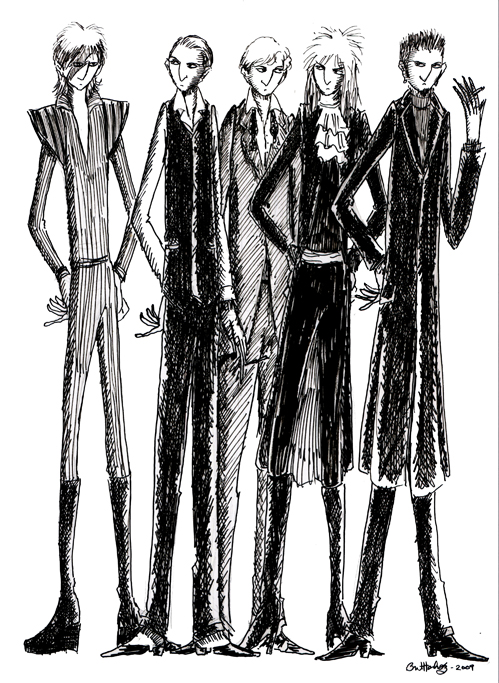
The Five Bowies, by Bret Herholz


I've written a few pieces over the last few years regarding the deaths of people I admire, but this is the hardest and most emotional. Perhaps it's because it was so unexpected, but David Bowie's death has hit me harder than I thought possible. It's hard to say why I'm so upset by the death of someone I never met, nor had any connection to. I admired the man enormously, of course, as did so many. He was a truly remarkable talent, responsible for revolutionary music in his youth, maturing to dominate whichever genre he turned his hand to as the years went by, never out of the charts for long and critically acclaimed throughout. Even those directions which didn't quite work are to be celebrated for the endless experimentation that defined the singer-songwriter's career. And that's without touching upon his acting career, rare and occasional that it was. Endlessly reinventing himself, Bowie's persona changed with his music, his gender expression and sexuality fluctuating depending on the period of his life and, to be fair, who he was talking to at the time. There was undeniable mystery about the man, so much more to him than we'll ever know. This otherwordly individual both starred in the seminal The Man Who Fell to Earth and was responsible for "Life on Mars," a song that can genuinely and honestly be argued to be among the greatest ever written. Whether incarnated as Ziggy Stardust or the Thin White Duke, Bowie was a unique and incomparable artist.

The death of David Bowie truly marks the end of an era. The future can never live up to the past.


Thursday, 11 June 2015

A very sad day

Today, we learned of the deaths of two legends of the acting world. Neither was a surprise; they were both old men, at the end of long, varied and remarkable careers. Both, however, will be sorely missed.

Sir Christopher Lee was born in London in 1922; he died on June 7th. He was 93 years old. He began acting on film in 1947, and continued acting up until he died (his intended final film, The 11th, will be released next year). His list of credits gives tell to an astonishingly prolific career. He was Saruman, Count Dooku, Sherlock and Mycroft Holmes, Fu Manchu, Lord Summerisle, Dr. Jekyll and Mr. Hyde, le Comte du Rochefort, Death and Scaramanga (and he was supposed to be Dr. No, but events conspired against him). His Hammer horror credits alone are impressive: the Monster, the Mummy, Sir Henry Baskerville and, most famously, Count Dracula, in several productions. His friendship with frequent co-star Peter Cushing was legendary, and he never really got over his friend's death in 1994.

Lee's life outside of acting was even more remarkable than his roles. He played Rasputin? So what, he'd met the man's assassin. He volunteered for the Finnish Army and fought in the RAF, and was assigned to the effort to track Nazi war criminals at the end of WWII. He led a distinguished career in the Special Forces, about which he remained very secretive throughout his life. When asked by a director to imagine what sound a man would make as his throat was cut, Lee quietly replied that he didn't need to imagine it. He was fluent in five languages and proficient in three more. His final years were marked by a burgeoning career in metal music. He meshed heavy metal with opera to great acclaim. He was a Knight Bachelor, a Commander of the British Empire, and a Commander of the Venerable Order of St. John, and bore the arms of the Holy Roman Empire. The man was, simply, a legend.

Ron Moody was born Ron Moodnick in 1924. He died today, the 11th of June, aged 91. It's easy to feel sorry for him, as the announcement of his death has been somewhat overshadowed by that of his fellow actor, but Moody was a prolific and talented actor himself. He will always be best known for his role as Fagin in the musical Oliver!, a role he reprised several times, but he had many other charismatic performances. He was the wizard Merlin in Disney's A Kid in King Arthur's Court, Sir Isaac Newton in Revelation, and Uriah Heep in the 1977 adaptation of David Copperfield. He appeared in many television series, both on screen and through voice acting. He was, notoriously, offered the role of the Doctor by the Doctor Who production team in 1969, to take over from Patrick Troughton. He always regretted turning it down, although he did play a Time Lord-like alien in the children's series Mike and Angelo, in which he had a memorable turn as Angelo's father. (I have an elaborate and ridiculous theory that he was, in fact, the second incarnation of the Doctor's enemy, the Meddling Monk.) He eventually made an appearance in Doctor Who in the 2005 audioplay Other Lives, as the Duke of Wellington.

Two mighty lords of acting, taken from us. Great men.

Wednesday, 18 March 2015

No More, With Footnotes

I've been trying to write this for days. It's astonishing how upset one can feel upon hearing of the death of someone quite removed from them. I never met Terry Pratchett. I wish I had. I could have made it to a signing or a convention without much difficulty, and met him, however briefly, but I never did. I did, however, read his books, and through someone's books may we know them, if only partly and fleetingly.

I've been reading Pratchett since I was around ten years old.* The library at my primary school** - where I would often spend breaktimes under the pretense of helping the staff, but in actuality just allowed us bookish types somewhere to read and chat in the warm - had a selection of his books for younger readers. There was Only You Can Save Mankind***, and its sequel, Johnny and the Dead (Johnny and the Bomb followed a little later). And there was the Truckers trilogy, now called The Bromeliad, the story of the tiny human-like Nomes and their high-speed life unseen by humanity. I'm fairly certain Truckers is the first of his books I read. Perhaps a little challenging for me at the time but I persevered. It was the juxtaposition of the fantastic and the mundane, of this race of little people living in the confines of a supermarket, with their alien box the Thing, it absolutely fascinated me. Not long after I moved onwards to secondary school, where the library was bigger, had computers in which was quite exciting, and had a solid selection of Discworld books.**** The first one I picked up was Guards! Guards! I was hooked.

It's become fashionable, in some quarters, to knock Pratchett's earlier works, but there's so much joy and charm and inventiveness that I find it hard to understand why. The first Discworld novels are simpler affairs than the later masterpieces, fairly straightforward parodies of the sword-and-sorcery high fantasy, but they're shot through with such ingenious humour, and such brazen punnery, that they swept me away. They also have the Luggage, a most ingenious creation, and perhaps my favourite character after the ubiquitous and utterly wonderful Death*****. The man with the scythe appears in very nearly every novel in the Discworld series, but it was his first starring role in Mort that I feel marked Pratchett's first truly great novel. His works gradually became more complex, with the Disc becoming somewhere he could take a step back from reality and comment on its absurdity. Guards! Guards! was the first of the Watch books, which began the gradual journey of Sam Vimes from Captain of the Night Watch of Ankh-Morpork to eventually the powerful position of Duke of Ankh, all against his better judgment. It's a turning point for the series and it's easy to see why it grabbed me so strongly and wouldn't let me go. Pratchett had addressed the lives of the "little people" before, but this was all about them. The guards, the henchmen, the lowly servants, who populate fantasy worlds but so rarely get their time in the limelight while the knights and kings and wizards are steering the course of history. Plus, it had dragons. I do love dragons******.

Vimes is one of Pratchett's avatars. You can tell them quite easily. While Pratchett's prose is saturated with his distinctive voice (perhaps why televisual adaptations of his works never quite seem to work as well as they should; that voice is absent, or at best, muffled), certain characters seem to speak for him. Rincewind, the cowardly "wizzard," was his earliest voice of reason, but in time Granny Weatherwax the witch, Sam Vimes, Tiffany Aching and Death himself all came to embody his unique worldview. Cynical, by god yes, but hopeful for this sad and delusional species called human. Somehow, though, it's when reading Vimes that I felt I was hearing his voice most clearly. For all the strength of the Discworld books being their human (or human-like) characters, Pratchett was never short of big ideas. Favourites are often those with a high concept at their heart, through which the poor, long-suffering characters must navigate. Small Gods, with its surgical deconstruction of Christianity, when God turns up to his one remaining true believer, as a one-eyed tortoise. Reaper Man, in which Death retires, with drastic consequences, and has to take his responsibilities back by force. Night Watch, with its exploration of destiny and free will, and Thief of Time, with its mind-bending time-twisting.

Not all the books were classics, but most of them were, and not many authors can say that. Not only the Discworld, though, oh no, there was much more. I may be in the minority, but I adore his two very early science fiction novels, Strata and The Dark Side of the Sun. So much invention, such wonderful alien creations, and such a skill for making us seem so mighty and so tiny simultaneously. The Carpet People, his first ever book, co-written by his teenaged and adult selves, which left me stepping very carefully for weeks. Nation, very possibly the best thing he ever wrote. A children's book, supposedly, but only in that its characters are young and you should give it to your children to read, because it will help them grow up to be wiser, kinder, more human souls. Not forgetting his collaborations: the Science of Discworld series with highly regarded scientists Stewart and Cohen, the Long Earth series with the great science fictioneer Stephen Baxter, and Good Omens, the apocalyptic collaboration of Pratchett with the other greatest modern British fantasy author, Neil Gaiman. Even Larry Niven's Rainbow Mars*******, with its many multiple Marses, was originally spearheaded by Pratchett.

Gaiman famously described Pratchett as not jolly, but angry, and this was more and more apparent in his later work. There is a seething anger coming through in his gentle prose, an absolute despair in humanity's failures and crimes. It's clear we disappointed him. Yet that golden, joyful, silly humour was still there, even as his Alzheimer's slowly took his skill from him. The Embuggerance, as he called it, slowly picking away at his great mind. What a terrible thing to have to live through, and to die from. Pratchett was a very passionate campaigner for the right to die, although in the end, his death was natural. If there is one good thing that has come of this appalling illness having struck him, it is the vast sums of his own fortune that he put into Alzheimer's research. Sufferers in the future may well have him to thank, in some small way, for their improved quality, and indeed quantity, of life.

Now he's gone. We'll never get a chance to read what was to become of Moist von Lipwig in the never finished Raising Taxes.******** There is one final Discworld book to come, that Pratchett finished before he died; The Shepherd's Crown, featuring young witch Tiffany Aching. There are still going to be adaptations of his books, and his daughter, Rhianna, is expected to take over the series, but it's unclear whether she'll be writing any more books or simply inheriting the intellectual rights. I'm actually pleased that I'm so far behind with my reading; I've four Pratchett books waiting, so for a little while at least, he lives on for me. And then I can just go back to the beginning.

Terry Pratchett was born on the 28th of April 1948. He liked astronomy, orang utans, and cats. He wrote fifty-seven novels and had an extinct turtle named after him. He died on the 12th of March 2015.

* That's 1994, fact fans.
** St. Wilfred's RC Primary. Headmaster Mr. Jones made sure we were well motivated. "Jesus always said, 'Try hard at swimming.'"
*** Which instilled in me a lifelong fear that I might actually be killing tiny pixellated people when playing computer games.
**** It's also where I first discovered The Hitchhikers' Guide to the Galaxy.
***** I used to flick through every book before reading it, looking for the TELLTALE CAPITAL LETTERS to make sure he was in it.
****** "Its eyes were the size of very large eyes."
******* Which had echoes in my very first professional publication, now I think about it, although that was really PPH's idea.
******** He was clearly going to become Patrician, wasn't he? Whether Vetinari liked it or not.

Sunday, 1 March 2015

He Am Spock

Leonard Nimoy died just a few days ago. His loss is felt keenly by so many of us. Through Star Trek, he reached millions as the wise, complex character of Spock. In what could easily have been, under a less talented actor, a monotone, robotic performance, Nimoy took the wellworn character of the emotionless alien and made him into a charismatic, compassionate and witty character, and, in time, an icon. Half-human, half-Vulcan, Spock spent much of his time in the Star Trek series attempting to better himself as a Vulcan, to live his life by logic and rationality, and to bury his emotions and his human side. Over time, his understanding and acceptance of humanity improved, as his friendship with his shipmates grew. Nimoy's ownership of the role can be evidenced by the fact that he created two of the concepts that everyone recognises as Vulcan: the V-shaped Vulcan salute and the legendary Vulcan nerve pinch. As Spock, Nimoy was part of the triumvirate that made Star Trek the beloved series it remains today, along with DeForest Kelley as Dr. McCoy and William Shatner as Captain Kirk. Sadly, of these three, only Shatner remains.


He was the only actor to have appeared in every episode of the original Star Trek series and its animated spin-off; Shatner came close, of course, but did not appear in the original pilot episode “The Cage” or the animated episode “The Slaver Weapon.” Early plans for the sequel series, known as both Star Trek II and Star Trek: Phase II, were altered to feature a new Vulcan character named Xon after Nimoy declined to return. However, once these plans advanced to becoming feature film productions, Nimoy signed up again, not only appearing as Spock in the first six Star Trek movies, but assisting with the writing of four of them, and directing both Star Trek III and Star Trek IV. In the course of these films, Spock went from contemplating the complete purging of his emotions, to fully accepting his human side and the strength it gave him. He gave his life for his friends, returned from the dead and continued his adventures in Starfleet. This wasn't the limit of his time in the role, of course; he also appeared in two episodes of Star Trek: The Next Generation, now in the role of ambassador, and in both of the most recent movies, playing the aged “Spock Prime” opposite Zachary Quinto as his alternative, younger counterpart. Plus, there were the interviews, the convention appearances, the audio productions and voiceovers for computer games, including the 2009 launch of Star Trek Online.


His relationship with the character was strained for some years, with the career defining role coming to overshadow much of his other work. Nimoy was an accomplished director, musician and poet, yet was, and always will be, best remembered for his time as Spock. The first volume of his autobiography, published in 1977 during the period in which he was distancing himself from the series, was entitled I am Not Spock, a clear indication of his feelings on the situation. By 1995, after the success of the Star Trek movies, his attitudes had changed, and he wrote I am Spock, in part to undo the damage he felt he had caused with his first book, which many considered made him sound bitter about the character that given him such success. For me, and so many others, Leonard Nimoy will forever be Spock, and while I will always enjoy and admire his roles on series such as The Outer Limits and films including Invasion of the Bodysnatchers, and his late career roles and send-up appearances (such as his wonderful guest slots on The Simpsons and Futurama), it is for his time on Star Trek that I will best remember him for.


What follows is a rundown of my top ten moments for Leonard Nimoy as Spock. There was so much more to the man, of course. Visit iReckon for E.G. Wolverson's top picks for Not Spock.


10) “Return to Tomorrow” - Spock is possessed by Henoch


A rare opportunity for Nimoy to play a different character in Star Trek, as Spock's body is used by the mind one of the last three survivors of a dead planet. Henoch is charming, sexual and manipulative, and Nimoy plays the villain with aplomb.


9) “The Enemy Within” - Spock subdues Kirk


A classic episode, which sees Kirk split into two beings by a transporter malfunction: one timid and weak, one strong but vicious. Faced with the wild Kirk, Spock is forced to disable him. Though the script called for Spock to pistol whip his captain into insensibility, Nimoy objected, considering this too violent for Spock. He came up with an alternative, and the Vulcan nerve pinch was born.


8) Star Trek: The Motion Picture – Spock recovers his emotions


The first Star Trek movie sees Spock on a journey from his coldest ever persona to finally accepting his human side. He begins the film on Vulcan, coming close to fulfilling the ceremony that will finally purge him of all emotion, only to sense the call of V'Ger, the powerful space intelligence, which stirs his human side. Returning to the Enterprise and his friends, he remains utterly passionless – until communion with V'Ger causes him to realise what they both are missing. Cold knowledge and logic are nothing without emotion. As Spock finally come to terms with his own nature, so Nimoy returns to the role he had sought to leave behind, and embraces it.


7) “Mirror, Mirror” - Parallel Spock


An episode that has pervaded into popular consciousness, “Mirror, Mirror” utilises and defines a classic sci-fi trope: the parallel universe. Kirk, Scott,y, Bones and Uhura are cast into an alternative world in which they serve on the Imperial Starship Enterprise, where the counterparts of their crewmates are brutal, selfish and cruel. Then there's the Mirror Spock, complete with goatee beard. Spock always had a touch of the devil in his looks, and never more so than here. The alter ego with an “evil beard” has become a shorthand in sci-fi, fantasy and comedy, but both the script and Nimoy's performance are far subtler than that, for Mirror Spock is not an evil man, but as coldly pragmatic and logical as his counterpart in the regular, more peaceful universe.


6) Star Trek (2009) – The meeting of the Spocks


Nimoy's involvement in the reboot could have been little more than a cameo and some handy exposition, but what we got was the welcome return of an old friend. His earlier scenes, in which he helps his friends-to-be Kirk and Scotty onto the right path work well, but it's his final meeting with his own, younger self that sticks in the mind most. The contrast between the earlier Spock – repressed, superior, yet naïve – and his older self – wise, content and comfortable with his human side – is fascinating.


5) “This Side of Paradise” - Spock and Leila


A wonderful exploration of Spock's past and the human side he keeps buried. On the planet Omicron he is reunited with Leila Kolomi, a woman from his past who is very much in love with him. Spores released by plants on Omicron give humans a blissful high, and remove Spock's blocks on his emotions, allowing him to love Leila back. Nimoy plays Spock in a completely different way to normal, yet entirely recognisable as the same character. The final moments between Leila and Spock are tragic; Nimoy plays his recovered state with a deep, suppressed sadness that is hugely affecting to watch.


4) “The Galileo Seven” - Spock learns how to command


This episode is all about Spock. Told largely from his point of view, Spock is dropped into command when his shuttle is downed on an uncharted planetoid. With aggressive natives outside, a frightened and alienated team inside, and a rapidly closing window for rescue, Spock tries every logical course open until he finally acts in desperation. It's a great example of Nimoy's ability to make Spock both entirely alien yet wholly relatable.


3) “The Naked Time” - Spock struggles with his emotions


A very well-remembered episode, which sees the crew of the Enterprise driven into a state of hyper-emotional intoxication by a mysterious infectious agent. While the crew go to pieces around him, Spock struggles to maintain his own control. Nimoy puts in a wonderfully subtle performance, simultaneously portraying Spock's desperate attempt to hold himself together, and his previously unspoken desire to allow his emotions free reign like his crewmates.


2) “Amok Time” - The onset of pon farr


Another episode all about Spock, in which we learn more about Vulcan life and culture than in any other story. His biology driving him to mate, Spock loses his self control, becoming violent and unpredictable. Some of Nimoy's best scenes involve Spock's struggle to maintain his rationality as his emotions threaten to erupt. This episode is the ultimate expression of that side of Spock's character, only this time it isn't his human half that threatens his composure – it's pure Vulcan drive. Nimoy goes through every powerful emotion in this episode: shame, lust, rage, grief and joy.


1) Star Trek II: The Wrath of Khan – Spock's sacrifice


Arguably the best of the Star Trek films, The Wrath of Khan is very much Kirk's story. However, Kirk story is incomplete without Spock (one of the reasons why Star Trek Generations, the first of the films not to feature Spock, doesn't quite work). While Spock has some fine interplay with McCoy, and an interesting relationship with his Vulcan protege, Kirstie Alley's Saavik. It is, however, the scenes between Kirk and Spock where the film has its emotional heart, and no more so than in those final, heart-wrenching moments. Khan is dead, but he's taken the Enterprise with him. The engine core is about to blow, unless someone goes into the lethally irradiated chamber and shuts it down. The final devastating moments between Kirk and Spock, separated by a transparent panel, as Spock, blinded and dying, gives his final words to his friend. A justifiably beloved scene by Trekkies and cinema goers alike, it was, at one point, intended to be the final death of Spock, and while his popularity meant a return for the character was decided upon before the film was even completed, it would have stood as a perfect send-off for the character. Brave, emotional yet perfectly logical, Spock sacrifices himself for his crew, and his friends. It's going to be a very difficult scene to watch from now on.


Friday, 31 October 2014

A Legend Lost

It was a bit bizarre yesterday, with Burgess Hill hitting the national and then global news twice. In very sad news, John Moore, the Coca-Cola Santa Claus, has died.

For better or worse, the Coke adverts are part of Christmas for a lot of us. It's a bit like hearing Slade for the first time in the year - once you've seen the Christmas Coke ad, you know it's properly Christmas time. The thing is, I had no idea that the legendary Coca Cola Santa, who appeared in many of those adverts over the years, lived in my town. I must have seen him in his his other jobs as a barman and driver. I may even have seen him as Father Christmas in his local appearances. And yet I never knew such a widely seen face made his home here.

The gods have seen fit to grant a pleasant day for the funeral. My thoughts to his family and friends.

Tuesday, 12 August 2014

Oh, shazbot!

I wanted to write a post about Robin Williams. He was to me, as he was to so many, an icon, one of the true greats of comedy and drama. But what more can I add to the many, many tributes that have been made today? Mork has returned to Ork, and that is that. A great and kind man, by all accounts, cut down by this most terrible illness. Even now, a day after his death, some people are attacking him for his "selfish" action of suicide. This makes me incredibly angry. Perhaps it's because of my own struggles with depression, or perhaps it's the sudden number of deaths with similar causes that have affected those I hold dear. Or perhaps it's just because it's an inane, ignorant, cruel thing to say. Already, though, there has been a perfect rebuke to the attacks by people like Shep Smith, a Fox News arsehole. By Dean Burnan at the Guardian, it's the best description of depression I've read in a long time.

For now though, let's remember the wise, troubled clown who made us smile so many times. His films were a fundamental part of my childhood. He was even pretty good in Fern Gully.

Robin Williams, you truly were the Pan.


Sunday, 15 June 2014

It seems that, recently, a lot of people I admire have been dying. I guess it's part of growing older, that more and more people that mean something to you will go. And perhaps the loss of my grandfather in April has made me more aware of it. I'm not sure. In nay case, as well as the great Rik Mayall, so far this month we've lost several admirable people.

Sam Kelly. A very beloved English actor. Best known for his comedy roles in 'Allo 'Allo and Porridge, and his dramatic roles in Topsy-Turvy and Holding On. He was a fine jobbing actor who appeared in dozens of British film, television and radio roles. I have particularly fond memories of his regular role in the lesser-known sitcom On the Up, and his two excellent turns for Big Finish Doctor Who, including the critically acclaimed The Holy Terror with his college contemporary Colin Baker.

Francis Matthews: An English actor best remembered for his various roles for Hammer Films, including major roles in The Horror of Frankenstein and Rasputin, the Mad Monk. He was also Paul Temple for the BBC and the original voice of Captain Scarlet.

Eric Hill: Once a lowly cartoonist in an illustrating company, Eric Hill went on to write the legendary Spot the Dog books. Pretty much anyone in the western world will have encountered these as a child. Hill even invented, with his first Spot story, the lift-the-flap book. Very happy memories of childhood.

Marion Brandvold: A name unlikely to be recognised by many, Marion Brandvolt was a palaeontologist and geologist who discovered the first dinosaur nest. The nest of Maiasaura, which revolutionised our understanding of dinosaur parentage and care, had a major impact on the field. Brandvold was 102 when she died, having lived to see huge developments in the field.

In May, we lost a number of notable people, including:

Pom: The pen name of Josef van Hove, a great Flemish cartoonist whose work was published in Belgian newspapers throughout the late twentieth century. His work decorates many a cafe wall in Brussels and Bruges.

H.R. Giger: The Swiss artist whose nightmarish visions inspired many a writer and moviemaker. Most famous as the creator of the Alien, his portfolio was vast and disturbing.

Maya Angelou: Probably the most notable individual on this list, Maya Angelou's autobiographical novels gained not only widespread critical acclaim but moved thousands of readers. Her writing and activism have furthered understanding of the realities of life for women and African Americans. A truly influential woman, there are no shortage of tributes online.

While none of the above died young, it does not make their deaths any less saddening. The greatest respect to them all.


Wednesday, 11 June 2014

Rest in Peace, the People's Poet

On Monday, Rik Mayall was found dead. We're all still reeling from this. The first I knew about it was about five minutes after the news broke, my good friend and former Bottom-watching companion Andy texting me as soon as he found out. Then came the barrage of other messages as we all tried to confirm that it was just a rumour, or a hoax, or the silly old bastard playing a prank. But it wasn't. Rik is dead, and we still don't know what happened.

I didn't know Rik Mayall, of course, but he was one of those people who was part of the background of my life. His earliest TV work predates me, so he was already a fixture by the time I was old enough to be aware of such things. Spike Milligan called him "the arsehole of British comedy," something I'm sure Rik found hilarious. And arsehole he was, creating grungy, oily, offensive characters who were as subversive as they were unforgettable. Most often partnered by his best friend and comedy partner Ade Edmondson, (together they were The Dangerous Brothers) Rik was the face of alternative comedy throughout the eighties and nineties. The Young Ones was too early for me to fully appreciate, since its anarchic approach had already had an impact on British comedy by the time I was watching. Even so, nothing ever really approached the chaotic freeness of The Young Ones.


I'm sure Rik would have taken some comfort in knowing that he outlived his nemesis, Bloody Thatcher, by a good year. While Rick, he's Young Ones persona, was an anti-Thatcher anarchist, or at least wanted to be, he was far from being Rik's strongest weapon against the hated Tories. Alan B'Stard, the lead character from The New Statesman, is described on Wikipedia as "a selfish, greedy, dishonest, devious, lecherous, sadistic, ultra-right wing Conservative back-bencher," which more-or-less describes most Conservative back-benchers. A fixture of the late eighties and early nineties, The New Statesman returned as a stageshow in 2006, the new Tory government making it as relevant as ever. Just watch this, and see how close Cameron and crew are to B'Stard's way of thinking:


The New Statesman wasn't written by Mayall, Edmondson or their usual collaborators, Ben Elton and Lise Mayer. More often than not, it was some combination of these four who would create the comedy masterpieces. And more often than not, Rik was called Richie, since there's no point wasting creative energy on thinking of new names all the time. He was Gertude "Richie" Rich in Filthy, Rich and Catflap (Ade was Catflap), and most notoriously, Richard Richard in the insane classic sitcom Bottom. Rik and Ade's three series as disgusting flatmates Richie and Eddie will remain some of my most adored comedy material for the rest of my life. It's a shame Andy and I never pulled our fingers out and did our own amateur staging of our favourite Bottom episode, 'S'Out, especially as my younger self looked an awful lot like Rik's younger self. If you're wondering what I look like, a young Rik Mayall isn't a bad estimate.

We saw, along with fellow Bottomers, the last two of the five live shows, with Rik sweating his arse off on stage as he and Ade dealt out appalling violence to one another. I even got a heckler kicked out (I believe they may have shot him, but that might just have been a sound effect.) Rik's Bottom will always be one of my favourite things to watch. However, even more wonderfully awful, more notorious, more adored, was his other best known character, Flashheart. As Lord Flashheart in Blackadder II, Squadron Leader the Lord Flashheart, the Flying Ace in Blackadder Goes Forth, and their assured ancestor Robin Hood in Blackadder Back and Forth, Rik was absolutely, utterly magnificent. It's almost impossible to credit that this man, the most desirable man who ever lived, was in fact the same as the least desirable, the perpetually un-shagged Richie. Only Rik could produce two polar opposites so memorably. Still, it's worth remembering his uncredited first appearance in the series, as Mad Gerald in the final episode of The Black Adder.


There were so many other characters, from Fred of Drop Dead Fred to Professor Adonis Cnut, the only good thing in Believe Nothing. Rik upstaged everyone, in everything. Even his occasional straight roles were memorably weird, and usually came with a smutty name, such as his occasional role in Jonathan Creek, Detective Inspector Gideon Pryke. And then there were all his many, many voice roles, always unmistakable. He was cut out of Harry Potter and the Philosopher's Stone, though, which just shows what a shit director Christopher Colombus was. He was even supposed to be the villain in the unmade Doctor Who movie The Dark Dimension, although it sounds like he would have been wasted in that too.

In 1998, Rik went and nearly killed himself in a quad bike accident. Seeing him lying prone on the ground by his bike, his wife thought he was joking, but fortunately realised soon enough to get him to hospital for urgent attention. He spent five days in an induced coma, and then some considerable time adjusting to life with an injured brain. Nonetheless, he and Ade wrote the script for the Bottom movie, Guest House Paradiso, while he was in hospital. He returned to acting first with voice work and later onscreen and on stage (Pryke was his first post-crash screen role.) There were rumours of a new series of Bottom, based on the "Hooligan's Island" in the last few years, but Rik and Ade said that they just couldn't work together anymore. Later interviews suggest Rik just wasn't up to the scripting process. Plus, Ade was warned about doing himself serious damage if he kept on with those violent stunts.

We don't yet know how he died. It was possibly something to do with his injury; he remained on daily medication for injury induced epilepsy for the rest of his life. He will be missed by two generations of comedians and fans. Tributes have poured in for him, but the last word should go to his co-conspirator, Ade:

"There were times when Rik and I were writing together when we almost died laughing. They were some of the most carefree, stupid days I ever had, and I feel privileged to have shared them with him. And now he's died for real. Without me. Selfish bastard."