Showing posts with label radio. Show all posts

Thursday, 8 January 2026

Listen to 'The Goblin King and Me' on BBC Radio

Broadcast today on Radio 4 and available to stream on BBC Sounds, The Goblin King and Me is a gorgeous 45-minute drama from Bafflegab Productions, written by Paul Magrs. 

Magrs has adapted The Goblin King and Me from his novelette Stardust and Snow, which is itself available as an ebook or limited edition paperback from Obverse Books, and as the first story in Paul's self-published collection Christmassy Tales via Amazon. Based itself on a true story told to the author, it's a beautiful story about the eyes of childhood, learning to live in a world that doesn't understand you, and embracing the magic in life for as long as you can. 

The 10th of January will be the tenth anniversary of David Bowie's death, so this is the perfect time for this story of a special meeting with the star that made a difference to little boy's life. It stars Frankie Treadaway, with support from real-life husband and wife James Bolam and Susan Jameson, with master impressionist Jon Culshaw as Bowie, in all his guises. A lovely late Christmas present.

Sunday, 8 July 2018

The World's Greatest Detective

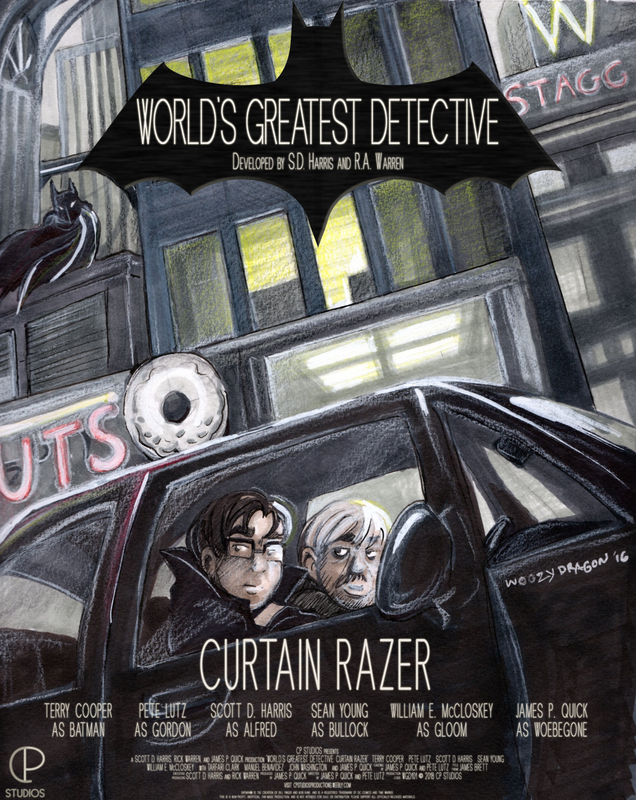
Lots and lots to write about soon, but for now the blog's a little quiet due to my being very busy with real life. Most of it good, though. For now, may I direct you to C P Studios where the first episode of The World's Greatest Detective is now available to stream or download!

"Curtan Razer," Episode One stars Terry Cooper as a note-perfect Batman. It also features Pete Lutz, Scott D. Harris (the C P Studios Doctor), Sean Young and William E. McCloskey, and a brilliant turn from James P. Quick as the villainous Mr. Woebegone. It's written by Scott Harris, James Quick and Rick Warren and features some excellent sound design. Episode two will be out next week and further episodes are to come, including "The Lynx of Mbacke," my two-part story at episodes five and six.

Listen here, you will not be disappointed.


Thursday, 26 April 2018

REVIEW: The Hitchhiker's Guide to the Galaxy: The Hexagonal Phase

Douglas Adams was one of the great comic writers of his generation, a man whose great propensity for wild ideas was matched only by his difficulty in actually getting them down on paper. He created The Hitchhiker's Guide to the Galaxy for radio, following it up with a second radio series, a television series, a ludicrously difficult computer game, the odd short story and five novels, before he worked on a film script that sadly did not make it to the screen before he suffered terminal existence failure.

This is not his story.

This is the story of Eoin Colfer, who wrote the official sixth Hitchhiker's novel, And Another Thing..., and of Dirk Maggs, who adapted it for radio, as he had adapted the third, fourth and fifth novels. Only small parts of it are Adams's, cribbed from recently discovered notes. The rest is the work of people who certainly admire Adams, who want to continue his work and explore the strange universe he created, but are unfortunately not as skilled as he was.

Almost forty years to the day that the original Hitchhiker's began airing, the BBC broadcast the first episode of The Hexagonal Phase (following Primary, Secondary, Tertiary, Quandary and Quintessential in a new ordinal numbering system for the modern age). Maggs had already done sterling work adapting the previous novels for radio (The Tertiary Phase at least having some input from Adams before his death). Due to the fact that The Secondary Phase bore very little resemblance to the second novel, The Restaurant at the End of the Universe, The Tertiary Phase consigned much of it to the realms of virtuality. In a similar effort to provide the series with a more satisfying ending, The Quintessential Phase had a multiple choice denouement, all of which have now been retconned to allow the story to continue. This is fine. There are more versions of Hitchhiker's than there are realities in the Plural Zones.

The problem lies with what comes after. It's been some considerable time since I read And Another Thing... but I wasn't impressed at the time, and having read more of Colfer's work since I have come to the conclusion that he's not just a poor Adams impersonator, he's a poor author. However, with Maggs and Adams himself involved in this, I thought it was worth a try. It has its moments, certainly, some of which are genuinely funny, but they are all too few and far between.

It's lovely, yes, to hear the old cast back together, those of whom are still with us. They sound older, naturally, but they all slip effortlessly back into their roles. There's a feeling of reunion about the proceedings. The late Susan Sheridan even has a short role as the original version of Trillian, thanks to some clever use of archived material, before Sandra Dickinson takes over, but I've always felt she was miscast in the TV series and it's no different here. There are some fun cameos - Stephen Hawking makes his final appearance in popular media voicing the Guide Mk. II, Lenny Henry is the mysterious Consultant and Jim Broadbent is perfectly cast as Marvin, the Paranoid Android. Toby Longworth sounds very at home as Wowbagger, the morose immortal who first crossed paths with our heroes in the third book Life, the Universe and Everything and who takes centre stage here.

Unfortunately, The Hexagonal Phase simply isn't funny enough to work as a comedy, nor is it interesting or exciting enough to work as a drama. Colfer's style is more plot-based than Adams's, but the plot is not gripping enough to make up for the lack of jokes and the serial is, even listened to in weekly half-hour episodes, actually quite boring. It also relies heavily on references to the original stories. It's perfectly possible to write a decent story that leans heavily on winks to the past - Ready Player One has shown you can make a reasonably entertaining film almost entirely out of them - but the overall effect here just reminds the listener of how much better the originals were. There's more to a story than persistently mentioning the Ravenous Bugblatter Beast of Traal.

I might be controversial when I say that radio was actually never the best format for Hitchhiker's; it was prose were Adams really shone. Nonetheless, the original series was groundbreaking and even in its wonkier moments had real charm and dryly satirical humour. This final chapter of the series is sadly lacking. Almost, but not quite, entirely unlike Douglas Adams.

Monday, 28 August 2017

REVIEW: 'Aliens in the Mind' by Robert Holmes

The classic BBC radio drama Aliens in the Mind is currently available to stream on BBC Radio 4 Extra. A fine science fiction tale from the mind of great scriptwriter Robert Holmes, you can listen to it here (at time of posting, the serial is on episode three of its six-part run). Here is my old review of this story, originally posted on The History of the Doctor.


Aliens in the Mind began life as a submission for the Doctor Who in the late 1960s by the now legendary Robert Holmes. Then titled Aliens in the Blood, it would have featured the second Doctor, Jamie, and presumably Zoe. For various reasons, it wasn’t picked up, but the outline was several years later to form the basis of this radio serial. Holmes was apparently unable to write the script himself, and it was instead handled by one Rene Basilico - although, having been unable to find any further information on this individual, he may be a pseudonym for all I know.

Rewritten in its entirety, the story is centred on two academics, John Cornelius and Professor Curtis Lark, played by two absolute legends of horror and sci-fi. The more stoic and mild-mannered Cornelius is played by Peter Cushing, while the witty American parapsychologist Prof. Lark is voiced by Vincent Price. Cushing is, of course, perfect in his role as a gentlemanly surgeon, while Price is as wonderfully fruity and sardonic as ever. Honestly, I could listen to that man read out telephone book - what a marvellous voice he has, capable of making anything seem witty or haunting. The duo are old acquaintances, reunited when their friend, Dr. Hugh Dexter, is killed under mysterious circumstances.

Travelling to the remote Hebridean island of Lerwigh, the doctorish duo discover that Baxter’s death is just one part of a far greater mystery. For the Lerwigh is plagued by something known as ‘island sickness,’ a strange affliction that affects the locals minds in their teens. Further investigation reveals that this is merely the maturation stage for a race of mutants - human anomalies with telepathic tendencies. Tendencies that even they, for the most part, are unaware of. They’d be harmless were it not for the occasional second-stage mutation, the so-called Controllers or Masters, who have the ability to psychically control the main mutant populace.

Uncovering the signs of a conspiracy, the pair take the young Flora (Sandra Clarke) away for examination. To all appearances, she is nothing more than a mentally-disabled young adult, but is, in fact, a budding Controller, able to call her fellow mutants from anywhere within a mile radius to obey her every command. In London, they discover that the ongoing emigration from Lerwigh has created a greater threat to humanity than they could ever have realised.

It’s a slow-paced drama, concerned with gently racking up the tension rather than providing action and thrills. It’s perhaps too slow at times, dragging a little in the middle episodes, although continual revelations and plot developments maintain interest. Cushing and Price dominate a fair-sized cast, their voices always distinct against the array of Scots accents. Scenes which have them simply sitting down to dinner are used to summarise the plot, with a smattering of banter to keep it diverting. There are flashes of Holmesian wit, but the dialogue does sometimes slip into dry exposition. Nonetheless, the tension gradually mounts to a chilling finale, which manages to tie up the immediate threat, while leaving the ending open to the greater consequences. Who fans will enjoy hearing Richard Hurndall in the cast, bringing two substitute first Doctors together. There’s some subtle but effective sound work, including some very restrained gunshots, but the main strength of the play lies in Price and Cushing’s earnest depiction of the concepts, which take in telepathy, hypnotism, slavery, politics and eugenics.


While not the classic Holmes’s reputation might suggest, Aliens in the Mind is a worthwhile and intriguing example of audio science fiction.

Monday, 14 August 2017

REVIEW: THE SLIDE by Victor Pemberton

Sadly, it has been reported today that Victor Pemberton, one of the truly great scriptwriters, has died. I thought this made a good occasion to re-upload my review of his highly regarded science fiction radio serial, The Slide, first broadcast in seven weekly parts in 1966.This review was written for The History of the Doctor, hence the very Doctor Who-focused elements in parts.


Victor Pemberton is best remembered by Doctor Who fans as the author of the Troughton serial Fury from the Deep, as well as the later audio release The Pescatons, starring Tom Baker. This is of course just one facet of a prolific career in television and radio (including work on the UK version of Fraggle Rock!), including this well-remembered radio serial from 1966. Contrary to popular fan myth, The Slide was never submitted as a Doctor Who story, although its success did likely have a bearing on Permberton’s later working for the series, and there are some similarities to Fury from the Deep. However, these are mostly restricted to the environmental themes of the plays, and the relentless, inhuman nature of the threat involved. If anything, The Slide has a more Quatermass­-y vibe, full as it is with realistic people and concerned scientists being caught up in unfathomable events.

Set in the small English town of ­­­­Redlow, The Slide pits it and its inhabitants against a constant onslaught from nature. At first a sudden, unexpected tremor creates a vast crack in the main road; then, at night, a thick, greenish slurry begins to seep from the crack, sliding impossibly up the road against the gradient. A deceptively gentle pace continually piles events upon the characters, so that each episode drives inexorably towards a terrifying conclusion. The Mud forms a continuous slide in the night, encroaching further and further into the town, while at day it solidifies into an immovable, impenetrable mass.

Themes of environmentalism and the conflict between human progress and natural order are at the forefront here. The play begins with the small scale crisis of townsfolk against a progressive developer who has made sweeping changes to the town’s environs. This is then reflected in macrocosm, as the Mud sweeps away the town to create its own environment, one of stillness and darkness. It even touches on an almost Gaia-like hypothesis, as the Mud is revealed to not only be alive, but intelligent, and some come to believe that the Earth herself is reacting against humanity, endeavouring to scour them from the surface. It does take the scientific elite an astonishingly long time to realise that it is sunlight that is causing the Mud to solidify in daytime, thus presenting a solution, but otherwise the bouts of theorising provide some of the most intriguing and enjoyable segments.

What makes the serial so effective, however, is its focus on real human characters, brought to life by some of the era’s most talented actors. The onslaught of the Mud leads to the rural townsfolk to lose their faith, to turn against one another, or to sink into depression. It’s a grim portrait of human frailty under pressure - although the revelation that the Mud is exerting a hypnotic influence is perhaps a bit much. Maurice Denham portrays ­­­­Hugh Deverall’s gradual collapse from influential developer to incoherent madman with alarming realism, while Dr Richards, the local GP, struggles to maintain his stiff upper-lipped composure in face of the onslaught. Meanwhile, the great Roger Delgado raises above a phony South American accent (“The surface of thee Earth is like thee theen crust of a pie…”) to create a powerful performance as the geologist Joseph Gomez.


The writing and performances are ably supported by some sterling work by the BBC Radiophonic Workshop. Perfectly created everyday sounds are thrown into sharp relief by the screeching whine emitted by the encroaching Mud, amongst which is some brave, highly effective use of silence. The Slide is a classic piece of science fiction, a masterful look back at the days of truly great radio.

Monday, 5 October 2015

Audio Explosion

Lots of exciting audio information!


Strangeness in Space has just released Episode 2, which is now streamable here for free. Starring Trev & Simon and Sophie "Ace" Aldred, this episode also features Rufus Hound as Atrocious Knocious and Peter Guinness as the villainous Dr. Scarifium. There's also a guest appearance by Carol Cleveland. It's very silly, and did I mention it's free?

Big Finish has been secretly recording a special new box set starring John Hurt! We always wondered if they might get there eventually, and now BF have broached the Time War, starting with The War Doctor: Only the Monstrous. Clearly that title refers to Nicholas Briggs, who has no regard for the dwindling of our bank balances. The press release goes on to say that there will be three further box sets for the War Doctor, followed by a prequel release featuring Paul McGann's eighth Doctor at the beginnings of the Time War. All the sets are available for £20 on pre-order for both CD and download. As well as this, McGann stars in this month's big release, the first set in the Doom Coalition series, which is set to crossover with BF's new River Song series. So bye-bye pocket money. (The order of events right now seems to be To the Death [previously on Radio 4X], Dark Eyes 1-4, Doom Coalition 1-4 [with a River Song instalment too], The Eighth Doctor: The Time War, The Night of the Doctor [the webcast mini-ep], The War Doctor: Only the Monstrous.)

Before all that, though, there's a chance to listen to some classic science fiction on Radio 4X. Walter M. Miller, Jr.'s 1960 novel A Canticle For Leibowitz has been adapted for radio in this excellent reading by Nigel Lindsay, who explores this devastated future through the eyes of a Catholic monk. The first book in the novel, Fiat Homo, is now available to download or stream in five episodes. It's really quite something.


Saturday, 25 July 2015

REVIEW: Strangeness in Space

EPISODE ONE: FEATHERHEADS

Well, that was stupid. Rather like the classic work of literature, Trev and Simon's Stupid Book. The latest crowd-funded extravanganza from Clare Eden, previously producer of the Parsec Award-winning The Minister of Chance, only rather less sensible than that and with more shoe puns. Strangeness in Space is a free-to-download audio comedy to kids of all ages, featuring the sort of sophisticated wit you might expect from a moderately talented dry cleaner (who doesn't do duvets, naturally). Written by Trevor Neal and Simon Hickson - better known as Trev and Simon - this is half an hour of joyous absurdity that appeals to the simple fool within all of us.

Trev and Simon play Trev and Simon, each one half of the 80s synth pop duo Pink Custard, while Sophie "Ace" Aldred plays Sophie, previously manager of the NASA Space Centre gift shop (actually a dream job of mine). As a vendor of toy space shuttles and astronaut ice cream, Sophie is by far the most qualified of the three to lead their accidental mission into space. Lost in a distant galaxy and bound for the planet Mirth, their only assistance on their quest a not-so-hyperintelligent robot named LEMON, what hope do these hapless humourists have against the Featherheads?

The cast is rather spectacular, not only the core trio doing what they do best, but also sometime-Dalek Barnaby Edwards as LEMON and the wonderful Doon Mackichan as the easily distracted narrator Bounty Flightingale. This is but the first episode, with episode two hopefully coming soon. Already recorded, episode two requires a little more funding for post-production. The future of the series will feature such luminaries as Rufus Hound, Carol Cleaveland and Peter Guinness. 

It is entirely free, but isn't on general release until the 1st of August. If you want an early listen, spending a few quid in the Space Shop will net you a link to the download, and will help get episode two funded. 

Suitable for children and idiots, Strangeness in Space is a nostalgic and wonderful bit of nonsense.

Try it if you like; Live & Kicking; late 1980s Doctor Who; eggs. 


Saturday, 20 September 2014

Capaldi in Space

There are some great little programmes hiding out on BBC Radio 4-Extra. This week I listened to The Further Adventures of the First King of Mars, which actually came out in 2008. It was originally written by Nick Walker to mark the fiftieth anniversary of Sputnik 1's orbital mission. I'm not sure of the connection, seeing that Sputnik never went to Mars, but never mind. It was repeated over the week in five fifteen-minute installments. A canny move, seeing that is read by Peter Capaldi, and thus serves as something to keep all the Doctor Who geeks going between episodes.

We all hoped that the twelfth Doctor would be like Malcolm Tucker in space, and while there's a touch of that to the character, it's Capaldi's mission captain here who is really the holder of that mantle. OK, the swearing isn't there, but god, this is an angry, overbearing and utterly disturbed man on a mission to Mars. The first manned mission to the red planet, totally ruined by having this man in command, utterly unsuited to the role and totally out of his depth. Over five short episodes there is a crash-landing, a death and an astonishing discovery that leaves the mission in tatters and the nature of Mars changed forever, all recounted by Capaldi with increasing hysteria. All hinging on his accidental running down of a space centre chimpanzee. It's just wonderfully bizarre, and Capaldi's caustic telling makes it. This should be repeated every year; it's a brilliant piece of cynical, completely British science-fiction. 

Tuesday, 10 December 2013

Return to Bluebell End

Oh ye of Littlehampton! Creator of The Minister of Chance, Dan Freeman, has, by methods unknown, resurrected his 2000 radio series Ectoplasm and hosted it on his site. Simply by clicking upon this here link one can be transported to the house at Bluebell End, home of the superlative supernatural investigator Lord Zimbabwe (Nick Romero). Join him on his missions into the unknown, as he, Doctor Lilac (Freeman), and his untrusty butler Theramin (Peter Donaldson) investigate the uncanny. Enter a world of possession, poltergeists, shape-changing pixie creatures, and sundry beautiful ladies (all played by Sophie 'Ace' Aldred - the ladies, that is, not the rest).

All four episodes of this hilarious nonsense are available to stream. Uncover the mysteries of 'The Curse of the Mummy's Curse' (aka 'The Curse of Tutancommon'), 'The Case of the Missing Lost Soul,' 'The Affair of the Baddie's Niece' and 'The Adventure of the Stupid, Ignorant Americans.' Best listened to with Monster Munch.


Sunday, 6 October 2013

Radio Review: Imaginary Boys by Paul Magrs

Paul Magrs is one of those authors whose work is often misunderstood. He has no fear of silliness or camp, and so his work is all too often disregarded, by those many critics who see silliness as the same as disposable, or irrelevant. To view such material is to do it an injustice. Paul's work is often very silly, frequently camp, fantastic and impossible to categorise, but just because something is silly, doesn't mean it isn't also serious.

Paul writes with passion and honesty, and nowhere is this more evident than in his new radio play, Imaginary Boys, broadcast as Radio 4's Afternoon Drama on the 3rd of October. It's a strange, funny, wonderful piece, quietly subversive yet beautiful in its telling of the love between two young men. For a gay listener, it will of course have some extra poignancy, but anyone who was once young and has fallen, unexpectedly, in love - which is to say, everyone - will find something to recognise here.

James Baxter gives a strong, truthful performance as seventeen-year-old David, struggling with how his community perceives his developing sexuality. There is, from what I know of Paul's life, more than a little of the autobiographical in David's story, which makes it all the more affecting. All of the tiny cast are excellent, but it is Geoffrey Breton, as the painfully literal, inhumanly literate Lawrence who steals it. Lawrence is a Noveliser from Verbatim 6, a small planet about three hundred light years from Earth. Paul introduced the Novelisers in his Doctor Who plays Find and Replace and Ringpullworld, both part of the Companion Chronicles series, so there's a little bit of extra fun for Whoheads, knowing that this must take place in the universe of Iris Wildthyme and the Doctor.

But that's not important. It's not about science fiction, or magic realism, or any genre trappings. It's about love. About falling in love with someone you feel you shouldn't, but can't help loving. About falling in love with someone through their writing. About growing up and learning about love. It's really quite wonderful.

Imaginary Boys is still available to listen to for the next few days on BBC Radio 4.

Saturday, 23 March 2013

Recent Radio


I like radio. Not the endless barrage of drivel interspersed with mediocre high-charting music that fills up much of the BBC and local output, but the actual programmes, most of which are confined to Radio 4 and its baby brother, 4 Extra. Well written, well performed drama and comedy through the medium of sound, the sort of thing that was a mainstay of popular entertainment in the Good Old Days but is now a shadow of its former glorious self. When there are decent programmes on offer, they are frequently missed, since the BBC is mostly intent of pushing its televisual output. Even the Radio Times has little time for radio anymore.

One of the few items that has received a good deal of coverage lately is the new adaptation of Neil Gaiman’s Neverwhere. Dirk Maggs adapted this one, as he has previously adapted several prose works, including the later Hitchhikers books. Neverwhere is a bit different, of course, having started out as a six-part TV series. It was broadcast in 1996, so I was twelve, for once exactly the right age to catch something on its original broadcast. The TV version of Neverwhere isn’t popular, having been thoroughly eclipsed by Gaiman’s novelisation, but I adore it. A broadcast serial is how it was originally conceived (by Lenny Henry, no less), although I have read of stage versions, for which I imagine it is equally well-suited.

The new radio version mainly pulled the media due to its superstellar cast, which includes James MacAvoy as the hero Richard, Natalie Dormer as Door and man-of-the-moment Benedict Cumberbatch as the Angel Islington. There’s more to it than big names, of course. There’s a reason big names become big. These are some of the best actors of their generation. While Cumberbatch’s presence will be the most celebrated – and I did enjoy how hammy he got in the final episode – it’s the leading duo that holds it together, with real chemistry on display. David Harewood is silkily smooth as the Marquis de Carabas, coming across as a little more dangerous than his televisual alter ego (played by Paterson Joseph), and we get the sheer joy of hearing Bernard Cribbens as Old Bailey and Christopher Lee as the Earl of Earl’s Court. If there is ever a sequel, please may we have David Warner as the Baron of Baron’s Court? Thank you kindly.

The joy of audio is its ability to create vivid worlds solely through the medium of sound. Neverwhere triumphs over its TV incarnation, forever looked down upon because of its limited budget and untreated video footage. On radio, the battle with the Beast of London is as powerful as it should be, rather than a slightly embarrassing mess. Equally well served by this format is Eric, a new adaptation of Terry Pratchett’s short novel of Discworld. Discworld adaptations for radio are common, but this one works particularly well. For a start, it’s actually funny, something that certain adaptations have somehow managed to miss. The difficulty, I guess, is in translating Pratchett’s humour, which comes across primarily from his prose style and turn of phrase, to a non-narrated format. Eric works it by focussing on the silliness of the situations. I don’t think I’ve heard anyone more suited to the role of Rincewind the Wizzard than Mark Heap, the unfairly overlooked actor of Spaced and Green Wing fame. The man is comedy on legs, and should any further TV adaptations of Rincewind stories be in the pipeline, I really, really hope they seek him out. The only issue I have with this adaptation is the terribly brief running time, with episodes only lasting thirteen minutes. Still, this does at least prevent them from getting stale.

Remaining on the fantasy-comedy route we come to Welcome to Our Village, Please Invade Carefully. I’m undecided on this one. I reviewed the pilot episode last year, and concluded that it had potential, but, after hearing two episodes (I missed the first and they’re only up for a week), I have yet to hear it reach that potential. This week’s episode was the better of the two, with some genuinely funny moments and a solid story idea. It’s not bad by any means; I just think that Eddie Robson can do a lot better than this. Village skirts on the edge of science fiction, with most of its jokes coming from the exploration of middle class England, and more could be made from the juxtaposition of this and the invading Geonin.

I suppose it’s only natural that I’d want more sci-fi in the show, as a sci-fi geek of some repute, but it still feels like Village is playing it too safe. Perhaps it should be taken off Radio 2 and given to a 4 Extra? Fewer people would tune in of course, but if it was left on iPlayer for more than a few days I’m sure it would garner a great many listeners after initial broadcast. A big shame is that my beloved Katherine Parkinson has not stayed on, Katrina now being played by Hattie Morahan. She’s perfectly fine, but Parkinson has is just a natural for comedy. Thankfully, Julian Rhind-Tutt is still on hand as Uljabaan, the alien leader, and Peter Davison is Katrina’s weary father Richard.

By far the most impressive programme I have listened to in some time is ‘The Startling Truths of Old World Sparrows,’ an instalment of Radio 3’s The Wire. The author and producer, Fiona Evans and Pauline Harris respectively, interviewed several elderly people and much of this is reproduced verbatim in a dramatic presentation concerning three pensioners dealing with a severe snowfall. The programme jumps from one person to the next as we explore the potential consequences of the snow on their lives, and we realise just how reliant they are on those who care for them. It’s a powerfully affecting look at the realities of old age in our country, and deserves praise for allowing elderly people to present their own concerns instead of having a younger writer explain them to us.

The most inspired decision is the casting. Rather than having three elderly actors portray the roles, the creators have chosen to cast children. All three of them are quite astonishingly fine actors, to the degree that there were several points at which I entirely forgot I was listening to children instead of fully-grown adults. Their names are Sydney Wade, Daniel Kerr and Ellis Hollins – ones to watch for in future, I feel. It’s an incredibly affecting and moving piece, with the vulnerability of the three protagonists really brought to the fore by their portrayal by children. It’s not something I would normally have listened to, and I did so on the recommendation of Paul Magrs. Truly exceptional.

Tuesday, 10 July 2012

REVIEW: Welcome to Our Village, Please Invade Carefully

It's not often that some new broadcast sci-fi comedy comes along, so we skiffy fans tend to get a bit excited and jump on it. Yet, for every Red Dwarf there's a Hyperdrive, so we try not to get our hopes up too much. Nonetheless, I expected something pretty good from Eddie Robson's new radio pilot: Welcome to Our Village, Please Invade Carefully. Robson has previously written for radio comedies including That Mitchell and Webb Sound and Newsjack, and has also written some particularly good Doctor Who audio plays, so he's got form. Still, balancing the two sides of the comedy-sci-fi equation isn't easy, especially if you don't want to alienate the casual Radio 2 listener.

Village (I'm not writing that whole title out every time) is a flawed show, but not a bad one. It's hardly riproaringly hilarious, but very few things are. There's a steady rate of jokes, more hits than misses, and a couple of good, laugh-out-loud moments. The concept is a winner: aliens have invaded a small village, erected a force field around it, and have set themselves up as very polite overlords. Seeing that trying to conquer the entire world is always doomed to failure in the films, they've decided to start small. It's all pretty slight, science fiction-wise, focusing more on the middle England village life of Cresden Green. As with any such production, the cast sell it. The always brilliant Katherine Parkinson plays Katrina, who's been stranded in the village having visited to blag some cash off her parents. Katrina attempts to form a resistance against the aliens, but is up against some typically English attitudes. After all, the aliens are just so polite.

Julian Rhind-Tutt is the leader of the alien Geonin, a slick, smooth-talking extraterrestrial presenting himself as a well-bred upper-class Englishman, whose diabolical plans for domination are swallowed by his new human constituency due to his class and good manners. Apparently, this was written before David Cameron came to power, but it's a nicely satirical approach anyway. It's the small-mindedness and pettiness of the villagers that let the Geonin get away with their plans; people are far too worried about being branded as racist for discriminating against the aliens to contemplate joining the Resistance. This is nicely inverted when Katrina points out another place that collaborated with foreign invaders: France. Extraterrestrials are one thing, but to be compared to the French...

Peter Davison is the third big name, and he provides some of the funniest moments, as Katrina's dad, an apparently mild-mannered village council-type hiding a surprisingly bloodthirsty temper. It's not all middle-class knobbery; there are a couple of great moments involving the Geonin's sentient computer, which skirt the more sci-fi side of things. It's not without it's problems, though. It's radio sitcom format is unlikely to set the world alight, and gives the impression that it's less original that it really is, so familiar is the style and tone. Some gags, inevitably, fall flat, and there's a very intrusive laughter track that should really be scrapped from any future installments. Still, Hitchhikers and Red Dwarf started off pretty shakily too, and developed into the standards by which sci-fi comedy is now judged. Village deserves the opportunity of a series; it definitely has potential.