Showing posts with label science and astronomy. Show all posts

Friday, 19 February 2021

It takes Perseverence

Fantastic news that NASA's Mars 2020 mission has been declared a complete success. Launched on July 30th on an Atlas V rocket, the unmanned spacecraft reached Mars on the 18th of February.


The Mars 2020 spacecraft was composed of a cruise stage, an aeroshell descent vehicle, and a Sky Crane, a device that delivered its passenger craft to the Martian surface. These craft are Perseverence and Ingenuity, currently active on the planet's surface. Perseverence is Mars rover, based on the design of the previously successful Curiosity, but with multiple improvements and upgrades. Among other upgrades is a Norwegian radar system, and a new rechargeable battery system that will help the system stay functional when solar panels are not an option. Ingenuity is the most remarkable new addition, a robotic helicopter that will act as a scouter for Perseverence and find areas of interest for the rover to explore.


The mission of the Perseverence-Ingenuity team is to explore the Jezero crater, a region which is believed to have held water around 3.5 billion years ago. As well as looking for signs of prehistoric water, the rover is looking for any signs of biological activity in the past. Jezero features a prominent delta, not only suggesting the existence of flowing water in the past but also a prime environment for preserving biomatter, should any exist. In 2026, a fetch rover will launch to collect the samples collected by Perseverence and return them to Earth.


Perseverence sent back its first photo of the Martian surface yesterday, and is happily getting on with its work on the planet. It's not the only mission to Mars that launched in the ideal window last July. China's Tianwen-1entered orbit on February 10th, and after two months of orbital observations will launch its own rover to the surface. The UAE launched its own orbiter, Hope or Misabar al Amal, which entered orbit on the 10th and will study Martian climate and weather patterns, in the hope of learning more about the drastic climate changes that affected the planet in the ancient past.


It's a very exciting time for space exploration, and we are gaining more knowledge about our solar neighbours every day.


Thursday, 4 June 2020

Crew Dragon Endeavour

With everything else happening lately, I neglected to post about the launch of the Dragon-2 class spacecraft Endeavour on the 30th of May. Initially planned for the 27th but delayed due to poor weather, the Endeavour carried Colonel Douglas Hurley and Colonel Bob Behnken to the International Space Station.

Fully titled the Crew Dragon C206 Endeavour, the spacecraft was developed by SpaceX as a new means of manned spaceflight. The original Dragon-class vessel was improved to the Dragon-2, with both a Crew and Cargo variant designed. The SpaceX Demo-2, as the mission is officially named, was the first manned spaceflight from the US since the last Space Shuttle mission, taken by the Atlantis in 2011. It was launched by a Falcon9 rocket, also designed by SpaceX.

It represents a major step forward in joint space travel cooperation between the private and state sectors, as a joint mission between SpaceX and NASA. The capsule is of course named for the Space Shuttle Endeavour OV-105, which replaced the destroyed Challenger in 1987. A follow-up mission is planned for the end of August. I can only imagine they keep their astronauts in strict quarantine given the latest conditions.

And yes, I know this is a massive vanity project for Elon Musk, but then, if it worked for Zefram Cochrane...

Crew Dragon Endeavour approaching ISS

Saturday, 2 May 2020

2020 Dinosaur News (Jan to April)

Quite a few interesting bits of palaeontological news have crept out during the last couple of months, and since I haven't done a palaeo post for a while, let's have a look.

SPINOSAURUS

Spinosaurus aegyptiacus is one of those dinosaurs that has had major revisions in its reconstruction since it was first unearthed in 1912. As with most large dinosaurs, remains of Spinosaurus tend to be very incomplete, so the species has been reconstructed using elements from related genera, gradually being refined as more Spinosaurus remains are discovered. (The type fossil getting destroyed in WWII bombings didn't help much either.) Over the years, the largest theropod has been re-envisaged as a crocodile-like predator that ate mostly fish, comfortably walked on all fours and lived a semiaquatic lifestyle, although this was style pretty hypothetical.

However, recently unearthed fossils show the Spinosaurus tail for the first time, and this shows not the slender, tapering tale known from most theropods but a great big fish-tail. The tail bones show a deep, paddle-like appendage, like that of an eel or newt. As Samir Ziouhri, who heads a team at Casablanca's Hassan II university says, "This tail is unambiguous. This dinosaur was swimming." The full Nature article goes into a little more depth, but this is a major breakthrough in our understanding of dinosaurs, and continues to illustrate just how diverse non-avian theropods were.


S. aegypticiacus econstruction by Mario Lanzas

DAKOTARAPTOR


Something I hadn't realised at all until I saw an Instagram post the other day by palaeontologist Emily Keeble (Deinonychusfloof) is that the huge and rather popular dromaeosaurid Dakotaraptor steini is a chimaera. To explain: in palaeo terms, a chimaera is a fossil that's actually cobbled together from a mix of animals' remains. Sometimes they're deliberate fakes, but usually they're happenstance combinations of remains. It appears that part of the holotype fossil for D. steini is actually from a turtle, which throws the whole analysis of the species into question.

Dakotaraptor has been described as one of the last of the dromaeosaurid dinosaurs, living at the very end of the Cretaceous in the same ecosystem as Triceratops and T. rex. It's also one of the largest, coming close to the biggest of the dromaeosauridae, Utahraptor and Achillobator. It's been tricky to pin down its exact relationship to other dromaeosaurids though, and this could explain why. It's already been suggested it's actually synonymous with Acheroraptor, which was named slightly earlier, so it's possible Dakotaraptor will be scrapped as a valid genus in any case.


OCULUDENTAVIS


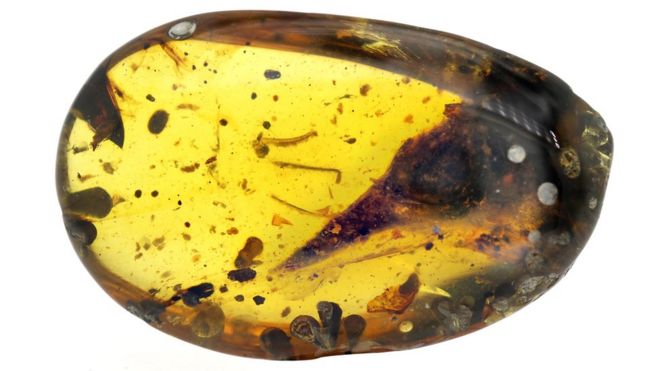
This one was a snappy news story: the tiniest ever dinosaur outside of Aves, the true birds. Oculudentavis khaungraae was found as a complete skull, only half an inch in length, preserved in Burmese amber. Initially it was described as a basal avialan, which is to say, a bird in the broadest sense (how exactly to define a bird is a tricky question), only slightly more advanced than Archaeopteryx (which I still consider closer to the dromaeosauridae than avialae in any case). If it was a bird-like dinosaur, it would have been about the size of a bee hummingbird, which is the smallest bird, and therefore smallest dinosaur, known.

However, as soon as the description was published, a number of palaeontologists pointed out that the odd mix of primitive and advanced features didn't so much look like an unusual bird but a lizard-like reptile, throwing the whole thing into question. A lot of living and extinct lizards have evolved bird-like skulls, and Oculudentavis seems to lack some of the features that define theropods. So sadly, as interesting a find as this is, it's almost certainly not a wee little dinosaur.

MASSOSPONDYLUS

Everyone loves a baby animal, even a long dead one, so here's a piece on the European Synchroton Radiation Facility and their X-ray of a dinosaur nest. The sauropodomorph Massospondylus carinatus left a nest of eggs 200 million years ago, and now we can see the tiny little baby dinos. The embryos were about 60% through their development, and appear to develop in much the same way as both modern reptiles and birds.


Sunday, 14 April 2019

Black Holes and Planetoids

The news has been alight with the first ever image of a black hole, released to the world this week. The black hole was imaged by a 200-strong team at MIT, led by Dr. Katie Bouman, whose face has become known across the world due to her vital role in the research. The Guardian has a great article on Dr. Bouman and her contribution to the creation of the algorithm that created the image.


The algorithm correlated data from the Event Horizon Telescope, a huge array of radio telescopes across the globe, which scan the sky for radio signals indicative of black hole activity, notably from Sagittarius A* - aka the Monster - a huge black hole at the centre of our own Galaxy, and M87*, the equivalent object at the core of Galaxy M87, over 55 million light years away.

The data collection is remarkable in itself, but it would be nothing without the teams of scientists working to interpret it. Dr. Bouman's algorithm is what is responsible for turning the reams of radio data into a visual image. While the image may not look impressive at first, this fuzzy ring of glowing gas is the first image ever of a phenomenon we long thought would never be seen. Until now, no one had ever seen a black hole, or had real proof of one's existence.


To put this image into some context, here's an imaging of the entire region from which the data was collected. The black hole is a tiny speck in a huge region of ionised gas, slowly dragging it all in and releasing energy. The black hole is over six billion times the mass of the Sun.


What's wonderful about this discovery is how many people are sharing it, talking about it and Dr. Bouman, and sharing the image. In our pop culture driven, the image has already become the subject of dozens of memes. Also, be careful if you're heading to New Earth on Doctor Who, that's in the same galaxy, along with all those Macra.

In further space news, the planetary body 2007 OR10, a dwarf planet candidate, has wandered the outer reaches of the solar system without a formal name since its discovery twelve years ago. Although nicknamed "Snow White," the trans-Neptunian body is the largest object in the solar system without a proper name. Meg Schwamb, an assistant scientist at the Gemini Observatory in Hawaii and co-discoverer of the worldlet, makes a good case for why it needs a name here. Her team has narrowed the name list down to three options, and is asking for the public to vote on the final decision.

The names are: Gonggong, a Mandarin name for a Chinese water god; Holle, a Germanic winter goddess and linked to the winter solstice; and Vili, a Nordic deity of Asgard who defeated the giant Ymir and created the Earth. I voted for Gonggong, because it is quite the silliest option of the three. You can read all about the suggestions and cast your vote here.

Saturday, 5 January 2019

At the edge of space

It's been a fascinating couple of weeks out at the furthest reaches of the solar system.

On New Years Day, the spacecraft New Horizons achieved flyby of the distant planetoid Ultima Thule (2014 MU69). You will recall that back in the summer of 2015, New Horizons made the most distant planetary flyby in history when it reached Pluto, taking shots in unprecedented detail. It's spent the last three-and-a-half years travelling ever outward, finally making it to Ultima Thule at a distance of 43 AU, or six light hours. The orbits of the two planetoids cross, and they are favourably positioned to one another during the spacecraft's window of opportunity.

Ultima Thule is a funny little planetoid. It's snowman-shaped, formed when two objects fused in a slow collision billions of years ago. It's nickname refers to a Latin phrase which became the name of the legendary northernmost point of the ancient world. NASA have also named the original planetesimals that came together Ultima and Thule (for the larger and smaller respectively) which is cute. Ultima Thule is only 31 km long at its greatest extent, and is a snapshot of the initial building blocks of the solar system, that came together to form larger planetoids and planets. NASA are now studying the data sent back for information on its composition, surface temperature and geology, and any evidence for rings, moonlets or a cometary coma.

The next destination for New Horizons remains to be seen, but it has power enough to remain operational until around 2030 and should be able to complete a final planetary flyby once a suitable, very distant target has been identified.

New Horizons is the fastest travelling spacecraft (in terms of initial speed) in NASA history, and is even catching up with the earliest space probes that were launched in the 1970s. Voyager 2 left the heliopause, officially entering interstellar space, in November (it's brother Voyager 1, although launched a little later, passed it and reached the threshold earlier). The Voyagers were be joined in interstellar space by New Horizons in the next few decades, as well as the now defunct Pioneer probes. NH will eventually pass the Pioneers (by the 23rd century, which is when Pioneer 10 is due to be destroyed by the Klingons), but will never catch up with the Voyagers.

Also in November, three astronomers (Sheppard, Tholen and Trujillo) observed the most distant trans-Neptunian planetary object ever. Officially designated 2018 VG18, but nicknamed Farout, the object is the first to be detected at a distance of over 100 AU. Currently at a distance of 120 AU, it beats Eris at an observed distance of 96 AU. In terms of average distance though, it is more than double that of Eris, although not nearly the farthest discovered. In 2014, the same team discovered FE72 which has a semi-major axis of a wahopping 1550 AU.

It's a fascinating time to be learning about the very fringes of our solar system.

Saturday, 20 October 2018

The State of the Universe


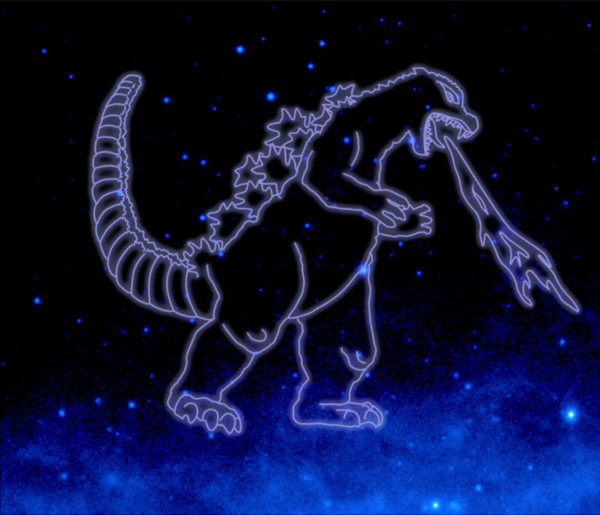
I didn't even realise that there were such things as gamma ray constellations. NASA's Fermi telescope team are creating a map of the sky that groups gamma ray sources - pulsars, black holes and blazars - into handy, recognisable images, just like we have with stars. The difference is that the Fermi team are naming their constellations after pop culture icons, among other recognisable things, including Godzilla (above), the TARDIS and the Starship Enterprise.

This is just one of a number of fascinating developments in astronomy and the space sciences. The wonderfully named BepiColombo has been launched on an Ariane 5 rocket and is headed towards Mercury. This new mission to visit the woefully underexplored innermost planet of the solar system is an historic joint endeavour between the European Space Agency and its Japanese equivalent JAXA. The ship is going to take over five years to spiral towards Mercury (the ESA website has a handy video illustrating the multiple flybys it will take to get there). The long, looping journey is necessary to avoid being pulled into the intense gravity well of the Sun.

The surface of Ryugu
JAXA is on a role, with their asteroidal survey ship Hayabusa2 now happily exploring near-Earth asteroid Ryugu, sending back data, images and even video of the surface. After four years travelling to the asteroid on its orbital path between Earth and Mars, Hayabusa2 will return to Earth carrying samples collected from its four robotic rovers. Three, of the MINERVA-II project and named simply ROVER-1A, 1B and 2, were developed by JAXA, while the Mobile Asteroid Surface Scout (MASCOT) currently charting the unusual geological and magnetic properties of the asteroid was built by a joint German-French initiative. ROVER-1A has taken the first ever images from the surface of an asteroid.

The Planetary Society also worked with JAXA to include messages to be imprinted on a marker that will be left on the surface of the asteroid. There was an opportunity to submit names to be included - my name, along with my brother's and sister's names, are now on Ryugu!

Thursday, 5 April 2018

Beyond the Farthest Star

Astronomer have announced the detection of the farthest individual star so far observed. The star, a blue supergiant (so very luminous indeed), lies over nine billion light years away. This means that the light from the star detected was emitted around 4.5 billion years after the Big Bang, according to the current model.


Now, this might sound like the star is pretty young compared to the Universe itself, and indeed, galaxies have been observed which are estimated to be almost 13 billion light years away, so we are seeing as they formed only hundreds of millions of years after Event One. However, this is the farthest, oldest star that has been detected individually. As with the farthest galaxies, the star has been visualised using gravitational lensing - space-time has been severely curved by high mass objects passing between us and the location of the star (in this case, a galactic cluster, with the lensing compounded by an unknown other mass). This magnifies the star making it bright enough to be detected at huge distances. However, the star is now long dead - blue supergiants have an estimated lifespan of a mere ten million years, a thousand times less than our own sun.


This is an amazing discovery, a combination of great luck and ingenious technique. One thing that does puzzle me is the name, though. Like most astronomical objects, the star has a catalogue designation (MACS J1149+2223 Lensed Star-1, the MACS prefix standing for MAssive Cluster Survey) but has been nicknamed Icarus. It's a nice name, but Icarus is famous for flying too close to the sun. It's a strange choice for the star that is farthest from the sun.

Link for more info

Wednesday, 14 March 2018

Master of the Universe

Stephen Hawking has died, aged 76. When he was 21 and diagnosed with a severe form of motor neurone disease, his doctors gave him two years to live. He sure showed them. Perhaps the greatest theoretical physicist of all time, certainly the most well-known, prolific and gifted physicist of the modern age, he held the Lucasian Chair at Cambridge, formerly held by Sir Isaac Newton, formulated theories of singularities within general relativity, proposed a union of quantum and relativistic physics and proved that black holes emit radiation (now called Hawking radiation).

Hawking would habitually make wagers with his fellow scientists on the most leading edge hypotheses, and would be wrong as often as right. He was never afraid to accept when he was wrong and work on new information to formulate new theories. A firm believer in the Many Worlds Interpretation, Hawking hypothesised multiple pasts for the universe and was still working on ideas at the very edge of understanding when he died. He also had a wicked sense of humour, an eye for the ladies, and was a huge fan of Star Trek and Red Dwarf, like all right-thinking people. The very last contribution he made to popular culture was an appearance as the voice of the Guide Mk. 2 in the latest series of The Hitchhiker's Guide to the Galaxy. He died one week after it was first broadcast.

One of the true greats, who will be remembered for his contributions to science for centuries to come.


Tuesday, 21 November 2017

Oooh, Oumuamua

Now this really is a fascinating discovery. If you've been following the NASA website or other space-related outlets, you'll have seen the news that we have the first confirmed sighting of an object from beyond our solar system. And it is most peculiar.


Spotted by the PANSTARRS, the first interstellar asteroid received the initial designation C/2017 U1, under the understanding it was a comet, and is now named 1I/'Oumuamua, with the initial part designating its unique nature as the first object of its type, and the formal name 'Oumuamua being Hawaiian for "messenger from afar, arriving first." It's utterly unlike any asteroid seen before, being distinctly elongated in a sort-of cigar shape, almost ten times as long as it is wide. In fact, it's a quarter of a mile long, and it travelling 87,000 miles per hour, coming at us from the direction of Vega in Lyra, although it is unlikely it originates there. It has probably been travelling through space for billions of years without coming into contact with another star system. Alternatively, it has been proposed that it was ejected from the stellar nursery in the Carina-Columba Association which would put its origin about 45 million years ago.

'Oumuamua will zip past Saturn in early 2019, but will take about 20,000 years to make it beyond the edges of the solar system. NASA scientists are debating the likelihood of success for a mission to send a probe to analyse the asteroid, but catching it will prove a challenge, as it may move beyond reasonable range before a mission can be developed. It's a tempting target, though, potentially telling us all sorts about the conditions possible in other star systems.

The fact that 'Oumuamua became visible during one of the various times that the catastrophic planet Nibiru is supposed to appear and end all life on Earth has not gone unnoticed, although a quarter of a mile of rock heading away from us is unlikely to cause any problems. It does look like it would make an excellent long-haul spaceship though. Is anyone else thinking Rama would have been a good name?

Monday, 18 September 2017

Twenty years of Cassini

On October 15th, 1997, a Titan IV rocket launched from Cape Canaveral, carrying a Flagship-class spacecraft named Cassini. For just under twenty years, Cassini, and its companion probe Huygens, travelled through space and set up home in the Saturnian system, until it was deliberately crashed into Saturn's atmospheric sea on September 15th, 2017.

A collaborative mission between NASA (who created and launched the orbiter, Cassini), the European Space Agency (who developed the probe Huygens and the bulk of its technology) and the Italian Space Agency (who provided Cassini's telemetry and radiocommunication equipment), the Cassini project took fifteen years to move from initial concept to launch. Originally scheduled to end in 2008, the Cassini mission was extended with the Cassini Equinox mission, and again in 2010, with the Cassini Solstice mission, before it was carefully and deliberately destroyed in its final plunge.

In its early years, the spacecraft made a flyby of Venus, looped back round and took some test photos of Earth's Moon, using the gravity of this flyby to boost towards the outer solar system. After three years in space, Cassini made a flyby of the asteroid Masursky, followed by a flyby of Jupiter, collecting the most detailed images ever of the great planet. While between Jupiter and Saturn, tests were made using radio signals to and from the spacecraft, which further proved the effects predicted by Einstein's theory of gravity. In 2004, Cassini reached its destination, entering Saturnian orbit and passing through the planets outermost rings, taking shots of several moons in the journey. Two new moons - named Methone and Pallene - were discovered, while the spacecraft made flybys of the largest moon, Titan.

At the very beginning of 2005, the Huygens probe landed on Titan, sending back telemetry as it did so. It revealed a world of icy "rocks" and marshes of liquid hydrocarbons, a strange, frozen inversion of Earth, the first time we could look beneath the dense, clouded atmosphere. Over the following years, Cassini continued to travel throughout the Saturnian system, making flybys of moons, and sending back new and surprising data, such as the revelation of water systems on Enceladus. It also sent back some of the most detailed, surprising and beautiful images of the great ringed planet itself. Over the two decades of its service, multiple fixes and adjustments were made by the mission control team remotely from Earth.

To that team, the mission's designers, and the spacecraft itself: I salute you.


The Earth, from Saturn.


See some of the most breathtaking images from the mission here at Vox.com


Monday, 17 July 2017

Star Trek Planetary Classification Guide

The following is based on the planetary classification system used in Gregory Mandell's Star Trek Star Charts and Chris Adamek's variant found at The Final Frontier, themselves based on the planetary classes so far named in televised Star Trek (classes D, H, J, K, L, M, N, T and Y). I've tweaked it considerably, though, to hopefully make it more closely match both what we've seen on screen and the types of planets found in reality. It has also incorporated David Sudarsky's gas giant classification scheme.

The classification scheme used on Trek is based around class-M being an Earth-type planet. In the original series we saw numerous class-M planets that ranged from being virtually identical to the Earth to all manner of oddly hued worlds, but all with a breathable atmosphere (except for Arret, which was described as class-M in spite of having lost its atmosphere). Other than the one class-K planet (Mudd), we hear very little about other classes, but the simple rule remained M = habitable.

From the movies and TNG onwards, more classes were introduced, such as the barely habitable class-H, the gas giant class-J and the barren class-D. The latter has been used very inconsistently, applying to a ringed gas planet in Voyager "Emanations" and the arid but habitable planet in Voyager "Gravity." TNG introduced class-L as a planet with a breathable atmosphere but otherwise unsuited to animal life (at least long-term), but Voyager gave us several class-L planets with humanoid civilisations (in the episodes "Muse" and "The 37s," notably). Over the years, the idea that only class-M planets are habitable has been lost, with Mandell's scheme including various classes that would have been included under M in the original Trek. I've tried to centre the scheme back on class-M here.

Enterprise revealed that M stands for "Minshara," a Vulcan term. TNG "The Royale" featured an obscure "Transjovian" class-K with a thick cold atmosphere, that I've tried to incorporate into the below scheme. The hellish Class Y was created for Voyager "Demon" and appeared a couple of times since, and the Class T ultragiant was featured in Voyager "Good Shepherd." Other classes mentioned over the years, such as Theta-class planetoids, class-9 gas giant and the Klingon Q'tahl class don't fit into this scheme. *  Updated with a new class to contain Essof IV from Star Trek: Discovery, which I've also presumed is the same class as Elba II from the original series. Had to squeeze it in as Class N3 but that'll have to do unless I start importing more letters.

(Images taken from various sources. Classes F, G, H, L, T, V, X and Y rendered by Chris Adamek at The Final Frontier. Classes A and O nicked from Wookiepedia. Classes B, D, E, I, J, K, M, N1, N2, P and Q are all photographs of real planetary bodies. Kudos if you can identify them all.)

Class A
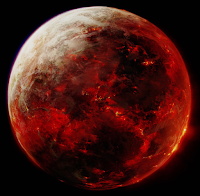
Molten 

Hot zone/lunar orbit

E.g. Gothos
Class A planets are young, rocky planetoids, the surface of which is kept at least 50% molten due to the proximity of the parent star or planet, via direct heating or gravitational effects. The atmosphere is thin, boiled away by the intense heat but replaced by volcanic outgassing. Due to the tenuous nature of the atmosphere, the heat released by the volcanic activity quickly dissipates into space.
Life forms: none


Class B
Ferrous/iron planet

Hot zone/ecosphere
E.g. Mercury, Kepler-10b, Proxima d
Small, mostly metallic rocky planetoids. Class B worlds exhibit a highly iron-rich crust, with a magnetic core and no mantle. Atmosphere thin to negligible, with little to no heat retention. The surface varies from extremely hot to cold dependent on position near star, and can exhibit molten surface areas. The night side of the planetoid will fail to retain the heat exhibited on the day side, left a frigid wasteland. These planetoids are inimical to life.
Life forms: none

Class C
Carbon planet


Hot zone/ecosphere
E.g Janssen (55 Cancri e)
Predominantly carbon-based planet, appearing blackened from orbit due to large deposits of graphite. The pressure within the mantle and outer core produces diamond deposits. The atmosphere is composed primarily of carbon dioxide, rich in hydrocarbons and monoxide smogs. Little to no surface water is to be expected on the surface of a carbon planet.
Life forms: anaerobic carbon-based life may be possible

Class D 
Asteroidal/dwarf 

Hot zone/ecosphere/cold zone/lunar orbit
E.g. Luna, Ceres, Regula, Paan Mokar
Rocky bodies varying in size from the tiniest planetessimal to planet-sized moons. Common around larger planetary bodies and in asteroid belts. Atmosphere tenuous, although water ice can manifest at the poles. Although naturally lifeless, Class D worlds may be adapted through use of pressure domes or oxygen caverns.
Life forms: none.


Class E
Ice dwarf

Cold zone/outer cloud
E.g. Pluto, Eris, Psi 2000
Small, sub-planetary bodies common in the outer star system, in the orbit of Class I planets, through the scattered disc and out into the Oort Belt. With a rocky crust covered in nitrogen ice, and an atmosphere tenuous in the extreme, Class E worlds are incapable of retaining the limited heat they receive from their distant parent star. There may, however, be subsurface water, heated by mantle activity, which can provide the basis for colonisation through pressure domes.
Life forms: rare, microbial.

Class F
Primordial

Hot zone/ecosphere
E.g. Excalbia
Young planets that are still developing, Class F planets represent the earliest stage of the formation of a habitable world. With partially molten surfaces, atmospheres rich in reactive gases and heavy vulcanism, Class F planets are inimical to life like ours, but have, on rare occasions, developed inorganic life, when present in the hot zone and continued in their plastic state for long enough. Those further out will cool over billions of years to become Class G, the next step in their evolution.
Life forms: metal-carbon complex (e.g Excalbian)

Class G
Developing

Hot zone/ecosphere
E.g. Janus VI
With a primarily silicate-based crust, these planets have cooled and solidified from Class F to form a more stable surface, although vulcanism is still rife. Water has begun to condense to form oceans, amid centuries of constant rainfall. The atmosphere and the life that may develop on the surface are intertwined; as the rich carbon dioxide atmosphere allows early photosynthetic life to flourish, these organisms flood the atmosphere with oxygen, pushing towards the next stage in its evolution. Over many millions of years further, these Cambrian-stage planets cool further to become classes H, K, L, M, N, O and P, dependent on various factors.
Life forms: primitive organic or silicon-based life, more rarely advanced silicon-based life (e.g Horta)

Class H
Extreme desert


Hot zone/ecosphere
E.g. Tau Cygna III, Shelia, Nimbus III
Rocky planets with primarily silicate crusts, Class H planets are true desert worlds. With very limited surface and atmospheric water, and high levels of surface radiation, Class H planets are not conducive to complex ecosystems, although hardy life may develop and flourish. Milder Class H environments may be colonised by humanoids with some adaptation. Class M planets can be reduced to Class H through environmental damage.
Life forms: radiation-resistant carbon-based organisms (e.g Sheliak). Not naturally conducive to humanoid life.

Class I
Ice giant/neptunian


Cold zone
E.g. Uranus, Neptune, Marijne VII
Cold worlds with thick atmospheres of hydrogen, water, methane and ammonia, commonly found in the outer reaches of a solar system. The hydrogen envelope is considerably thinner than on a Class J world, but this is still the dominant element of the planet. Such planets commonly attract a number of moons and impressive ring systems. In spite of the name, ice giants have little solid material and are mostly fluid.
Life forms: unknown


Class J
Gas giant/jovian

Ecosphere/cold zone
E.g. Jupiter, Saturn, Cherela
Huge planets with thick hydrogen and helium-based atmospheres, rich in hydrocarbons. Beneath the gaseous layers lies liquid hydrogen above a metallic hydrogen core. Class J planets commonly support many moons and ring systems, and these moons may themselves be habitable worlds in their own right. Class-J planets dominate a star system in the inner region of the cold zone. With sufficient engineering prowess, habitable Class M environments can be constructed between the cloud layers of a gas giant.
Class J planets correspond to classes I to III on the Sudarsky scale. The coolest are Class I jovians, Jupiter-type planets with ammonia clouds, often with complex and powerful weather systems. Warmer are the Class II jovians, which feature water vapour clouds. Class III jovians have no chemical components that form clouds and appear as featureless blue-white orbs.Those straying closer to the star are captured and are heated to Class-S.
Life forms: Jovian-type, hydrocarbon-based (e.g Lothra)

Class K
Adaptable


Ecosphere/cold zone
E.g. Mars, Mudd
Class K planets are essentially dead terrestrial planets, with a primarily silicate crust, rich mineral deposits and no magnetic field. The atmosphere is thin, predominantly carbon dioxide, and retains little heat, leading to a frigid desert landscape. Nonetheless, there can be some weather systems in a Class K atmosphere, and vulcanism can occur. Water and/or carbon dioxide ice may be found at the poles. Class-K environments can develop from the evolution of Class G, or through the long deterioration of classes G, L or M. Rich in mineral deposits. Although fundamentally lifeless except for the most basic of organisms, Class K planets are readily adaptable through use of pressure domes or oxygen caverns, and are prime targets for terraforming.
Life forms: microbial carbon or silicon-based life.

Class K/T
Transjovian

Cold zone
E.g. Theta-116-VIII
This subclass represents frozen class-K planets that have drifted or been expelled into the outer system, commonly by gravitational perturbation by a larger body. A thick atmosphere of nitrogen, neon and methane accretes and can develop turbulent weather systems. Transjovian-class planets are highly inhospitable and experience phenomenally low surface temperatures.
Life forms: none

Class L
Marginal


Ecosphere
E.g. Phylos, Kaijur 12, Kokytos
Similar to Class M planets, Class L are on the borderline of life-bearing environements. Typically rocky, silicate-crust planets, Class L worlds are commonly arid, but in some cases display oceans or tundra. Surface temperature varies considerably, and the atmosphere is thinner than on a Class M world, with high levels of argon, carbon dioxide, and often other toxic gases. Radiation levels are potentially dangerous. Class L environments may feature basic ecosystems, normally only with plant life. They may, however, be colonised by humanoid life, and are excellent targets for terraforming. (Planets assimilated by the Borg, where the atmosphere has been altered by pollution with carbon monoxide, methane and fluorine, may be considered a variant of Class L).
Life forms: Most have no native animal life. Plant life often abundant on more temperate examples.

Class M
Terrestrial 

Ecosphere/lunar orbit
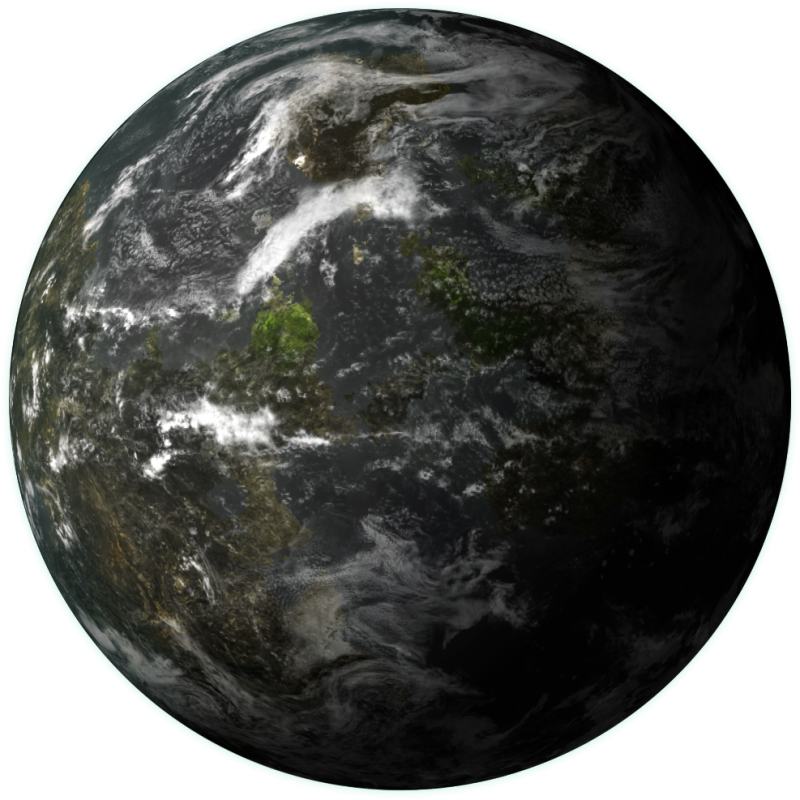
Also referred to as "Earth-type," S3 or Minshara-class, Class M planets are the cradles of life. With silicate crusts, those with rotating iron cores can display strong magnetic fields. Rich nitrogen-oxygen atmospheres with some carbon dioxide, water vapour and trace gases are ideal for the development of varied, complex biospheres. Class M planets feature high surface and atmospheric water content, essential for organic life. Surface conditions can vary considerably across the globe, from tundra, to temperate, to desert environments. Class M worlds are found in orbit of stars or larger Class-I, J and U planets, and can vary widely in visual appearance. Class M is divided into subtypes dependent on surface water levels and other features, and these can vary over the course of a planet's lifespan (for instance, Earth was a Type-4 ice-world during one period of its early history, and Exo-III was once a more hospitable Type-2).
Life forms: abundant carbon-based life, including humanoids
M Type-1 Arid. E.g. Vulcan, Cardassia Prime, Deneb IV, Lambda Paz
Surface water 25-50%
M Type-2 Temperate/varied. E.g. Earth, Bajor, Altamid, Kaminar
Surface water 50-80%
M Type-3 Pelagic. E.g. Argo, Azati Prime, Antede III
Surface water 80-95%
M Type-4 Glacial. E.g. Andoria, Exo-III, Rigel X, Delta Vega
Surface ice 50-95%
M Irregular E.g. Barzan II, Ba'ku planet, Planet Hell, Gaia
Class M but with unusual features, such as, atmospheric variances, radiation belts and ring systems.

Class N1
Reducing

Hot zone
E.g. Venus
Although similar to Class M planets in size and geological make-up, Class N planets are rendered as hugely different environments due to their atmospheric conditions. A thick carbon dioxide atmosphere causes a runaway greenhouse effect leading to extremely high surface temperature and pressure, utterly inimical to humanoid life. Some nitrogen, water and sulphur dioxide exist in the atmosphere, which is dominated by clouds of sulphuric acid, leading to corrosive rainfall. A Class N world may potentially be adapted to class-M by long-term terraforming, but this is a significant undertaking and such planets are usally overlooked in favor of more hospitable worlds.
Life forms: rare; microbial organisms may exist in cloud layer.

Class N2
Sulphuric

Hot zone/lunar orbit
E.g Tholia, Io
A variation of the Class N planet in which a considerably thinner atmosphere, composed mainly of sulphur dioxide and monoxide, sodium chloride vapours and molecular oxygen. Large deposits of sulphur exist on the surface giving a yellow-green colour from orbit. Temperature is lower than N1 conditions, but still high in comparison to Class M, with significant vulcanism caused by gravitational effects from the host planet or star, or by an unstable core. Unlike on N1 worlds, N2 enviroments may develop complex organic life, although such organisms will rely of sulphur respiration and use hydrogen sulphide as a biological solvent in place of water. This life form type is far rarer than the more common oxygen/water type organisms.
Life forms: sulphurphilic organisms (e.g Tholian)

Class N3
Corrosive


Hot zone/ecosphere
E.g. Elba II, Essof IV
Planets with less severe atmospheric effects than classes N1 and N2, Class N3 worlds are still highly dangerous for organic life forms. Displaying variable surface temperatures and pressures, N3 atmospheres are predominantly carbon monoxide, laced with corrosive and reactive chemicals such as sodium perchlorate, rapidly toxic to oxygen-breathing life. However, they are also rich in useful chemicals such as deuterium, and can be used for small habitats using pressure domes.
Life forms: none

Class O
Oceanic

Ecosphere
E.g. The Waters, Megara, Kepler-22 b
True ocean worlds with no surface land area. Oceans on Class O planets are typically thousands of kilometres deep, with phenomenal pressures at the depths. Turbulant atmospheres of nitrogen, oxygen, water vapour and carbon dioxide envelop the planet. On hotter variants of the Class O, the ocean surface may vapourise, giving a continuous fluid surface, rather than a delineated ocean and atmosphere, on the edge of becoming a Class U world.. Cooler Class O worlds can potentially be colonised with artificial habitats, and have considerable scope for food cultivation in the form of plankton and algae.
Life forms: abundant, marine carbon-based organisms.

Class P
Cryoterrestrial

Cold zone/lunar orbit
E.g. Titan, Breen
Similar in size and structure to Class M planets, but in far colder regions, Class P planetoids display enivronments that are like frigid shadows of  terrestrial worlds. With a dense nitrogen-methane atmospheres, and surface rich in hydrocarbons, the seas and oceans on Class P worlds are comprised from short-chain hydrocarbons such as methane and ethane. In place of rock, mountains and landmasses form from water ice; cryovolcanism is apparent. These planetoids display a subzero ecosystem. In the later stages of a star's evolution, Class P worlds may be heated to another evolutionary stage, dooming existing ecosystems and pushing the planetoid towards classes K, L or M.
Life forms: hydrocarbon and ammonia-based

Class Q
Cryo-ocean

Cold zone/lunar orbit
E.g. Europa, Ganymede, Enceladus
Ocean worlds in colder regions, these are smaller planetoids enclosed in thick water ice crusts. Atmosphere is tenuous, beneath the ice layer exists an extremely deep ocean. Undersea heating from the planetary core, or gravitational effects from a host planet, can lead to non-photsynthetic ecosystems. Commonly form as moons around planets of classes I, J and U. Can potentially be colonised with artificial habitats, although care must be taken not to damage the existing, submarine environment.
Life forms: marine carbon-based organisms

Class R
Rogue/orphan planet

Interstellar
E.g. Dakala, Omarion
A varied class, containing those bodies that are planet-sized but not tied to a star's gravity. Such bodies, sometimes called planemos, can range from terrestrial to Jovian size; the largest are on the borderline with the brown dwarf class. Rogue planets form in the interstellar void from accreted material, while orphan planets are ejected from star systems by gravitational effects. Thick, carbon-rich atmospheres can lead to retained surface heat and non-photosynthetic ecosystems, sometimes displaying very unusual adaptations to their harsh environment.
Life forms: varies, from none to complex; carbon or silicon-based

Class S
Hot jovian/pegasid


Hot zone
E.g. Galileo (55 Cancri b), Osiris, 51 Pegasi b
Gas giants, similar to classes I and J but in short, close stellar orbit, maintaining an extremely high temperature. Carbon monoxide is the dominant carbon-carrying molecule. Class S planets correspond to classes IV and V on the Sudarsky scale, with Class IV being the cooler of the two, displaying alkali metal vapour clouds. The hottest planets are Class V, with silicates and even iron forming clouds. These planets glow red due to the high thermal output.
Life forms: none known

Class T
Gas supergiant/ultragiant

Cold zone
E.g. Kappa Andromedae b
Gigantic gaseous planets with thick hydrogen atmospheres and enormous gravitational pull, these planets are on the verge of becoming stars. Supergiants accrue complex systems of moons ranging from planetesimal to planetary size, effectively becoming miniature star systems in themselves. Any such bodies that exceed 13.6 Jupiter masses would begin deuterium fusion and become a brown dwarf or "substar."
Life forms: unknown


Class U
Transitional


Hot zone/ecosphere/cold zone
E.g, Dulcinea (Mu Arae c), Kepler-10c
Existing in size between the Class I ice giants and the Class V superterrestrials, Class U planets are large enough and with strong enough gravity to retain a thick atmosphere of hydrogen, helium and hydrocarbons. The atmosphere transitions to oceans of semisolid compressed water above a rocky core. Sometimes known as gas dwarfs - something of a misnomer for such large planets.
Life forms: Jovian-type, hydrocarbon-based.


Class V
Superterrestrial

Ecosphere/cold zone
E.g. COROT-7 b, Gliese 163 c, Persephone
The so-called "super-Earths," large rocky/metallic planets intermediate in size between terrestrial and ice giants. Their higher gravity allows them to retain dense, hydrogen-rich atmospheres. Surface temperature and pressure high and unsuitable for humanoid habitation, but complex high-temperature life can evolve, and they are potentially viable for colonisation using pressure domes.
Life forms: silicon or carbon-based, adapted for higher pressures


Class W
Divided/locked

Hot zone/ecosphere/lunar orbit
E.g. Daled IV, Klavdia III, Remus
Rocky planets kept tidally locked to the parent star or sister planet by the intense gravitational interaction of other bodies in their system. One side is overlit and heated, displaying molten areas and a burnt, desert-like surface. The far side is kept in perpetual darkness and cold, sometimes with a more temperate dividing line if the atmosphere is dense enough to mediate the heat. Such planets may be colonised, and some display native life that has adapted to the extreme environment, often in unusual ways.
Life forms: microbes and plants, some display higher organisms.

Class X
Chthonian

Hot zone
E.g. COROT-7b
The dead core of a Class-S or T planet, stripped of its atmosphere by millennia of stellar activity. Dense and metal-rich, these planetoids are rare and valuable. Uninhabitable and ultimately doomed to absorption by their parent star.
Life forms: none


Class Y
Demon-class

Hot zone
E.g. Ha'dara, Theta Zeta
Exceedingly unfriendly, these planets display thick atmospheres rich in toxic gases, high radiation levels, extreme surface pressure and corrosive conditions, even harsher than Class-N planets.
Life forms: rare, but mimetic life has been discovered.


Class Z
Pulsar planet
E.g. Draugr, Poltergeist, Phobetor
Planets found in orbit of pulsars (rapidly rotating neutron stars), bathed in intense magnetic radiation and inimical to all known life. Subdivided by origin, pulsar planets may form from the remains or cores of destroyed companion stars, or may be more ordinary planetoids captured by the pulsar's gravity.

Thursday, 2 March 2017

FILM REVIEW: Hidden Figures

It's hard, as a British person in the 21st century, to understand how many American states remained racially segregated until the latter half of the twentieth. That's not to say racism and illegal segregation don't exist today, or where I live, but the widespread and legally enforced separation of black and white populations has never existed here. The echoes of racial segregation can be seen throughout the United States today, and this is hardly surprising, considering that it was a simple matter of fact for so many people still alive today. While racial segregation is now illegal in the US, we can already see a modern form of segregation, against same-sex couples and transgender individuals, taking shape under the guise of "religious freedom laws." They're even trying to keep people from using public toilets again.

So Hidden Figures is a timely piece, both last year's bestseller by Margot Lee Shetterley and this new film adaptation. I confess to not having read the book (yet, it's now high on my too-read list), but the film was something I was eager to see as soon as I heard about it. Part of this was down to the excellent cast, but mostly it was a desire to see an underexplored side to the space race, a major part of 20th century history which has always held a fascination for me.

Hidden Figures centres around three African American women, working for NASA in 1961, on the eve of manned spaceflight. Katherine Goble (nee Coleman, later Johnson), played by Taraji P. Henson, was and is a remarkable woman who displayed one of the finest mathematical brains of the 20th century. (Katherine Johnson, now 98-years-old and described by all who meet her as "sharp as ever," received the Presidential Medal of Freedom two years ago and attended this year's tumultous Oscars with Henson.) Katherine is the central character of the film, but a great deal of focus is also given to her friends and colleagues, Mary Jackson and Dorothy Vaughan. Jackson, played by Janelle Monae, was one of the most notable engineers at NASA and a tireless advocate for equal workplace rights. Vaughan, played by Octavia Spencer, taught herself computer programming language and became a frontrunner in the field of computing. They were, respectively, the first black female engineer and supervisor at NASA. Of the three, I was previously aware of Vaughan and Goble/Johnson, but I hadn't heard of Mary Jackson until watching the film.

The cast are uniformly excellent. As well as the three leads, the cast includes Kevin Costner as the director of the Space Task Group, Kirsten Dunst as Vaughan's departmental supervisor, and Mahershala Ali as Jim Johnson, Katherine's suitor and then husband. Although given relatively little screentime, Ali is magnetic, and it's hardly a surprise to me that he was become the first Muslim actor to win an Oscar (for Moonlight, one of my must-sees for March). There's also a role for the now ubiquitous Jim Parsons's, as chief engineer Paul Stafford, who comes across as a straight version of his usual cerebral, socially inept characters. Glen Powell is suitably charismatic as the legendary astronaut John Glenn, albeit reduced in age somewhat for the film.


For all the support they have from the wider cast, though, the strength of the film lies with the leading actresses, in particular Taraji P. Henson. She grounds the film with a performance that paints Goble as both an exceptionally gifted woman and a very straightforward one, someone who is both down-to-earth and looking to the stars. Janelle Monae adds a sassier, sexier side as the highly intelligent engineer Jackson, displaying a refusal to ever submit to the unfair treatment of her state, while Octavia Spencer makes Vaughan the most fundamentally likeable of the trio, coming across as a quietly brilliant and highly compassionate woman. Both Jackson and Vaughan are portrayed as more ambitious than Goble, who is simply so remarkably intelligent that it is ludicrous that she shouldn't be included in the most important meetings of the Mercury programme, and proves herself indispensible.

This was a time when the word computer meant someone who sat and performed calculations with pencil and paper. In a time when we each carry a supercomputer in our pocket and there's serious talk about private leisure flights to the Moon, it's amazing to see the first men travel to space, and the very first, cutting-edge IBM systems installed at NASA (taking up a huge office space). But it's the attitudes that are the most alien. A big chunk of the film is taken up with Goble's treks across the NASA grounds to find a toilet she is allowed to use, a drawn out, repetitive sequence that hammers home both the tragedy and absurdity of the situation. Jackson has to petition to be allowed to attend an all-white college in order to gain the qualification necessary to apply to become an engineer. Black people live in fear of being stopped by a white policeman, unsure what will happen if they say the wrong thing... well. maybe some things haven't changed.

A film like this is bound to romanticise the facts somewhat. Even a little surface research shows that the screenwriters have altered the facts somewhat. The three women had already made significant strides in their careers by 1961, but aligning these events with the first manned spaceflights makes it all the more momentous. John Glenn really did insist that Goble check the calculations before he made his first orbital flight aboard Friendship 7, but it wasn't the breakneck, white knuckle rush that it's portrayed as here. Most notably, it was Mary Jackson who had to trek across campus to find a washroom, not Katherine Goble. She just used whichever lavatory she pleased. In reality, it seems that NASA, although far from perfect, was more equitable than is shown here. Nonetheless, the film works, because even if the facts don't quite align with what we see, it's making an important point. NASA may have been making strides forward, but America as a whole was lagging behind. The events play out against a background of civil rights protests and violent repurcussions. This was the society these women lived in.

While it tweaks events, the script doesn't play too loose with established facts. I was pleased to see that Alan Shepherd and Gus Grissom got their dues as the first and second Americans in space, before the glamour of Glenn's 1962 orbital mission. (Legendary as he is, there are those who erroneously think Glenn was the first man in space; he was the fifth.) It's a pity we couldn't hang on a little longer for the flight of Valentina Tereshkova, the first woman in space, but that would stretch the narrative out to mid-1963. While dominated at points by these world-changing events, this is a very human story, and as much is made of Goble's personal life and her romance with Jim Johnson as the mathematics, space flights and social upheaval. Genuinely excellent, this is a must-see.


Thursday, 23 February 2017

The Worlds of TRAPPIST-1

The internet is alight with people sharing the news of NASA's latest announcement. After teasing us with talk of a discovery "beyond the solar system," NASA announced the existence of a seven-planet star system located less than forty light years away. What's most exciting about the discovery is that most of the planets are considered potential habitats for life.

The star known as TRAPPIST-1 is, like many modern stellar discoveries, named after the device used to detect it, in this case, the TRAnsiting Planets and Planetesimals Small Telescope in Chile. You may notice that this doesn't quite spell out TRAPPIST, but the inventors are obviously Belgian beer fans and I can support that. Located 39 light years away in Aquarius, TRAPPIST-1 is described as an ultra-cool dwarf star, on the borderline of a red dwarf and a sub-stellar brown dwarf. Three planets were discovered there and announced back in 2015, and since then, the NASA Spitzer telescope and the Very Large Telescope at Paranal have detected four more. The extent of the system was announced last night (Feb 22nd).

In spite of being such a cool, dim star, TRAPPIST-1 may make an effective sun for life-bearing planets due to their extremely close orbits. All seven known planets orbit the star closer than Mercury orbits the Sun, and at least three of them are considered right within the system's habitable zone. This makes the planets astonishingly close together; the first and second planets are only slightly further apart than the Earth and the Moon. Finally, elaborate skies hanging with enormous sister planets can be considered a reality, not just science fiction. 


OK, this is Vulcan, but you get the idea


The planets are named TRAPPIST-1b through to -1h, and, unusually for discoveries of this type, are labelled in order of distance from their star. Each of them is within Earthlike mass and radius, with at least three of them estimated as being smaller than the Earth, and all are considered to be rocky, terrestrial-type planets. TRAPPIST-1b and -1c are the closest, with featureless spectra that indicates either a cloudless, water vapour dominated atmosphere, or a thicker, Venus-type atmosphere. They most likely lost the bulk of their surface water while their star was still cooling, and are less likely as abodes for life. TRAPPIST-1d is more likely habitable, although still closer than the calculated Goldilocks zone. TRAPPIST-1e, -1f and -1g are right within this zone, and are probably fairly cool in comparison to their inner brethren, far more likely to hold liquid water, Depending on the thickness of the atmosphere, they may be cooler than the Earth, or more comfortably terrestrial. TRAPPIST-1h is less well analysed so far, but is likely cold and less hospitable.

While the relative positions of planets to the star suggest potentially life-supporting temperatures, we shouldn't jump to conclusions. As always, Earthlike is a relative term. Red dwarf stars, let alone ultra-cool dwarfs, are debatable as life-supporting stars, due to the extreme proximity of their planets. The year on these planets will be very rapid, in the manner of a few days (-1b's year lasts only a day-and-a-half in Earth terms, with -1h at no more than 35 days, probably less). They are also likely to be tidally locked, with one side of each planet permanently facing the star. Both facts would lead to extreme weather conditions on the surface. Equally, radiation from the star, including X-rays and extreme energy ultraviolet radiation, would bombard the planets constantly at that proximity, depleting the atmospheres and making it harder for life to form.

Still, there is reason to hope. Even if the planets are lifeless now, they may not be always. Stars' longevity is inversely proportional to their size and temperature, and an ultra-cool dwarf like TRAPPIST-1 is likely to last a thousand times as long as the Sun, remaining stable for trillions of years. TRAPPIST-1 is estimated at only 500 million years old at present, but it could become a host for life for many thousands of millions of years in the future. 


Click the link here for NASA's announcement and an artist's impression of planet TRAPPIST-1d.


Sunday, 11 September 2016

Mission to...

Two exciting space travel updates from the 8th of September - nicely timed to coincide with Star Trek's big anniversary.

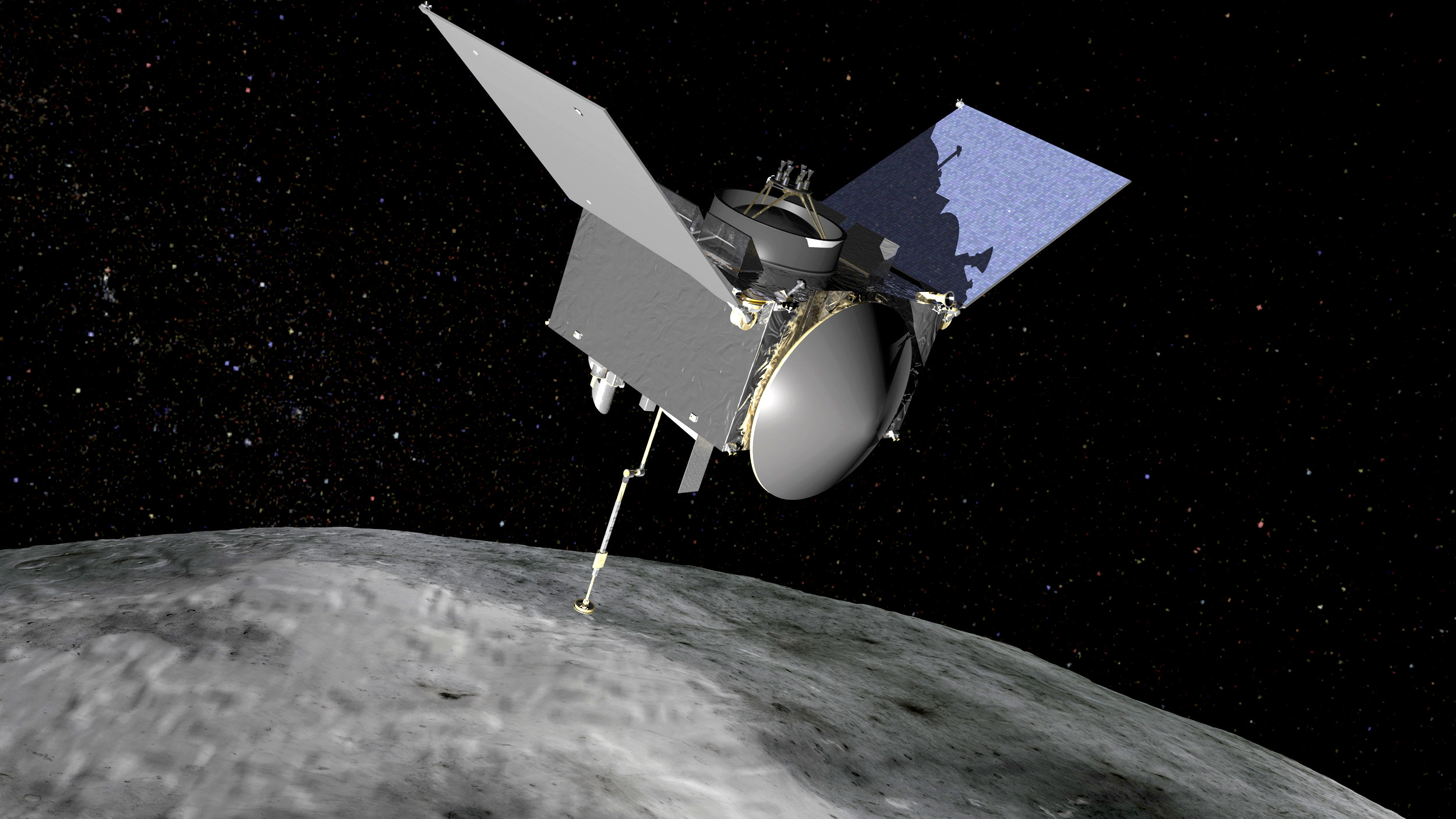
NASA has successfully launched its latest spacecraft and begun the OSIRIS-REx mission. In a spectacular triumph for contrived acronyms, the Origins, Spectral Interpretation, Resource Identification, Security, Regolith Explorer is now underway. The eponymous spacecraft is an unmanned robotic probe, which was launched via an Atlas V rocket from Cape Canaveral, will journey to the near-Earth Apollo asteroid Bennu, with which it is expected to rendezvous in 2018. Once there, it will begin 500 days of surface charting and ultimately will extend a robotic limb to begin sampling the asteroid's material. OSIRIS-REx is programmed to finally return to Earth in 2023.

Bennu is a carbonaceous asteroid that was chosen for its proximity to Earth at present. A primordial object, the materials gathered from the asteroid should shed light on the makeup of the Solar Sytem during its initial formation, almsot five billion years ago. The organic nature of the asteroid should help indicate how the early ingredients of life came to arrive on the primeval Earth. This is the third of NASA's New Frontiers programme, following Juno (currently in Jovian orbit) and New Horizons (speeding towrds the Kuiper Belt).


Artist's interpretation of OSIRIS-REx approaching Bennu


Bennu was named by a young lad named Michael Puzio, who won out over about eight thousands entrants in a "Name That Asteroid!" competition run by the University of Arizona and the Planetary Society. Bennu was a solar deity in early Egyptian mythology, a phoenix-heron that renewed itself in fire. A fine name for an inner-system asteroid. OSIRIS-REx, aside from the excellent acronym, was chosen because Bennu is a potential Earth impactor and Osiris was the Egyptian lord of the dead. So that's cheerful.

Shortly before OSIRIS-REx blasted off, Virgin Galactic completed their first test flight of the VSS Unity. This was the first flight undertaken by VG since the disaster that destroyed the Enterprise two years ago. Unity is the second of VG's SpaceShipTwo-class spaceplanes, launched, as with its predecessor, from the carrier vessel VMS Eve. It was expected that Unity would be named VSS Voyager, however the eventual name was chosen by Prof. Stephen Hawking. Unity was piloted by Mark Stucky and Dave Mackay, and by all accounts, it was a perfect test flight. Hopefully, Unity will do what Enterprise failed to do and make it into sub-orbital flight and become a true spacecraft.


Shot of the VSS Unity taken by the crew of the VMS Eve


Read about OSIRIS-REx
Read about Unity

Wednesday, 27 April 2016

Moon of Makemake

Astronomers working with the Hubble Space Telescope have announced the discovery of a satellite the dwarf planet Makemake. As yet, the moon is unnamed, having the provisional designation S/2015 (136472) 1, which refers to its year of initial observation and its position orbiting Makemake. Currently, the team have nicknamed it MK 2, although an official name will be chosen in time, most likely in connection with the Rapa Nui mythology from which Makemake is taken.

Makemake is one of five confirmed dwarf planets in the Solar System, one of four which exist in the outer part of the system, along with Pluto, Haumea and Eris. It is very like Pluto, being about two-thirds its size, and like Pluto, has an extremely bright surface. MK 2, on the other hand, is much smaller, and extremely dark. Along with its orbit, which is thought to be aligned edge-on to the Earth and its observatories, this has made it very hard to make out within the glare of its parent body.

The presence of a satellite will, as with Pluto, make measurements of Makemake easier and more accurate. It seems likely that such satellites are common among outer system planetoids. All four outer system dwarf planets are now known to have at least one satellite: Eris has Dysnomia, Haumea has Hi'iaka and Namaka, Pluto has Charon, Nyx, Hydra, Kerberos and Styx, and Makemake has MK 2. Most of the likely dwarf planet candidates in the outer Solar System, including Quaoar, Orcus, Salacia, Varda, also have moons. It appears to be an extremely busy place.

The full article from Hubble is here.