Showing posts with label Fifth Doctor. Show all posts

Tuesday, 27 June 2023

WHO REVIEW: Once and Future 1 & 2

 There's something a little underwhelming about Big Finish's latest multi-instalment extravaganza, put together to mark Doctor Who's sixtieth anniversary. A story involving the Doctor in multiple incarnations, meeting friends and enemies in unexpected combinations sonds like the very thing to mark the occasion, but it's also exactly what Big Finish has been churning out in quantity for the last few years. With the company now given over to almost pure nostalgia, this is business as usual. I bought the first two releases almost out of a sense of obligation, rather than expecting anything new.

Admittedly, the idea of having the Doctor pushed back through his lives in a catastrophic "degeneration" is a fun one, and a good way of having multiple Doctors involved without just having them taken out of time or just bump into each other as they usually do. For real impact, though, this should be the current Doctor - indeed, setting this right after "The Power of the Doctor," with the Doctor regenerating back into David Tennant and then through all their past lives would tie in beautifully - but BF aren't allowed to do that. Instead, this is during the Time War, and we're not even clear on which Doctor has been injured. (It seems that it's probably the Eighth, going by the TARDIS sound effects and McGann's notable absence, but this isn't certain.)

It's also one of those conceits that would work better on screen than, in which case it would look essentially the same as the mysterious guardians of the Doctor's subconscious in the aforementioned "Power." On audio, there's just about enough variation between the different actors' voices for the incarnations to differentiate, with only Tom Baker and McCoy really distinctive enough from a single line to truly stand out. I also can't help but wonder: what's he wearing? Are his clothes changing too, or is he repeatedly regenerating while wearing the same, now doubt rather careworn, outfit?

PAST LIVES


First up is this episode from Robert Valentine, which does precisely what you'd expect it to. The Doctor settles on the form of Tom Baker, arriving back on Earth on the trail of the Monk, who he's sure has something to do with all this. (What the Doctor can and cannot remember seems to change per scene in this series.) For his own benefit, the Monk has abducted Sarah Jane, straight from her mistaken drop-off point in Glasgow, mere moments after The Hand of Fear. This is a nice touch, albeit one that plays merry hell with established contintuity, but that doesn't seem to be much of a priority with this series, and rightly so.

Rufus Hound is entertaining as always as the Monk, and Sadie Miller continues to do a good job of filling her mother's shoes as Sarah Jane. UNIT get involved, with both Jenna Redgrave and Ingrid Oliver returning as Kate Stewart and Osgood. While it's fun to hear this collection of characters together, there's really nothing else to it. A group of the most generic aliens you could hope to avoid turn up and cause complications, and the entire thing unfolds predictably. "Past Lives" just about works as the launch to a series, leaving us with more questions than answers, but barely works as an adventure in its own right,

THE ARTIST AT THE END OF TIME


The second episode, written by the reliable James Goss, is far better, giving us an original concept as the basis for the story. In the twilight days of the universe, a high-end art gallery displays works cribbed from civilisations in their final moments. Only it seems to be that, quite impossibly, they're all by the same artist. The Doctor, settling on his cricketiest form, arrives looking for a Time Lord so he can sample some DNA (buy them a drink first), and his clone-ish daughter Jenny arrives on the trail of the mystery of the artworks.

There are two big draws for this release. One is having real-life father and daughter Peter Davison and Georgia Tennant playing fictitious father and daughter together. Unfortunately, Big Finish already did that, ten years ago, for their fiftieth anniversary release. As you might expect, the two of them have wonderful chemistry together, and Davison's perfected older, grumpier version of his Doctor works well with the fast-witted, enthusiastic Jenny. Yet it again feels so predictable, bringing them together on the basis that, well, that's what we do for the anniversary, right?

The other draw is the inclusion of the Curator, played here by Colin Baker, giving us not one, but two, classic Who actors in the role. Given that the whole point of this series is that the Doctor is jumpig between faces, having Baker the Second in here as well seems a bit superfluous. Fortunately, the story makes it worthwhile, giving us a truly intriguing and affecting tale of the Doctor's far, far off future. This is seemingly a long way beyond the days when he was even calling himself Curator, now retired at the end of time and painting planets as they are about to bite the dust. Baker gives a lovely, melancholy performance that's similar to, but distinct from, the Sixth Doctor.

Again, there are oddities to ponder. I'm fine with the idea that the Curator varies his appearance over time, either by regenerating again or simply picking a face for the week, but shouldn't the Doctor recognise that face? Given that this is seemingly the Eighth (or later) Doctor, just wearing the face of the Fifth, isn't he surprised to meet someone wearing the face of the Sixth? Also befuddling is that the Doctor is now fully aware of his daughter's existence, again bringing into question when this takes place for him, or just how memory is supposed to work in these stories.

Quibbles aside, though, "The Artist at the End of Time" is a strong story, giving apocalyptic stakes in the most genteel, personal way. On this basis, I think I'll give the third episode a try, but whether I can be persuaded to stay for the whole story is another question.

Thursday, 17 June 2021

WHO REVIEW ROUND-UP: The Gates of Hell (Out of Time 2)

The first volume in the Out of Time trilogy gave us the irresistible team-up of Tom Baker and David Tennant. Now we get something we've seen before: Tennant teaming up with Peter Davison. The last time, way back in autumn 2008 (which seems like yesterday but was actually almost thirteen ruddy years ago), there was a wonderful frisson from having Tennant meet his favourite Doctor on screen. In "Time Crash" Tennant was clearly sharing the screen with his hero, remaking his role as his own and paying tribute to it (along with a script from Steven Moffat, who also cites Davison as his favourite Doctor). Now, though, there's even more of a buzz to it: for the first time, father-in-law and son-in-law share a Doctor Who adventure playing their own versions of the same character.

As such, there's a different feel to The Gates of Hell than to "Time Crash." This is two men who know each other well, playing off each other in a familiar, comfortable way. Both are, by now, so well established as their Doctors that they slip effortlessly into the roles. It all feels terribly cosy.

Nonetheless, this is a better story than Out of Time. David Llewellyn provides a gripping script that utilises the Cybermen effectively (and after the Daleks last time, it was inevitably going to be the Cybermen). The Cybermen are basically a technological version of the living dead, so putting them in a crypt - the catacombs beneath Paris - just works, the same way that having them stomp through graveyards in "The Next Doctor" worked, or having them emerge from graves in "Death in Heaven" did. Cleverly, he uses the two Doctors overlapping timelines as a threat, rather than an awkward social situation, with the collision of two timestreams destabilising history and allowing the Cybermen to rework history to their own design. We end up exploring Paris in various periods of history, from the 14th century to the French resistance, as the Doctors try to undo the damage to the timeline.

Llewellyn's not afraid to chuck in a few fanwanky references. It's fun that the two Doctors remember meeting each other in "Time Crash," and, being in Paris, we could expect the Doctor to reminisce about visiting the city with Romana. I wasn't expecting the Fifth Doctor to mention his previous self's visit to the catacombs in the comic series The Forgotten, though. 

The guest cast in this one are very good, with Mark Gatiss putting in an insidious turn as the villainous Joseph Delon. Glen McReady does a fine job as both his father Marcel and King Charles the Mad. With Gatiss being one of the core group of Doctor Who writers and performers, both for Big Finish and on television, and McCready being a prolific BF semi-regular, it's a bit of an inside gig and a boy's club - and that's before you factor in Nick Briggs, the company's director, once again voicing the monsters. Thank goodness, then, that we have one significant female guest role, and someone pretty new in the role. Shelley Conn has been in one BF release before - Situtation Vacant, eleven years ago - but by BF standards that's practically unheard. Her character, time agent Tina Drake, makes a very likeable pseudo-companion. The only thing that was slightly off-putting was her faux-American accent - not because it was particularly bad, but because it sounds almost exactly like Nicola Bryant's in some scenes, and when the episode opened I just assumed Peri was travelling with the Doctor.

Altogether, a solid bit of Cyber-action, livened up by the interplay between the two Doctors. 


Placement: Both Doctors are travelling alone, and both remember the events of "Time Crash." The Tenth Doctor seems to imply this wasn't too long ago for him, so probably between "Voyage of the Damned" and "Partners in Crime." Finding any alone time for the Fifth Doctor is a challenge, but The Compleat Adventures suggest a gap between The Awakening and Frontios where these stories can happen and that'll do (unless the Doctor really does bugger off for years while he's meant to be dropping off the Gravis).

Monday, 23 March 2020

Who Novelisation Quest 5: "The Five Doctors" by Terrance Dicks

1983 cover
The Five Doctors is unique among the Target novelisations in being written and released before the serial it was based on reached the screen. This must have been an odd experience for the fans looking forward to the series' twentieth anniversary, able to read the story and get the main events before seeing the episode itself. On the other hand, it's not much different to my experience of the TV special, seeing that I'd absorbed most of the stories from programme guides before I saw them.

It isn't the strongest of Dicks's novelisations, but given that he had to speed-write this to meet the deadline, it's pretty solid. It was never the most logical of his scripts in the first place, unsurprising given his remit to include as many Doctors, companions and monsters as possible and then having to rewrite this to suit who was available. Given this, it's odd that the novelisation doesn't differ more from the televised version. Why not take the opportunity to go back to the earlier version of the script, and bring the Fourth Doctor into the story fully? Why not include more faces from the past, without the restrictions of actor availability?

1991 cover
Perhaps that would be asking too much of Dicks when rushing something to completion with such a difficult brief. There are some shifts in the story, mostly a few minor scenes reintroduced or moved around, and even this mainly brings the story more in-line with the later Special Edition video release. There are a few little asides that are noteworthy: the First Doctor being near the end of his life is particularly intriguing, given his tightly-packed adventures on screen. I dislike the insistence of having Susan call the Doctor by that title, rather than Grandfather, which Carole Ann Ford rightfully insisted on when filming the special, even if there is a flimsy justification in the prose. (Basically, everyone else calls him that, so she does too.)

The Five Doctors was a bit of silly anniversary fun, and the novelisation is no different. Even a speed-written Doctor Who story by Terrance Dicks is effortlessly entertaining. It's a pleasure to read.


Data: 
First published by W. H. Allen (Target imprint) in 1983
Based on The Five Doctors, first broadcast in 1983
Audiobook read by Jon Culshaw, with Nicholas Briggs as the Cybermen and Dalek

Tuesday, 6 August 2019

WHO REVIEW: The Legacy of Time


While Big Finish Productions started producing audioplays in 1998 (with the adaptation of the Bernice Summerfield New Adventure Oh No It Isn't!), it was in July 1999 that the released their first Doctor Who production, The Sirens of Time, on CD and audio cassette. Twenty years later, when even CDs seem a bit archaic and most people download their purchases, BF has released their own anniversary celebratory box set featuring a spread of Doctors, companions, favourite characters and time-twisting shenanigans. SPOILERS will follow in this review of the gigantic six-hour collection.


I've been a bit disappointed in BF's reliance on the same handful of writers and recurring cast, it makes sense for an event project to be placed in reliable hands. Ken Bentley directs all but one episode and by its nature, this features a host of recognisable voices playing familiar characters. The set involves six very separate stories which are linked by a general theme of things going wrong with time, all of which are eventually linked together in a just-about coherent fashion. The overall plot is basically irrelevant, though – the fun is in the individual adventures and the cross-pollination of various Doctors and spin-off casts.

LIES IN RUINS by James Goss

The set kicks off, appropriately enough, with Bernice Summerfield hard at work in the field. She's joined by River Song, who has of late been enjoying her own series of adventures in The Diary of River Song, where she has encountered various incarnations of the Doctor, and latterly, the Master, in flagrant defiance of continuity or logic. Given that River is essentially a combination of the two great heroines of the Wilderness Years, Benny Summerfield and Iris Wildthyme, it makes sense that she should finally meet one of them. (River meets Iris is one story that I'm dying to hear.)

Having two time-travelling archaeologists could have been an exercise in redundancy, but Alex Kingston and Lisa Bowerman have a great chemistry that balances finely between catty one-upmanship and bawdy companionship. It's a bit like when Rose and Sarah Jane fought over the tenth Doctor, only to bond over their mutual experiences of travelling with him. River has one up on Benny, having actually married the Doctor rather than simply been very good friends indeed, but they rub along together surprisingly well once the Doctor turns up.

The eighth Doctor is the version who arrives in the story, but he's not the version either Benny or River remember. Benny, of course, mostly encountered this Doctor in the earlier days of his life, while River, while meeting him in the latter years, still found him in generally good spirits. This is a tired, angry Doctor, though, one who's very, very close to becoming the Doctor of War. When confronted by a very personal threat, he comes closer than ever before to turning the corner from hero to warrior. It's not merely their shared affection for the Doctor that brings River and Benny together though, but also their mutual dislike of his new companion, the impossibly bubbly Ria (named for the companion in the old, pre-BF Audio Visuals range, and played with rambunctious energy by Alexandria Riley).

As good as the ladies are, though, it's Paul McGann's performance that really blows the competition away. This is a Doctor who's lost his faith in the universe after seeing it torn apart in the Time War, who, in the words of River, has lived a very long time indeed. It's a funny thing that the Doctor we saw the least of on TV (of the main incarnations) is the one whose borne one of the longest and most traumatic lives.

THE SPLIT INFINITIVE by John Dorney

The second story jumps back an incarnation for a story that sees characters from the eighties during the sixties and seventies. BF's Countermeasures series – one I haven't explored much, unlike The Diary of River Song – has featured the special operations team from 1988's Remembrance of the Daleks, in their natural home of the 1960s, and latterly regrouped in the 1970s. “The Split Infinitive” hedges its bets by being set in both decades, utilising the running concept of time anomalies to tie the two periods together in ingenious fashion. Cue lines along the lines of “meanwhile, ten years earlier...” as events in one period influence the other and vice versa.

Sly McCoy rrrrollls and rrroarrs through the adventure, while Ace hops back and takes care of events in the further past. They're both completely at ease in their characters after all these years, although McCoy's performance is still as idiosyncratic as ever. The Countermeasures team are a solid troop of characters, but it's Pamela Salem's Professor Jensen who stands out for me – she's an actress of pure class. Dorney's script brings in the Rocketmen, BF's own brand of recurring space gangsters, who work perfectly in the retro setting, although they are a bit too similar to the also-ran baddies that appear in the first episode. There is, however, a gorgeous joke put in just to explain the unending nonsense around UNIT dating.

THE SACRIFICE OF JO GRANT by Guy Adams

Episode three is an exercise in nostalgia, one that could have been saccharine but is actually rather beautiful and moving. BF's UNIT series is another one that's been going for donkey's years, on and off, and lately has been updated to include not only the Moffat-era UNIT team of Kate Stewart and Osgood, but also Katy Manning as Jo Jones. This (slightly misnomered) episode sees Mrs Jones and Ms Stewart pulled back in time to the Pertwee era.

As with “The Split Infinitive,” this episode involves a story split across two points in history, this time on the Jurassic coast. Yes, there are great sea dragons wrenched from prehistory by the temporal disturbances (good idea, that). Plot is secondary here, though, with this story hinging on the emotional interplay between the characters. I certainly didn't expect a highlight of this box set to be the Doctor and Jo chatting over a pub lunch.

I've been a bit sniffy about Tim Treloar's turn as the third Doctor, but it sounds like he's lately really gotten a hold of the role. There are moments in this episode where he's absolutely dead on Pertwee, although there are others where he drifts pretty far away. Regardless, hearing Jo catch up with her Doctor is a beautiful thing. Nevertheless, the most affecting moment is Kate taking a brief but moving phone call from her late father (recreated here by Jon Culshaw), and god, that was beautiful.

RELATIVE TIME by Matt Fitton


“The Doctor's Daughter” was a dreadful episode, but it did introduce a character who clearly had more potential than the episode explored. “Relative Time” brings back Jenny Anomaly, fresh from her own BF series about a year ago. Georgia Tennant (nee Moffett) is of course the real life daughter of Peter Davison, and having the sort-of daughter of the Doctor share a story with her actual father is, of course, irresistible. They have, in fact, appeared together in a BF Doctor Who before, 2000's Red Dawn, Georgia's first acting role I believe.

In “Relative Time,” she plays Jenny as a lively, adventurous, exciting character, heavily drawing on the performance of David Tennant as the Doctor. So, we basically have someone working with her dad while playing her husband. Still, it works, and the interplay between the more fuddy-duddy fifth Doctor and the boisterous Jenny is a lot of fun. It's always good to hear the snarky side of the fifth Doctor come out, as well, and he's in a dreadful mood for a lot of this story.

The episode see the insane Time Lord known as the Nine attempt a grand heist. This is, of course, an earlier version of the Eleven, the villain of the Doom Coalition box sets with McGann. While I'm not entirely sure if a character who continually reverts to his own earlier incarnations needs to be portrayed in earlier regenerations, I really enjoyed John Heffernan's posh kleptomaniac. He's got his own sidekick in the form of Thana, an immortal ne'er-do-well played by Ronni Ancona. It's a bit of silliness that has time for a few poignant moments between father and daughter, but mostly, it's just a lot of fun.

THE AVENUES OF POSSIBILITY by Jonathan Morris

The fifth instalment of the set was originally to have been a Jago & Litefoot story, but the death of Trevor Baxter necessitated a major rethink. Jonathan Morris has come up with an ingenious idea, of alleyways that lead from the past to variant futures, and as he says in the behind-the-scenes interview, it's something that could spawn a ten-part epic. Here, though, it's mostly used as a way to up the ante as the time anomalies threaten to turn British history into a fascist nightmare, and remind that there by the grace of god we go.

In place of the Victorian sleuths, the sixth Doctor is accompanied by Charley Pollard, formerly companion to his next-incarnation-but-one, and DI Patricia Menzies. These characters first appeared together in the 2008 release The Condemned, and it's bizarre to think that this radical mix-up of a later companion and an earlier Doctor happened over a decade ago. It's still a lot of fun to hear Anna Hope's broad Mancunian police officer join forces with India Fisher's posho Edwardian adventurer.

Acting as pseudo-companions are John and Henry Fielding, (Richard Hansell and Duncan Wisbey), who ground the story in some kind of rationality. I knew Henry Fielding as the author of Tom Jones and was only peripherally aware of his role as the founder of the first modern police force, but I was completely clueless as to his brother John. This was a man who revolutionised social justice and became a respected magistrate after he was blinded as a teenager. He could even, it is said, recognise the criminals of London by the sounds of their voices. This is someone who deserves far more exploration than this relatively short adventure can allow.

COLLISION COURSE by Guy Adams
The final story in the set has to pay double duty as both the fourth Doctor adventure and the obligatory multi-Doctor knees-up. Respect to BF for not making this another full-on multi-Doctor story with the Daleks and the Master causing trouble, as might have been expected. The eventual meeting of all the Doctors to save the day is only the climax to the story, and Tom Baker gets a fairly decent story to himself, but it's easy to overlook it in all the subsequent excitement. We do, however, get a rather lovely celebration of the varied nature of the fourth Doctor era, with both Louise Jameson and Lalla Ward returning as Leela and Romana respectively. The unlikely pairing have become a great double-act over the years in the Gallifrey series, and here we have them both remembering a trip with the Doctor to the planet Henlen; however, the details of their journeys are heavily at odds.

The overarching story reaches its head with temporal anomalies and jostling timelines running out of control. It's all down to the nefarious Sirens of Time, returning from the very first BF Doctor Who adventure, something that feels quite right and proper. Tied into this is the vital journey of the first ever TARDIS, a turning point for the history of the entire universe and a moment ripe for pardoxes and cosmic catastrophe. It's fannish as hell but there's nothing wrong with that in anniversary story, and the climax, while silly in the extreme, is punch-the-air good fun. While it's a trifle hard to swallow Benny being dragged into it again, seemingly just because she's so important to BF rather than any sensible story reason, it's a good excuse to have her meet Leela and Romana plus multiple other Doctors. (At the end of this story and including all media I think she's clocked up eleven distinct incarnations, even more than River.)

It's all an excuse, really, to get as many Doctors together in one room as possible. The proto-TARDIS needs six Gallifreyan pilots, so Romana needs a crew, and all six incarnations of the Doctor from earlier in the set turn up. What's even more indulgent, yet tremendously welcome, is a drop-in cameo from three more. I won't say the actors involved, but one played a villain on the series, one played a companion, and one is married to another star of this box set. It's all rather joyous and sends this very pick-and-mix release out on a high.

Sunday, 12 February 2017

New from The Doctor Who Project

TDWP have just released the latest in their Brief Encounters line - a series of adventures for Doctors One to Seven. This time it's "Shadow at the Heart" featuring the fifth Doctor and Nyssa, as played by Peter Davison and Sarah Sutton in the hit BBC TV series.

This short was written by me and my compatriot James P. Quick of C.P. Studios, from James's original idea. I think we've come up with something pretty special here, especially if you're a fan of early 80s Doctor Who. I have also been involved with C.P. Studios' upcoming series of Batman audioplays, The World's Greatest Detective. Keep an eye on the website for updates.

You can download the story in PDF format for free here.


Sunday, 19 June 2016

WHO REVIEW: The Two Masters Trilogy

AND YOU WILL OBEY ME

VAMPIRE OF THE MIND

THE TWO MASTERS


Big Finish has been especially open to fan demand over the last year or so, and one thing that many fans - including myself - have often hoped for is a "multi-Master" adventure, to compliment the many multi-Doctor stories on the roster. Now that BF have two regular actors in the role, at different points in the character's history, they've finally been able to craft this story. Rather than a one-off, the concept has been used for the latest trilogy of main range releases, with the fifth, sixth and seventh Doctors each taking a chapter. Initially, it seems a straightforward structure, with Geoffrey Beevers portraying his calcifying version of the Master in the first release, followed by Alex Macqueen as his campier, later incarnation, before they team up for the finale. However, these temporally complex stories make it a little more complicated than that.

The trilogy starts with And You Will Obey Me, written by BF stalwart Alan Barnes and tightly directed by Jamie Anderson. Pitting Peter Davison against Geoffrey Beevers, it gives us a combination of hero and villain that we never experienced on television, with Beevers making his one screen appearance as the Master one serial before Davison took over as the Doctor. They work well opposite each other, with the most mild-mannered of Doctors providing stark contrast to this exceedingly sinister and cruel Master.

The story starts on a surprisingly light note, with the Doctor attending an auction for a mysterious but familiar grandfather clock. This begins a sequence of events that leads him to team up with Annie (Sheena Bhatessa), before becoming involved in a plot that stretches from the 1980s to the 21st century, as the Master manipulates three youngsters in a terrible plot. The story takes both Time Lords in unusual directions, with the Doctor put through the moral wringer and the Master becoming a deeply twisted father figure. While he is as sadistic and callous as we've ever seen him, Beevers's Master displays a little more flair and humour here than we're used to. Nonetheless, his final actions are quite horrific; this is the Master at his most coldly evil. It's a strong adventure, with some emotional clout, the only weak element being the alien hunters pursuing the villain. They're rather too cliched and uninteresting to make much impact.

Vampire of the Mind provides a solid middle adventure that pushes the overall story along with some intriguing questions. Once again, the combination of Doctor and Master works well. Both Baker's Doctor and Macqueen's Master are toned down a tad from their usual level of bombast, but their respective egos are enough to create a storm. The Master is somewhat more vulnerable here than we've known him in this incarnation; his memory is full of holes and he is somewhat desperate, but this only serves to make him more ruthless and cruel than ever.

Justin Richards pens the script, and while he's never going to be known for experimental material, he's always good for a straightforward and effective adventure. Vampire of the Mind gives the Doctor another one-off companion - Dr. Heather Threadstone, played very well by Kate Kennedy, and someone I'd be keen to hear return. The Mind Leech - the vampire of the title - is both a pitiful and frightening creature, and once more the Master has taken on an ally/slave that is more than he can fully handle. There are some fun pokes at the cliches of Master stories here, and it ends with a believable, albeit possibly unnecessary, reason for the Doctor to forget about this out-of-sequence encounter with his enemy.

The final instalment, The Two Master itself, is the strongest and most enjoyable of the lot. It's hard to explain just why without spoiling the plot, but some elements are too good not to gush over. Bringing the Master together in two incarnations had the promise to be a Doctor-Doctor encounter turned up to max, and this is just what we have, with the two versions of the villain butting heads as much as they admire each other, double crossing as often as they work together. The Master's cruelty and callous disregard for life reaches new heights here. It seems the Master cannot be trusted by even himself. Hilariously, the dying Master, who is here being manipulated by a lunatic cult, manages to steal his own body. Thus, for much of the runtime we have Macqueen playing the Beevers Master and vice versa. This is just one element of a time-bending storyline that involves whole sections of the timeline vanishing and a threat to the entire universe. It's bizarre and pretty ambitious; suitably apocalyptic for the clash of Masters.

The time-tearing shenanigans also give the trilogy the perfect get-out clause for out-of-sequence meetings and continuity quandarie, and although we finally get to learn what happens to the Master to leave him in the terrible state he was when found on Tersurus (leading into The Deadly Assassin), the nature of the story makes everything questionable enough to ignore this going forward if so wished. As with both previous stories, this is ably directed by Jamie Anderson, although he does overuse the dialogue-free sound in certain sequences. The weakest elements of the story are, sadly, the heroes. Lauren Crace is fine as Jemima, but she's a completely generic companion role to perform, while Sylvester McCoy becomes hard to understand in some of the more dramatic scenes. He does, however, nail the final victory over his doubled-up foe. The Two Masters is a highly effective finale to a very enjoyable series.

Tuesday, 29 October 2013

WHO REVIEW: The Light at the End

Let's admit it, chaps and chapettes – it's getting exciting now! The fiftieth anniversary is almost upon us, and Big Finish has released its own celebratory get together a month early, the devils. While the TV series is focusing, quite sensibly, on the 21st century Doctors, fans who want to see the elder Doctors represented can rest assured that Big Finish has done us all proud with The Light at the End.


BF supremo Nicholas Briggs has spoken of his reluctance to go for a multi-Doctor team-up. This is understandable, of course; balancing the needs of multiple leads and all their companions with a coherent, diverting storyline isn't easy. Big Finish has quite some history with multi-Doctor stories. Briggs himself kicked off the range with The Sirens of Time, which took the fifth, sixth and seventh Doctors, then BF's entire roster, and built a fun but flawed story around them. Each Doctor had an episode, with a finale that teamed them all up to save Gallifrey. For the fortieth anniversary, BF took a different tactic, with Zagreus using the unusual idea of bringing Peter Davison, Colin Baker and Sly McCoy in to support Paul McGann's eighth Doctor, but as new characters. The subscriber special The Four Doctors was more straightforward, with Doctors five to eight all taking part in a time-crossing adventure, before a brief fan-pleasing get-together at the end, while Project: Lazarus gave us a rather peculiar Six/Seven team-up.


The Light at the End is a little more traditional in its set-up. It's essentially a new Five Doctors, bringing together the five extant 20th century Doctors together. There's plenty of interaction between the various Doctors, and while the story understandably focuses on the surviving Doctors, the first three incarnations are featured. Though separated from their successors, the first three Doctors do take part in proceedings, mostly appearing as phantoms to the rest of the characters. Big Finish's solution to the lack of the original actors is one that will divide fans, to be sure, but it is, on the whole, successful, and it wouldn't seem right to not have the characters included. The degree to which these Doctor stand-ins will convince listeners is variable, but they ultimately pull it off, and bump this five Doctor team-up to include all eight of the old gents.


The story for Light is, understandably, straightforward, despite the transtemporal shenanigans. The Master, in his pre-Traken form, purchases the services of the Vess, a rather Dalek-like race of intergalactic arms dealers. Using their ultimate weapon, the nature of which is rather ingenious, the Master causes the TARDIS to collapse in on itself, causing the Doctor's timeline to collapse inwards with it. When the various Doctor are first made aware of the threat when a mysterious red light appears in their TARDISes, as they pass through a particular point in space and time. They each track it back to Totton, Hants, on the 23rd of November, 1963. Yet only the fifth Doctor manages to reach Totton, with the others being diverted into a peculiar pocket universe. How these supposedly disparate locations fit together is rather clever, and the crux of the Master's plan.


To begin with, the Doctors are kept separate, gradually pairing off before all eight of them come together for the grand finale. The fifth Doctor and Nyssa are able to reach the house at Totton, the location that is mysteriously linked to the unfolding events. Peter Davison and Sarah Sutton are perfect as usual as an older, more mature version of their televisual team, quietly investigating the mystery that has affected Bob Dovie. John Dorney is excellent as Bob, a perfectly ordinary man whose life is torn apart by the sudden intrusion of the Doctor and Master into his life. There's even an appearance by young Benedict Briggs, son of Nicholas, as Bob's offspring Kevin. It's rather cute, but events become unsettling very quickly in this spooky section of the story.


The fourth and eighth Doctors, and their respective companions, get to team up against the Master, and the result is joyous. The two Doctor who we never thought we'd get back, and here they are, bouncing along together, two gorgeous voices in conversation. Their Doctors get on marvellously, with the exception of a little fashion critique, and the actors have some real chemistry. If there's ever the chance of a further team-up with these particular Doctors, I'd buy it in a heartsbeat. The companions are just as good, with India Fisher's Charley and Louise Jameson's Leela sharing some fun scenes. It's just lovely stuff.


The other pair-up, between Doctors number six and seven, is also very successful. There's something extra appealing about having a Doctor dealing with his immediate successor, especially when it's the exuberant sixth Doctor meeting the more subdued seventh. Nicola Bryant doesn't get too much to do as Peri, but she has some good chemistry with Ace, and gives McCoy a gently moving moment as he comments on the strange feeling of meeting long lost friends. Sophie Aldred gets a treat of a scene as Ace. Not only does she give us the funniest moment of the play with her rundown of the various Doctors (“Old Man White Hair, Beetles Haircut...”), she's fantastic partnered with Colin Baker. It's strange to hear Ace with another Doctor – for some reason, it's hard to imagine her with anyone but McCoy – but she's well matched by Colin Baker. The temporal ghosting as the TARDIS collapses lets us hear some other companions too, with almost everyone that Big Finish still has at their disposal making at least a brief contribution.


Geoffrey Beevers is wonderful as the Master, but that's no surprise. His silkily sinister tones are perfect for the audio version of the Doctor's oldest enemy. While his successor once opined that “a universe without the Doctor scarcely bears thinking about,” this severely damaged version of the Master is fuelled by nothing more than desperation and cold, agonising hatred. He's a particularly nasty piece of work, and using the instantly recognisable villain as the threat for this story save time. It's a strong, streamlined story, well structured, cleverly revisiting the same events from alternative viewpoints. Plus, we get to hear the eighth Doctor face the Master again, which has been a long time coming.


Finally, all eight Doctors come together to solve the Master's plot, but naturally, it's the original who finally cracks it. The eventual solution is a little pat, and might irritate some listeners as it undoes much of what we've just heard. However, it works, and leads to a very funny epilogue. This is a corking adventure, balancing all the Doctors better than ever expected. A well made, well written story that celebrates all eras of the series prior to the great relaunch, The Light at the End is an absolute treat.

Friday, 23 August 2013

The Men Who Would Be Doctor (part one)


The twelfth Doctor has been cast. Of course, there have been more than twelve Doctors. Since BBC Wales brought the series back to our screens, it has introduced no fewer than seven new Doctors - Christopher Eccleston, David Tennant, Matt Smith and now Peter Capaldi as proper, regular incarnations, plus John Hurt as a mysterious missing incarnation, Toby Jones as the evil Dream Lord version of the Doctor, and David Morrissey as the pseudo-Doctor, Jackson Lake. And this doesn't cover all the other extra Doctors from the original run of the programme, the movie versions of Doctor Who, the various spin-off versions for Comic Relief, BBCi, stageplays, Big Finish 'Unbound' plays and all manner of other oddities.

Look back into the series' past though, and the list of would-be Doctors is even longer and more baffling. The men who were considered, approached and auditioned. The men who would be Doctor...

Hugh David

The original choice for the Doctor, right back in the very beginning. Hugh David was the choice of Rex Tucker, the caretaker producer for Doctor Who until Verity Lambert took over as full producer. At thirty-eight, David was younger than the original conception of the part, although it's likely that he would have been required to 'age up,' much as Hartnell did when he won the role. In any case, Lambert did not consider David to be right for the role, and the dashing star of Knight Errant is thought to have declined already. David moved into directing, and went on to direct two Doctor Who serials, The Highlanders and Fury from the Deep, both starring Patrick Troughton.

Geoffrey Bayldon

Another younger man considered for the part of the Doctor before Hartnell won it. He would have been thirty-nine at the time, but had experience in playing older characters. His reluctance to accept another 'old man role' is part of the reason he declined the part, as he later told Doctor Who Magazine. Bayldon has played numerous roles over the years, including Organon in the 1979 serial The Creature from the Pit, but is most famous for his starring role in Catweazle during the early seventies. He would finally play the Doctor in two 'Unbound' audios for Big Finish, Auld Mortality and A Storm of Angels. Other actors considered for the role of the first Doctor include Cyril Cusack, Leslie French and Alan Webb.

Boris Karloff


Now, this is an odd one. While most of us now think of Boris Karloff as the star of such monster movies as Frannkestein, The Bride of Frankenstein and The Mummy, his impressive physical stature wasn't his only unusual aspect. Karloff was once as famous for his powerful voice - modern audiences might remember this best from the animated How the Grinch Stole Christmas, in which he was both Grinch and narrator. Karloff was the preferred choice for a Doctor Who radio series designed for sale to America, capitalising on the success of the 1960s Dalek films. In the event, Peter Cushing reprised his role as Doctor Who, and recorded an unsuccessful pilot episode, which is now long lost.

Michael Hordern


Patrick Troughton was always the first choice to take over from William Hartnell - it's rumoured Harntell insisted upon it. However, there was never any guarantee Troughton would agree to taking in the part, and negotiations began with the respected stage and screen star Michael Hordern. In the event, Troughton took on the role, and secured the programme's future.

Valentine Dyall


Another actor considered for the second Doctor was Valetine Dyall, well known for his deep, booming voice (not unlike Boris Karloff then). The imposingly tall actor took more voice roles than screen parts, and was radio's 'Man in Black' for years. He eventually joined the Doctor Who fold in 1979, as the evil Black Guardian, a role to which he returned in 1983. Can you imagine him as the Doctor? He would have been terrifying!


Brian Blessed

Although perhaps not as terrifying as Brian Blessed and his legendarily powerful lungs. Long linked in fan lore as a potential choice for the role of the sixth Doctor, Blessed recently revealed he was offered to take the role of the second. Precisely how formal an offer this was is unclear, particularly considering Blessed's propensity for tall tales. Blessed would have been a mere thirty years old at the time, but still possessed of a prodigiously projectable voice. In 1966, he had just finished a three-year stint on Z-Cars, making him a very recognisable actor in Britain. He would eventually appear in Doctor Who in 1986, as the mighty King Yrcanos in Mindwarp.


Ron Moody


In 1969, following the success of the musical Oliver! Doctor Who producer Barry Letts looked to secure Ron 'Fagin' Moody as the third actor to play the Doctor. It's easy to see Moody playing the Doctor in a similar vein to Troughton, quirky and mercurial. He declined the role, and expressed regret at his decision years later. Jon Pertwee was cast and the show went onto huge success in its colour years.


Graham Crowden

When Pertwee left the role in 1974, a long list of actors was drawn up by Letts and the production team looking for a new Doctor. Early thoughts were to return to an older actor, which led to the addition of Ian Marter as Harry Sullivan, to take on the physical stuff. One actor offered the part was Graham Crowden, who would later join the Doctor Who fold with his, um, unique performance as Soldeed in 1980's The Horns of Nimon, opposite the man who eventually won the Doctor role, Tom Baker.

Fulton Mackay


Having already impressed the producers with his performance in 1970 serial Doctor Who and the Silurians, Scottish actor Fulton Mackay was a preferred choice for Letts's team. Indeed, the role almost went to him, but a comedy pilot that he recently shot went to series, and he was forced to choose between the two regular roles. He chose Porridge.


Jim Dale

With the search for an older actor bearing no fruit, the Letts and co began to look at younger men. Jim Dale, best known for his Carry On... roles, might seem an odd choice now, but he was very seriously considered by the creative team. To see how it might have worked, try watching his disturbing performance as snake oil salesman Doc Terminus in Pete's Dragon. Other actors who auditioned for the part include Michael Bentine and everyone's favourite grandad, Bernard Cribbens.


David Warner

Another name that has been linked with the fourth Doctor shortlist over the years is genre favourite, David Warner. Very recently, he was asked about this in an interview, and has explained that although he was invited to discuss the role, he was never offered the part, and that any talk of him turning it down is hyperbole. In any case, he was already engaged in other work and wouldn't have been able to commit to the role. Warner eventually played the Doctor for Big Finish in 2003, as a version of the third Doctor in Unbound: Sympathy for the Devil, one of many roles for the audio series, and finally appeared onscreen in Doctor Who opposite Matt Smith in the 2013 episode Cold War.


Richard Griffiths

The late Richard Griffiths was considered for the role of the Doctor three times. When Tom Baker resigned, John Nathan-Turner wanted someone entirely different to take on the role; the hefty thespian certainly would have been a contrast to the lanky Tom Baker. In the end, of course, the role went to Peter Davison. Years later, Griffiths was on the mind of casting directors both for the potential 27th season of the show, which would have aired in 1990, and again during the troubled production of the Doctor Who TV movie, which went through various shapes until settling down into the Paul McGann oddity we got in 1996. For Doctor Who fans, watching Withnail and I, with eighth Doctor McGann, potential Doctor Griffiths and spin-off Doctor Richard E. Grant is like some kind of bizarre, parallel universe version of The Three Doctors.

Ken Campbell

Various actors auditioned for the role of the seventh Doctor when Colin Baker was let go. The list includes such names as Tony Robinson, Dermot Crowley and Chris Jury, who was once famous as Lovejoy's sidekick Eric, but isn't really famous anymore. Strangest of all was Ken Campbell, stand-up performer and 'one man dynamo of British theatre.' His audition was considered 'too disturbing' by the production team. In the end, his protege Sylvester McCoy got the part. At least Jury got a role alongside McCoy in The Greatest Show in the Galaxy, although it'd be great to see Campbell's audition tapes.

Click here for part two, in which we'll explore the potential Doctors since 1990.

Thursday, 6 June 2013

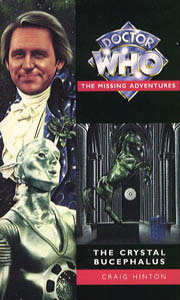
Who Book-Quest #5: The Crystal Bucephalus by Craig Hinton

Ah, Craig Hinton, the late, great master of continuity porn. Forever to be remembered as the originator of the word fanwank, a charmingly enthusiastic presence on the old Continuity Cops mailing group, and as an author of some of the most enjoyable Doctor Who fiction of the long wilderness. That was the great thing about Craig: he loved continuity, live and breathed it, but he still knew how to create a rollicking good story. Continuity fetishism is usually stifling to creativity, but Craig had the imagination necessary to avoid this trap.

The Crystal Bucephalus was Craig’s first novel, published in 1994. It doesn’t have the sheer continuity overload of some of his later works like the sixth Doctor PDA The Quantum Archangel, so it’s a little more accessible to the more casual fan. But then, how many casual fans were picking up Virgin’s Missing Adventures line in the mid-nineties? I’m against continuity in place of creativity, but when it comes attached to a story like this, it’s the icing on a delicious cake.

The Crystal Bucephalus is a time-travelling restaurant built on an abandoned planet. Shades of The Restaurant at the End of the Universe in there, of course, with the great, the good and the rich of the Galaxy meeting to dine at this most exclusive of locales. However, rather than serving food itself, the Crystal Bucket (as it has affectionately become known) instead sends it patrons to the greatest eateries throughout history, where they can interact with the locals, disguised and unable to alter the flow of time. Which is all well and good, of course, until things go wrong.

The Doctor, along with Tegan and Turlough, had been happily enjoying a meal in 18th century France until accidentally being drawn into the Bucephalus’ time fields due to the presence of two of its patrons, one of whom is none other than Maximillian Arrestis, the head of the Elective, the greatest crime syndicate in galactic history and a man of unparalleled personal vision. His murder raises a few problems, with the Doctor, as usual, being accused. Two things get him off the hook here: firstly, he owns the Bucephalus (something he isn’t proud of) and secondly, Arrestis’s murder doesn’t stick. What follows is an adventure that revolves around the Bucephalus but impacts on locations throughout time and space.

The novel is based primarily in the eleventh millennium, a period of history that Craig chose due its being barely explored in the original series. It’s a period of delicate peace between the remains of the Federation, the criminal Elective, and the Lazarus Intent, a vast religious organisation that numbers its followers in the quadrillions. The Intent is at the heart of the events of the novel, with many decisions revolving around characters’ faith in its teachings or their abuse of its power. At first, it seems that Craig is attacking religion, particularly the Christian Church (the Intent is basically a galactic Holy See), but in time it becomes clear that he is supportive of faith and the good that organised religion can do, but wary of the harm that it can be used for if perverted.

That’s not to say this is a deep, philosophical novel. First and foremost, it’s a soap opera, with much of the drama coming from the tortured relationships of the Bucephalus’ creator, Alexhendri Lassiter, and his ex-wives and fellow temporal physicists, Monroe and Matisse. This triangle, which extends to include Arrestis, is the catalyst for events throughout the tale. Add to the heartache and backstabbing plenty of violence, murder and temporal anomalies and you have a cracking, if occasionally contrived, adventure.

Craig nails the central TARDIS trio. His fifth Doctor – who experiences a lengthy side trip in which he sets up his own restaurant and is adopted by a furry alien couple in the 63rd century – is particularly well captured, his grit and resolution coming through despite his recognisable soft exterior. Tegan’s characterisation strikes the right balance between her frequent bolshiness and her often forgotten softer side, and she strikes up a strong, believable friendship with Tornqvist, an important figure within the Lazarus Intent. Turlough gets less time to shine, but nonetheless hits the right notes between the self-centred scoundrel he begins as and the slightly less self-centred near-hero he ends up as. Craig also makes a point of getting the TARDIS crew out of their uniform-like costumes and into some fancy clothes, although both Turlough and the Doctor are back in their usual togs by the end of events.

The continuity points are ever-present, but not intrusive. Rather, they’ll bring a smile to the face of anyone who has followed Doctor Who both on television and during the early years of the Virgin novel line. The Bucephalus’ time projection is maintained by Legions, the multidimensional beings that appeared in the New Adventure Lucifer Rising, while other species such as the Alpha Centaurians, Chelonians and Silurians appear in cameos. There are plenty of cheeky hints along the way too; not only is it insinuated that Turlough’s world of Trion was colonised by the Gallifreyans, it is also strongly implied that New Alexandria, the planet on which the Bucephalus is based, is in fact the long-dead corpse of Gallifrey. Then there are the numerous Star Trek references for fans to spot, and Lazarus knows what else I’ve missed…

The novel builds to one hell of a climax, in which the author not only manages to bring the various temporally separated protagonists together but even finds a decent and believable use for shapeshifting pseudo-companion Kamelion. Much of the climactic finale takes place within the belly of the TARDIS, building a far more evocative picture of the death knells of a timeship than the recent TV episode Journey to the Centre… and even leading into the brand new shiny console room that debuted in The Five Doctors.

The Crystal Bucephalus is a grand read for any died-in-the-wool Who-head. Arguably, Craig Hinton never really managed to craft a story as well as he did here, often slipping a little too far into the excesses of continuity fetishism. Nonetheless, I’d love to see what he would made of the mass of mythology that has built up in the years since his death in 2006. The marvellous geek.


Thursday, 30 May 2013

Doctor by Doctor #5

Captain of the Team


Peter Davison, 1981-84


By now, we know the Doctor. A force of nature, storming through the universe, filled with the arrogance of a man who knows that he is the most intelligent person in any room where he might find himself. An old rogue, gruff but charming, a man with effortless authority and gravitas. So far, at least. The fifth Doctor is different.

In 1981, with Tom Baker ready to depart after a record TARDIS tenure, John Nathan-Turner and his production team faced the difficult challenge of continuing Doctor Who without the man who had become synonymous with the lead role. The only solution was to do things completely differently. The transformation of Doctor Who from late seventies camp to, well, early eighties camp, had already begun in Baker’s glossy final year. Now the transformation would be completed with the recasting of the central role. The Doctor would be played by an already well-known face, a younger, more skilled actor, already a household name for the role of Tristan Farnon in All Creatures Great and Small. The difference between Baker’s sweeping, dominant performance and Davison’s more subdued approach couldn’t be greater. Davison’s naysayers often accuse him of being a boring Doctor, and he’s been saddled with the nickname ‘the wet vet.’ They couldn’t be more wrong. Davison’s performance as the Doctor perfectly embodies a subtler take on the character that was exactly what the series required after years of Tom Baker’s excesses.

The fifth Doctor is a unique version of the character, more sharply defined against the generic characterisation of the Doctor than any of the other incarnations, even the northern ninth. He does, of course, share many of the Doctor’s perennial traits: curiosity, intelligence, compassion, humour. On the other hand, many Doctorish personality traits are absent or greatly reduced. He is very rarely arrogant; his description of himself as “Pretty, sort-of, marvellous,” in Time Crash is about as full of himself as he gets. While he is frequently ratty, with a sarcastic streak to his humour, he is slow to anger, and when he does lose his temper it is for the most serious of reasons.

From the outset, the fifth Doctor seems weaker than his predecessor, it’s true. Left damaged by a traumatic ‘death,’ the Doctor is still regenerating during the opening few episodes of his debut serial, Castrovalva. It’s unsettling to see the Doctor like this, so vulnerable, relying on his new companions to help him back to the TARDIS. Once there, he comes apart, the unravelling of his costume symbolising the deconstruction of his character. Slowly, he pieces himself together, cycling through his earlier personae as he seeks to establish his own, new self. He is damaged, it’s true, and it’s a long time before this version of the Doctor ever seems quite comfortable with himself. He looks in horror at his reflection, aghast at the young, handsome man he has become. After centuries of dominating events with easy authority, to appear fresh-faced and inexperienced must be a terrible setback. It certainly affects his relationships with his companions, as we’ll see later.

"Well, it wouldn't be cricket!"


One of the first things he comes across, as he searches the TARDIS for the zero room in which to recover, is the Ship’s cricket pavilion. He probably installed it in his fourth incarnation (in which he often mentioned a preference for cricket), but it provides his fifth self with a vital lifeline in his time of need. The very moment his personality is forming, he finds something with which to identify and define himself. In reality, the fifth Doctor’s costume, which remains barely changed throughout his tenure, was a product of branding concerns. In terms of the fiction however, it perfectly matches this Doctor’s character. It’s not an outfit that a real Edwardian cricketer would ever have worn; rather an eccentric mixture of period and modern elements, but the dominant element is the cricket jumper. Cricket symbolises everything that is most important to this Doctor: team-playing, sportsmanship, good manners and grace. The beige frockcoat with its red-piping and the Panama hat lend a more sartorially striking air, the garish striped trousers a showier element, reduced by the muted colours of the overall ensemble. The celery, worn where another well-dressed gent might wear a rose, adds an eccentric touch, later given the most spurious justification in Davison’s final story. Quite how it sticks on, though, is anyone’s guess, as is its astonishing ever-freshness (perhaps he replaces it in-between stories?)

His first delicate moments aren’t helped by the fact that the Master – seemingly completely mad following his unnatural rebirth – has set up another contrived trap for the Doctor and his friends. The Doctor solves the riddle of Castrovalva, of course, and it seems to be the strength required to face up to the Master that finally pulls him back to together. He certainly doesn’t seem to care about his former ‘best enemy,’ though; from now on, any mercy on the Doctor’s part towards his foe is down to nothing more than his usual decency and compassion. The Master hounds the Doctor from now on, through this life and into the next, but the cat-and-mouse playfulness between them is over. The Doctor, quite understandably, would happily be rid of the lunatic.

Arguably, though, he feels the same way about several of his companions. While he praises the team that has formed around him, and thanks them for their help in his time of need, he has a difficult relationship with both Tegan and Adric, with only Nyssa sharing any real friendship with him. This is hardly surprising, though; the Doctor chose none of these people as companions, and suddenly he’s found himself responsible for them. With a younger Doctor came a younger set of travelling companions, and an altogether different dynamic. Davison was only twenty-nine when he was cast, almost twenty years younger than his predecessor and the youngest Doctor ever until Matt Smith was cast in 2010. This youth sets him apart from all his predecessors, and is characterised in different ways. There’s a youthful physicality to him, a sort of breathless enthusiasm that manifests unexpectedly. Witness his immediate response to a mission accomplished in Castrovalva: a brisk running race back to the TARDIS for him and his team. On the other hand, there’s very much the sense of great age trapped within a young body, a steady-headedness that belies his physical nature. Despite his apparent sportiness, this Doctor rarely engages in any physical activity in the course of his adventures, preferring a more cerebral, diplomatic approach.

"For some people, small beautiful events is what life is all about!"


The Doctor’s apparent youth does affect his attitude, however, and this is most apparent in his relationship with Adric. Now, we all know that Adric is rubbish, a gawky, geeky character played by one of the most hopeless regular actors in the series. However, alongside Tom Baker, his character worked. Adric makes sense as a young protégé for the high-minded fourth Doctor. Next to the fifth Doctor, however, the relationship is different. As an awkward, wilful adolescent, Adric needed a firm hand, someone he respected. The fifth Doctor could never offer that, and so this aspect of the characters’ relationship was more or less dropped. Their dealings with each other are more like that of a man and his petulant kid brother. Adric was an accident waiting to happen in this sort of setup, and soon enough, the little twerp got himself killed, running back into a doomed situation to try to prove himself to the Doctor when he could have got out. The Doctor, for his part, suppresses his reaction to this, burying his guilt and urging the others to move on. However, he continues to punish himself for ‘failing’ Adric; indeed, this incarnation’s final word is ‘Adric.’ (On the other hand, I don’t think the Doctor’s nights are constantly plagued by guilty dreams of Adric, unlike some of the spin-off writers.)

Tegan is another headache for the Doctor. Again, it’s easy to imagine that the fourth Doctor would have had an easier time with her, his more dominant personality winning the battle of wills. The fifth Doctor, quieter and more restrained, finds is harder to stand up to ‘the mouth on legs,’ her brash Ozzie charm the antithesis of his restrained manner. While none of his initial companions are there by his choice, at least Adric wanted to be there, and Nyssa has nowhere else to go. Tegan, on the other hand, actively wants to be anywhere but in the TARDIS. Much like Ian and Barbara, she just wants to get back to Earth, and has no qualms in making this very clear to the Doctor. About the only thing they have in common is liking cricket. In fairness, the Doctor has no excuse for not getting her back to Heathrow, having somehow developed the ability to fly the TARDIS perfectly except when this airport is involved. Tegan’s heart is in the right place, however. She puts her all into helping the Doctor during his regeneration, and while she goes to pieces during the first attempt to take her home (Four to Doomsday, which lands them on a starship in orbit by mistake), she then survives a particularly horrific experience at the hands of the Mara. Tegan slowly comes to terms with her life in the TARDIS, and the Doctor gradually develops some respect for her.

Adric’s death threatens to drive a wedge between them once again. Tegan didn’t like Adric at all, but she is left shocked by his sudden death, and even more so by the Doctor’s absolute refusal to go back and save him. The Doctor’s objection to rescuing him isn’t on the grounds that it can’t be done; he flat out refuses to even discuss it, as if altering this event is morally repugnant to him. Staunchly moral, this Doctor will not even entertain the idea of changing history for personal reasons. Once the TARDIS finally reaches Heathrow, the Doctor dumps Tegan back where she belongs, just as she had come to value her opportunity to travel in space and time. The Doctor carries on with Nyssa, a far more suitable companion for him in this incarnation. Quiet and bookish, thoughtful and highly intelligent, Nyssa is the perfect companion for a more reserved Doctor. Sadly, with three companions to take care of, she is often sidelined in the stories, left to get on with the technical stuff while the Doctor keeps the other, unreliable sidekicks out of trouble. Their extended series of adventures together in audio format illustrate their suitability to one another rather better, but on television, Tegan is drawn into the Doctor’s world again almost immediately in the strange series of coincidences that is Arc of Infinity. Nyssa certainly seems pleased to have some female company again, while the Doctor takes a little longer to appreciate Tegan’s return.

"Brave heart, Tegan."


There’s a good-naturedness to the fifth Doctor that his immediate predecessor lacked. While he is sometimes irritable he is always pleasant company, polite and well-mannered to the end. He is astonishingly patient with his companions, and often with others he meets in his travels. There’s the sense that this Doctor would rather take things slowly, holidaying through the universe and maybe settling down once he has found somewhere to his liking. Trips to Deva Loka begin well, only for local matters to intervene, forcing the Doctor to take action; he is still incapable of ignoring an injustice or the threat to an innocent. In spite of his more ordinary, human demeanour, he is open-minded when it comes to other cultures and alien life, only stepping in when he is certain it is the right thing to do. He graciously accepts being called an ‘idiot’ by Panna of the Kinda – can you imagine any of the other Doctors taking that lying down? – and listens patiently to the Monarch of Urbanka before standing up to hid madness. Probably the happiest we see him is at the Crowley’s cricket match and fancy dress party, and he still gets ensnared in a family disgrace, pulled in by his curiosity. He may be looking for a quiet life, but he is still the Doctor, and this is the lifestyle he has created for himself.

The fifth Doctor comes across as far more straightforward than his predecessors, but he does have a devious side. He lets the Time Lords throw him to the wolves in Arc of Infinity, confident that the real threat behind the scenes needs him alive; and he carefully judges Turlough, that most mysterious of companions, steering the young man onto the right path. It’s this desire to see the best in people that marks him out; he remains optimistic in the face of the constant darkness he encounters in his travels. His trust in Turlough proves correct, even though this alien orphan has been press-ganged into assassinating the Doctor by the Black Guardian. Even when he has discovered the Guardian’s involvement, the Doctor remains confident that Turlough will come through. It’s only during his last trip in the TARDIS, on the Planet of Fire, that Turlough angers the Doctor; having extended his trust, the Doctor is not welcome to having it betrayed.

There are many times when this Doctor seems less formidable than his former selves. He no longer seems quite as sharp, having to expend great concentration when planning moves against the Master and getting Adric and Nyssa to take care of much of the theoretical side of things. He uses glasses for the first time since losing his elderly first body (although his tenth incarnation will suggest that these are merely ‘brainy specs’ used for effect). Events often resolve themselves more by luck than by judgment, with the Doctor occasionally seeming like a bystander in his own show. All the time, though, he is observing events, learning, questioning, staying one step ahead. This is a Doctor who prefers to work on the periphery of events, only to have to get involved once the danger becomes too great. He also rushes to help people in immediate danger, with no thought to himself; it’s this straight-up compassion that shows the Doctor at his best.

"Sweet? Effete!"


It’s interesting to look at the other Doctors’ attitudes to this incarnation. While the fifth Doctor often seems frustrated with himself – ‘I should have realised!’ being a common complaint on his part – it’s his immediate successor who criticises him the most. Admittedly, the sixth Doctor is appallingly vain and full of himself, but his disparaging take on the ‘effete’ fifth isn’t so incredible. When he meets his other selves, changes in attitude become apparent. (Indeed, this version of the Doctor suffers from crossed timestreams particularly seriously, not only meeting three of his earlier selves in The Five Doctors, but later version on screen (Time Crash), on audio (The Sirens of Time) and in print (Cold Fusion, The Eight Doctors.) His first self argues with him, eventually conceding that he did ‘Quite well,’ while his seventh self dismisses him as ‘Not even one of the good ones.’ It’s only much later that his tenth self reveals how much he has come to appreciate life in his fifth incarnation. OK, so this was a fourth-wall break, allowing both Stephen Moffat and David Tennant to praise their favourite Doctor, but it nonetheless stands as a reappraisal of the fifth Doctor in the show itself. Davison himself considered that he was too young for the part. Possibly he is right, although I feel the sudden injection of youth did the series the world of good. Still, it’s interesting to hear him play the part now, in his fifties, for Big Finish’s audio productions. His more mature performance, more measured than even his subdued take in the eighties, is impeccable. Unlike the later Doctors, there is simply no room for extra exploits in his storyline, and so the audioplays create a sort of parallel timeline, in which new adventures, and new companions, are retroactively inserted into the Doctor’s life. A lost world in which an older fifth Doctor led a different set of adventures, shining a new light on his character.


Also illuminating is his attitude to his enemies. There’s a sense of frustration, more than anything, to the Doctor when he is confronted by his perennial foes. His exasperated dealings with the Master I’ve already commented on. Equally, when he encounters the Cybermen, in their new beefy guise for the eighties, he seems frustrated at their inability to appreciate the universe for what it is. For a man who has come to appreciate the simpler things in life, the need to conquer and destroy is merely baffling. It’s equally true of his dealings with the Mara, a malign, sexual intelligence that perverts Tegan into its instrument. The dark desires the Mara represents are the antithesis of this virtuous hero. (That said, I disagree with the analysis that the fifth Doctor is entirely sexless. His interactions with Professor Todd in Kinda, and to a degree with Kari in Terminus and even Jane Hampden in The Awakening are mildly flirtatious, and indicate that this youthful looking Doctor is attracted to more mature women.)

This quiet, non-confrontational Doctor is a strange fit in the series at this time. It was all change at the televisual level, with the Saturday night slot that had served Doctor Who so well for so long replaced with a Monday-Tuesday double bill. This altered the structure of the stories, no mostly comprised of four-part serials which would play out essentially as two-parters, changing direction after episode two for a new approach in the concluding third and fourth instalments the following week. High concept stories abounded, but for every thoughtful exploration of the universe, such as Castrovalva, Kinda or Terminus, there was a militaristic actioner, including Earthshock, Warriors of the Deep and Resurrection of the Daleks. While the former story type seems tailored to Davison’s performance, the latter throws it into sharp relief. The real reason for the existence of these gung-ho stories is the presence of Eric Saward as script editor and occasional scriptwriter. His view of the science fiction was very much in the more action-oriented, violent future war mode – even comparatively sedate stories in this period frequently had high body counts and copious amounts of kid-friendly green gore.

Yet throwing our good Doctor into this environment forces him to act in ways he is not comfortable with, showing him in both his best and worst light. Rarely (although not never) had the Doctor picked up a weapon before the Davison era. By the end of his first season, the fifth Doctor was gunning down Cybermen, and would later engage in the slaughter of his perennial enemies, the Daleks. Revelation really is the story that shows this dichotomy. The Doctor goes off to face Davros, determined to execute him and finally put a stop to the Daleks’ latest campaign of destruction. Tellingly, the vindictive scientist talks him into sparing his life, at least long enough to get the upper hand once again. It’s a shocking turn of events; not only does the Doctor mow down Daleks and then decree that their creator must die, when he finally faces him he cannot pull the trigger. Following this, Tegan leaves the Doctor’s company, appalled by the carnage around her. The Doctor vows to mend his ways, but what he really means here is questionable. I agree with Gareth Roberts’s interpretation: the Doctor is vowing to toughen up.

"There should have been another way..."


The following story, Planet of Fire (first episode broadcast on February 23rd 1984, the day of my birth, fact fans!) shows this newfound resolve in action. Once more ensnared in the Master’s intrigues, the Doctor allows his onetime friend to burn to death, looking on impotently but resolutely. Sure, the Master returns, as he always does, but this doesn’t lessen the power of this moment. The Doctor also destroys Kamelion, the occasional companion who has been hiding away in the TARDIS for several episodes. Once more turned into a puppet by the Master, Kamelion begs for destruction, and the Doctor grants it. For all the ‘wet vet’ nonsense, the fifth Doctor can prove to be single-mindedly callous if the situation calls for it.

Finally, with a new companion, Peri Brown, by his side, the Doctor makes the fateful decision to visit the Sirius system. Caught up in the machinations of various power-hungry individuals on the planets Androzani Major and Minor, the Doctor is swept up in an orgy or warfare and violence that leads inevitably to his own death. The Caves of Androzani is rightly lauded as a classic of Doctor Who, and was voted as the greatest story of all time in the most recent DWM story poll. A triumph of writing, direction and acting, it’s a thrilling and claustrophobic affair that shows the fifth Doctor in his finest light. The seedy, malicious world of Androzani is everything this Doctor is not; selfish, greedy and violent for its own sake. Thrown in there, he is swept along impotently, but his very presence is the catalyst for the entire corrupt system to collapse at last. The source of all the greed and corruption is spectrox, a life-extending substance that, in a nice example of symmetry, is fatally toxic in its raw form. Unfortunately, the Doctor and Peri are both exposed. What follows is four episodes of the Doctor doing everything he can to get Peri out of this hellhole he’s inadvertently brought her to, in an effort to save both their lives. He even fights off his impending regeneration in order to keep moving forward (check out the effect in episode three as he regains consciousness, and compare it to the effect used for his eventual transformation.)

Finally, he manages to escape with the barely vital Peri, with just enough of the fabled spectrox antidote for one. This he gives to his companion, before collapsing to the floor. ‘I might regenerate,’ he mutters. ‘Feels different this time…’ Although for the first time here, the series presents a regeneration as simply what happens to the Doctor when his life is threatened, it is also presented as very nearly failing altogether. ‘Is this death?’ he murmurs, as Peri tends to him. No, this is no mere change for the Doctor; this is very possibly the end of his life altogether. Of course, he regenerates, in crescendo of sound and colour, but that does not reduce the sacrifice he makes. The fifth Doctor dies to save a single innocent life, and this is quite right. Anything grander would not do his character justice.