Sunday, 21 June 2015

FANS WHO: The Ten Doctors by Rich Morris

The Ten Doctors is a webcomic released in single page instalments from 2007 to 2009, on Rich's Comixblog, a site packed full of fantasy comics featuring characters both original and fan-appropriated. Rich Morris, also the author of the extremely popular Yet Another Fantasy Gamer Comic, wrote and illustrated The Ten Doctors on an ad hoc basis, often daily, often not, and at almost 250 pages, with other projects going on alongside it, it's easy to see why it took so long to reach completion. It's also absolutely manic, featuring pretty much every major companion, villain, Time Lord and alien race from televised Doctor Who up till Rich began writing it in 2007.

It sounds like it should be a mess, and while there's the occasional moment where it becomes a little overegged, it actually holds together very well. In fact, it's really rather brilliant. Following it as it was published was in some ways better than reading it now in one big go. While it was hard to remember all the ongoing plot points over the two years it ran, that also meant the odd strands that petered out didn't stand out. Reading it together, it's clear that there was a fair bit of making it up on the run, but that considered, it works incredibly well, especially once it gets all the Doctors to Gallifrey and focuses on the central plot.

Without spoilering it, the story picks up the tenth Doctor after the events of The Runaway Bride, brings in his previous nine incarnations and takes them all over time and space in an elaborate array of plots and counterplots that converge on Gallifrey on the eve of the Time War. This was, of course, long before The Day of the Doctor or any hint of the War Doctor, or any of the events connected to the War, so there's no point trying to make it fit in with what we've seen now. It does, however, tie in beautifully to everything we'd seen up to that point. Given how many characters there are running around, Rich does an amazing job of keeping everyone busy and useful to the plot. While some of the companions are a bit superfluous, pretty much everyone is there for a reason, even if it is just comic relief (and this is a genuinely funny comic, especially for those as steeped in the series' lore as me and Rich).

Some of the best material comes with the interactions between the Doctors. Particularly lovely is Ten's heartwarming reaction to seeing Five, which evokes the classic skit Time Crash in spite of being posted over six months before that was broadcast. Six is as full of himself as ever, rubbing his other selves up the wrong way, none more so than Four, who's fully aware that he's the most popular Doctor ever. Two and Three snipe and snap at each other while the first Doctor retains his position as the venerable old man of the group. Nine has some surprisingly harsh moments, the events of the Time War uncomfortably close for him, while Eight, who remains separate from the others for the bulk of the story, provides sharp relief to his successor. And, in spite of the title, and the time it was written, there are more than ten Doctors taking part. I'm not sure how you'd count them all... the Fourteen Doctors, maybe? There are even some surprising regenerations.

There are some poignant moments, but overall, The Ten Doctors is just bloody good fun. It's a celebration of Doctor Who in all its overcomplicated silliness. A joyous romp by a fan, for fans, illustrated in a charmingly simple yet effective style. Rich and his co-conspirators have released several more Doctor Who related strips over the years, many of them wonderfully unlikely crossovers (James Bond, Forever Knight, Jem and the Holograms!), but this is the best. There's plenty of extra information in Rich's notes and appendices, including a complete Doctor Who timeline listing all the episodes, site comics and multi-Doctor adventures (I helped out a little with that). It doesn't look like the site has been updated much in recent months, but things have started up again just very recently. There's plenty to enjoy on there, but first, download The Ten Doctors. Have fun.

Wednesday, 17 June 2015

Park Attractions: Velociraptor

The first in a series of articles on the animals featured in the Jurassic Park franchise. The JP films are monster movies and not intended to be wholly accurate, but it's fun to look at the real dinosaurs that inspired them and see how they compare.

Appearances: Jurassic Park, The Lost World, Jurassic Park III, Jurassic World
Mounted skeleton of the Velociraptor

While T. rex is the big draw of the franchise, the Velociraptors are the real stars. Not terribly well known before Jurassic Park, Velociraptor is now one of the most notorious and popular dinosaurs. The word "raptor," originally an old Greek word meaning thief, predator or plunderer, used to be used primarily to refer to birds-of-prey. Nowadays, when someone says "raptor" they're almost invariably referring to Velociraptor or one of its close relatives.

The raptors in the films are particularly exaggerated for dramatic effect. The real Velociraptor was a medium-sized predator, about two metres/seven feet long and half a metre/a foot-and-a-half tall. The raptors in the films are over twice the size of this, standing eye-to-eye with humans. The movie versions are in fact more similar to Deinonychus, a related genus (both are part of the dromaeosaurid family). The Deinonychus was larger, although not quite as large as the JP raptors, and had a deeper muzzle more akin to the movie versions. Part of this is down to when Crichton wrote the original novel; at the time, Deinonychus was considered another species of Velociraptor. The iconic fossil being excavated at the beginning of the story is found in Montana, in the range of Deinonychus fossil sites, while the Velociraptor is only found in Asia. So really, what we're seeing in the JP films is a Deinonychus, not a Velociraptor.

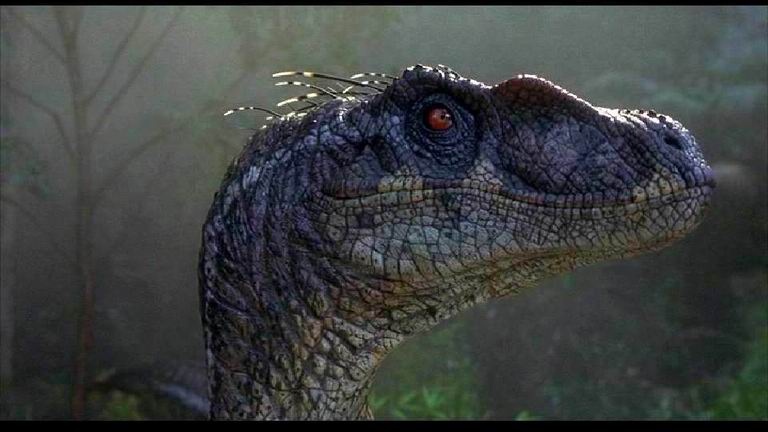
The somewhat amended JP3 raptor.
In 1991, another related American genus was discovered: the Utahraptor, an even bigger dromaeosaurid with proportions more similar to the raptors already being developed for the first film. Utahraptor gave the JP raptors a credibility boost and has become one of the most popular dinosaurs itself. Dromaeosaurids are considered some of the most intelligent dinosaurs, characterised by pack behaviour and large brain cases for their body size. However, it's all relative; raptors probably weren't much more intelligent than an average bird species today.

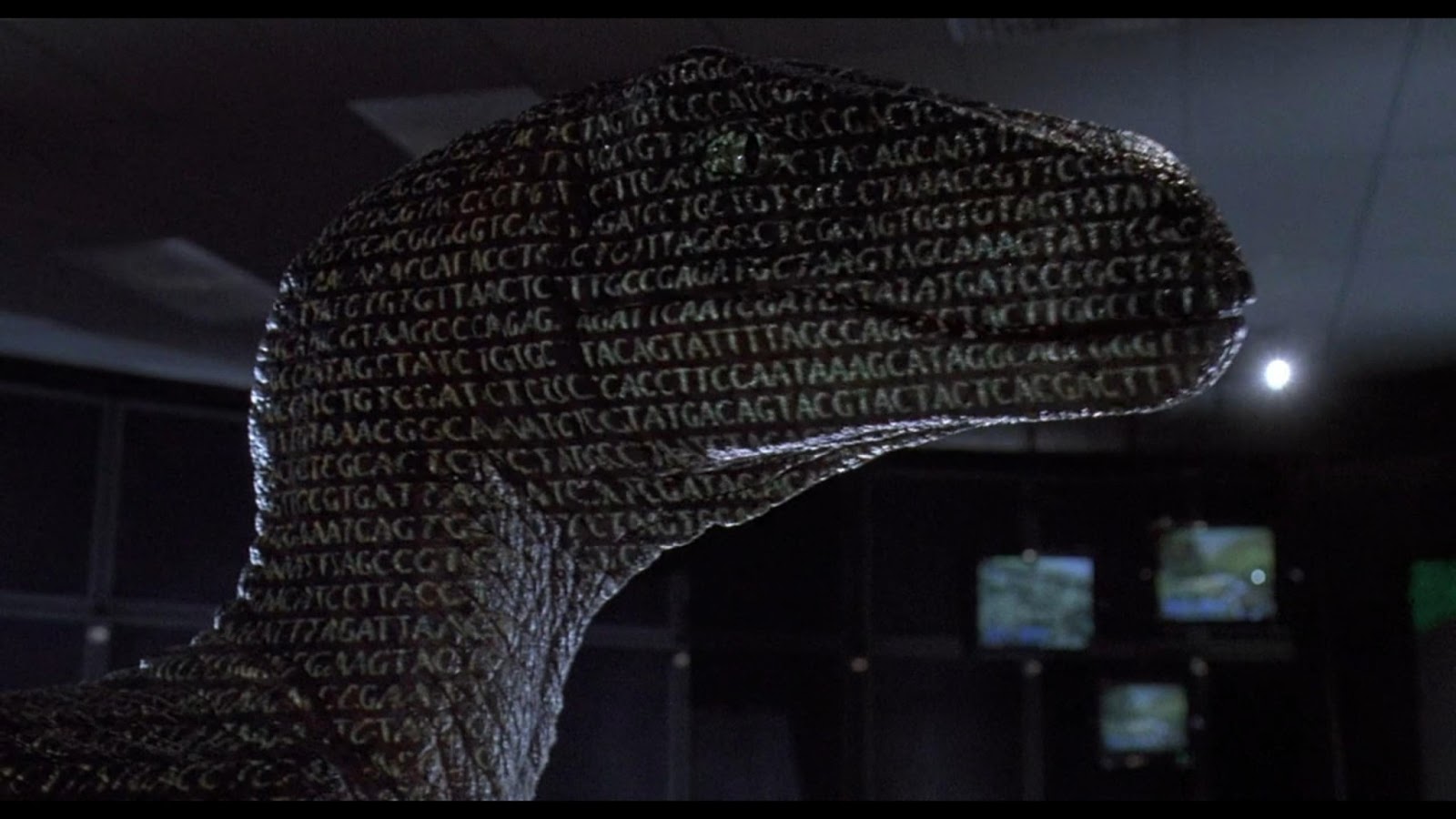
The most significant difference between the real Velociraptor and the JP raptors is in their appearance. When Jurassic Park was being filmed, the appearance of the dinosaurs was, with some dramatic licence, close to contemporary scientific knowledge. Over the following few years, however, a rush of excellently preserved fossils has shown that most coelurosaurian dinosaurs had feathers for warmth and/or display, with some, including the dromaeosaurids, having well developed feathers akin to modern flight feathers. Dr. Alan Grant had to confront a kid whining about the Velociraptor skeleton looking more like a six-foot turkey. He was more right than he knew (and a six-foot turkey sounds pretty terrifying to me). By 2000, the feathered dinosaur was becoming recognised enough that some limited quills were added to the heads of the scaly raptors of JP3, but they've been returned to a fully scaled look for Jurassic World. Part of this is for easier audience recognition, and mostly just because the filmmakers think it looks cooler. There is a handy line in JW covering the discrepancy, though: Dr. Wu points out that all the dinosaurs at the park are hybridised with other species, and that in nature they would "look quite different." Plenty of fans have theorised that the frog DNA used to patch the codes, which was such a major plot point in the first story, made the raptors bald. It would have been a nice touch if, by the time of Jurassic World, they'd started using duck DNA instead because it was a closer match. And it would have stopped them changing sex...

Another myth to be busted: the terrifying image of the Velociraptor slashing open its prey's belly, leaving the guts to flop out. No one is certain, but simulations with sculpted claws and pork bellies make it unlikely that the claw was sharp enough or curved correctly to slice open flesh that way. What seems more likely is that packs of raptors would team up on larger prey, using their sickle claws to pierce the flesh and hang on while they used their razor-sharp teeth to viciously bite at the flesh. The prey would most likely have died of blood loss even if they had managed to shake the raptors off. Much of the time, Velociraptors would have preyed on smaller animals, either around their own size (such as with the famous battling dinosaurs fossil of a Velociraptor and Protoceratops in a clinch), or much smaller, and they would also have scavenged. Not that this makes a pack of raptors any less of a terrifying prospect.

A classic shot from the first JP


For all the changes made for the books and films, one thing Crichton was dead right on was stressing how bird-like the Velociraptor was. It's clear now that the dromaeosaurids were very closely related to the earliest birds; indeed, some definitions include them as birds (it's very much a matter of semantics). Early dromaeosaurids were tiny animals, extremely bird-like, some of them, such as the abundant Microraptor, with feathers sufficiently adapted for gliding or posibly even powered flight. The sickle claw seems to have initially evolved as a climbing aid for aboreal species, later being becoming weaponised as some branches of the family re-adapted to a terrestrial, predatory lifestyle.

Finally, I'm afraid that the wing-like forelimbs of the Velociraptor mean that it most certainly would not be able to move its hands in such a way to open a secured door.


Sunday, 14 June 2015

DANDY SPACE LOG 1-10 & 1-11

Season One, Episode Ten - There's Always Tomorrow, Baby

It's the Groundhog Day episode, and our first look at Meow's home planet, Betelguese, where Dandy and co. are forced to make a landing in order to get the Aloha Oe serviced. It should only take a couple of days...

He's Not a Space Cat, Baby: Meow's not keen on going back to Betelgeuse, but at the end of the day (a very long day), he's glad he goes home. His family are thrilled to see him, from Li'l Mamma to his dad, who is in fact very proud of his son, in spite of his not following him into the family business (making parts for an unknown appliance at Screw Industry). When he's not chasing rare aliens, he's playing Galaga. He had an old sweetheart named Katie, who now works at the bar his dad drinks at after work; sadly for Meow, Katie is gay. Despite all his protestations to Dandy, most everyone calls him Meow (or Mew), not Mrrwmewmew. When Meow finally cottons on to the fact that he and everyone is living the same day over and over, his immediate conclusion is that they've all developed superpowers.

He's Dandy, Baby: Totally bonds with Meow's dad over their shared love of boobs. Dandy has trouble believing that they're caught in a timeloop, and just thinks that life on Betelgeuse is so incredibly boring that it just feels like the same day over and over. Even when he is convinced, he doesn't really care until it's pointed out to him that the Aloha Oe will never get fixed and therefore he'll never get to BooBies. He tries to steal a spacecar but it explodes, killing him - until the day starts over again.

He's Just a Little Obsolete, Baby: It's QT who first notices the day has been repeating itself - after 88 iterations. Dandy's complete nonchalance means no one pays it any mind until the 100th iteration.


There's Bad Guys Too, Baby: The Gogol and Jaicro Empires are still at war, battling for control of the universe. Both sides have potentially monstrously destructive weapons of war. The Jaicro have huge Gundam/Ideon style mechas for battling in space, while the Gogol have the CORE - an unstable weapon that requires the rare element Pyonium to function. When Admiral Perry orders Dr. Gel to activate the CORE without the requisite levels of Pyonium, it explodes, sending a discharge of pure Pyonic energy through space.

Phenomenology, Baby: The Pyonium energy travels to Betelgeuse and hits the calendar in Meow's family's house, twisted space-time into a Moebius loop and forcing everyone to repeat the day over and over. The effect is only stopped once Meow's dad uses his metalworking skills to cut the affected page from the calendar.

I Know This Planet, Baby: In real life, Betelgeuse is, of course, a star. Also called Alpha Orionis, it's a red giant lying approximately 700 light years away (assuming it hasn't already collapsed). In Dandy's universe, however, it is the name of a small blue planet, in close orbit with a much larger red planet, which hangs heavy in its sky. Much of the surface is water, and the region we see is experiencing a temperate summer. So not unlike Earth, really. The native Betelgeusians are catlike creatures, although the females tend to wear wigs and make-up that make them look more human-like (which is actually a little disturbing). The area we see looks very much like rural Japan with a touch of downtown Tokyo.

The Bottom Line, Baby: A great episode. Meow finally gets some much needed focus (QT will get his turn soon), and learns that sometimes, you have to go home in order to start afresh. It's a fine character piece and a great bit of sci-fi. Obviously, Groundhog Day is the immediate point of comparison, but it has more in common with the Star Trek: The Next Generation episode "Cause and Effect." In any case, time loop episodes are ten-a-penny in science fiction, but rarely are they done with as much humour and heart as this.


REVIEW: Jurassic World

Nostalgia may rose-tint our spectacles, but it also increases their focus. I was nine when Jurassic Park was released in 1993; I saw it on release and firmly believe it to be an absolutely classic film. Naturally, I was tremendously excited to finally get to see a fourth instalment in a franchise I have followed from the beginning (movies, original novels, junior novelisations, toys, games and all). However, Jurassic World had a hell of a lot to live up to.

There are clear weaknesses in the finished film, even after a decade of script revisions in development hell. The characters are walking clichés, and while the Jurassic Park cast were hardly given the most original characters to work with, they at least felt rounded, and at the time, reasonably new. The rock and roll mathematician and teenage hacker are cheesy as hell now, but in fairness, it was the Nineties. Jurassic World gives us a man's man gamekeeper, and an ice queen career woman who just needs a real man to break down her walls. I have to agree with Joss Whedon's comments regarding the sexual politics of the film; this was par for the course in the Seventies.

But then, I'm not going to see a Jurassic Park film for high art. This is a monster movie, and a very good one. I'm on the fence regarding the inclusion of the genetically hybridised dinosaur, Indominus rex. On the one hand, I agree with Chris Pratt's character, Owen: dinosaurs are “wow enough.” Actual dinosaurs are incredible, there's no need to make up new ones. Yet, it's hard to argue that this allows some spectacular set pieces and pushes the plot into interesting territory. It's hard to swallow a dinosaur intelligent enough to trick the keepers into letting him out, let alone one that virtually has the power of invisibility. The Indominus is an absurdly pimped up beast, from her quills to her gnarly teeth, but as producer Colin Trevorrow has said, this isn't a documentary. It's a sci-fi monster movie. Also, it's not like the rest of the dinosaurs are scientifically accurate, and although I'd rather see feathery Velociraptors charging about, the creatures here all look fantastic. And I do appreciate a brief line from Dr. Wu (BD Wong, the only actor from the first film to return), pointing out that all the dinosaurs are hybrids to a degree, and would have looked quite different in nature.


Jurassic World is an allegory for corporate excess and the commodification of natural resources. This is, to be fair, hard to accept coming from a Hollywood blockbuster with a budget of $180 million. The Indominus was created to tempt moviegoers who have been spoiled by a slew of big budget sci-fi action movies, just as it was created in universe to keep happy the tourists who have become bored with ordinary dinosaurs. Nonetheless, it makes its point, and a subplot regarding the weaponisation of dinosaurs – something that earlier treatments of the film were said to focus on – provides a strong thread, as well as clearly setting up the direction for a fifth film. The movie's plot is completely predictable, every beat signposted, even the final fate of the mighty Indominus obvious almost from the outset. However, sometimes a little predictability works in a story's favour. This is a movie where you just need to sit back and wallow in the spectacle, and spectacular it is. It's a CGI overload, of course, and will age far quicker than the original, which still stands up extremely well today; although it's good to see that puppetry still has a place for scenes of physical interaction.


Pratt is as charismatic as ever as gamekeeper and raptor trainer Owen Grady, even if the role does sometimes come across as an extended audition for Indiana Jones. Bryce Dallas Howard is pretty perfect in the role of Claire Dearing, the park's operations manager. She's fundamentally unlikeable to begin with, until Pratt's character melts her heart and breaks through to the real woman within. Every independent woman just needs a bit of rough with a big weapon, right? Her two nephews, played by Nick Robinson and Ty Simpkins, are both great, although it might have been fun to make the older brother the enthusiastic dinosaur fan and the youngster the disdainful one who needs to be amazed. Vincent D'onofrio does what he does best – the charismatic villain, in this case, the security chief and champion of weaponisation. Smaller roles for Omar Sy, Irrfan Khan, Jake Johnson, Lauren Lapkus and Katie McGrath are all essential, and the entire cast acquit themselves well. Plus, there's a couple of fun little cameos to watch out for, although some kind of inclusion of the late Richard Attenborough would have been welcome.


At the end of the day, though, it's the dinosaurs who are the stars. The Velociraptors, always the heart of the series, have not lost the development they received in Jurassic Park III, and the four trained raptors have plenty of personality, especially the beta, Blue, with her special relationship with Owen. There are some thrilling moments with the tank-like Ankylosaurus, a huge flock of pterosaurs, and the new addition, the sea lizard Mosasaurus. The dino petting zoo is the cutest. The best moments, though, are reserved for everyone's favourite, the T. rex herself. Although it isn't mentioned in the final film, this is intended to be the original T. rex from Jurassic Park, twenty-five years old and not about to let the Indominus usurp her as queen of the park. (And for everyone who complains that no zoo would keep a known man-eater as an attraction, I can tell you from experience that you are wrong.) For all the mediocre writing, throwback sexism and unoriginal characters, this is simply great fun. Any film that end with the biggest and best dino-on-dino fight ever committed to screen is going to leave me satisfied.


Friday, 12 June 2015

New Bats, New Supes, New Bats'n'Supes

Action Comics #41
Batman #41
Batman/Superman #21


Batman towers over Superman on the cover of issue 21.
Things are changing at DC. Again. One of my problems with DC is their continual reboots, which for the most part only make continuity more complicated. 2011's New 52 movement, thankfully, was a cleaner break than most, tweaking characters and storylines that in many cases worked well in their new guise (although not all). Now, though, DC are at it again, with their Convergence event; not a reboot, but a major shake-up, changing the situations the key characters find themselves in and posing new challenges. Post-Convergence, the main lines have settled and we have the first indications of their new direction.

It's no secret I'm a Marvel man, but the core DC heroes are irresistible. Some of the the changes coming up might be little more than costume tweaks, but the central duo, Batman and Superman, have truly been shaken up. I picked up this week's Batman/Superman as the quickest way to check the new look out, and enjoyed it so much I went and downloaded both characters' solo titles for the month as well (Batman came out this week too, Action Comics arrived last week).

To summarise: Bruce Wayne is dead (supposedly). There's a new Batman in Gotham. Superman has been drastically de-powered, and his identity is known. Things are not as they should be.

I love what they've done with Superman. One of the big problems with Superman has been his gradual increase in power over the years, to absolutely ludicrous levels (the movies are perhaps the worst offenders here). There have been several attempts to downgrade his abilities, alter them or take him out of the picture, but this one really works for me. He's still astonishingly strong, but no longer so absurdly powerful that he can knock a moon out of orbit or punch a hole in space-time. He can jump pretty damned far, but no longer leap tall buildings in a single bound, let alone fly. He needs to eat, he gets tired and feels the cold. He's been locked out of the Fortress of Solitude and even his costume has been shredded.

Superman been humanised, and it's a fantastic move. For the first time in ages, he feels like Clark Kent, a man, doing the right thing despite the fact he might pay the price. It's made all the more compelling by the outing of his identity. Luthor can't bring himself to believe it, and suspects it's all a trick. Meanwhile, the police want him for his part in the endangerment of Metropolitan citizens, and those citizens themselves have turned against him, in a wave of xenophobia against the alien interloper. All of a sudden, it seems the whole of Metropolis thinks like Luthor. He doesn't even have Lois to turn to. And yet, there are those who remain loyal to him. There's a wonderful scene where he returns to his old neighbourhood, to be greeted by an overwhelming show of support, from people who remember the good he has done and are proud to have known Superman. He keeps fighting, even as he bleeds and bruises, because he owes these people. It's a great reaffirmation of the character.

I'm less certain of the new direction of Batman. It's very clear that Bruce Wayne will be back, and the writers aren't even playing coy about it. For now, though, Jim Gordon is Batman, an unexpected development but one that is, in the circumstances, quite logical. Part of Batman's central conflict is his position outside the law, and the reversal of this - a police operated Batman - is a strange but understandable about-face. In that set-up, there's no one it could be but Jim Gordon. The much-mocked robo-flopsy armour works much better in context, but its ridiculous looks don't escape a jab or two in the script. Thankfully, it's not the only new Batsuit available. The final pages reveal another look which works perfectly.


I'm still not quite sold on the new direction for Batman, but one thing it has done is totally shake up the relationship between the two heroes and their titles. With all the Batman vs. Superman hype, it's easy to forget that Clark and Bruce are firm friends and allies. Clark no longer has Bruce to back him up, and it makes his situation all the more vulnerable. It's also a fascinating reversal; Batman working within the law, Superman hunted by them. I'm really interested to see where this goes.