So wrong... yet so very compelling.
Thursday, 5 January 2012


Tuesday, 3 January 2012
Sherlock Holmes Double Review
'Sherlock Holmes: A Game of Shadows' and 'Sherlock: A Scandal in Belgravia.'
It’s been a highly Sherlockian year for me so far. New Year’s Day saw the second series of Sherlock begin with A Scandal in Belgravia, while on the 2nd I took in the second of Guy Ritchie’s cinematic takes on the legendary sleuth, with Sherlock Holmes: A Game of Shadows. Two sequels, two different takes on Holmes. Both the BBC and Hollywood versions are hugely successful, modernised tellings of Sherlock Holmes tales that have taken as much criticism as they have praise. While each production is based, primarily, on a different Conan Doyle story, they each feature several of the same characters and elements. The two productions have many differences, but also many similarities, so I thought it’d be fun to compare and contrast them.
Before I get on with the job of overanalysing the productions and tearing them apart, I just want to say that I found them both immensely enjoyable. The first run of Sherlock on BBC1 won me over immediately, and the second series, so far, hasn’t disappointed. While the 2009 Sherlock Holmes movie didn’t impress me as much, I did enjoy it, once I stopped being a snob and finally watched it, and the sequel is a great improvement. That doesn’t mean that there weren’t elements that I’m dying to have a little rant about. First things first: A Game of Shadows is mostly informed by The Final Problem, the great showdown story which introduced Moriarty, and in which he and Holmes take one another down. A Scandal in Belgravia is, as the title makes obvious, a version of A Scandal in Bohemia, the classic story featuring Miss Irene Adler. However, both alter and embellish the stories hugely; also, Moriarty and Adler feature in each production, albeit briefly in their guest roles.
It’s been a highly Sherlockian year for me so far. New Year’s Day saw the second series of Sherlock begin with A Scandal in Belgravia, while on the 2nd I took in the second of Guy Ritchie’s cinematic takes on the legendary sleuth, with Sherlock Holmes: A Game of Shadows. Two sequels, two different takes on Holmes. Both the BBC and Hollywood versions are hugely successful, modernised tellings of Sherlock Holmes tales that have taken as much criticism as they have praise. While each production is based, primarily, on a different Conan Doyle story, they each feature several of the same characters and elements. The two productions have many differences, but also many similarities, so I thought it’d be fun to compare and contrast them.
Before I get on with the job of overanalysing the productions and tearing them apart, I just want to say that I found them both immensely enjoyable. The first run of Sherlock on BBC1 won me over immediately, and the second series, so far, hasn’t disappointed. While the 2009 Sherlock Holmes movie didn’t impress me as much, I did enjoy it, once I stopped being a snob and finally watched it, and the sequel is a great improvement. That doesn’t mean that there weren’t elements that I’m dying to have a little rant about. First things first: A Game of Shadows is mostly informed by The Final Problem, the great showdown story which introduced Moriarty, and in which he and Holmes take one another down. A Scandal in Belgravia is, as the title makes obvious, a version of A Scandal in Bohemia, the classic story featuring Miss Irene Adler. However, both alter and embellish the stories hugely; also, Moriarty and Adler feature in each production, albeit briefly in their guest roles.
Monday, 2 January 2012
Year's up
Crikey, it's the second of January already. This new year's just storming along, isn't? Mind you, I did sleep for almost three quarters of the first of January, so it's not too surprising that it seems to be going fairly quickly. At least Christmas is over; actually, it's the ninth day of Christmas, but near enough done with. Now, I love a bit of Christmas, but it's a bloody relief to have it all over. Especially since I had to wrok on Christmas Eve, Boxing Day, and the 27th, 28th, 29th and 30th. Which is, of course, nothing compared to those policemen, nurses, doctors, firemen, and so forth, who worked right through Christmas Day, but still. At least I've had three days off for New Year, and eventually managed to do something to celebrate. New Year's Chinese - a strange irony there. I'll have to have a western meal for Chinese New Year in February.
Christmas Day was a lot of fun, though, which is part of the reason I struggled so much getting up for work on Boxing Day. Who enjoyed the Doctor Who Christmas Special? I liked it a great deal; not quite up to the previous year's standard, but just right for the alcohol sodden, sentimental feel of Christmas Day. If you don't like things quite so festive, then how about reading Stromboli's Comet, the 2011 Christmas Special for The Doctor Who Project, if you haven't already? A wonderful read, and only Christmassy in the vaguest sense (it is, after all, about a snowball).
There are plenty of fan productions to look forward to in the upcoming months. Panic Moon is publishing its January issue any day now, and it's always a good read if you like snappy little Who-obsessed articles. Whotopia, the Canadian web fanzine, is soon to release its 23rd issue. This edition is a Matt Smith special, including the long-awaited reviews for the whole sixth series, up to and including my review of The Doctor, the Widow and the Wardrobe. An extended edition will appear on this very blog in good time (or, to put it another way, my review was too long and the unedited version is sitting there waiting to be read).
If fanzines aren't your thing, how about some brand new Doctor Who on film? Oh yes, now this is exciting! There are two fan productions on the horizon. Those who follow the fanfilm phenomenon should be familiar with Nick Scovell and Interalia's work. If you're not, then you should track down a copy of The Millennium Trap. This was a rather marvellous fanfilm released in 1997, filmed in glorious monochrome and starring Nick Scovell as the Doctor. There's a trailer here, but don't bother with the download link - the download is no longer available, sadly. I'm sure it's still possible to track down the 2009 special edition, though, if you look hard enough online. Scovell is a fantastic Doctor, and it wasn't long before he took to the role again, on stage, in a theatrical remake of Fury of the Deep at the Portsmouth New Theatre Royal in 2002. In 2006 - with the aid of a surge in Who popularity thanks to the new series - came The Evil of the Daleks, which I was lucky enough to see. The following year, I went to see the group's last stage production, The Dalek Masterplan, which was utterly brilliant.
The plan was for the next play to be based on The Power of the Daleks; however, the BBC declined the permissions required. Quite why, I don't understand; they had happily allowed the previous productions, which raised money for Children in Need, and can only have further encouraged the ever growing Doctor Who fandom. Nonetheless, the stage play was not to be. However, production is now well under way on a filmed remake. The Power of the Daleks will be made available on YouTube later this year. To whet your appetite, there's a very exciting trailer here.
But that's not all! At the end of The Millennium Trap, the grievously injured Doctor regenerated. Finally, fifteen years later, we're going to see an adventure featuring this new Doctor, played by James Harper, in Doctor Who: I Can See You. You can catch these guys on facebook.
That's all the Who nonsense I've planned to go on about for now. Join me tomorrow, when I shall go on about Sherlock Holmes for a change.
Christmas Day was a lot of fun, though, which is part of the reason I struggled so much getting up for work on Boxing Day. Who enjoyed the Doctor Who Christmas Special? I liked it a great deal; not quite up to the previous year's standard, but just right for the alcohol sodden, sentimental feel of Christmas Day. If you don't like things quite so festive, then how about reading Stromboli's Comet, the 2011 Christmas Special for The Doctor Who Project, if you haven't already? A wonderful read, and only Christmassy in the vaguest sense (it is, after all, about a snowball).
There are plenty of fan productions to look forward to in the upcoming months. Panic Moon is publishing its January issue any day now, and it's always a good read if you like snappy little Who-obsessed articles. Whotopia, the Canadian web fanzine, is soon to release its 23rd issue. This edition is a Matt Smith special, including the long-awaited reviews for the whole sixth series, up to and including my review of The Doctor, the Widow and the Wardrobe. An extended edition will appear on this very blog in good time (or, to put it another way, my review was too long and the unedited version is sitting there waiting to be read).
If fanzines aren't your thing, how about some brand new Doctor Who on film? Oh yes, now this is exciting! There are two fan productions on the horizon. Those who follow the fanfilm phenomenon should be familiar with Nick Scovell and Interalia's work. If you're not, then you should track down a copy of The Millennium Trap. This was a rather marvellous fanfilm released in 1997, filmed in glorious monochrome and starring Nick Scovell as the Doctor. There's a trailer here, but don't bother with the download link - the download is no longer available, sadly. I'm sure it's still possible to track down the 2009 special edition, though, if you look hard enough online. Scovell is a fantastic Doctor, and it wasn't long before he took to the role again, on stage, in a theatrical remake of Fury of the Deep at the Portsmouth New Theatre Royal in 2002. In 2006 - with the aid of a surge in Who popularity thanks to the new series - came The Evil of the Daleks, which I was lucky enough to see. The following year, I went to see the group's last stage production, The Dalek Masterplan, which was utterly brilliant.
The plan was for the next play to be based on The Power of the Daleks; however, the BBC declined the permissions required. Quite why, I don't understand; they had happily allowed the previous productions, which raised money for Children in Need, and can only have further encouraged the ever growing Doctor Who fandom. Nonetheless, the stage play was not to be. However, production is now well under way on a filmed remake. The Power of the Daleks will be made available on YouTube later this year. To whet your appetite, there's a very exciting trailer here.
But that's not all! At the end of The Millennium Trap, the grievously injured Doctor regenerated. Finally, fifteen years later, we're going to see an adventure featuring this new Doctor, played by James Harper, in Doctor Who: I Can See You. You can catch these guys on facebook.
That's all the Who nonsense I've planned to go on about for now. Join me tomorrow, when I shall go on about Sherlock Holmes for a change.
Wednesday, 21 December 2011
More Earthlike exoplanets
A little update on the ongoing search for planets. NASA confirmed yesterday that the Kepler telescope has successfully located two planets of Earthlike size and mass. After the 'twin' planet of Kepler-22b getting all the fanfare, this latest discovery has slipped by with little fanfare, yet it's just as significant, since these are the first confirmed terrestrial planets of comparable size to our own.
The two planets have been located in star system Kepler-20, which has now been thoroughly investigated and has previously revealed three larger planets. With five planets, Kepler-20 is quite a busy system, although not the most populous known (HD 10180 and Kepler-11 both have a confirmed six planets, still behind our own system with its eight major planets). Kepler-20 is about 290 parsecs away (that's nearly 950 light years) in the constellation of Lyra, and is a reasonably close match to our own Sun.
So, these two new worlds, designated Kepler-20e and 20f, are the smallest ever found. Detecting planets this small isn't easy. There's a good article here on the discovery, which explains some of the long process that was required to confirm the discovery. There's also a nice little animation illustrating the planetary system.
The previously trumpeted planet Kepler-22b has a radius approximately 2.4 times that of Earth, while the previous record holder of smallest exoplanet was K-10b, the first confirmed terrestrial exoplanet with a radius of 1.4 Earths. It's clear to see that the Kepler project has been slowly getting closer to an Earth-sized planet. Now it has been rewarded with two. K-20f is the larger of the two, at 1.03 Earth radii, while its sibling K-20e is only at 0.87 of Earth's radius; roughly the size of Venus.
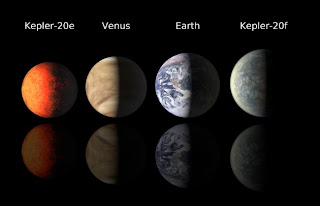
However, there's no use getting excited about alien life forms or comfortable planetary colony sites. All the planets found orbiting Kepler-20 do so much closer than Mercury does the Sun. K-20f is the outermost, and orbits in only twenty days. There is a slim chance it may retain an atmosphere of heavier chemicals - water vapour, perhaps - but K-20e, is in a six-day orbit, with an estimated surface temperature of 1040K, so there's no chance of it retaining any atmosphere.
It's a peculiar system altogether, really. Planet b is the innermost, followed by planets e, c, f and d - which means it's running big, little, big, little, big. The three larger planets are probably gaseous, and are somewhere in the super-Earth size band, smaller than Neptune - hot gas dwarfs. It's a far cry from our own system, with four terrestrial planets, two huge jovian gas giants and two smaller, colder gaseous planets, all much further from the Sun and from each other. It seems that the Solar System is by no means typical for the galaxy. It'll be very interesting to see what the next few planetary systems turn out to be like.
UPDATE: Only hours after I posted this, a further discovery was announced, detailing two planets found orbiting the star KOI 55 (aka KIC 05807616), a dying subdwarf. The two planets, KOI 55.01 and KOI 55.02 are even smaller than Kepler-20e, at 0.76 and 0.87 Earth radii respectively, and they have extraodinarily close orbits that last only a matter of hours. Betsy Green, one of the researchers on the project, has issued a statement saying that KOI 55 must have previously been a red giant star, having long since passed through this phase of its existence, and that the planets must have been drawn inside its mass during its giant period. Furthermore, to have survived this immersion in the star's outer layers, the planets must once have been gas giants, with their thick atmosphere's taking the brunt of the star's energy. The fluid layers would have been stripped away, leaving the dense metallic cores behind. Such planets, known as Chthonian planets, have been theorised before, but never definitively identified.
There's a detailed article on the findings here at the Daily Galaxy.
The two planets have been located in star system Kepler-20, which has now been thoroughly investigated and has previously revealed three larger planets. With five planets, Kepler-20 is quite a busy system, although not the most populous known (HD 10180 and Kepler-11 both have a confirmed six planets, still behind our own system with its eight major planets). Kepler-20 is about 290 parsecs away (that's nearly 950 light years) in the constellation of Lyra, and is a reasonably close match to our own Sun.
So, these two new worlds, designated Kepler-20e and 20f, are the smallest ever found. Detecting planets this small isn't easy. There's a good article here on the discovery, which explains some of the long process that was required to confirm the discovery. There's also a nice little animation illustrating the planetary system.
The previously trumpeted planet Kepler-22b has a radius approximately 2.4 times that of Earth, while the previous record holder of smallest exoplanet was K-10b, the first confirmed terrestrial exoplanet with a radius of 1.4 Earths. It's clear to see that the Kepler project has been slowly getting closer to an Earth-sized planet. Now it has been rewarded with two. K-20f is the larger of the two, at 1.03 Earth radii, while its sibling K-20e is only at 0.87 of Earth's radius; roughly the size of Venus.

However, there's no use getting excited about alien life forms or comfortable planetary colony sites. All the planets found orbiting Kepler-20 do so much closer than Mercury does the Sun. K-20f is the outermost, and orbits in only twenty days. There is a slim chance it may retain an atmosphere of heavier chemicals - water vapour, perhaps - but K-20e, is in a six-day orbit, with an estimated surface temperature of 1040K, so there's no chance of it retaining any atmosphere.
It's a peculiar system altogether, really. Planet b is the innermost, followed by planets e, c, f and d - which means it's running big, little, big, little, big. The three larger planets are probably gaseous, and are somewhere in the super-Earth size band, smaller than Neptune - hot gas dwarfs. It's a far cry from our own system, with four terrestrial planets, two huge jovian gas giants and two smaller, colder gaseous planets, all much further from the Sun and from each other. It seems that the Solar System is by no means typical for the galaxy. It'll be very interesting to see what the next few planetary systems turn out to be like.
UPDATE: Only hours after I posted this, a further discovery was announced, detailing two planets found orbiting the star KOI 55 (aka KIC 05807616), a dying subdwarf. The two planets, KOI 55.01 and KOI 55.02 are even smaller than Kepler-20e, at 0.76 and 0.87 Earth radii respectively, and they have extraodinarily close orbits that last only a matter of hours. Betsy Green, one of the researchers on the project, has issued a statement saying that KOI 55 must have previously been a red giant star, having long since passed through this phase of its existence, and that the planets must have been drawn inside its mass during its giant period. Furthermore, to have survived this immersion in the star's outer layers, the planets must once have been gas giants, with their thick atmosphere's taking the brunt of the star's energy. The fluid layers would have been stripped away, leaving the dense metallic cores behind. Such planets, known as Chthonian planets, have been theorised before, but never definitively identified.
There's a detailed article on the findings here at the Daily Galaxy.
Sunday, 18 December 2011
Doctor Who Christmas Special now available
Well, OK, not the Christmas Special. However, The Doctor Who Project has now made available its Christmas Special, Stromboli's Comet, by Jez Strickley and Jake Johnson.
You can download it for free here.

You can download it for free here.
Subscribe to:
Posts (Atom)