Showing posts with label Sherlock Holmes. Show all posts

Saturday, 28 January 2017

REVIEW: Sherlock 4-3 - The Final Problem

Named for "The Final Problem," and incorporating elements of "The Adventure of the Musgrave Ritual" (both 1893).

Tonight on Doctor Who, our hero faces the ultimate challenge when he is caught in a trap by "The Two Masters!"

Sherlock reaches another season finale, and very possibly the final episode of the series altogether. Over the years the series has drifted from an action-detective programme to a contrived melodrama. This isn't a complaint - there's been a tremendous amount to enjoy during the last two series - but it's a far cry from how it started. There's precious little of the consulting detective left, and although logic puzzles abound, this is more about the interactions between increasingly bizarre characters. Characters that include an increasingly Doctorish Sherlock, and two arch villains who bear a significant resemblance to the last two iterations of the Master. Sian Brooke's entertainingly chilling portrayal of Eurus Holmes is very similar to Michelle Gomez's performance as Missy, while Andrew Scott's version of Moriarty has been basically just John Simm's Master with less restraint since the beginning.

There's a lot wrong with The Final Problem, which detracts little from how enjoyable it all is. The plot is contrived to the point of nonsense, but it pelts along from set piece to set piece, quickly enough that you don't notice how paper-thin it all is until after it's finished. Benjamin Caron's direction isn't as elaborate or as original as his predecessors', but it's stylish and works perfectly for a mostly enclosed, claustrophobic episode. There are some very impressive scenes; the opening sequence in particular stands out, both as being unsettling and dreadfully cliched. Which perhaps sums up this episode; cliches performed perfectly. (One wonders how Sherlock and John would have explained away the situation if Mycroft had stuck the killer clown with his swordstick.)

Having revealed Eurus as the hitherto-unknown third Holmes sibling, the mystery of Sherrinford is answered. It's the name of the island prison in which she is held captive (and not her codename, which I had suspected). It's this which paints Mycroft in the most terrifying light yet, even in an episode that humanises both him and Sherlock more than any other. Not only is he capable of locking away his sister in maximum security solitary confinement for almost her whole life, but he tells their parents she's dead. Well, she did say Sherlock was always the kind one. (The setting also lays Gatiss's influences open; the island prison screams The Sea Devils; another way that Eurus evokes the Master.)

Eurus is a disturbing character; Mycroft and Sherlock's worst aspects without any humanistic redeeming features. Her intellectual prowess, which apparently stretches to the power of precognition, far outstripping Sherlock's own astonishing development in this area, receives little exploration. The script is of the "tell, don't show," school in this regard. We hear of how Eurus can reprogram someone's mind just by talking to them, but other than the actions of Art Malik's prison governer, we don't see it demonstrated. She's spent weeks as both John's seducer and therapist, but has made seemingly no impact on his psyche at all.

Nonetheless, she's far more impressive in every respect than Moriarty. I approve of the villain being kept dead (although that was a splendid bit of misdirection), but having him just pop up on tape every now and again leaves only the character's irritating aspects, and none of his power. For a genius, Mycroft can be exceptionally stupid, allowing Eurus and Moriarty their brief tete-a-tete, although perhaps he was hoping his sister would reprogramme the man to be less of a threat. Other elements work extremely well, but stand up poorly to scrutiny. Why would Eurus try to blow up Sherlock, John and Mycroft, if she wants them to come to Sherrinford and play her games?

All I can think of is that she knew them all well enough that they would survive the attack, but needed it so that they would believe the similar threat to Molly.  Poor Molly. Perhaps the episode's standout scene and a wonderful performance from Louise Brierly. It's simplicity makes it more believable than, say, the truth about Redbeard or Sherlock's remarkable memory fugue. The strength of the episode is in the performance of the central trio. It's Cumberbatch, Freeman and Gatiss who sell all this nonsense and make us believe in it. All three are now so attuned to their roles that they can find new aspects to their characters, although it's Martin Freeman's powerful last turn as John Watson that stands out.

So, will this be the end of Sherlock? Somehow I doubt it, although it may well be some time before it's possible to get Freeman and Cumberbatch together again for long enough to film anything. I imagine there will occasional one-off specials for years to come. For now, though, The Final Problem, for all its flaws, makes for a triumphant send-off for Sherlock Holmes and Dr. Watson.

Stray thoughts:

The use of the little girl on the plane is the most contrived element of all, yet actually very effective. Cinematic pseudo-psychology at its finest.

It's great to see Cumberbatch/Sherlock's parents back again, although they seem to forgive Mycroft's decades of lying rather quickly.

This is the first season of Sherlock to end without an actual cliffhanger as such, although the dynamic duo are mid-adventure. Given how poorly the cliffhanger between The Lying Detective and this episode is resolved, this is perhaps reassuring.

Rathbone Place: lovely touch.


REVIEW: Sherlock 4-2 - The Lying Detective

Based on "The Adventure of the Dying Detective" (1913)

You have to hand it to the BBC, it takes guts to let a programme go out with Jimmy Saville as the villain, after being institutionally culpable for his continued crimes. That said, the character played by Toby Jones, Sherlock's version of canonical villain Culverton Smith, isn't especially like Saville. He simply occupies the same niche: a man who is continually able to commit grotesque crimes due to his beloved public persona. He's a showbiz charity darling, in spite of being, on the face of it, utterly revolting and sleazy. The Lying Detective wouldn't work half as well as it does without Jones's repellant characterisation of Smith, and we wouldn't believe Smith's acceptance and success if we hadn't already seen Saville manage it in reality.

As far as Sherlock episodes go, The Lying Detective sticks reasonably closely to the story that inspired it, keeping the main shape of "The Dying Detective." It changes pretty much all of the cosmetic elements, of course, and even the villain is very little like the original; the literary Culverton Smith was merely an implied murderer, not a boastful serial killer. Equally, Holmes is suffering from a disease in the short story, rather than crippling drug addiction. Still, the spirit of the story remains, albeit adapted to the ongoing Sherlock/John/Mary emotional triangle, and the denoument of the story remains essentially the same. Although in the case of The Lying Detective, the episode carries on after the story finishes in order to set up the next instalment of the ongoing series.

This is a standout episode for Cumberbatch, who absolutely sells Sherlock's descent into addiction. Admittedly, we've seen this before on the series, but this is a deeper descent, and the fact that it has all been prompted by Mary's posthumous demand that he "go to hell" to save John doesn't negate this. Whatever kind of plan Sherlock has, there is no way that someone pushes themself to this level without having genuine problems. His friendship with John is what holds Sherlock together; without that, he's one step away from becoming a true obsessive who can only moderate himself through drugs.

The direction in this episode is superb. Nick Hurran is the perfect choice for an episode that revels in confusion and hallucinatory. He has a wonderful knack for the arreting visual. Beyond Cumberbatch, the cast is uniformly excellent, with Martin Freeman, as always, beyond reproach. I'm overjoyed that we haven't seen the last of Amanda Abbington as Mary, even if she is relegated to the faintest of supporting roles. Louise Brealey and Mark Gatiss both get some excellent moments, but it's Una Stubbs who steals this episode. For an episode that is so wound up in the Sherlock-John relationship, it's Mrs Hudson who absolutely steals the show. This series would be a shadow of itself with Stubbs.

The Lying Detective is, if not a stand-out episode of Sherlock, at least a return to form. This is a fine example of the series doing what it does best: a combination of mystery, character drama and arresting visuals.

Stray throughts:

Would anyone, honestly, allow someone to drug them before imparting a confession, just so they could unload themselves without repurcussion? How does Smith find these people? What is wrong with them?

Sian Brooke puts in a wonderful performance as the faux Faith Smith, protraying her as a kind of female equivalent of John Watson, stick and all.

Also a treat to see Tom Brooke back as Bill Wiggins, however briefly.

Strangely satisfying to have a reference to H. H. Holmes, one of the earliest documented historical serial killers, and someone who was a contemporary (albeit in the USA) of the original fictional Sherlock Holmes. 

Friday, 6 January 2017

REVIEW: Sherlock 4-1 - The Six Thatchers

SPOILERS FOR SERIES FOUR, EPISODE ONE

Loosely based upon "The Adventure of the Six Napoleons" (1904)

And so, after another long break, Sherlock is back and, more or less, on form. The episode chugs along nicely, with plenty of action and derring-do. A very exciting, cinematic opening for the latest run, with some excellent character moments for all the principle players. It's all very disjointed though, never quite cohering into more than a series of vignettes. For every element that is added early and picked up in the climax, there is an element that never ties into the main storyline. Which is fine, I guess, but after three series we've come to expect everything to be a clue, or a plot point, or a running gag. I'm not sure if this is Gatiss losing track of the series' style, or playing with the audience.

The six Thatchers is a clever updating of the six Napoleons, and naturally prevents us from sympathising with the victims too much. I mean, it's terribly sad that the rich couple's son has died in a desperately grim and arbitrary way, but they had a fucking shrine to Thatcher in their house. That's a straightforward way of telling that someone is an appalling person. Watson is too polite to say anything, and Sherlock genuinely doesn't care, but no one would blame them for just walking out as soon as they saw that collection of dragon portraits.

Sherlock's behaviour is baffling at the outset, and it's not clear if he is head-spinningly high, or just pretending to be to take the piss. I don't think we've ever seen Cumberbatch play him so giddily and, well, Doctorishly before. It's tremendous fun, but not what we've come to expect from the character. I like that the exile plot has been so quickly written off. It's not as if the British government can't just doctor footage and wipe someone's record clean with a few choice instructions.

As much as we focus on Sherlock during the episode, it's really all about the Watsons. It's easy to feel desperately sorry for John, upstaged by Mary as the ultimate sidekick. The script plays cleverly with this though, both making John into a more flawed, less sympathetic character by having him tempted to be unfaithful, and by keeping Mary resolutely the star of her own show, albeit one that happens almost entirely off screen, only occasionally intersecting with Sherlock.

So, John. Given the quieter, less exciting material, Martin Freeman nonetheless excels. So far, it appears that John has merely been texting the woman on the bus, a pretty minor indiscretion, but it's entirely possible there's more to it than we've seen. Even so, with a wife and a baby, John's behaviour plays with our sympathies, Of course, by the end, we're desperately sorry for him, even as he (quite understandably) shuts Sherlock out.

Mary, on the other hand, is more of a question. As always. The episode has great fun exploring Mary's superspy skills, only to happily skewer it by having Sherlock simply slap a tracer on her. Making her background the key to the mystery of the week is effective, even as it shows Sherlock at its most contrived. Until, finally, Mary is killed off, seemingly to drive a wedge between Sherlock and John. Presumably, the status quo will eventually be restored, with Holmes and Watson back as they started, albeit with added baby. This is assuming, of course, that Mary is really dead. It would hardly be the first time this series has played that game, and this is a Moffat show we're talking about. No one seems able to stay dead in these things. Not forgetting the fact that the London Aquarium is just up the road from one of the capital's largest hospitals.

Stray thoughts:

I hope they don't involve Moriarty in this season at all, and he just remains Sherlock's personal obsession.

Whatever the provenance, "ammo" is a poor choice of code word in a combat situation.

This episode includes the best ever use of the classic "As always Watson, you see but you do not observe" line.

The best bit, however, is the part with the dog.

Waiting on Sherrinford here.

Wednesday, 9 March 2016

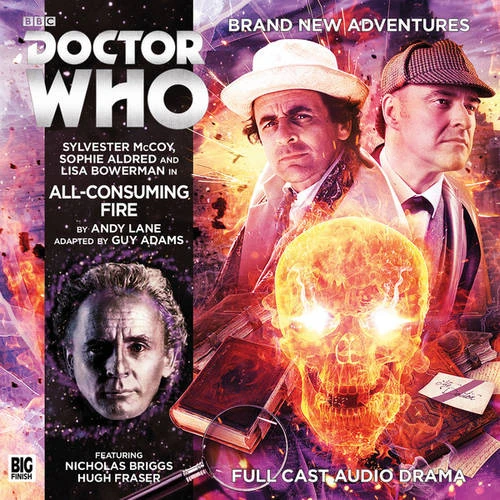
WHO REVIEW: All-Consuming Fire

Big Finish have begun to listen to the overt requests from fans when planning their Doctor Who releases. This isn't necessarily a great idea, since fans like me can come up with truly terrible ideas, but I'm pleased that we're getting a "Two Masters" story, and a return for the David Warner incarnation of the Doctor, both requests I added my voice to. And then there's this: perhaps the most obvious choice for a novel adaptation, and one that I, among other fans, have suggested.

Big Finish have already adapted several of the New and Missing Adventures, the popular Doctor Who novels released by Virgin Books in the nineties. They also have a successful range of Sherlock Holmes adventures, starring (Big Finish top bod) Nick Briggs as the great detective. So All-Consuming Fire, Andy Lane's excellent Doctor Who/Sherlock Holmes/Cthulhu mythos crossover is an obvious choice.

The original novel was split into three sections, each with a different setting. The first sees Holmes and Watson in their natural environment of smog-bound London, assigned a mission of vital importance by none other than the Pope himself. The second sets them further afield, into India, where the otherworldly elements of the plot become more overt. Finally, they travel through a rift in space to another planet in another dimension entirely, in full-on science fantasy territory. The adaptation follows this quite solidly, with two episodes set in London, followed by an episode each in the subcontinent and the alien realm.

I like that the audioplay opens with BF's marvellous Holmes theme, introducing the setting through the words of Richard Earl's perfectly cast John Watson. It's only then that the late eighties Who theme rolls out, juxtaposing with the Victorian setting in a suitably weird way. Both Briggs and Earl are on fine form, and the guest cast - which includes the wonderful Hugh "Captain Hastings" Frazer as Sherringford Holmes - are uniformly good. The third episode brings focus onto Bernice Summerfield, the Doctor's hard-drinking archaeologist companion, who is now so completely inhabited by Lisa Bowerman that there doesn't seem to be anything else to say on the matter. She's spot on. Her rapport with Earl's Watson is one of the highlights of the story.

The original novel, although very good indeed, loses its way somewhat in its final section, with Lane seeming more comfortable writing the Victoriana than the sci-fi stuff. (He's actually written many Doctor Who stories, and while there's some peculiar stuff in there, his period writing is generally his best. Indeed, he's since gone on to become the author of the Young Sherlock Holmes novel series.) Part of this is down to the focus on Ace. I never much enjoyed reading "new Ace," the hard-bitten space marine, and I don't much enjoy hearing her either. One of the strengths of the novel, though, was the intelligent examination of Holmes. Within London, his abilities and knowledge are so finely honed that he is almost invincible; in India, he's out of his element but still remarkably capable. On another world entirely, however, he's almost adrift, his knowledge next to useless. This is mostly lost in the adaptation, and the story is less interesting for it.

On the whole, the adaptation is highly successful, and remains a very enjoyable adventure. The weakest element is, sadly, the Doctor himself. While it's a joy to hear the Doctor and Holmes squaring off and teaming up, Sylvester McCoy gives a weak performance that detracts from the fascinating version of his character the novel range developed. Nonetheless, I'm looking forward to hearing further adaptations of classic Doctor Who novels.

Monday, 10 August 2015

REVIEW: The Albino's Treasure by Stuart Douglas

There are a lot of Sherlock Holmes pastiches out there, with more published every year. In any such popular and busy crowd, it's hard to stand out. Titan's Further Adventures of Sherlock Holmes range itself is already coming up to twenty titles. A new book has to be pretty special to stand out amongst all the Sherlockery.


The Albino's Treasure, though, does stand out, as both an spot-on pastiche and a rollicking good read. The first full-length novel by Stuart Douglas, it's his second published Holmes story after he contributed to the publisher's 2013 collection Encounters of Sherlock Holmes. (Once more, full disclosure: Stuart Douglas is the head honcho at Obverse Books, which means he was my publisher for Iris Wildthyme of Mars.) It's a tough balance to hit when writing a Holmes book in the Doyle style, as narrated by John Watson. There's a distinct recipe to this type of story, which when made correctly, achieves the flavour of a Doyle original while still offering something new and contemporary. It's not easy, but Douglas gets it right. His Holmes is acerbic, witty and impatient, but with compassion there for those willing to see it, while his Watson is intelligent but all to quick to react, and easily charmed by the fairer sex. Lestrade walks the fine line between the dunce that Holmes sees him as and the competent officer he ought to be.


The Further Adventures series is a favourite of genre buffs and fans of the period for its habit of taking characters of various origins and implanting them into Holmes's world. The Albino's Treasure wears its influences on its cover. If you can't guess who the mysterious Albino is, well, maybe take a quick look at some of Obverse Books' earlier publications. However, the pale-skinned villain is not the only famous opponent Holmes and Watson must face. The Lord of Strange Deaths is also pulling strings, and his true name is as famous as they come. The novel's climax is a thrilling meeting of some of fin de siรจcle pulp's most notorious characters.


The story begins as an investigation into anarchic organisations on the fringes of London society, before developing into a mystery involving art history, political machinations and secrets that have lain buried for centuries. There's a good balance between the more intellectual challenges and the brilliantly portrayed action scenes, and it maintains an easily readable pace throughout. It also has some very funny moments; my favourite line coming early on in Watson's narrative: “I am as fond of art as the next man, but only as I have found that the next man, generally, is not terribly fond of it either.” Altogether, a very enjoyable tale for the Great Detective.
 

Thursday, 28 May 2015

Hammerama: The Hound of the Baskervilles (1959)

There have been over twenty screen adaptations of Arthur Conan Doyle's novel The Hound of the Baskervilles made since 1914. Of all these, Hammer's 1959 version remains one of the most popular and well-regarded. It marks several firsts for Holmes on film: it is the first of the many Baskervilles adaptations to be made in colour, and also marks the first time that the great Peter Cushing played the sleuth. He would go on to play Holmes for the BBC nine years later, in which time he would get another attempt to adapt the story. Cushing's love of the source material is well known, and he brought much of his knowledge of Sherlock Holmes to the production, from his performance to advice on the set dressing. Famously, he suggested Holmes should affix his correspondence to the mantlepiece with a jackknife, as in the original stories.

As a gothic mystery, The Hound of the Baskervilles was eminently suited to the Hammer treatment. It's a perfect marriage of studio, director and material, Terence Fisher's gothic horror stylings bringing out the spookier aspects of the story, while the rationalist nature of the story keeps him from indulging too much in his excesses. That said, plenty of Hammer's excesses are on display here, right from the extended prologue, taking a macabre glee in Hugo Baskerville's (David Oxley) deplorable actions. What little blood we see is glowing crimson, there's a ritual sacrifice, an underground mine sequence, and a gratuitous tarantula thrown in for good measure. For all this, and sundry little tweaks to the story, it remains mostly faithful to the plot. The strangest change is to Miss Stapleton, Mr. Stapleton's vicitmised wife in the novel, transformed into his vengeful lunatic daughter (Marla Landi) for the Hammer translation.


The real draw, though, is the cast. As well as Cushing giving perhaps a career great performance as Sherlock Holmes, his great friend as co-star Christopher Lee plays Sir Henry Baskerville with brooding class. The chemistry between Lee and Cushing is as strong as ever, even if this does have the consequence of making it appear that Holmes and Sir Henry are more familiar than they should be (excepting the classic scene of their misunderstood first encounter). Then there is Andre Morell, in my opinion, one of the great Watsons, erudite and resourceful, exactly what is needed for a story in which he shoulders so much of the action. It's a fantastic central trio, raising the production above its challengers. Plus, Cushing and Morell together make it almost like the Doctor and Quatermass working as consulting detectives. There are some excellent turns by other cast members, particularly mighty Francis de Wolff as Dr. Mortimer and John le Mesurier as the servant Barrymore. Still, they're just support for that classy core group.

The only thing that lets this film down is the rushed and anticlimactic ending, but that's true of every version of The Hound of the Baskervilles. A classic.

Happy birthday to Mssrs. Cushing and Lee!

Wednesday, 3 September 2014

Obversally Yours

Woohoo! Iris Wildthyme of Mars is now available for pre-order from Obverse Books!

The latest set of adventures featuring time-travelling adventuress Iris Wildthyme and her animal friend Panda, IWoM is to be released on the 30th of September. It features stories from all sorts of excellent authors, including editor of the book Philip Purser-Hallard, Ian Potter, Simon Bucher-Jones, Selina Lock, Dale Smith, Juliet Kemp, Richard Wright, Rachel Churcher, Mark Clapham and Lance Parkin, Aditya Bidikar, Blair Bidmead, and also me. It is availabel at a reduced price for pre-order in hardback and ebook formats.

Also on the way is another volume from Mr. Purser-Hallard, the third anthology of The City of the Saved. Tales of the Great Detectives takes us beyond the end of time and explores the many facets of the greatest detective, Sherlock Holmes. It too is available for pre-order in hardback and ebook for release on the 30th.


Friday, 16 May 2014

Blogs I Like (I Like Blogs)

Fish Stix and Custard  The extremely beautiful and rather wonderful Ashley, aka Fish Stix aka Iso Suicide aka Papyrusaurus, blogs geeky stuff. Frequent awesome crafting updates. Occasional rudity.

Little Weirdos  A blog that explores the wonderful world of tiny plastic critters. Monster in My Pocket, Mini Boglins, MUSCLE etc, plus new lines being manufactured today. Cool stuff.

Yog-Blogsoth Michael Bukowski's eldritch illustrations of Lovecraftian monstrosities and creatures from myth. Good for nightmares.

The Theropod Database  Amateur palaeontologist Mickey Mortimer analyses the latest theropod finds and sees whether the main papers stand up to scrutiny. Pretty in depth and not easy for the layman, but still fascinating.

Written Worlds  Author Christopher L. Bennett talks about his own work and the shows he loves. Lots of Trek, Mission: Impossible and Godzilla.

E.G. Wolverson  Former supremo of The History of the Doctor, now finds time between child-rearing duties to read books and play with Lego, then blog about it. Particularly worth reading are his 'Prose vs Pictures' pieces.

Doc Oho Reviews  Doc Oho, aka Joe Ford, has been reviewing Doctor Who books, audios and episodes forever, along with Star Trek DS9, Voyager, The X-Files, Buffy and lots more. Reams of stuff on this site.

Doyleockian An excellent blog dedicated to all things Sherlock Holmes, with a special focus on the man himself, Sir Arthur Conan Doyle.

Life on Magrs  One of my very favourite authors, Paul Magrs, blogs about his own work, what he's been reading, and his cat. And if there's one thing the Internet loves, it's cats.

Peculiar Times  Another great writer, Phillip Purser-Hallard, the creator of The City of the Saved and the editor of the upcoming Iris Wildthyme of Mars. Especially worth checking out around Christmastime, for special stories.

From a Story By...  Obverse Supremo Stuart Douglas reviews stuff and bibbles about anything that takes his fancy. Not updated very frequently, but worth reading whenever it is.

The Further Adventures of Bret M. Herholz  Bret's scratchy line drawings are unique and wonderfully characterful. He has a particular penchant for Doctor Who and Sherlock Holmes, but he illustrates all sorts. Definitely worth checking out.

KitchenFoyle Michael Kitchen/Foyle's War Tumblr. Lovely.

Friday, 21 February 2014

CAPTAIN'S BLOG: TNG 2-3

2.3) Elementary, Dear Data
or
Watson the Holodeck Today?


The Mission: Rendezvous with the USS Victory.


Planets visited: None.


The Great Detective: Turns out that Data is a huge fan of the works of Arthur Conan Doyle and the adventures of Sherlock Holmes. He's got the entire canon in his database (but does he have the apocryphal stuff? Has he read The Seven Per Cent Solution? Would he recognise Benedict Cumberbatch, Robert Downey Jr. and that bloke off Torchwood?) Dr. Pulaski challenges him that all he can do is parrot the solutions from the original texts, or rearrange the elements in the Doyle style. Data and Geordi set out to prove that he can solve an original crime.


The Napoleon of Crime: Unfortunately, when Geordi asks the computer to create a villain capable of outwitting Data – not Sherlock Holmes – it increases the intelligence and self-awareness of Professor Moriarty, inadvertently creating a sentient holographic character. Initially, Moriarty is purely villainous, but moves beyond that, into a being who, quite reasonably, simply wants to be able to continue his existence.


Lady Bones: Pulaski's really not coming off very well here. Her constant belittling of Data, treating him as just a machine, bating him for being less than human, it's just – ugh. I guess it's kind of like the Spock/Bones interplay, but that was kind of racist – speciesist? - itself, and this comes across much worse. Still, Moriarty has respect for her, which is a questionable compliment.


Geordi Shore: Spends his spare time building a model of the HMS Victory, the USS Victory's namesake. (The Victory was Nelson's flagship, sailing between 1765 and 1812, and is now preserved as a museum ship in Portsmouth. Yes, I've been on it, every schoolboy in southern England has.) This whole calamity is Geordi's fault for misspeaking, but in fairness, whomever programmed the computer should really take some of the blame here.


The Picard Manoeuvre: Initially perceives Moriarty as a threat, unsurprisingly, seeing as he's taken over his ship. However, once he meets the man, he deals with him on a level basis and agree that he has a right to life, and commits to finding a way to allow him to exist outside the holodeck.


Future Treknology: So, let's get this straight: the computer is capable of accidentally spontaneously creating a sentient programme when misinterpreting an order. That's something of a design flaw, isn't it? In fact, if creating a mind is so easy, why did Soong spend years working on Data and his brethren?

Moriarty's steampunk controls for the Enterprise, all big brass levers, are gorgeous. The whole ship should look like that.


Space Bilge: The episode starts with a log entry that states that there's nothing to do but sit around and wait for the Victory to arrive. Well, that's a promising lead-in to an exciting adventure, isn't it?

Props to Picard for swearing to look for a way to help Moriarty, but rather than saving him in a file, why not just leave that holodeck running the programme? Surely they can put up with a queue for holodeck two? Or is Picard to scared of the guy to leave him running?


Future Fashion: Everyone dresses up to the nines for their trip to 19th century London. Data, Geordi and Pulaski look great, but Picard and Worf steal it. Seriously, Worf looks amazing in a suit. It's a shame Beverly isn't here – she'd knock 'em dead in a Victorian dress.


Trek Stars: Daniel Davis is the star of this episode, bringing charm and dignity to the role of Moriarty. He'll be back as the mastermind in the eason five episode, 'Ship in a Bottle.'


The Verdict: Not quite the classic it's made out to be, but great fun with a strong, central dilemma. Moriarty convinces as both a genuine threat to the Enterprise and an interesting character in his own right. The moment when he realises he has control over his environment, just by saying 'Arch,' is wonderful.


Tuesday, 14 January 2014

REVIEW: Sherlock 3-3 - His Last Vow

CONTAINS SPOILERS

Now that's a season finale. The Empty Hearse and The Sign of Three might have been lacking in the mystery and jeopardy stakes to some extent, but His Last Vow more than made up for it, hitting a perfect balance between the emotional focus of the preceding two episodes and the Holmesian adventure of the previous two seasons. His Last Vow is a tour-de-force... up until the last minute or so, when things took a turn for the groanworthy.


After the very loose adaptations of the first two episodes, it was a pleasant surprise that His Last Vow stuck so closely to its source material. Having little in common with “His Last Bow” beyond the title, the odd quote about “an east wind coming,” and a cheeky reference to beekeeping. No, this episode was based on “The Adventure of Charles Augustus Milverton,” sticking closely to the plot of the story, albeit updated in Sherlock's signature style, up until the point at which we meet the blackmailer's assassin. Following that, it moves onto a riff on “The Adventure of the Empty House” and some wholly unexpected revelations.


Playing up Sherlock Holmes's legendary substance abuse – only hinted at in the series, but a well-explored facet of his character in most modern adaptations – the opening sequence is one of the series' best. Martin Freeman is better than ever in this episode, and that's saying something. It's great to see John being an awesome character on his own, proving that, although he may be a normal person, he is by no means an ordinary one. It's a fascinating exploration of John's character, his need for danger to fulfil his post-military life, that we haven't really seen since A Study in Pink.


Then, of course, there's Mary. We knew, of course, that something was up with her. Aside from the fact she was receiving telegrams from “CAM,” it was inevitable that a major character in this series would have something untoward in her past. Even Mrs Hudson has a shady background; Molly seems to be the only one who is exactly who she seems (not that the fanfictioneers haven't been theorising). It's a testament to Amanda Abbington's skill as an actor that she is entirely convincing both as the Mary we've come to know and the ex-agent and assassin who would shoot a friend in the chest. Whil we're kept guessing as to her real motives, there's never any doubt that she truly loves John and would do anything to protect him. It's an exceptional performance.


The star turn of the episode, though, is by Lars Mikkelson as Charles Augustus Magnussen. (Why the writers saw fit to change his name from Milverton to Magnussen I don't know, unless it's a nod to how Doyle originally changed the name of real-life villain Charles Augustus Howell to use him in fiction.) Mikkelson brings a reptilian coldness to his performance, breaking through to a seedy, malignant glee at his actions, that is truly unpleasant to watch. Magnussen is a truly horrible character, and it's easy to see why he would turn Sherlock's stomach. Making him a Murdoch-like newspaper magnate is a good, satirical touch, too. I confess I much prefer him as villain to Moriarty. His cold-hearted, untouchable arrogance makes him truly hate-worthy, and Mikkelson's subtle yet powerful performance is truly brilliant.


Amusingly, the one point that has had some fans up in arms in Sherlock's relationship with Janine, former bridesmaid. Anyone who knows the original story will know that this is perfectly in keeping with Holmes's plan, in which he became engaged to Milverton's housemaid in order to infiltrate his life. Just like in the Milverton story, Sherlock uses his new girlfriend as a means to an end, but this time, his victim gives just as good as she gets. It's a brilliant, and believable, turn to have Janine using Sherlock to make money from the tabloids, fitting her rather cunning personality that we got glimpses of in The Sign of Three. Sherlock is an absolute bastard in this episode, but he sure suffers for it. Seemingly the sexuality he displayed was all an act, but given the chemistry displayed between him and Janine, I'd say there was more than a little genuine attraction there. To be honest, I could watch and listen to Yasmin Akram all day; I hope we see more of her in the fourth series, in her Sussex country home.


I could spend an hour praising the cast of this episode. Another chance to see the Holmes family, with the senior Cumberbatches playing the senior Holmeses, is a treat. Gatiss is as good as ever as Mycroft, particularly in the electrifying confrontation between the two brothers at 221B. A terrific addition to the cast is Tom Brooke as Bill Wiggins. This junior Sherlock manages to be even more bizarre than his mentor. A mix of Holmes's page Billy and Wiggins, the eldest member of the Baker Street Irregulars, this new sidekick is a fine addition to the growing ensemble.


Things go badly wrong for Sherlock when he catches Mary in the act of assassinating Magnussen. This is where the story diverges most from its inspiration. In the original, Holmes does not stop the killing. Here, his presence alone alters events, and Magnussen lives, necessitating Sherlock's eventual act of murder. Mary's shooting of Sherlock leads to an effective sequence in his broken down mind palace, which is all the better for its later reflection in Magnussen's perfectly ordered memory vault. There's never any chance that Sherlock will die, of course, and the fun lies in seeing how he will avert his death. (There's a lot of that going on in Moffat's work. Sherlock has gotten so Who-y this year, I half expected him to regenerate on the floor.) Sherlock has worked distinctly below his extraordinary high standards this series, and here he makes two huge mistakes. He fails to realise who is holding the gun to Magnussen's head, and underestimates the extent of the blackmailer's abilities. His grand plan goes horribly wrong.


The climactic final act brings everything together, although there is less satisfaction in the reveal of Mary's identity than there could have been. A little more build-up, some more foreshadowing, a chance to actually work out what she was hiding, and this could have been even more powerful. As it is, the success of this strand is down to the performances of Cumberbatch, Abbington and Freeman. The final confrontation between Sherlock, John and Magnussen is a powerful scene, but having been diverted from the Magnussen plot, it's less affecting than it might have been. Sherlock's murder of Magnussen is shocking, but not surprising. There is not other way he could be dealt with, and the possibility that Sherlock was capable of murder was always likely. Perhaps more alarming is that Mycroft can pull some strings and prevent his arrest and sentencing, revealing just how powerful a man he is.


Finally, it appears that Sherlock will be sent on a dangerous mission to eastern Europe, paralleling his actions during his two year sabbatical and engendering some genuine concern over whether he could survive. Then, there's a bit of spam with Moriarty's face on it, and he's called back. Not only does this rob us of what looked to be an interesting change in direction, it simply doesn't work as a twist. It's frankly just one rug-pull too many. While it's not impossible that Moriarty might have survived – if Sherlock can fake his death, then so can Jimmy M. – it robs the conclusion to season two of its impact. Frankly, this version of Moriarty has been done to death. I wish that had literally true, not just figuratively. The one solace is that no characters actually see Moriarty, merely a mock-up of his image. Only the viewers get his final words to the camera. He may really be dead. We'll have to see.


His Last Vow was a thrilling, funny, sexy, powerful ninety minutes of television. However, that last twist does not give me very high hopes for season four.

Wednesday, 8 January 2014

REVIEW: Sherlock 3-2: The Sign of Three


As Sherlock belts through its third season, we are treated to a grand old knees up, mere days after the great detective's return from the dead. In TV world, however, six months have passed, with Holmes and Watson taking on cases such as 'The Mayfly Man' and 'The Inexplicable Matchbox'. The Sign of Three bears scant resemblance to its near namesake, the novel The Sign of the Four, although it does follow it in one important aspect. As with Doyle's novel, this episode finally takes stock and begins to humanise Sherlock, making him a more fallible, and slightly more likeable character.


For a primarily comedic episode, The Sign of Three packs a great deal of emotional punch, eclipsing even the previous episode's reunion in its development of Sherlock and John's relationship. The depth of their friendship is, of course, no secret to viewers, but the realisation that he has a best friend is something that profoundly changes Sherlock's character. It's this evolution than allows the episode to move into more outrageous and comical territory than it has before, giving us such unlikely sights as Sherlock taking John out for a precisely calculated stag night, which fails, leading to some of the funniest scenes in a series which has never been afraid to mix humour with pathos and adventure. The drunken sequences are brilliantly played by both Cumberbatch and Freeman, and are sure to be the most memorable sequence of this episode, if not the whole third series.


The focal point of the episode is Sherlock's strained best man speech, an astonishing monologue which manages, somehow, to make the detective even less likeable than usual, before hitting such a poignant conclusion that the audience, at the wedding and watching at home, couldn't help but be moved to tears. It's a truly exceptional piece of writing, at once true to Sherlock's character and a break with it. Along with his bizarre 'Frenchman' jape in The Empty Hearse, it's a moment when the savant acts out of character, but for in character reasons. Sherlock is, slowly, learning to experience ordinary human emotions, and his attempts to interact with his closest friend betray this. His jokey reintroduction to John after a two year absence shows that he is still uncertain how normal people react to traumatic situations, while his painful yet beautiful speech show that he is learning to get it right.


While the episode is credited to all three of Sherlock's writers, it is recognisably a Moffat creation. The interplay between couples and their friends is very much his forte, his use of weddings as a source of drama easily seen, and the humour very much in his style. All three writers contributed scripts to Doctor Who during Matt Smith's tenure, and this episode does, at numerous points, begin to sound like a Who script. There are certain lines that could easily have been delivered by Matt Smith, in precisely the same way as Cumberbatch delivers them. While this isn't a surprise – Sherlock Holmes and the Doctor have numerous similarities as characters and the same writers are scripting them – the characters are not interchangeable and shouldn't become too similar. In The Sign of the Four, it got to the point that I wouldn't have been surprised if he whipped out a sonic screwdriver.


Amanda Abbington, as Mary Morston, continues to be a fantastic addition to regular cast, managing to steal scenes from both Freemand and Cumberbatch, which is no mean feat. Mary can wrap both Sherlock and John around her little finger, and it will be interesting to see how the relationship between the characters goes from here. Not only do we have the 'sign of three' itself to consider (a very clever little moment), but there's the telegram from 'CAM,' which leaves Mary looking distinctly unnerved. Clearly, the shadowy villain of the season has something on Mrs Watson.


The Sign of the Four was a beautifully produced, heartwarming and hilarious production. However, it's the second episode to lack a powerful central mystery. While the 'Mayfly Man'/'Bloody Guardsman' dilemma gave the episode a major crime, it lacked the focus of episodes past. The clear signposting of John's commander, Major Sholto, as the intended victim was also a poor move, robbing the denouement of much of its impact. The length of time it took Sherlock to reason who the victim was to be was surprising, too. Perhaps this is a sign that the great detective's powers of deduction are waning as his emotional capacity develops further. Time will tell... but not too much time, since we speed onto the final episode on Sunday.

Friday, 3 January 2014

REVIEW: Sherlock 3-1: The Empty Hearse


You can't please everyone all of the time.


I don't suppose it's too much of a surprise that there's been something of a backlash by some of the more devoted Sherlock fans. After two years waiting to find out how Sherlock faked his own death, some viewers were disappointed to not get a definitive answer. Perhaps we will, in time, but until then, the elaborate yet plausible scheme Sherlock describes to beardy Anderson seems the most likely. Those who are desperate for a definitive answer missing the point. It's the speculation that's fun. Starting the episode with an absurd but justabout believable sequence that had us going “Oh, yes, see, I thought so,” before being rudely shown that it was absolute rubbish, is a wonderfully cheeky bit of fun at the expense of the fans and their myriad explanations. Not to mention the shippers – Sherlock/Molly, Sherlock/Watson and Sherlock/Moriarty, they all get their moment. Plus, a Derren Brown cameo. It's such fun.


Still, that's all window dressing. What I've been waiting for is the first scene between Sherlock and John. As well as being quite hilarious, with Sherlock donning his least convincing disguise in all of the many, many adaptations, it's quite beautifully played by all concerned, most particularly Martin Freeman. He truly is one of our great actors, and the series is damned lucky to have him play Watson, and play him so perfectly. The scenes in which Sherlock is reunited with Mycroft, Lestrade, Molly and Mrs Hudson are all brilliantly done, each reacting differently and perfectly in character, but nothing tops that moment when John finally recognises Sherlock.


There are, of course, numerous references to the canon, from the Sherlock fanclub Empty Hearse itself, the name a cheeky nod to the original grand return story, “The Adventure of the Empty House,” to numerous asides to other adventures, even a possible hint towards Doyle's non-Holmes story “The Lost Special,” in which a train goes missing on a section of disused railway. The actions of Sherlock across the world, undoing Moriarty's criminal network, is bound to provide fresh fuel for the fanfictioneers. Indeed, adventures with Baron Maupertuis and the Sherlock version of Sebastian Moran have already cropped up across the web, so it was inevitable that they would appear, even briefly, in the series itself. And, of course, there are the obligatory Doctor Who references. You can ask me if you didn't spot them.


For once, I could really believe in the fraternity between Sherlock and Mycroft, as the highly amusing game of Operation! gave way to both a 'deduction off' and a frank (for the Holmeses) discussion on companionship and loneliness. A rather wonderful scene. Add to that the very sweet cameo from Sherlock's surprisingly normal parents, played by Cumberbatch's own parents Wanda Ventham and Timothy Carlton, and it's a veritable family reunion.


On the other hand, there's the addition of Mary Morstan, beautifully played by Freeman's real life partner, Amanda Abbington. Naturally, there's fantastic chemistry between the two, but also between Abbington and Cumberbatch, selling the beginnings of a friendship between the two characters. It will be interesting to see how the relationship between the three characters develops.


While the character moments are perfect, the humour is spot on and the setpieces are suitably tense (the chase to rescue Watson from the bonfire is terrifying in conception, if a little poorly directed), there is something missing from this episode. It lacks a strong central mystery, instead throwing varied elements into a pot and stirring them around in the hope that a strong narrative will result. Unfortunately, it doesn't, leaving this story rather less than the sum of its parts. It sets off an intriguing new storyline regarding the new villain behind the terrorist network and Watson's abduction. As an episode in itself, however, it lacks something, never reaching the heights of the previous two season openers.


Nonetheless, The Empty Hearse succeeds in reintroducing the core elements of Sherlock and whets our appetite for the events to follow (in rapid succession, the next episode airing on Sunday). Like Sherlock himself, Moffat and Gatiss are adept at manipulating us until we once more ensconced in Sherlock's world, as unable to resist as John Watson.

Wednesday, 6 February 2013

Miscellaneous cool things

A short time ago I reviewed Big Finish Productions' seventh Doctor special release, UNIT: Dominion. What you may not know is that I was also lucky enough to win a selection of signed script fronts from the chaps at BF. They arrived today!

Signed by Sylvester McCoy, Alex MacQueen, Tracey Childs, Beth Chalmers and more, plus a little card signed by Nick Briggs (Time Lord 1). A lovely little extra to add to my enjoyment of this audio saga.

My past has come back to haunt me this month. Ten years ago(!) I wrote for a Doctor Who fanfic series called The Ninth Doctor Adventures or NDAs (we only had eight Doctors back then). The chap in charge, James Allenby, has resurrected and revamped the series as Doctor Who: Darkpaths. He's even unearthed my story, 'Putty Love.' It's very, very strange seeing this again. I really, really hope I've got better at writing in the intervening years. Still, it does feature a Doctor based on Richard O'Brien.

I've been watching a lot of Sherlock these last couple of months. I'll be writing an article on the series for Television Heaven, once the site has undergone its revamp. So I've been watching all the episodes, making notes, and watching again with commentary. Plus, interspersing them with the occasional Rathbone movie, just for fun.

Also, Being Human. Series five has kicked off, and the first episode, although it was a little swamped with the setting up three new adversaries, was rather excellent. I'm very much looking forward to seeing how this series progresses. Only six episodes this time, I understand, rather than the usual eight, but that just means I'll get working on my article for Television Heaven too. (Yes, I've a few things planned. Expect some more Doctor Who and Quatermass as well, in time).

Also, it's Pat Troughton month! I've been listening to The Power of the Daleks and The Shadow of Death, and reading The Menagerie. Which serial shall I watch? Torn between The Mind Robber and The Invasion. Maybe I'll find time for both. Expect the next 'Doctor by Doctor' essay in short order, plus more reviews before the month's out.

And... Red Dwarf! The twenty-fifth anniversary is imminent!


Friday, 17 February 2012

What's what, and what's not, and whatnot

Ah... Rioja...

Who here watched Attention Scum! back in the early days of this century? Oh, just me then. Nonetheless, I feel moved to speak of my enjoyable evening in Hove, on perhaps the very point, nebulously defined, whereapon Brighton and Hove meet and intermingle, and the one becomes the other. Sorry, I went to see Simon Munnery last night, and his mode of speech does rub off on one after a while. It was a very enjoyable hour or so of peculiar stand-uppery at The Old Market Theatre, made all the more special by our meeting him briefly in the pub beforehand, and watching the second half of the Ajax-Man Utd match (although he did miss the last ten minutes or so, what with having a show to prepare). It was a fairly short gig, but I'd prefer something brief and hilarious to something that drags on for hours on end to diminishing returns. And, though there was a fair amount of old material, it was his finest old material, old favourites such as the legendary Sherlock Holmes monologue, along with such new treats as a punk rock musical depicting the fate of the airship R-101.


What else has occurred in my life of late? Very little blogworthy, I'm afraid, being for the most part too uninteresting to speak of, and happily, just occasionally, far too unseemly for polite conversation. I'm lagging behind appallingly in my writing, owing all sorts of pieces to a number of people, to whom I apologise. I ask you not to fret, I've a week off coming, and plan to cram in as much typing as I can, although my birthday celebrations will no doubt take up a good deal of my time.

Who geeks and Trek geeks alike pop in to see this blog's bloggings, and will no doubt be aware that IDW have announced a new crossover title. Well, it had to happen eventually. As far as I know, there has never been an official, licensed crossover between Doctor Who and Star Trek before, although fanfic and cheeky meta-references abound. Now that IDW hold the comic rights to both, it's hardly surprising that they've gone for it at last. They've gone a bit crossover happy altogether recently. I'm not entirely sure that the current TARDIS team and the crew of the USS Enterprise-D are best suited to each other. I'd have thought the Doctor would fit in better in the more colourful bridge of the original Enterprise, but the classic crew have already crossed over this year with the Legion of Super Heroes. What's more, both Doctor Who and Star Trek have referred to each other as fictional creations. Still, with holodecks and Lands of Fiction around, this needn't matter at all, assuming they don't simply ignore the problem completely. Has there ever been a Trek-Wars crossover done officially? Surely that's the next step, and what with Star Wars happening a long time ago, in a galaxy far, far away, a short trip in a wormhole could easily bring the franchises together; and I'm sorry, but it has to be Kirk in that one. I love Jean-Luc, but I can't see him swinging a light sabre.

And what of my other favourite show, my latey-neglected Red Dwarf ? Series Ten is in the works, set to air on DAVE later this year. I'm trying to remain optimistic, but the last outing, Back to Earth, was very hit-and-miss, with too much miss and far too little hit. Hopefully getting the show back to an ongoing series and back in front of a live audience will revitalise it, but I'm not sure. It has, however, made me realise it's high time I got the original run on DVD (my dusty old videos have pretty much had it now). I still feel that the best future for Red Dwarf is on audio. Big Finish should get the rights, get a couple of new writers on board to shake things up. It doesn't matter how old the cast gets, and there'll be no wasting time and money on visual effects. Half hour episodes for the radio and download purchase, released in twos or threes on CD. Get it back to being a proper sitcom in space; focus on the Lister-Rimmer relationship. It could really work.

Monday, 30 January 2012

This is just one of those posts that covers a variety of things I've been into over the last few weeks. It won't get nearly as many hits as my Sherlock review, my most popular post by far. Is this due to my erudite comparison of the two modern iterations of the Sherlock Holmes archetype? Or is it because it shows up quickly on Google image searches for Lara Pulver as Irene Adler? I'm not sure, but I'm going to stick a picture of her in here as an experiment.
There, that should do it.

Since I last blogged, the web has been buzzing with speculation concerning Sherlock's miraculous return from death. Suffice to say, we've all got our own theories, but we'll have to wait till next year to find out. Think yourself lucky - back in 1893, when "The Final Problem" was published, readers had to wait ten years to find out that he'd even survived! These days, of course, everyone knows he makes an ingenious escape, so both The Reichenbach Fall and A Game of Shadows have Holmes falling to his death only to appear again before the end credits. The fun this time round is working out how. Having studied the previous work of Mr Moffat, I deduce that the Sherlock Holmes we saw fall was, in fact, nothing more than a Sherlock-shaped robot from the future, filled with tiny people. Nonetheless, we must wait patiently for the new adaptation of "The Adventure of the Empty House." Have you heard the story of "The Empty House?" Don't worry, there's nothing in it.

Back in 2011, my sister and I embarked on a televisual quest to watch the entirety of Buffy the Vampire Slayer and Angel. We got as far as the halfway mark of Angel's fifth and final season before we both got too busy to continue for a while, but this week found time for a three day viewing session and finished it off. I shall, in good time, write a list of my favourite episodes from each series, with brief reviews. On the whole, though, I think Angel, at its best, was better than Buffy. So hunt me down those who disagree. It was a great journey through the highs and lows of life in a supernatural world, watching as Buffy got ever skinnier and more uptight, Xander got beefier, Willow got sexier, seemingly ageless vampires got older, and, unxepectedly, Wesley became the coolest character in the entire franchise. Blimey, though, there were tears at the end.

You may recall my earlier wibbling on about The Minister of Chance, and audio drama spin-off from Doctor Who. Well, Radio Static have now kindly made the first two episodes available for free. Just visit the official website and you can download them in MP3 or subscribe to them on iTunes. Work has begun on the third episode, Paludin Fields. Radio Static have decided to try financing this instalment through the IndieGoGo system, which allows like-minded people to make a contribution in return for perks and treats. Visit this site and take a look, and see if you can spare a few quid to help make the third part of this epic adventure a reality. Time Lords don't pay for themselves, you know.

Meanwhile, I have not been entirely idle. One project that has already produced something readable is my new job of reviewer for Television Heaven. This website, run by Mr Laurence Marcus, aims to catalogue sixty years worth of cult television. I have so far written reviews of the original three Quatermass serials, which can be read on the site now. Just click on these links for reviews of The Quatermass Experiment, Quatermass II and Quatermass and the Pit. It was a treat watching these again and analysing them, and in the coming month I'll be reviewing some classic Sixties Doctor Who. With next year the 50th anniversary of Who and the 60th of Quatermass, we need to celebrate these early serials.

Tuesday, 3 January 2012

Sherlock Holmes Double Review

'Sherlock Holmes: A Game of Shadows' and 'Sherlock: A Scandal in Belgravia.'

It’s been a highly Sherlockian year for me so far. New Year’s Day saw the second series of Sherlock begin with A Scandal in Belgravia, while on the 2nd I took in the second of Guy Ritchie’s cinematic takes on the legendary sleuth, with Sherlock Holmes: A Game of Shadows. Two sequels, two different takes on Holmes. Both the BBC and Hollywood versions are hugely successful, modernised tellings of Sherlock Holmes tales that have taken as much criticism as they have praise. While each production is based, primarily, on a different Conan Doyle story, they each feature several of the same characters and elements. The two productions have many differences, but also many similarities, so I thought it’d be fun to compare and contrast them.

Before I get on with the job of overanalysing the productions and tearing them apart, I just want to say that I found them both immensely enjoyable. The first run of Sherlock on BBC1 won me over immediately, and the second series, so far, hasn’t disappointed. While the 2009 Sherlock Holmes movie didn’t impress me as much, I did enjoy it, once I stopped being a snob and finally watched it, and the sequel is a great improvement. That doesn’t mean that there weren’t elements that I’m dying to have a little rant about. First things first: A Game of Shadows is mostly informed by The Final Problem, the great showdown story which introduced Moriarty, and in which he and Holmes take one another down. A Scandal in Belgravia is, as the title makes obvious, a version of A Scandal in Bohemia, the classic story featuring Miss Irene Adler. However, both alter and embellish the stories hugely; also, Moriarty and Adler feature in each production, albeit briefly in their guest roles.