Showing posts with label audiobooks/audioplays. Show all posts

Thursday, 8 January 2026

Listen to 'The Goblin King and Me' on BBC Radio

Broadcast today on Radio 4 and available to stream on BBC Sounds, The Goblin King and Me is a gorgeous 45-minute drama from Bafflegab Productions, written by Paul Magrs. 

Magrs has adapted The Goblin King and Me from his novelette Stardust and Snow, which is itself available as an ebook or limited edition paperback from Obverse Books, and as the first story in Paul's self-published collection Christmassy Tales via Amazon. Based itself on a true story told to the author, it's a beautiful story about the eyes of childhood, learning to live in a world that doesn't understand you, and embracing the magic in life for as long as you can. 

The 10th of January will be the tenth anniversary of David Bowie's death, so this is the perfect time for this story of a special meeting with the star that made a difference to little boy's life. It stars Frankie Treadaway, with support from real-life husband and wife James Bolam and Susan Jameson, with master impressionist Jon Culshaw as Bowie, in all his guises. A lovely late Christmas present.

Sunday, 8 December 2024

WHO REVIEW: Once and Future: Coda - The Final Act

(A few spoilers herein.)


The Once and Future series comes to a belated conclusion, marking Doctor Who's 61st anniversary, which a nice enough idea I guess. I lost interest in this special series, intended to mark the 60th anniversary last year, and never caught the original ending. I grew tired of the increasingle arbitrary combinations of characters and creatures that Big Finish were throwing in. When it reached a team-up between Jackie Tyler and Lady Christina, I stopped ordering them.

This extra little story was far more tempting, though. For one thing, it's not really a chapter of Once and Future's degeneration story, but a prelude to the upcoming Fugitive Doctor series. You'd call it a backdoor pilot if the series hadn't already been recorded and made ready to go. We still haven't had Jo Martin play the Doctor alone, as here she's sharing the limelight with the War Doctor (spoiler alert I guess, but he's the one was degenerating up and down his timeline). This is an interesting pairing; the two outlier Doctors, both inserted into the continuity retroactively. The numberless Doctors, both of them not quite the Doctor we're used to.

It's a pity, of course, that John Hurt is no longer with us, as having him actually take part in another anniversary story and act against yet another Doctor would be a treat. It's never going to be the same having an impersonator standing in for the real deal. Hats off to Jonathon Carley, though; his impression of Hurt is exceptional. This is the first time I've actually listened to Carley beyond a couple of clips and his appearance on Doctors Assemble during lockdown. It's uncanny, by far the most convincing of all the new-old Doctors. Of course, being a good impressionist isn't enough; fortunately Carley's a solid actor as well.

In fact, I'd go as far as to say that he's better here than Martin in. Not that she's bad, but there are certain lines where her delivery is a little stilted, where it sounds like she's reading from the script. (I know she is reading from a script, but it shouldn't sound like that.) For the most part, though, she's a pleasure to listen to, and while she has to share the limelight with another Doctor, she gets plenty of time to lead the story and show us what her Doctor can do.

The story is simple but rather great. The Fugitive Doctor is sent by her superiors in the Division to track down a time-travelling war criminal and take him out. The War Doctor, from his perspective, is being targeted by a time-travelling assassin. Neither Doctor is aware that their enemy is another version of themselves. They're ideal incarnations to pit against each other: one has let go of his moral code in order to fight the Time War, while the other has yet to develop that code. Neither is quite the Doctor as we've gotten to know them, and are more similar to each other than their many other incarnations (that we've met so far, at least).

Indeed, the alleged ruthlessness of the Fugitive comes across far better here than in her introduction, where she just carried a big gun and played the sort of dirty tricks the Doctor always plays. This is a Doctow who'll raise an army to get the results she wants. The Warrior does the same, although it turns out his judgment and aggression has been affected by outside factors. This is the one element of the story I really didn't like. That's what the War Doctor should be like, he shouldn't need to be pushed into doing it.

Fixing these Doctors up with Benny is a stroke of genius. She's become perhaps the archetypal audio companion, and knows the Doctor just about as well as anyone. I'm fairly sure she's met more versions of the Doctor than anyone now, even if only briefly (I count fifteen - the first nine numbered Doctors, the Twelfth, the Valeyard, Muldwych and Unbound, and now Fugitive and War). She's the best person to hold both these iterations to account when they stray from what, to her and to us, the Doctor stands for. 

Lisa Bowerman is as great and as sardonic as ever, Isabel Stubbs makes for a fine Elizabeth I (who recognises a younger version of the Doctor she met at the 50th, but he doesn't know her) and even Chase Masterson doesn't sound out of place in her random, but welcome, appearance as Vienna Salvatore. As for the decision to include the Voord... well, I'm always partial to a bit of Voord, and while their about the least interesting sounding creatures, they work well enough in the story. Their involvement even ties into the Four Doctors comic event, where we learned that they were involved in the Time War and had their histories tampered with. (Whether this was a deliberate link or just a case of a similar idea cropping up twice, I don't know, but it's a nice touch either way.)

The agency that eventually turns out to have set the Doctors against each other is apparently already well-established in the Time War audios, but the dialogue suggests they're being set up to tangle with the Fugitive Doctor again in her own series. If this release can indeed be viewed as the beginning of that story, then it should be a lot of fun.

Placement: The Fugitive Doctor has already cut ties with the Division, so this is after Doctor Who: Origins. For the War Doctor, it's after the rest of Once and Future, right in the middle of the Time War. For Benny, it's after her adventures with the Unbound Doctor.

Monday, 2 September 2024

WHO REVIEW: Deathworld

Deathworld is the first Big Finish release I've been excited for for quite a while. The latest in The Lost Stories range, this is based on a story treatment submitted by Bob Baker and Dave Martin, classic Who's big ideas men, for Doctor Who's tenth season. It never got further than that, being scrapped in favour of their second idea, which became The Three Doctors. It's very similar to the broadcast story in many ways: all (then) three Doctors appear, the Time Lords are involved, UNIT HQ is beseiged, and the Doctors and their companions are sent to another world outside of their reality.

It's a far more esoteric adventure, however. Instead of facing a disembodied Time Lord in a universe of antimatter, the Doctor is forced to battle Death himself, in his realm beyond time. It's a wonderfully out there idea for Doctor Who, and I've long been fascinated by it as a road not taken. It wouldn't have been completely out of place back in season ten - only one story before the Doctor fought the Minotaur in Atlantis and stood in the vortex facing a god that ate time itself, and in the sixties there were occasional trips beyond reality, to the Land of Fiction of the Celestial Toyroom. Now, of course, the idea of the Doctor facing the Grim Reaper in the afterlife doesn't seem unlikely at all, in the series' new "gods and monsters" phase.

From the sounds of it, this is one of those Lost Stories where there was little more than an outline to go from, so BF writer John Dorney has basically created the entire script from scratch. It's great work; it fair zips along, with the occasional quieter to focus on loss and the philosophy of death. The dialogue is, for the most part, very strong; only once do the characters fall into the trap of describing what they're seeing instead of reacting to it, which makes it better than a lot of BF scripts. Dorney peppers the script with little references to other adventures (the First Doctor asking if the Brigadier is related to Bret Vyon was fun), and his use of the odd phrase or paraphrase from The Three Doctors itself seems appropriate, given that surely some of Baker and Martin's material would have ended up in either version.

There are some irritating bits. Having the different Doctors discovering the same thing then reporting to each other gets repetitive. Why the Brigadier refers to himself as such, instead of his actual name, is a mystery, although this is far from the first story to include that. Looking at the story itself, while it's fun to have the First Doctor and the Brig team up, and it's something we never got to see on TV, it's also a shame one of the First Doctor's companions doesn't take part. This is, I presme, due to who the production team thought they could get involved at the time.

Indeed, they were pretty overconfident there, since in the event Frazer Hines was unavailable to play Jamie, while Hartnell was too unwell to be involved fully, necessitating some serious rewriting. It's wonderful to be able to hear a full team-up of the first three Doctors, their different personalities brought into focus by their interactions with Jamie, Jo and the Brig, as they're busy sniping at each other. Using Death as the antagonist is a clever way to frame the meeting of different Doctors; as they discuss, they are to each other a reminder of their mortality, albeit a very different kind of mortality to humanity's. 

Interestingly, the story involved a number of elements that, by coincidence, appeared in the latest season on TV. While the version of Death here is miles away from Sutekh as God of Death, they fundementally come from the same idea. There are more specific moments that line up; there's even an army tricked into fighting itself. Other parts are hard to imagine televised Doctor Who fully committing to then or now; armies of zombies would either push the boundaries of what the programme could get away with, or be so neutered for the teatime slot as to be pointless. It's one of these time when audio is a benefit; we can let our imaginations run wild, without concern for budget or viewer sensibilities.

There is, however, a fundamental drawback to this whole endeavour. Since the first three Doctors are now long dead, Big Finish relies on its squadron of impersonators to recreate them for this story. Stephen Noonan stands in for William Hartnell; Michael Troughton for his father Patrick; and Tim Treloar is now well-established as Jon Pertwee's understudy. As well as the Doctors, Jon Culshaw portrays the Brigadier in place of the late Nick Courtney. Happily, Frazer Hines and Katy Manning are still with us, but it does make for a strangely distant experience. It does fit with the theme of death and loss, though, and for the most part, the impressions are strong. At times, they're uncannily accurate, while other times they're wildly off, but they're mainly solid so it doesn't detract from the story.

Hats off to Joe Shire as Death himself, as well as his three fellow apocalyptic horsemen. He gives a powerful, sinister, yet oddly avuncular performance as the personification of Death. Joe's got a number of Big Finish credits to his name now (notably he's a regular in Torchwood Soho), but his first turn as main villain is a triumph. Good work, Uncle Joe! Dianne Pilkington gives a good performance against him as the overconfident Lady President of Gallifrey.

The climax to the story does fall under the somewhat frustrating category that undoes the adventure, but it doesn't feel like a cop-out, unlike some. In this case, it's in keeping with the dream-like, otherworldly nature of the story. I'm not keen on the range's continued insistence to force its releases into existing continuity, clumsily segueing here into The Three Doctors. It's far better to let these "what if?" stories remain in their own, unique little universes. Still, it doesn't undo what is a fun adventure, and one that worth waiting for through the recent delays.

Placement: As Dorney has gone to pains to fit this into established continuity, we might as well have a try. As previously noted, for the Third Doctor, Jo and the Brigadier, this leads directly into The Three Doctors

For the Second Doctor and Jamie, it's a little trickier. They're one their way to pick up Victoria, and Jamie mentions experiments by the Sontarans, clearly setting this after The Two Doctors. However, neither of them recognises the Brigadier, so from their perspective it's also before The Web of Fear. This means that The Two Doctors takes place during season five, rather than after season six and the Doctor's trial, where most fans place it. This is probably the work of script editor Simon Guerrier, who took this stance in his audioplay The Black Hole, which dialogue suggests follows this straight after. Funnily enough, The Black Hole was a working title for The Three Doctors. If this is right after The Two Doctors, Jamie has met three extra incarnations of the Doctor in a matter of days.

The First Doctor mentions going to find Steven, so for him, this is presumably between The Daleks' Masterplan and The Massacre

Thursday, 19 October 2023

WHO REVIEW: Once and Future 5 & 6

So, you may notice that I haven't reviewed the 3rd and 4th instalments of Big Finish's Once and Future anniversary series. This is because I haven't bought or listened to them. Release 3, A Genius for War, sees the Doctor shift into his seventh self, played by Sylvester McCoy, to face Davros at the height of the Time War. While that sounds like it might be a strong story, the Seventh Doctor vs. Davros and the Daleks again is just.. old hat. We've seen it before. So it didn't pique my interest.

Still, it sounds an awful lot more interesting than release 4, Two's Company. The Sixth Doctor, the Two (an earlier version of the Eleven), Lady Christina, Harry Sullivan and Jackie Tyler? Why? Whatever led anyone to put that random selection of characters together? Particularly Jackie, who seemed to be in almost every BF release in August. I assume Camille Coduri was at a loose end when these were recorded, and is presumably cheap.

So I may well have missed a couple of important points, but that's where the TARDIS Wiki, for all its eccentricity, is your friend. The important question answered: yes, the Doctor's clothes are regenerating (or degenerating) along with him, and in release 5, The Martian Invasion of Planetoid 50, we learn that even his screwdriver is changing with him. This story also reveals that the Doctor's degeneration is able to shift him into future incarnations, which is how Stephen Noonan's teeth-grating impersonation of the First Doctor is able to suddenly turn into David Tennant, as what I assume is the Tenth Doctor (but with all the Tennant Doctors running around, who knows?)

Given that to make the story work the Doctor's memory is shifting backwards and forwards, giving them knowledge seemingly at random, you've got to wonder why they didn't just set this series in the show's "present," instead of the Time War.

Anyway, Planetoid 50 is good fun. The Paternoster Gang are always good value, and it makes sense for them to be running around the invasion from The War of the Worlds, even if this isn't really London (it's not even Woking). I liked Hannah Genesius as the Doctor's one-off companion, the beautifully named Jessamy Moore. But the real draw of this episode is the inclusion of Missy, giving us the opportunity for Michelle Gomez to play against Tennant. They absolutely fizz together, with the gobbiest Doctor up against a version of the Master even more glib and self-obsessed than he is. 

It seems that the Master is suffering from the same degeneration issue as the Doctor (presumably they're actually in their Yana incarnation? I'm not sure anymore), and while Missy and the Doctor part company, it's not long before they're reunited in release six, Time Lord Immemorial. This episode sees the Doctor and the Master's unending frenemyship linked to an chaotic event that threatens the entire universe. So, the stakes are getting a lot higher.

The real draw here, though, and the reason I wasn't going to miss this release, is the team-up between Christopher Eccleston and David Warner as the Ninth and Unbound Doctors. The very last appearance of Warner for Big Finish, and, I believe, his last performance before he died last year, it's a significant moment, and having the Manc Doctors together is a treat. Yet, it's actually rather a sad listening experience. Warner is clearly unwell, his voice so altered he's almost unrecognisable at times, making this a very bittersweet experience.

Plus, we get our first chance to see the Ninth Doctor go up against the Master... and they decided they'd degenerate into the Lumiat. This is a bit of a bizarre choice, giving us the good version of the Master rather than the Doctor's archenemy for this historic event, but Gina McKee's incarnation actually works very well against Nine. (Eccleston, McKee and Warner have experience working together, and it comes across.) The Lumiat remains just as obsessed with the Doctor as when she was the Master, and her desperate need to get the mission done before she shifts back to a hostile incarnation adds something new to the story.

Solid as always is Nicola Walker as Liv Chenka, again, rather randomly included but providing a welcome dose of sanity to the proceedings. An odd choice is the hiring of Robert Powell as the eponymous Time Lord Immemorial; he's another acting legend, but his voice is modulated to the point he could be anyone. The cast is uniformly strong though, giving weight to some occasionally shonky dialogue.

All that's left now is for the Doctor to find The Union in the seventh release, where Paul McGann will once more take the lead alongside every Doctor BF can get their hands on, and finally discover what's actually going on in this peculiar series.


Notes: Strax reveals that he is familiar with the Eleventh, Twelft and Thirteenth Doctors ("A cheery 'boy' with yellow hair").

When the Ninth Doctor and Unbound Doctor find themselves face-to-face, they both assume the other is the future incarnation, before very quickly realising that they're from alternative universes. Makes you wonder why the conversation didn't go that way between Thirteen and the Fugutive.

For Liv, this is set before the Ninth Doctor Adventures adventure Hidden Depths: Flatpack, as she doesn't recognise the Doctor in his Eccleston incarnation. For the Paternoster Gang, I couldn't hazard a guess.

Tuesday, 27 June 2023

WHO REVIEW: Once and Future 1 & 2

 There's something a little underwhelming about Big Finish's latest multi-instalment extravaganza, put together to mark Doctor Who's sixtieth anniversary. A story involving the Doctor in multiple incarnations, meeting friends and enemies in unexpected combinations sonds like the very thing to mark the occasion, but it's also exactly what Big Finish has been churning out in quantity for the last few years. With the company now given over to almost pure nostalgia, this is business as usual. I bought the first two releases almost out of a sense of obligation, rather than expecting anything new.

Admittedly, the idea of having the Doctor pushed back through his lives in a catastrophic "degeneration" is a fun one, and a good way of having multiple Doctors involved without just having them taken out of time or just bump into each other as they usually do. For real impact, though, this should be the current Doctor - indeed, setting this right after "The Power of the Doctor," with the Doctor regenerating back into David Tennant and then through all their past lives would tie in beautifully - but BF aren't allowed to do that. Instead, this is during the Time War, and we're not even clear on which Doctor has been injured. (It seems that it's probably the Eighth, going by the TARDIS sound effects and McGann's notable absence, but this isn't certain.)

It's also one of those conceits that would work better on screen than, in which case it would look essentially the same as the mysterious guardians of the Doctor's subconscious in the aforementioned "Power." On audio, there's just about enough variation between the different actors' voices for the incarnations to differentiate, with only Tom Baker and McCoy really distinctive enough from a single line to truly stand out. I also can't help but wonder: what's he wearing? Are his clothes changing too, or is he repeatedly regenerating while wearing the same, now doubt rather careworn, outfit?

PAST LIVES


First up is this episode from Robert Valentine, which does precisely what you'd expect it to. The Doctor settles on the form of Tom Baker, arriving back on Earth on the trail of the Monk, who he's sure has something to do with all this. (What the Doctor can and cannot remember seems to change per scene in this series.) For his own benefit, the Monk has abducted Sarah Jane, straight from her mistaken drop-off point in Glasgow, mere moments after The Hand of Fear. This is a nice touch, albeit one that plays merry hell with established contintuity, but that doesn't seem to be much of a priority with this series, and rightly so.

Rufus Hound is entertaining as always as the Monk, and Sadie Miller continues to do a good job of filling her mother's shoes as Sarah Jane. UNIT get involved, with both Jenna Redgrave and Ingrid Oliver returning as Kate Stewart and Osgood. While it's fun to hear this collection of characters together, there's really nothing else to it. A group of the most generic aliens you could hope to avoid turn up and cause complications, and the entire thing unfolds predictably. "Past Lives" just about works as the launch to a series, leaving us with more questions than answers, but barely works as an adventure in its own right,

THE ARTIST AT THE END OF TIME


The second episode, written by the reliable James Goss, is far better, giving us an original concept as the basis for the story. In the twilight days of the universe, a high-end art gallery displays works cribbed from civilisations in their final moments. Only it seems to be that, quite impossibly, they're all by the same artist. The Doctor, settling on his cricketiest form, arrives looking for a Time Lord so he can sample some DNA (buy them a drink first), and his clone-ish daughter Jenny arrives on the trail of the mystery of the artworks.

There are two big draws for this release. One is having real-life father and daughter Peter Davison and Georgia Tennant playing fictitious father and daughter together. Unfortunately, Big Finish already did that, ten years ago, for their fiftieth anniversary release. As you might expect, the two of them have wonderful chemistry together, and Davison's perfected older, grumpier version of his Doctor works well with the fast-witted, enthusiastic Jenny. Yet it again feels so predictable, bringing them together on the basis that, well, that's what we do for the anniversary, right?

The other draw is the inclusion of the Curator, played here by Colin Baker, giving us not one, but two, classic Who actors in the role. Given that the whole point of this series is that the Doctor is jumpig between faces, having Baker the Second in here as well seems a bit superfluous. Fortunately, the story makes it worthwhile, giving us a truly intriguing and affecting tale of the Doctor's far, far off future. This is seemingly a long way beyond the days when he was even calling himself Curator, now retired at the end of time and painting planets as they are about to bite the dust. Baker gives a lovely, melancholy performance that's similar to, but distinct from, the Sixth Doctor.

Again, there are oddities to ponder. I'm fine with the idea that the Curator varies his appearance over time, either by regenerating again or simply picking a face for the week, but shouldn't the Doctor recognise that face? Given that this is seemingly the Eighth (or later) Doctor, just wearing the face of the Fifth, isn't he surprised to meet someone wearing the face of the Sixth? Also befuddling is that the Doctor is now fully aware of his daughter's existence, again bringing into question when this takes place for him, or just how memory is supposed to work in these stories.

Quibbles aside, though, "The Artist at the End of Time" is a strong story, giving apocalyptic stakes in the most genteel, personal way. On this basis, I think I'll give the third episode a try, but whether I can be persuaded to stay for the whole story is another question.

Thursday, 16 June 2022

WHO REVIEW: Wink (Out of Time 3)


The third, and officially final, release in Big Finish's Out of Time series (although I'd be astonished if Tennant doesn't return with McCoy, McGann or Even Eccleston in the future), is "Wink," a clever response to the 2007 classic "Blink" and subsequent stories featuring the Weeping Angels.

Having faced the Daleks with his fourth incarnation and the Cybermen with his fifth, you might expect that the Tenth Doctor would face another classic Who monster alongside his sixth self. However BF instead pit them against the Angels, further  cementing their status as the top monster created for the revived series. It's not the first time BF have used the Angels, and they still seem a difficult and strange choice for audio.  Lisa McMullin's "Wink," though, utilises them in a genuinely inventive and effective way. 

The story sees both Doctors arrive on Lucidus Silvara, a planet that is bathed in all-encompassing white light that blots out everything else, rendering anyone who arrives there essentially blind. The colonists on the planet have therefore developed into a civilisation that doesn't even have a concept of sight. McMullin puts real thought into how such a society might function, including a fascinating art gallery based entirely on immersive soundscapes. The people's use of a vague, undefined sense called "intuit" is a bit of a handwave though. Props, though, for crafting a script in which the dialogue is as natural as it is here, without any of the "point and describe" style that Big Finish so often falls victim to.

Such a place would seem like a perfect hinting ground for the Angels, but it's more complex than that, and the beings are fleshed out in some interesting ways. The Angels have been drastically overpowered in return appearances, but "Wink" makes some of the these abilities a strength, notably including their use of a dead victim's voice in a far more dynamic and effective fashion than originally managed in "Flesh and Stone." We're also given a fascinating insight into the Angel's reproduction, a cleverly high-concept development from their previously seen abilities. 

Putting the Sixth and Tenth Doctors together was bound to result in something of a stand-off. Pitting the Sixth Doctor against the only incarnation who's more full of himself than he is could have been explosive, but Six behaves with remarkable restraint. Baker gives a strong performance, while Tennant occasionally veers into the self-parody he was guilty of in his alter episodes. It does lead to some fun sniping between the two incarnations, who are more similar than they might like to admit. 

Together with fine support from Joanna van Kampen and Ayesha Antoine as one-off companions Estra and Padilla, and Clive Hayward as the Angel Dax, "Wink" works very well and is ultimately the strongest of the Out of Time line. 

Placement: The Tenth Doctor appears to be on his runaway side-trip between The Waters of Mars and The End of Time, but isn't spouting on about Time Lord Victorious stuff so probably nearer the latter. For the Sixth Doctor, more uncertain, although Ten gives him the idea of dressing in blue so before he first does so in Real Time. Given that he's travelling alone, perhaps just before he meets Evelyn in The Marian Conspiracy.

Thursday, 7 April 2022

WHO REVIEW: Mind of the Hodiac


Mind of the Hodiac - a classically old school Doctor Who title if ever there was one - is a hotly awaited title from Big Finish. The latest in the Lost Stories range, Hodiac has its origins in a script that Russell T. Davies wrote in 1986 or '87, which he happened upon when ferretting through his old materials looking for things for the lockdown events. 

One of the best regarded writers in the history of Doctor Who, and much beyond, he's certainly one of the most important. He brought the programme back sixteen years after its cancellation, and it's now been back for longer than that. This isn't the first time he's resurrected a script he'd submitted to the production team in the eighties. "The Long Game," back in series one starring Christopher Eccleston, was also a reworking of a script submitted to the latter years' production office..

But in these cases, remember, "submitted" means "rejected." Neither of these scripts were taken forward by the production team, who sent back positive-sounding notes to the young Davies. While "The Long Game" was substantially reworked for the modern series, it still felt the most old-fashioned episode of the series. Mind of the Hodiac doesn't even have that update going for it. Even though RTD's script was forward-thinking for the time, it's still very much Doctor Who of the eighties (and it's only forward-thinking in relation to the strange, idiosyncratic world of Doctor Who). 

Big Finish have a long history now of bringing Lost Stories to life. Some are really rather excellent, others make it very clear why they were dropped in the first place, but the production team always goes out of their way to make the audios sound like they're recovered soundtracks from the era they were first submitted. This is both a good and a bad thing. I love eighties Doctor Who, in all its weirdness, but there's no way you'd make television like that anymore. Creating an audioplay that invokes the era runs the risk of recreating the worst of it, from dodgy music choices to some, shall we say, "heightened" acting.

Hodiac sits in the odd position of being very clearly written by Davies, but also very evidently a bit of late eighties Who. Colin Baker and Bonnie Langford are present and correct, this script presumably having been submitted for season twenty-four, before Baker had been pushed out of the programme. It's a glimpse, then, of an alternative twenty-fourth season, in which the Sixth Doctor travelled with Mel, and their easy chemistry in Big Finish shows that they're a team that could have worked very well. Here, though, although both actors give it their all, they're characterised oddly. Mel seems to be in a particularly bad mood, sounding more like Peri for much of the first episode, while the Doctor has developed an obsession with The Wind in the Willows and keeps relentlessly quoting it. The behind-the-scenes interviews reveal that Davies had just scripted a stage version of the book and had become rather obsessed with it himself, but while it fits with the verbose Sixth Doctor it quickly becomes irritating. 

Potentially more interesting is the, unusually large, supporting cast. This is where the script is most obviously like RTD's other Doctor Who work. Hodiac features a strange juxtaposition of mind-bending sci-fi and mundane ordinary life, with a strong theme of family. T'Nia Miller (recognisable to Who fans as the regenerated General in "Heaven Sent" but better served by Davies's own Years and Years) is very good as Mrs Maitland, struggling to hold her family together after her husband abandoned her with her two daughters in an apparently haunted house. Sutara Gayle has hidden depths as her mum, while Loreece Harrison is brilliant as her forthright teenaged daughter Lisa. The pesky poltergeist activity drives them to the untrustworthy psychic investigator Mrs Chin. Another RTD favourite, Annette Badland, who of course played Margaret Slitheen in Doctor Who series one, brings Mrs Chin to brilliant life. A religious nutjob who thinks that somehow her work with the family will bring her closer to God, Chin provides an earthly villain and is pure Davies anti-religious theatre through-and-through.

All this works. Where things don't work so well is in the depths of space, in the hard sci-fi regions of the galaxy, where we meet a financial conglomerate that's willing to start devastating wars and recessions so long as it helps line their pockets. The anger at corporate greed is again very Davies, but none of this is very interesting. I work in finance, and frankly, hearing old men in space talk about it isn't any more exciting than hearing old men on Earth talk about it. Some middling performances by the many cast members in these scenes don't help. The Tungsten Warriors, while they sound cool, are faceless brutes, and while that's kind of the point of them, it's again pretty dull.

Sadly, the worst element of this is the eponymous Hodiac. From the same school of meaningless names as the Borad and the Lukoser, the Hodiac is one half of a being, separated in time and space. One soul in two bodies, reincarnated over and over, with nothing actually in common or to do with each other and, therefore, ultimately meaning nothing. Laurie Kynaston is giving it his best, I'm sure, but he isn't good enough to make the portentous sci-fi dialogue sound anything but risible. I do like the idea of a powerful space villain obsessed with the Doctor's coat, though.

A big failing with the production is clearly that only the first half is actually by Davies. There never was a script of the second episode, since it never got commissioned, although there were copious notes from which Scott Handcock wrote a new script. But with Handcock, one of BF's jobbing writers, creating the whole second half and adapting the first, it all becomes pretty standard Big Finish filler. That the Hodiac plot collides with an takes over the Maitlands' plot for much of the second half doesn't help either, since it sees the more interesting material reduced to make way for dull sci-fi nonsense.

Even though Davies's material is clearly better than Handcock's, it's still very obviously the early work of a promising young writer who hadn't quite found his voice or polished his skills. At the end of the day, for all the work the cast are putting into it, Hodiac is simply rather lifeless, and is more interesting as a historical document than an entertaining adventure. 


Monday, 28 February 2022

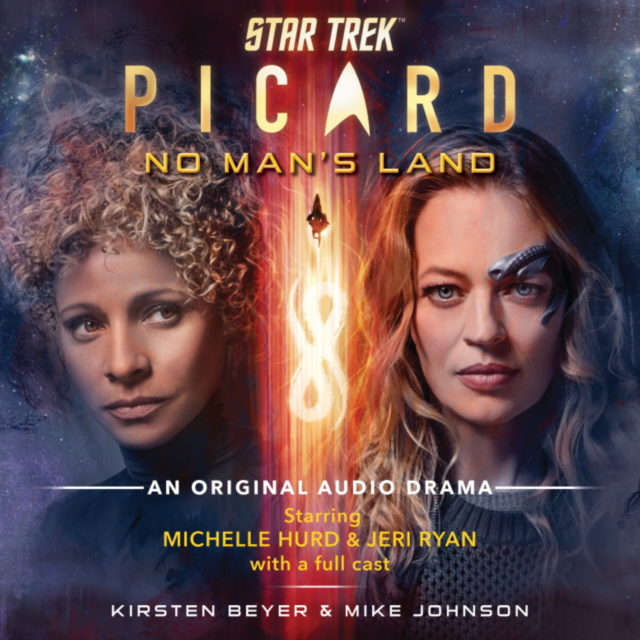
TREK REVIEW: Star Trek: Picard - No Man's Land


Whetting the appetite for Picard's imminent second season, No Man's Land is a rare foray by Trek into the medium of the full-cast audio drama. Given that other franchises, most notably Doctor Who, have created huge and successful lines in audio, and that Trek audiobooks (as in readings of prose rather than actual audioplays) are an established product, it's odd that there have been so few of these over the years.

Given how well it works, No Man's Land could very well kick off a whole new direction for Trek fiction. Picard and Discovery writer, and Pocket Books author Kirsten Beyer joins with comics writer Mike Johnson to work in this new medium. At just over an hour-and-a-half long, it's nicely paced, and a good deal happens, with plenty of audio-only action and tension. First and foremost, though, this is a personal drama, focusing on character relationships, primarily the two leads. Michelle Hurd and Jeri Ryan star as Raffi Musiker and Seven of Nine respectively, picking up their screen roles and building on them. Much of this is to do with their tenuous new romance, teased at the end of the last episode of Picard's first season.

While it was good to see a same-sex romance on Trek, especially between two older women (a rarity on television still), it did seem to come out of nowhere, especially as Raffi and Seven hadn't interacted all that much on screen before then. No Man's Land redresses the balance, exploring their feelings for each other and convincingly portraying the two women as nervously falling for each other. It's no whirlwind affair; both Raffi and Seven are damaged by their previous experiences and are cautious in making new connections. Much of Raffi's personal background was hinted at on screen, and explored in more detail in the Picard novel The Last Best Hope. Seven's post-Voyager life, on the other hand, remains quite mysterious, and while the audio sketches in some details, there's plenty of room left for the TV series to explore more without worrying about contradiction.

The lack of visuals really hammers home just how different Ryan's performance is to her Voyager days. She simply doesn't sound the same after twenty-plus years, and the older, more human but even more guarded Seven is a distinctly different, yet recognisable, version of the character. Aside from exploring her reluctant attitude to relationships, the story delves into her history with the Fenris Rangers, the still virtually unknown power that has taken over some of the Romulan Empire's former sphere of influence. While they remain quite mysterious after this, the impression we get is of a loose alliance of various life forms trying to keep some sort of order in a dangerous region of space.

The plot concerns the Rangers bringing Seven back into service to help them track down a figure from her past, who, inexplicably, appears on galactic records going back centuries. A brutal Romulan warlord, one of many vying for power in the region, is stopping at nothing to discover his secret, and the Rangers are trying to prevent him gaining more power and destabilising the quadrant further. We're introduced to some fun characters in the Rangers' employ, including Deet, who comes across as quite a Star Wars-style character with his peculiar voice and language. The authors generally resist the urge to have characters over-describe what they're seeing – a common mistake in audio – which pleasantly leaves the alien characters' appearances up to the listeners imagination.

In spite of a strong performance by the remaining cast, this is solidly Seven and Raffi's story, and the plot exists to service the emotional storyline as the two women work out what it is they want from life and each other. If there's a complaint, it's that the music is sometimes intrusive, but largely the sound design works well and helps make the production recognisably Star Trek. While it's not essential listening, it's an enjoyable and satisfying story that is, fundamentally, about love.

Thursday, 17 June 2021

WHO REVIEW ROUND-UP: The Gates of Hell (Out of Time 2)

The first volume in the Out of Time trilogy gave us the irresistible team-up of Tom Baker and David Tennant. Now we get something we've seen before: Tennant teaming up with Peter Davison. The last time, way back in autumn 2008 (which seems like yesterday but was actually almost thirteen ruddy years ago), there was a wonderful frisson from having Tennant meet his favourite Doctor on screen. In "Time Crash" Tennant was clearly sharing the screen with his hero, remaking his role as his own and paying tribute to it (along with a script from Steven Moffat, who also cites Davison as his favourite Doctor). Now, though, there's even more of a buzz to it: for the first time, father-in-law and son-in-law share a Doctor Who adventure playing their own versions of the same character.

As such, there's a different feel to The Gates of Hell than to "Time Crash." This is two men who know each other well, playing off each other in a familiar, comfortable way. Both are, by now, so well established as their Doctors that they slip effortlessly into the roles. It all feels terribly cosy.

Nonetheless, this is a better story than Out of Time. David Llewellyn provides a gripping script that utilises the Cybermen effectively (and after the Daleks last time, it was inevitably going to be the Cybermen). The Cybermen are basically a technological version of the living dead, so putting them in a crypt - the catacombs beneath Paris - just works, the same way that having them stomp through graveyards in "The Next Doctor" worked, or having them emerge from graves in "Death in Heaven" did. Cleverly, he uses the two Doctors overlapping timelines as a threat, rather than an awkward social situation, with the collision of two timestreams destabilising history and allowing the Cybermen to rework history to their own design. We end up exploring Paris in various periods of history, from the 14th century to the French resistance, as the Doctors try to undo the damage to the timeline.

Llewellyn's not afraid to chuck in a few fanwanky references. It's fun that the two Doctors remember meeting each other in "Time Crash," and, being in Paris, we could expect the Doctor to reminisce about visiting the city with Romana. I wasn't expecting the Fifth Doctor to mention his previous self's visit to the catacombs in the comic series The Forgotten, though. 

The guest cast in this one are very good, with Mark Gatiss putting in an insidious turn as the villainous Joseph Delon. Glen McReady does a fine job as both his father Marcel and King Charles the Mad. With Gatiss being one of the core group of Doctor Who writers and performers, both for Big Finish and on television, and McCready being a prolific BF semi-regular, it's a bit of an inside gig and a boy's club - and that's before you factor in Nick Briggs, the company's director, once again voicing the monsters. Thank goodness, then, that we have one significant female guest role, and someone pretty new in the role. Shelley Conn has been in one BF release before - Situtation Vacant, eleven years ago - but by BF standards that's practically unheard. Her character, time agent Tina Drake, makes a very likeable pseudo-companion. The only thing that was slightly off-putting was her faux-American accent - not because it was particularly bad, but because it sounds almost exactly like Nicola Bryant's in some scenes, and when the episode opened I just assumed Peri was travelling with the Doctor.

Altogether, a solid bit of Cyber-action, livened up by the interplay between the two Doctors. 


Placement: Both Doctors are travelling alone, and both remember the events of "Time Crash." The Tenth Doctor seems to imply this wasn't too long ago for him, so probably between "Voyage of the Damned" and "Partners in Crime." Finding any alone time for the Fifth Doctor is a challenge, but The Compleat Adventures suggest a gap between The Awakening and Frontios where these stories can happen and that'll do (unless the Doctor really does bugger off for years while he's meant to be dropping off the Gravis).

Monday, 14 June 2021

WHO REVIEW ROUND-UP: The Ninth Doctor Adventures - Ravagers

SPHERE OF FREEDOM 

CATACLYSM 

FOOD FIGHT

It's still hard to believe that Big Finish have secured Christopher Eccleston for their Doctor Who audios. We probably have the pandemic to thank for that, since, as Eccleston said, it's a paying gig, and the sort that can be done remotely while screen and stage work is in a major lull. Still, I don't think anyone ever seriously expected him to return to the role, and while he's never likely to work for the BBC again, it's great to have him back in any capacity.

What's interesting about this set, which is made up of a single three-part story even though it's presented as three individual adventures, is that the Doctor isn't the brooding character we thought we might get. Given that Eccleston cited the quality of the scripts as a major reason for his taking the gig, it was safe to assume we'd be getting some of the heavier weight stuff he's best known for, all the more since these sets seemed to be set before the beginning of the 2005 TV series. Many of us expected a Doctor still weighed down by the guilt of the Time War, the broken character we glimpsed in "Dalek" and "The Parting of the Ways." 

What we get, though, is the grinning, goofy Ninth Doctor that it's easy to forget was actually the majority of Eccleston's performance in the role. This is the Doctor who has a powerful lust for life. Yes, this is his way of avoiding facing his past, and there are elements of the damaged Doctor there - a reluctance to trust, a reactive attitude when things go wrong. Overall, though, this a Doctor who's a pleasure to be with, and hearing Eccleston bring him back to life is a joy.

For better or worse, Ravagers is very much a standard Big Finish release. It's easy to imagine any of the Doctors from Fourth to Tenth arriving and having this same adventure. This is hardly surprising, since it's Nick Briggs writing and directing again, so a certain stylistic sameyness is inevitable. Maybe this is better, though, than some epic designed to showcase how different the Ninth Doctor is to the others. The difference comes from Eccleston's performance, not something forced into the story. In time, of course, we're going to be subjected to the rollcall: we've already had meetings with the Cybermen and the Brigadier confirmed, and Eccleston has expressed interest in doing stories with River Song and the Master. We'll get a multi-Doctor story somewhere along the way, and it'll be great to hear this Doctor interact with his fellows (in fact the only TV Doctor we haen't seen or heard meet another incarnation). For now though, this is just a fun adventure, not an exercise in ticking off a list of Doctor Who-must haves, or an event release. Just having Eccleston back is event enough.

Indeed, had this not been Eccleston's big return, it's easy to see this release being overlooked. A timey-wimey tale that utilises alinear storytelling and the characters experiencing events in different sequence, it's sometimes hard to follow due to the lack of any visual or prose clue to tell the times apart. The eponymous Ravagers are an interesting idea but fail to make an impact as monsters. Camilla Beeput is great as Nova, the one-off companion for the story, the sort of gobby young woman the Doctor immediately takes a like to, even if she is a bit of a generic assistant sometimes. Jayne McKenna is solid as Audrey, the sympathetic villain with a very un-villainous name, but she's never going to jump to the top of the memorable villains rundown.

No, this isn't groundbreaking new Who. It's a solid adventure that features Christopher Eccleston jumping back into the role, a return for one of the greatest Doctors ever, and for now, that'll do nicely.


Wednesday, 2 June 2021

WHO REVIEW ROUND-UP: SHORT TRIPS

Before I get on with the review of the very exciting new release The Ninth Doctor Adventures, I thought I'd step back and review some of the releases in the Short Trips series I've enjoyed lately, including two adventures for the Ninth Doctor from prior to Eccleston's return to the role.

BATTLE SCARS


First we go back to series nine of Short Trips, from 2019, for the first appearance of the Ninth Doctor in the range. Written by Selim Ulug, who joined Big Finish's roster of writers on the strength of his winning entry in the Paul Spraggs Memorial Story Competition, it's one of those stories designed to plug a hole in the canon. Back in "Rose," we saw a picture of the Ninth Doctor with the Daniels family, who'd mysteriously not travelled out on the Titanic and lost their lives in 1912."Battle Scars" tells that story, with the Doctor arriving almost literally on the Daniels' doorstep, injured and insensible. 

We find the Doctor very soon after the Time War and his regeneration, possibly right afterwards. It could easily have been nothing more than a fanwanky gap-filler, and while there's nothing wrong with that, it's far more. There are elements of this, of course, with the Doctor even picking up his "Fantastic!" catch phrase, but it's fundamentally an exploration of the futility of war, the damage it causes to an individual and others in their lives, and the difficulty of moving on. There's an extraterrestrial influence as well, but that's just colour. Young Connie, the pseudo-companion for the story, is the standout character. Like all BF's Ninth Doctor stories until Eccleston returned, this is narrated by Nick Briggs, who gives as solid a reading as we've come to expect. His Ninth Doctor is sometimes dead on, sometimes a bit parodic, but overall one of the better stand-in Doctors. Altogether, an excellent trip.

Placement: Very soon after The Day of the Doctor.

HER OWN BOOTSTRAPS


Onto series ten from 2020, and we have another Ninth Doctor story, this one by Amy Veeres. This one tidies up some trailing continuity threads from "Rose" as well, looking at why the Doctor was at Krakatoa just before it erupted (both Krakatoa and the Titanic have been visited by so many iterations of the Doctor and other time travellers it's amazing there's room for any actual historical people at either event). However, it's mostly a standalone story which sees the Doctor tidying up after the Time War and trying to prevent a young scientist from being remembered as a terrible war criminal. Althea Bryce actually ends up being a quasi-companion character, and while it's all wrapped up in a neat paradox, it's a fairly strong character piece.

Placement: Not long after "Battle Scars," with both thematically linked by having the Doctor clean up old Time War weapons. Authorial intent puts the final scene with Rose just after "The Long Game."

DELETED SCENES


Stepping back from the revived series is this Second Doctor story from the tenth run of shorts, a charming little story of fin de siecle filmmaking. It's 1908 and the Doctor and Jamie have arrived in gay Paris, stumbling into the life of one Celine Tessier. Naturally, anyone from such a fine and storied lineage is a boon to any story and it's long overdue that a Tessier is the centre of a Doctor Who adventure. More tragic events lead on from the first meeting, in a gentle but affecting story by Angus Dunican. Cinematic pioneer George Melies also has a major role in the story, and it outdoes "Her Own Bootstraps" by having an entirely different Doctor follow up on events in the epilogue.

Placement: The Doctor is travelling with only Jamie and no lady companion, so presumably between Fury from the Deep and The Wheel in Space, unless it's much later on in the "Season 6-B" era.

FREE SPEECH


Finally we have the last story from series ten, Eugenie Pusenjak's winning entry in last year's Paul Spragg Memorial contest. It's a high concept science fiction story which sees the Tenth Doctor arrive on the planet Skaz, where speaking costs money. Pusenjak takes this seemingly simple concept and explores its every repurcussion. The primary character Aymius finds himself under arrest, having to recount the events of the story under interrogation, but rapidly running out of funds to do so. While he tries to keep things concise and not waste words, if his account runs dry he will be automatically silenced by a tongue chip, a catastrophic result in his situation.

It's an ingenious conceit that allegorises how the voices of the poor are ignored while those of the rich and powerful are always heard. It's a thoughtful but pacey story which sees the Doctor as the instigator of change but doesn't pretend that he has overturned the status quo himself. Jacob Dudman, the main man when it comes to 21st century Doctors for BF, gives a strong and spirited reading of an excellent story.

Placement: Could pretty much happen anywhere when the Tenth Doctor is travelling alone, but dialogue hints it might be shortly before "Smith and Jones" since the Doctor mentions an adventure with Benjamin Franklin in both.

Saturday, 1 May 2021

WHO REVIEW ROUND-UP: Echoes of Extinction (Time Lord Victorious)

 Ah, I was excited for this one. Originally intended for a two-sided vinyl release in November, it was pushed back due to COVID so that at least the shops could be open when the record went out. Having a Doctor Who LP sounds appealing, but since I'd have no way to play the thing I got the traditional download. The idea of Paul McGann and David Tennant meeting sharing an adventure was too tempting to pass up. Then it became clear that they would be experiencing separate but linked adventures, which seemed a missed opportunity, but then we've had a lot of multi-Doctor stories lately so I reasoned it was a different way of approaching it. Still, it seems a bit of a swiz that the two Doctors don't meet at all.

Still, let's rate the story on its merits, not its fannish concerns. Oh dear. Sadly, Echoes of Extinction just isn't terribly good. The central concept, that of a monster haunted by voices that push him to kill is solid, but the execution, if you'll forgive the pun, is unarresting. The second half, with the Tenth Doctor, is more entertaining than the first, largely because Tennant gives a spirited performance while McGann unfortunately sounds unenthused. This has always been a problem of his audios: you can tell when he's enjoying a script or not. There are some fan-pleasing actor choices here too, with Burn Gorman portraying the obsequious Network and Arthur Darvill as a cockney space pirate type, and while they're pretty entertaining, the characters aren't all that great to begin with. Mina Anwar and Kathryn Drysdale are pretty solid, but again, haven't got all that much to work with. Unfortunately, Inès de Clercq is wholly unsuited to her role as the Captain Frye. Is she only in this because she's Darvill's wife?

I'm also unconvinced by this release's inclusion in the Time Lord Victorious range, which is petering out now during its overextended run. The only link to the overall story is the vague similarity of the genocidal monster of this release to the genocidal monsters of the main plot. The Tenth Doctor name drops the Kotturuh and muses that the Eighth Doctor, whose involvement he has become aware of, is about to go through the nasty bits of the Dark Times affair, but it's pretty flimsy. This wouldn't really matter if the story itself was stronger, but as it is, it's all rather forgettable.


Placement: The Eighth Doctor is shortly to experience the events of the Time Lord Victorious range, so presumably for him this is after the Stranded box sets but before He Kills Me, He Kills Me Not. For the Tenth Doctor, it's after the TLV main stories, the most recent being All Flesh is Grass, however, he also mentions his fiance Liz, presumably a reference to Elizabeth I in The Day of the Doctor. On the other hand, they actually married in that story, and he sounds more like he's doing an impression of Elizabeth II, which raises all sorts of questions. On balance, right after The Day of the Doctor, allowing for some clouding of the Doctor's memories of those events.

Friday, 23 April 2021

WHO REVIEW ROUND-UP: Return of the Cybermen

This is the first in, I think, the sixth run of Lost Stories, which began over ten years ago and petered out a few years later when it looked like Big Finish had completely mined the resource of undeveloped Doctor Who stories. Then, the range made an unexpecter return with a pair of stories two years ago, and it looks like there are plenty more scripts to be unearthed from the depths of the Beeb's filing cabinets.

Return of the Cybermen is the original version of what would become Revenge of the Cybermen (Jedi return, but Cybermen can wreak revenge, apparently), which closed out season twelve in 1975. This is the script written by Gerry Davis, co-creator of the original Cybermen, adapted for the new format by John Dorney. Refreshingly, it's presented as what it is: an alternative final story for that season, with no attempt to fit it into existing continuity. There was, apparently, a plan to do this, with a timey-wimey twist at the end, but it was ultimately decided not to go with this, which is a relief. The earlier Lost Stories recreation of "Season 27" misguidedly rewrote original storylines to try to fit in with where Big Finish had already taken the characters, rather than giving us the original ideas as an alternative continuation. I prefer this: a look sideways at what might have been.

The big draw here is having the Fourth Doctor reunited with Sarah Jane and Harry for a new adventure, something which seemed very unlikely to ever happen. Ian Marter, of course, sadly died in 1986, aged only 42, while we've just had the tenth anniversary of Lis Sladen's death. While Sladen reprised the role of Sarah Jane Smith for Big Finish in her own series, before doing the same for the BBC, by the time Tom Baker finally decided to join BF she was too ill to continue and died soon after. Yet we now have a new season twelve TARDIS team, with Sladen's daughter Sadie Miller taking on her role, and BF stalwart Christopher Naylor playing Harry Sullivan. 

It's really rather a beautiful recreation of this classic team. While it was never going to truly recreate the combination of Baker, Sladen and Marter, it comes remarkably close. Miller sounds similar to her mother, of course, but occasionally, just occasionally, she sounds exactly like her, and it's spooky. Naylor, on the other hand, does a fine impression of Marter that never sounds like a send-up. Both are fine audio actors and do their forebears proud. Tom Baker, of course, is on fine form as always as the Doctor. He never seems quite as enthused with these straighter sci-fi stories as with the sillier ones, but he never fails to give a spellbinding performance. 

Not that Return of the Cybermen isn't silly. It's marginally more sensible than the version that reached the screen, but not by much. It still relies on the conceit that the Cybermen, having developed a terrible weakness to gold, would elect to go straight for an asteroid covered in the stuff, and that's just the start of their illogical actions. Still, this version, which has no Vogans on their planet of gold, is a bit more reasonable, although the asteroid we get, populated by what sounds to be a lost colony of South Africans, isn't exactly the most enticing setting for the climactic sequences.

Events on the Nerva Beacon are rather more gripping, with some excellent performances by the guest cast. I particularly enjoyed Nicholas Asbury's gruff interpretation of the station commander, a real no-nonsense spacedog. The music and audio effects provide a very 1960s feel to events. There are a lot of recycled elements from Davis's earlier scripts, too, such as the Doctor's reliance on his 500-year-diary (straight from The Tomb of the Cybermen) and the Cybermen's extreme vulnerability to radiation (The Tenth Planet). It would have been derivative in1975, but they would have gotten away with it then, while an audio presented to fans who've watched and heard this stuff over and over it seems repetitive. Still, at least there's consistency, even if it does hammer home just how many weakness the Cybermen have. 

I don't think Return of the Cybermen will top many best-of lists for BF this year, but it's a pretty solid, enjoyable adventure made special by the performances of the lead cast. In any case, it's a better, more coherent story than the one that replaced it, an let's be honest, even that old nonsense is a lot of fun.

Saturday, 3 April 2021

WHO REVIEW: Masterful


Finally got round to getting the special Big Finish release Masterful, released in January to celebrate the fiftieth anniversary of the Master's first appearance in Terror of the Autons in 1971. And a special it is – a three-hour extravaganza featuring no fewer than ten iterations of the Master, with five actors reprising their roles as the archvillain from TV, including the first ever appearance of John Simm as the Harold Saxon incarnation in a BF audio.

Following The Two Masters a few years ago and then the first double-Master story on TV with "Twice Upon a Time"/"The Doctor Falls," BF have gone a bit Master-mad lately, with multiple incarnations turning up in Doctor Who audios, The Diary of River Song and more. Before Simm, they managed to get Sir Derek Jacobi and Michelle Gomez back on board with their own series, and even sorted out the remaining rights issues that let them bring Eric Roberts onboard as the TV Movie incarnation of the villain (with his own box set just released as I write this). I haven't listened to all of these (money and time being something of a stumbling block when it comes to BF's gargantuan output) but it's hard to see how they could outo Masterful for sheer Masterly magnificence. There's a lot of Masters here so I'm going to go with Tumblr-style notation to tell them apart.

The basic idea is that Simm!Master invites as many of his past incarnations as he can reach to his big evil castle on his own planet at the edge of the universe, to announce that he's conquered reality and finally killed the Doctor (intriguingly, both he and Missy are familiar with the Thirteenth Doctor). He is joined by the incarnations played by Geoffrey Beevers (the crispy Master), Alexander Macqueen (BF's own resurrected Master), Roberts!Master, Jacobi's War Master, the Ainley!Master and even a teenaged incarnation, seemingly the very first, pre-regeneration iteration of the character, played by newcomer Milo Parker. Presumably this is an older version of the child Master we saw played by the William Hughes in "The Sound of Drums," who died tragically 2018, and will one day grow up to become the alleged "First Master" played previously for BF by James Dreyfus (notable by his absence since BF has ditched him for extreme TERFiness). Into this crashes Missy, who was very specifically not invited.

If you think the Doctor's incarnations rub each other up the wrong way, then sit down for the Master's inter-regenerational bitching. The character is so fuelled by a combination of arrogance and self-loathing that the different incarnations simply can't stand each other, and can't be trusted to not kill off their own past and future selves, regardless of the temporal paradoxes this would ensue. Notably, young Milo!Master, who has dreams of stamping his power-mad ideals on the universe, can't believe his future selves' callous disregard to life; the earlier Masters are all horrified by Simm!Master's sheer vicious brutality; and all the male Masters are utterly embarrassed by Missy, likening her to a "drunken aunt at a wedding," while Missy claims she's simply the first one to admit she'd mad and start enjoying it. Simm!Master is particularly furious to see Missy there, since he now thinks he's at the pinnacle of his existence and doesn't need to ever become her.

Things rapidly become more complicated. The Roger Delgado incarnation – the original, you might say – is conspicuously absent, which is a bizarre move in a production designed to celebrate his beginning this enduring character. I understand the deluxe version of this release includes a special audiobook featuring his incarnation, Terror of the Master, but his absence is sorely felt. Storywise, though, it's because he's just smarter and more cautious than most the others, and when the time scoop comes for him, he pushes Jo Grant in there instead. It then turns out that the Ainley!Master actually sent Kamelion in his place. When that lunatic is more cautiously sensible than you are, you've really got to rethink your approach. In both Kamelion and Master form he's voiced by John Sessions, who varies from parodic to spot-on depending on the line, but Ainley!Master really isn't all that important to things as they go on.

Of course, you should never trust the Master even if you're the Master, and it turns out that Simm!Master, in his desperation, has nearly destroyed the entire universe and almost killed himself in the process, and has brought his earlier selves here to feed on their regenerative energies. This is a bit of a fool's errand considering several of them are squatting in stolen bodies, or falling apart altogether, and will of course create universe-threatening paradoxes, but with reality falling apart anyway I don't suppose it matters. Missy takes control of both Kamelion and the time scoop and scatters everyone throughout time and space (although it turns out they're all in a fairly small area of chaos created by Simm!Master's machinations).

The success of this story is all in the interplay of the characters and iterations of said characters. For the most part, the Masters are paired off, but each thread treats them differently. The most effective, for me, was the thread following Beevers!Master. I'm not entirely certain where in his timeline this is intended to be – it could be the original incarnation between Delgado and Ainley, or a reverted version from after Ainley or even after Roberts – but it doesn't really matter. Beevers!Master finds himself stranded on a world almost abandoned, somehow fitted with a perception filter which gives him a normal, even handsome appearance and dulls the pain of his viciously injured body. He meets a woman named Kitty (Abigail McKern) who has her own secrets, but the two settle down together at her house and develop a real rapport that slowly develops towards love. Beevers gives an incredible performance that really makes you feel for this most sadistic of Master's, and makes it clear that his cruelty is his lashing out at a universe that has inflicted such terrible pain on him. It's a similar story to the seminal BF release Master, but with the addition that the Master knows exactly who he is and what he'll be going back to if he leaves. It's absolutely heartbreaking. Plus he calls himself Jeremy, which is hilarious. Into this precarious situation comes the Roberts!Master, slinking around and whispering seductively to Kitty, doing his best to gently turn her against his other self. It's a subtle performance by Roberts and one that makes me look forward to hearing more of him returning to his movie character.

Meanwhile, the Macqueen!Master finds himself in a desperate situation on a colony ship that's lost its way and is running dangerously low on food. It's great to his this camp smooth-talker again, after far too long an absence from BF, as he tries to turn things to his advantage but continually finds events working against him. It turns out the captain of the ship is the Milo!Master, and the two end up in a game against each other, trying to get and keep control of the ship – and it turns out that Macqueen!Master's more ruthless approach may actually be the best thing in the long run. The War Master and Simm!Master are forced to team up in a "Gridlock"-styled world that has been devastated by Simm!Master's interference. The interplay between the two successive incarnations – who amusingly start referring to each other as "dad" and "son" – is brilliant, with the War Master particularly disgusted by his near-feral future self. The War Master has been characterised by BF as the most sophisticated, and most humane of all the incarnations, which makes his turning to violence all the more disturbing when it happens. In comparison, Simm!Master seems barely in control of himself.

It's appropriate that of all the companion characters who could be included in this story, Jo Grant was chosen. She was, after all, there at the beginning of the Master's story in 1971. Katy Manning is always a treat to listen to, and she pairs up well with Culshaw's Kamelion, who takes the form of the Third Doctor for a time, giving the Doctor a presence in the story without actually involving them. Better, though, is later in the story when Jo teams up with Missy. It's a similar pseudo-companion relationship to Missy and Clara in "The Witch's Familiar," with the added element of a lot of history between the characters. Jo spends much of the time trying to get Missy to admit that, in spite of their enmity, she and the Delgado!Master were quite fond of each other, and that maybe there's something decent under the surface of the Master's angry and controlling demeanour.

Alongside all this is a side story with Mark Gatiss returning as the Unbound Master, happily ruling his own little universe and popping over to make sure the devastation sweeping the primary universe doesn't infect his own. His suave incarnation has some lovely, albeit rather incestuous interplay with Missy, and he begins by pretending to be the Doctor (something the Master seems to enjoy throughout his incarnations). He ends up saddled with Kamelion, but his storyline doesn't fully resolve or intersect with the rest so is a bit wasted. There's also an inevitable, but ultimately rather pointless, cameo by Gina McKee as the Lumiat, Missy's goodie-goodie successor.

While it's made by the bitchy interaction between different versions of the Master, who are considerably more different than each other than the Doctor's regenerations, there's a deeper story here. The Master's self-hatred becomes all the more apparent as the various incarnations turn on each other, with Missy's eventual revelation that she manipulated events so that her other selves had the opportunity to redeem themselves tying into this nicely. While this has to be before her redemption arc on the series proper, it's clear that Missy is already beginning to wonder if there's something more to her existence than evil and ambition. Combined with the revelations of the nature of the wave of destruction sweeping the universe, though, this makes the Master a tragic figure, doomed to play out the same pointless, self-destructive patterns of behaviour throughout their lives, never to find peace. While it's contractually impossible for BF to use the current Dhawan!Master, his reverting to furious evil and the seeming death wish he displays follow on perfectly from where we leave Missy at Masterful's catastrophic outcome. Inevitably this entire story disappears up its own paradox, being written out of reality like a time-travelling episode of Star Trek: Voyager, but the examination of its central character still hold. You'll come away feeling rather sorry for the old bastard.

Friday, 11 December 2020

WHO REVIEW CATCH-UP: Out of Time


Out of Time is the first in a trilogy of audios from Big Finish, which are each going to be released a year apart - pretty restrained for the company, who normally chuck out a major box set every couple of months when there's something significant to shout about. Each one features the Tenth Doctor teaming up with a classic series incarnation, and a fan favourite monster. Next year we'll have The Gates of Hell with David Tennant and his father-in-law against the Cybermen, followed by Wink in 2022 with Colin Baker and the Weeping Angels. 

First though is Out of Time itself, which sees Tennant team up with Fourth Doctor Tom Baker. This is, of course, a big thing, with the two most popular Doctors by any reasonable measure joining together for an adventure. This doesn't, however, automatically mean it's going to be any good, although you'd at least expect it to be pretty entertaining. Which, in all fairness, it is. It's a slight story, more of a runaround than anything, but then again, does a release like this need to be anything else?

The Tenth Doctor pops in for a visit at the Cathedral of Contemplation, a huge, mysterious structure outside of time where anyone from any era can attend for solace. He's in a mood because he's avoiding his impending regeneration, and has gone there on his big holiday before facing The End of Time. However, the Fourth Doctor is already there, having picked up a temporary travelling companion in the form of Private Jora (Kathryn Drysdale), a young deserter from the 26th century.

There's some enjoyable farce as the Tenth Doctor avoids (poorly) letting on who he is to his earlier self, while secretly hoping he'll work it out. It doesn't take Four too long to get the measure of him, and he pretty quickly squashes Ten's sulk about the future. Four's meeting himself in a new form, and for him, it's confirmation that he'll survive, whereas for Ten regeneration is death. 

However, Jora's space commander dad turns up looking for her, followed by a phalanx of Daleks, leading to the two Doctors working together to run rings around them as they plan to use the temporal powers of the Cathedral to invade the Earth and win the war. The Doctors' eventual victory is pretty cunning. 

While there's nothing really unusual or outstanding here, it's a pretty fun little adventure, livened up by some wonderful chemistry between two beloved Doctors who, for the most part, keep on the right side of self-parody while doing a bit of a best-of performance. And after all, isn't that why we're here anyway?

Best Lines:

 "More like apres-deva-vu: knowing what's going to happen but only after it does. Maybe it's always like this when I run into them... well, I wouldn't remember."

"Old school? I prefer to think of myself as classic!"

Placement:

For the Fourth Doctor, in the period between The Deadly Assassin and The Face of Evil. For the Tenth Doctor, during the gap between The Waters of Mars and The End of Time, but presumably after the Time Lord Victorious period. For the Daleks, the 26th century, in the Second Dalek War that followed Frontier in Space - except that they're Time War Daleks, so presumably travelling back along their own timeline, which ties into the events of the novel Prisoner of the Daleks.

Monday, 7 December 2020

WHO REVIEW CATCH-UP: Missy Vol. 2


Has there been too much of the Master lately? Big Finish, BBC Books and others have out out a hell of a lot lately, and the fans have too (hey, I've contributed to some of it). Missy's appearance on the TV series seems to have kicked off a fan obsession with the character, with the various iterations and regenerations appearing more often than ever before, with multiple multi-Master events as well. It could easily see the character becoming overused to the point of sickness, but for now, I'm enjoying the extra adventures for the character. (We've even got Eric Roberts back, although I'm way behind on the various releases.)

Of all the incarnations, it's Missy who's the easiest to imagine having her own adventures, as a sort of wicked pseudo-Doctor. I've not picked up the first boxed set from BF, but the second one was recommended to me as having some irresistible ideas. This is true, but the execution isn't quite there.

THE LUMIAT

The real draw of the set, "The Lumiat" sees Missy acting out her most vicious plans in an attempt to get the Doctor to pay her some attention. However, when a mysterious time-travelling woman turns up to fix things, it's not the Doctor at all, but someone calling herself the Lumiat, and she knows an awful lot about Missy and her plans. 

The big spoiler: the Lumiat is Missy's next incarnation, having come into existence when Missy utilised a desperate gambit to create a new life cycle when she was left for dead on the Mondasian colony ship in "The Doctor Falls." Sh'es a sort of anti-Valeyard, by her own admission, being all that's good from Missy manifested (incidentally, the way they talk about the Valeyard makes it sound like Missy's got a crush on him). Gina McKee puts in a good performance as the Lumiat, who's just similar enough to Missy to be believable as a future incarnation, but she does inevitably come off as a basic Doctor-clone sometimes too. 

To be honest, I'm amazed the Beeb signed off on this. The inference of the story is that the Lumiat is immediately prior to the Dhawan Master, although there's plenty of ambiguity, and there's also a get-out clause regarding the process of her regeneration disconnecting her causally. For now, at least, this is the official story for the Master. The episode itself isn't anything spectacular, but it does cast a fascinating light on Missy (here clearly prior to her appearance in series eight) and how she changes over the course of the programme.

 BRIMSTONE AND TERROR

A direct sequel to the first box, with Missy once again involved with two plucky Victorian schoolchildren for whom she had played governess. Of course, I haven't heard this, but the story itself lays everything out so it's very easy to follow. Missy as an evil boarding school headmistress is pretty irresistible, and she's relentlessly entertaining. The kids are fine, I guess, but there's only so much plucky well-spoken enunciation that I can enjoy. Dan Starkie is as fun as always as Strax, posing as "Mr. Strackie," and this episode apparently ties into one of the Paternoster audios. It's a nice tying together of the expanding Victorian era of the spin-offs. On the whole, pretty good fun.

TREASON AND PLOT

The strongest story of the set, "Treason and Plot" sees Missy stuck in London in 1605 in time for the great Gunpowder Plot, doing her best to unstick history so that the Time Lords will turn up to fix things, allowing her to make her escape. However, a probationary Time Agent named Rita Cooper turns up and does her utmost to keep history on track. It's a great runaround with the plot constantly twisting as Missy tries to divert history and Rita tries to put it back. The least continuity-laden of the episodes, it works better for standing alone. Ony Uhiara is great fun as Rita, and I could easily see her turning up in future audios.

TOO MANY MASTERS

On paper, this is a great idea. The Monk and Missy meeting up (for the second time after a previous adventure in the first set, and again, plenty of exposition here to bring me up to speed), each one trying to pin the Master's former crimes on each other. Rufus Hound is still brilliant as the latest incarnation of the Monk (the third? I'm really not sure) and he could honestly make the transition to the TV series. 

Unfortunately, this is also the latest of BF's recent obsession with the Ogrons, the worst possible aliens for lengthy dialogue on audio. Fair play to the actors involved for trying, but extended speeches by people doing painfully slow "I'm...not...thtoopid...I'm...just...an...Ogronnnnn..." voices becomes unbearable after about five minutes. Didn't get anywhere close to finishing this one. A really shoody end to an otherwise pretty entertaining boxed set.

Sunday, 29 November 2020

WHO REVIEW CATCH-UP: Stranded vol 1

The latest of Big Finish's Eighth Doctor boxed sets, Stranded is set to be another four-box series comprising sixteen linked stories which will play out over the next couple of years. I've let these slip over the last few years; Dark Eyes started very promisingly but carried on too long and lost focus, although it was enjoyable throughout, while Doom Coalition never really engaged for me. I haven't even looked at buying Ravenous, although the write-ups suggest some intriguing ideas. 

Stranded, though, intrigued me from the start. Putting the Doctor in a new, self-imposed exile on contemporary Earth is irresistible. Indeed, I'm surprised the television series hasn't tried it for a year to mix things up while saving costs. Expense isn't such an issue for Big Finish - setting a story on Skaro costs the same as setting it in Croydon - but the dramatic potential is promising, and it certainly makes for a new direction for the series. And let's be fair, Doctor Who audios could do with some new and interesting ideas lately. The series features the Doctor living with Liv Chenka (Nicola Walker) and Helen Sinclair (Hattie Morahan), his now stalwart companions, in a converted house in London (amusingly converted to flats after his old companion Thomas Brewster sold it). The TARDIS, meanwhile, is just a police box, sitting on a street corner and turned into makeshift mini-library.

Of course, the Eighth Doctor's been here before, back in the BBC Books "Earth Arc." This is quite a different take on exile for him, though - the books had the Doctor living without his memories, spending over a century on Earth and very much alone. There are similarities, though - the Doctor searching for his old life (which he knew he was missing before, even if he couldn't remember it), feeling increasingly isolated, and occasionally almost crossing paths with other iterations of himself. This time there's no risk of him bumping into the Third Doctor during a previous exile, but the Twelfth Doctor's subsequent self-imposed exile is finishing around now. The Eighth Doctor's life was always marked by a complex timeline where past and future threatened to intercede.

Plus, it's 2020 now, and Big Finish are making a bold and deliberate move of support to the LGBT community by having a new companion who happens to be trans enter the scene, and engage in a same-sex relationship with an existing companion. This is good, important stuff, and I'm pleased we're seeing moves like this now, even though we're not quite there on TV (in spite of the attacks on "wokeness" the series is getting).

LOST PROPERTY

The big draw of this set, of course, was the inclusion of Tom Baker as the Curator. There's absolutely no ambiguity about his identity at all anymore - this is the Doctor, far in the future, although just how far is endlessly open to question. The Curator, it seems, spends much of his retirement tidying up after his earlier selves and keeping them out of trouble (shades of Merlin there).We meet Ron (David Shaw-Parker), who lives at the Doctor's house on Baker Street with his husband, and also happens to work at the local lost property office, run by an alien named Midge (Robert Portal). The Curator uses this as a sort of sorting office for the various bits of extraterrestrial bric-a-brac he and other travellers have left lying around. The Twelfth Doctor has given Midge a Pandora Bolt, a security device that instils fear and paranoia, which then comes into Ron's possession and affects those living in the house.

It's a slightly contrived set-up (like that's unusual in Doctor Who), but one that works very well as a way to introduce the various new characters that inhabit the Doctor's reduced world. In honesty, not much happens during the episode, but that's kind of the point. This is a mundane story - mundane as in worldly, rather than dull - concerned with the ordinary battles and relationships of everyday life. The Doctor, of course, is singularly inept in this area, so Liv and Helen are left to do much of the everyday work and engagement. There are a lot of characters introduced, just like it would be moving into a new flat in a busy house. Among the most notable is Robin (J.J. Davison), a teenaged boy who has just moved in with his dad and almost runs away. The Curator talks him out of it, and in time (over the course of the set) he develops a pleasant friendship with the Doctor. 

Some of the best moments are between Helen and the Curator - hilariously, Helen theorises that he's an incarnation of River Song - and naturally between Helen and Liv, who are both more suited at Earthly life than the Doctor and lost in time. (Helen being from the sixties and Liv from the far future.) The little oddities of early 21st century life are fun to view through their eyes, but there's the ongoing theme that people really aren't all that different whoever they are.

WILD ANIMALS

While she's introudced in the previous episode, Tania's main involvement in the story begins here. Played by Rebecca Root, she comes across as a very ordinary but perfectly charming woman, and there's the beginnings of something close between her and Liv almost straight away. While Liv and Helen integrate into the household, the Doctor continues to struggle with a mundane (in both senses) life, and his sanity is already suffering. When someone is violently attacked in a local park, the Doctor sets it upon himself to solve the crime and bring the assailant to justice, which does not put him in the good books of the police. The Doctor is depressed and desperate for some adventure in his life, but even when it comes to crime and "real" adventure, he is spectacularly unsuited to human life. It's a rare story where the Doctor has to face the limitations of his abilities. There's some real tragedy in this episode, not least when Liv is shot in an entirely pointless altercation. On the plus side, in hospital she and Tania finally ask each other out, and Liv - being from a more civilised century - is entirely unphased to learn that Tania is trans.

MUST-SEE TV

Respect to Big Finish for not thinking that merely making a character trans was enough to autmoatcially make her interesting. While Tania appears like quite an ordinary person, she has a secret life, as evident from the end of part one. Tania, it turns out, works for Torchwood, and has been placed at Baker Street to keep an eye on the Doctor. Torchwood are well-informed enough to realise that the Eighth Doctor is too early in his timeline to know about them, and equally that this means he must be protected or their own existence could be compromised. She's assisted by PC Andy (Tom Price) who fits perfectly into the set-up and adds a solid comedic element to the story. After two episodes mostly concerned with the everyday problems of life on Earth, the sci-fi side picks up here, with the mysterious Mr. Bird moving in and tinkering with their tellies to undertake shifty surveillance. It's solidly entertaining, but least effective of the set.

DIVINE INTERVENTION

This final episode starts off with the joyfully mundane, as the Doctor wins a ton of cash on a quiz show (and, wonderfully, thinks he'll be allowed to go back and do it again next week) while Liv and Tania plan a romantic dinner date, to which the Doctor then invites himself and the entire household in an attempt to build the community. It's fun sitcom stuff that sees the Doctor finally settling in, so naturally it can't last. His presence on Earth for so long has led a group of aliens from his own personal future to track him down, who intend to take him out before he can influence their timeline and cause their ruin. This is, of course, paradox on top of paradox, and that's just the sort of thing the TARDIS needs to provide a burst of temporal energy to kick start its regeneration. So, an end to the exile is in sight - in three boxed sets time, of course. The sudden intrusion of alien assassins during a major dinner is fun,  and after the strained attempts to keep life "normal" in "Must-See TV" is effective, but the first two episodes, which were largely concerned with more realistic concerns, were stronger. "Divine Intervention," and the set as a whole, work, but I fear the promise of the original concept is already being lost. We shall see - it's certainly enough of a success to make me want to pick up Stranded 2.