Showing posts with label dinosaurs. Show all posts

Friday, 26 July 2024

Television Heaven update

Evening all,

I've a bunch more reviews over at Television Heaven this week.

First, we have the adventures of sleuth, magician technician and all-round know-it-all Jonathan Creek.

Then we join Michael Kitchen as Hastings' finest in WWII crime drama Foyle's War.

Then, having been just announced for a relaunch, I revisit the groundbreaking prehistoric documentary Walking with Dinosaurs.

You may also have missed some classic Tom Baker Doctor Who reviews. Gothic classic Pyramids of Mars introduced the terrible Sutekh, who returned to plague the Doctor in the latest series. A few years later, the Doctor was recruited by another godlike entity to search for the cosmic Key to Time, a season-long quest I've divided into part one (featuring The Ribos Operation, The Pirate Planet and The Stones of Blood) and part two (featuring The Androids of Tara, The Power of Kroll and The Armageddon Factor).

That's it for the moment, while I knuckle down to some fiction.

Tuesday, 21 June 2022

REVIEW: Jurassic World Dominion


I don't really get the poor reviews Dominion is getting. I can absolutely agree that a sixth film in the franchise was unnecessary, but then, no sequels were ever really necessary or could hope to match the original Jurassic Park. Even Chrichton's The Lost World struggled to justify its existence in that respect, and the film version even more so. Dominion is about making a comment on the modern world and the commodification and exploitation of science, and the lengths to which those on the top of the capitalist world will go to to ensure their own dominion. That's what it's about, but it's not what it's for. It's there because we want to see characters we like running away from dinosaurs, because that is entertainment.

So no, I don't get the vitriol, because Dominion kept me thoroughly entertained throughout. On a purely visual level, there were elements here that surpassed anything that has gone before in the Jurassic Park saga. The raptor chase through Valetta – utilising the Atrociraptor mainly, I feel, for the cool name – is a fantastic juxtaposition of visuals and a truly breathtaking action sequence. Sights of dinosaurs sloping into town, a Brontosaurus blocking a highway because it just doesn't know where it's found itself, are beautiful (and far more effective than the T. rex-does-Godzilla attempt of The Lost World). The impossibly vast Quetzalcoatlus – inflated beyond even the giraffe-sized creature's natural scale – providing a hazard to aircraft is what this series is all about. Plus, we finally had proper feathered dinosaurs, the imaginary science of the films catching up with the real science of palaeontology, which has revolutionised our understanding since the novel was originally published.

It was fitting for the film to bring back the original three leads of Jurassic Park. I've said it before, but it's never really, truly a Jurassic Park film without Sam Neill as Dr. Alan Grant (one of the reasons I have a soft spot for the much maligned Jurassic Park III). Some viewers disliked that Grant, now old, bearded and solitary, is a rather lost figure at the beginning of the film, but it's absolutely fitting that he would gravitate back to the familiar world of fossil hunting, the last bastion of the world before dinosaurs walked again. He retains strong chemistry with Laura Dern's Ellie Satler, who gets to shoulder most of the trio's half of the film. Satler was always the most impressive of the characters when it came to surviving in the Park, and it's only right that she gets much of the limelight here.

Having been wasted in a cameo in Fallen Kingdom, Jeff Goldblum gets to play Dr. Ian Malcolm for real again. While he does, as always, play himself, Goldblum is able to make Malcolm into a character again with a genuine reason to be involved, instead of just a celebrity stop-off of quirky delivery. This half of the film, which stays resolutely away from the other side for much of the runtime, gives the old guard a chance to shine, without the newbies overshadowing them. There's able support from Mamoudou Athie as Ramsay Cole, the turncoat PA and communications head at Biosyn, who puts in a classy performance. Making Lewis Dodgson the villain was a clever idea. While it was a shame to have to recast him (but look, no one is going to work with Cameron Thor, if he was even out of prison in time to film it), Campbell Scott makes for a suitably nefarious billionnaire. Linking him back to the character who was barely seen but was ultimately behind the chaos of the first film is a great touch, especially since Dodgson was such a major character in the novels. Here, he comes across as less of a scientist than in the books, and more an evil Jeff Bezos or Elon Musk. Which is to say, a Jeff Bezos or Elon Musk.

Frankly, the classic characters overshadowed the Jurassic World crew. Chris Pratt still remains a likeable presence as Owen Grady, but by now his Velociraptor whisperer schtick is getting a bit old. Still, he handles the action scenes excellently and has great chemistry with Isabella Sermon. As the teenaged clone Maisie Lockwood, Sermon steals her scenes: a gobby, angry posh girl with an entirely justifiable chip on her shoulder due to her unique and unexplained past. Bryce Dallas Howard does well as Claire Dearing, especially in her action scenes where she portrays a tangible desperation (the slow escape from the Therizinosaurus is one of the most nail-biting moments in the franchise), she lacks chemistry with Sermon and, surprisingly, with Pratt.

DeWanda Wise, on the other hand, has palpable chemistry with Pratt. So much so, in fact, that the only way to keep her character Kayla from falling into Owen's arms is to make her gay. Kayla could be a stock action film character – she's a daredevil pilot, a criminal finding her principles again, etc. – but Wise has enough charisma to carry the part off and make her a success.

Are there problems? Of course there are. While keeping their storylines linked but separate for so long helps, the film does feel overstuffed two sets of heroes: six adult leads and one child is a lot to juggle. This means some elements feel a little cut short: Grant and Satler's revival of their relationship seems a bit forced, and Maisie's discovery of her mother is swamped by the many other elements jostling for attention. The monstrous locusts work as an immediate threat, but not a world-ending catastrophe. Surely even a company as powerful as Biosyn would be investigated if their crops were the only ones not being threatened by this sudden and impossible strain of genetically-engineered insects?

The fight between the Giganotosaurus and T. rex is presented as being a climactic moments, but neither has had much impact on the film by that point, and so feels unearned. While there's something more to it if you know that this is the same T.rex Grant, Satler and Malcolm faced in the original film, nothing is made of this in the film itself. In the end, I was cheering more for the poor, blind, herbivorous Therizinosaurus than either apex predator, but the final fight fell flat. The similar battle between T.rex, Indominus rex and the Mosasaurus, that this was clearly meant to evoke, worked far better, even if it was more far-fetched (even the utterly mismatched Spinosaurus vs. T.rex fight in JPIII was better).

There are some huge logistical problems with the set-up, of course. Supposedly, all these dinosaurs are roaming loose after they escaped from the house at the end of Fallen Kingdom – really, all of them? Even the Brontosaurus that clearly couldn't have fit in there? Even the Mosasaurus that lives in the bloody sea? Dr. Wu's redemption is nice, but far too easy, with the final end of the film feeling anticlimactic.

In spite of those hard-to-swallow pieces, this was a cracking dinosaur movie. Anything that presents a dinosaur black market, complete with dinosaur smugglers and trained raptor attack dogs, in the bowels of the Maltese capital, with a truly gorgeous, beaten-up old Carnotaurus as the main attraction, is a winner in my book.


Tuesday, 19 April 2022

Doctor Who: The Fossilist

 If you like Doctor Who adventures featuring the Sea Devils and remarkable women from history, why not try this story written by James P. Quick and myself for The Doctor Who Project?


Wednesday, 8 September 2021

Catching Up

 It's been a bit quiet on the blog of late, due to the amount of real life stuff I'm dealing with right now. Unfortunately, the day job is using up an awful lot of my energy lately, and combined with the amount of time I'm spending on my own mental health it's leaving me with less time and oomph to write.

With that in mind I've been trying to prioritise certain works above others, but that does mean both the blog and my Vocal projects have been a bit ignored. But there will be a whole bunch of reviews coming soon, and some new fiction too. In the mean time, I've got a selection of new articles and reviews over on Television Heaven:

That classic nineties puppet-based prehistoric satire, Dinosaurs;

The recently finished and absolutely delightful Atypical;

To tie in with the Paralympics, the beautiful historical TV film The Best of Men;

The powerful and heartbreaking It's a Sin;

The latest in my season-by-season overviews, Buffy S2 and The X-Files S6;

and some classic Doctor Who serials - The Ark, Vengeance on Varos and The Greatest Show in the Galaxy.


Wednesday, 6 January 2021

Mary Anning Rocks

 There are only eight days left to fund the Mary Anning Rocks campaign, raising funds to give the great fossilist the memorial she deserves by building a statue in her honour in her home town of Lyme Regis. 

Designs are completed for the statue, which will, if funded, sit in the Jurassic Coast of Lyme Regis, Dorset. If you'd like to help commemorate one of the greatest palaeontologist of all time, still so unfairly overlooked by history, then click here to read more and donate. (Look, David Attenborough has backed it, and you can't argue with him.) 


Wednesday, 1 July 2020

2020 Dinosaur News (May/June)

TROODON NO MORE?


I'm clearly behind the times, because it look like Troodon, a well known and beloved genus of theropod, has been declared an invalid genus. And this was deduced back in 2017, apparently! Still, it only seems to be making its way into public consciousness now. While it's a stinger, it's not really too surprising. Troodon has been a mess since it was first named in 1856, based on nothing but a serrated tooth. Originally classified as a lizard, then a megalosaurid (like almost every predatory dinosaur at one time or another), in 1924 it was considered that Troodon was a carnivorous pachycephalosaurid. I'm old enough to remember books still calling it a unique meat-eating ornithischian, even though this was pretty much thrown out by 1945 (books on dinosaurs tended to take a long time to bring themselves up to date). Of course, now omnivorous ornithischians are accepted in the early development of the order. 

Stenonychosaurus was a quite well known theropod in the 80s and 90s, before being considered a junior synonym of Troodon (the same thing happened with the family Saurornithoididae and Troodontidae). In 2017 it was suggested that the original specimen of Troodon being just a tooth, was undiagnostic, and referred all species back to Stenonychosaurus, although since, some have been pulled to a new genus, Latenivenatrix. This has been challenged, though, by others stating that Troodon formosus, the type specimen, should be the valid name, considering that Stenonychosaurus went unused for so many years. In either case, it seems that the family Troodontidae, and even the subfamily Troodontinae, are going to remain the favoured names.

ARCTIC EDMONTOSAURUS


Edmontosaurus (formerly also Anatosaurus and Anatotitan) is one of the best-known ornithopods from the late Cretaceous, known from two species: the earlier E. regalis and the end-of-Cretaceous E. annectens. Now, an international team has concluded that the Alaskan genus Ugrunaaluk is a third species, E. kuukpikensis. Edmontosaurus was already known to have ranged far and wide across North America, but this pushes it further north than generally supposed, into what was already the Arctic north. While it wasn't as cold in the Arctic in the late Cretaceous as it is now, it still shows that Edmontosaurus was able to adapt to a variety of different habitats. The Japanese genus Kamuysaurus is a closely-related hadrosaur that spread into Asia on similar latitudes, showing that Edmontosaurus and its closest relatives were a hugely successful group of herbivores and among the most common dinosaurs of the period. "The caribou of the Cretaceous" at SciTech Daily

TRANSITIONAL CERATOPSIDAE

Two transitional genera of chasmosaurine ceratopsids have been identified from fossils in New Mexico, bringing light to the evolution of this branch of late Cretaceous dinosaur diversity. The two new genera show a clear pattern of development from the well-known Pentaceratops known from 75.3 million years ago, which had notably tall frill with a distinct, deep notch in its centre. An as-yet-unnamed example from 100,000 years later shows the frill notch deepening, while 100,000 years later still the new Navajoceratops sees the frill close up over the notch. By 74.6 mya, Terminocavus sees the frill begin to close up fully, and it finally heals over in Anchiceratops at 71.5 mya.

The precision of dating the genera is remarkable and illustrates a clear lineage. I wonder, though, it the new genera will be folded into Pentaceratops and Anchiceratops following further analysis. Sci-News.com


RUNNING IN CROCS


South Korea, the prehistoric tracker's heaven, has revealed an array of fossil tracks over the years, but a recent discovery has upturned established facts about crocodylomorphs. A group of tracks that clearly show bipedal locomotion - and were originally hypothesised to be from a large pterosaur - have been re-identified as the ichnogenus Batrachopus, a genus reserved for crocodile-related tracks. While there are many bipedal genera of croc relatives known from the fossil record, they all date back to the Triassic period, dying out in the mid-to-late Triassic in a major extinction event. Before this, crocodylomorphs were the dominant reptile group, with a huge variety of forms, but after the max extinction most were replaced in their niches by dinosaurs. 

These tracks however date back 113 million years to the early Cretaceous, over 100 million years after we'd expect to find them. While the exact genus of croc that left the tracks isn't known, it shows that more diverse crocs survived in some regions far later than originally thought. Scientific American Nature (for more detail)

MONSTER EGGS

Back in 2011, Chilean scientists discovered a strange, ovoid fossil in the Antarctic rocks. It was nicknamed  The Thing, but after years of analysis, it has been conclusively identified as the egg of a marine reptile. Julia Clarke of the University of Texas was the one who finally deduced it was a soft-shelled egg, of the type lain by lizards and snakes. At 11.4 by 7.9 inches it's absolutely huge and the first fossil egg to be unearthed in Antarctica. It's larger than any dinosaur egg save for that of the elephant bird, and even that was only slightly larger and much thicker-shelled. Clarke and her fellow palaeontologists has deduced it's egg of a mosasaur, a gigantic marine lizard, which explains the similarity to modern lizard and snake eggs, but it's far larger than nay soft-shelled egg ever seen before. It's also a surprise since it was hypothesised that mosasaurs gave birth to live young, an idea now thrown into doubt. The formations where the egg was found have previously turned up fossilised mosasaurs and plesiosaurs of various stages of development, so it seems it may have been a sort of marine reptile birthing ground and nursery. 

The mosasaur egg has been given the taxonomic name Antarcticoolithis bradyi. Syfy Wire

Saturday, 2 May 2020

2020 Dinosaur News (Jan to April)

Quite a few interesting bits of palaeontological news have crept out during the last couple of months, and since I haven't done a palaeo post for a while, let's have a look.

SPINOSAURUS

Spinosaurus aegyptiacus is one of those dinosaurs that has had major revisions in its reconstruction since it was first unearthed in 1912. As with most large dinosaurs, remains of Spinosaurus tend to be very incomplete, so the species has been reconstructed using elements from related genera, gradually being refined as more Spinosaurus remains are discovered. (The type fossil getting destroyed in WWII bombings didn't help much either.) Over the years, the largest theropod has been re-envisaged as a crocodile-like predator that ate mostly fish, comfortably walked on all fours and lived a semiaquatic lifestyle, although this was style pretty hypothetical.

However, recently unearthed fossils show the Spinosaurus tail for the first time, and this shows not the slender, tapering tale known from most theropods but a great big fish-tail. The tail bones show a deep, paddle-like appendage, like that of an eel or newt. As Samir Ziouhri, who heads a team at Casablanca's Hassan II university says, "This tail is unambiguous. This dinosaur was swimming." The full Nature article goes into a little more depth, but this is a major breakthrough in our understanding of dinosaurs, and continues to illustrate just how diverse non-avian theropods were.


S. aegypticiacus econstruction by Mario Lanzas

DAKOTARAPTOR


Something I hadn't realised at all until I saw an Instagram post the other day by palaeontologist Emily Keeble (Deinonychusfloof) is that the huge and rather popular dromaeosaurid Dakotaraptor steini is a chimaera. To explain: in palaeo terms, a chimaera is a fossil that's actually cobbled together from a mix of animals' remains. Sometimes they're deliberate fakes, but usually they're happenstance combinations of remains. It appears that part of the holotype fossil for D. steini is actually from a turtle, which throws the whole analysis of the species into question.

Dakotaraptor has been described as one of the last of the dromaeosaurid dinosaurs, living at the very end of the Cretaceous in the same ecosystem as Triceratops and T. rex. It's also one of the largest, coming close to the biggest of the dromaeosauridae, Utahraptor and Achillobator. It's been tricky to pin down its exact relationship to other dromaeosaurids though, and this could explain why. It's already been suggested it's actually synonymous with Acheroraptor, which was named slightly earlier, so it's possible Dakotaraptor will be scrapped as a valid genus in any case.


OCULUDENTAVIS


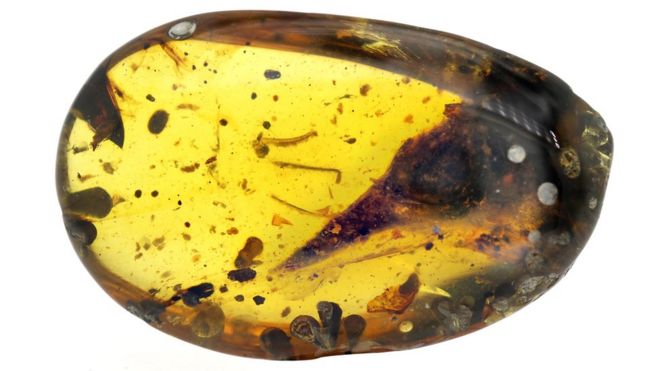
This one was a snappy news story: the tiniest ever dinosaur outside of Aves, the true birds. Oculudentavis khaungraae was found as a complete skull, only half an inch in length, preserved in Burmese amber. Initially it was described as a basal avialan, which is to say, a bird in the broadest sense (how exactly to define a bird is a tricky question), only slightly more advanced than Archaeopteryx (which I still consider closer to the dromaeosauridae than avialae in any case). If it was a bird-like dinosaur, it would have been about the size of a bee hummingbird, which is the smallest bird, and therefore smallest dinosaur, known.

However, as soon as the description was published, a number of palaeontologists pointed out that the odd mix of primitive and advanced features didn't so much look like an unusual bird but a lizard-like reptile, throwing the whole thing into question. A lot of living and extinct lizards have evolved bird-like skulls, and Oculudentavis seems to lack some of the features that define theropods. So sadly, as interesting a find as this is, it's almost certainly not a wee little dinosaur.

MASSOSPONDYLUS

Everyone loves a baby animal, even a long dead one, so here's a piece on the European Synchroton Radiation Facility and their X-ray of a dinosaur nest. The sauropodomorph Massospondylus carinatus left a nest of eggs 200 million years ago, and now we can see the tiny little baby dinos. The embryos were about 60% through their development, and appear to develop in much the same way as both modern reptiles and birds.


Saturday, 22 February 2020

Dinosaurs of the Museum fur Naturkunde


This is what you see when you enter the Hall of Dinosaurs. The size of the thing.


The Allosaurus fragilis with his head through a window.


I pegged this as a Dryosaurus, but it's a close relative, Dysalotosaurus


The Elaphrosaurus, a relative of my favourite dino Carnotaurus, as shown by his stumpy arms.


Diplodocus carnegii


Brachiosaurus keeps his head down here so you can actually see it properly.


Because getting the whole thing in is a bit of a challenge.


Because Brachiosaurus brancai aka Giraffatitan is just enormous.


The comparatively small Dicraeosaurus


Kentrosaurus also shares the central display


And the skull of Stygimoloch (perhaps a young Pachycephalosaurus?)

Berlin it to win it

I got back this morning from a short trip to Berlin, my birthday present from the lovely Suzanne. We spent three nights on Turmstrasse in Moabit, not far outside the Mitte neighbourhood. We had a brilliant time, it was only a pity we couldn't stay longer. We arrived on Wednesday afternoon and chilled out for a bit, before heading out for some snacks and beers in the local cafes and bars. We might have had a few too many of the beers, in retrospect, as we didn't manage to get up until midday. However, we did have an excellent night, especially once we found our way to a craft beer place run by a barmaid who could somehow keep fifteen tabs straight in her head. We made some friends and crashed a Tinder date, and sampled some very good beers. A couple of shots, too. That might explain the missed morning as well.

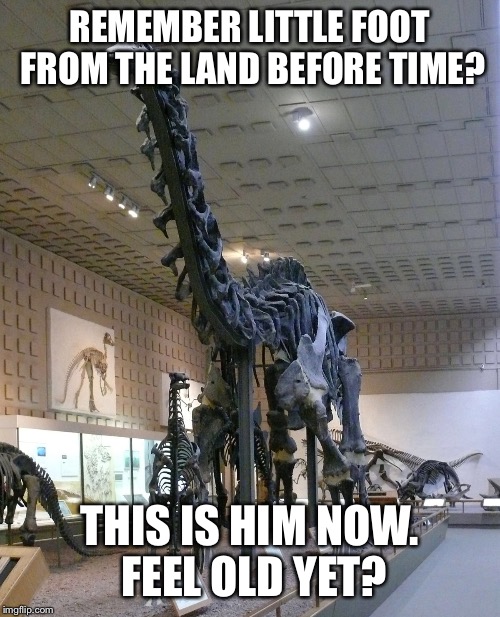
Once we managed to get ourselves out of bed, we walked along Alt-Moabit to Mitte to visit the Museum fur Naturkunde, one of my main reasons for wanting to visit the city. One of the best natural history museums in the world, the Berlin museum is famous for holding the largest mounted fossil skeleton in the world: the great Brachiosaurus brancai. Also known as Giraffatitan (respect to the museum for sticking with the traditional classification), this gigantic beast was uncovered in Tendaguru, Tanzania and is 13 metres tall. It shares its central podium with a Dicraeosaurus and a Diplodocus carnegii, the latter a cast from the Carnegie Museum specimen. That's the same as Dippy, currently on tour from the London NHM, and its incredible that the huge dinosaur that usually dominates that museum's entrance hall is dwarfed by the brachiosaur. Dippy is longer, but doesn't have the sheer size of the brachiosaur.

I got plenty of snaps - I'm not photographer, so not everything came out well - including the Allosaurus, Elaphrosaurus, Dysalotosaurus and Kentrosaurus. I got too excited explaining the significance of the Berlin specimen of Archaeopteryx lithographica to remember to get a pic of it. Plus there were some plesiosaurs and sundry pterosaurs (Flugsauria!), a huge gallery of taxidermied animals, including extinct species such as the thylacine and quagga, some alarmingly large models of insect and spiders and a gigantic display of organisms preserved in jars of ethanol.

Other than the dinosaurs, which I got far too excited about, the best part of the museum was the Earth and Space room, which had a huge display unit projecting the evolution of the universe, suspended over a sort of sofabed. The excitable kids made it, although my back didn't survive quite intact, it was a lot of fun. Plus I learned that the German for Crab Nebula is Krebsnebbel, which is not only hilarious itself but when run back through Google Translate comes out as Cancer Fog. (Also, German for seal is seehund, which is adorable.)

This wasn't the only bit of culture we took in. Friday was our sightseeing day, thanks to a hop-on/hop-off tour bus which took us right into the heart of Mitte. We got off to see Checkpoint Charlie and the Berlin Wall Museum that sat at the old site, which provided a brilliant multimedia experience that really brought the bizarre situation in Berlin in those days too life. It's weird to think that was just over thirty years ago, well within living memory of many people in the city. We were, appropriately enough, staying in the old British Zone, but nowhere in the western part of the city is far from the line with the east. Suz and I can just remember the Wall coming down, but we were very young indeed and the significance we pretty lost on us back then. It certainly looks pretty American around there now, with KFC and McDonalds immediately dominating the road across from the museum. We focused on currywurst, kebabs and waffels while we were in town. (We also accidentally ordered a mixed grill for four at McDarwich, but we salvaged the remains for later snacking.)

We followed the Wall with the Spy Museum, which wasn't very secret at all, but was fascinating and a lot of fun. The dressing up area was a bit poor, since the spy look seems to be just my normal hat and coat (I thought about swapping my hat for a less well-worn one, but they were all tagged.) The history of spies and cryptography is astonishingly long, though, and there was a lot to learn among the kid-friendly activities.

It's a shame we didn't have more time for a few more museums, but we also wanted to get in plenty of restaurant and chilling out time as well. We're definitely planning on going back, now that we vaguely know our way around and have a better idea of where else we want to see. There's enough museums to keep us busy for a couple of weeks at least. And plenty of beers and currywurst still to try.

(Photosauruses to follow)

Saturday, 15 September 2018

Now available - "The Fossilist"

My latest bit of fanfic is now available at The Doctor Who Project. The Fossilist is my third short for the site, the second written with my talented friend James P. Quick. I'm really rather pleased with this one.

The Fossilist features the TDWP Ninth Doctor and Silver, along with the noted amateur palaeontologist Mary Anning. I previously wrote for the Basil Rathbone-inspired Ninth Doctor in City of the Dragon - his penultimate adventure and my first contribution to TDWP. Anning is something of a hero of mine and I hope we did her wonderful story some justice with this silly adventure.

If you enjoy it, there are some notes at the end which give you a little insight into how James and I work together and how the story developed.

Also, there are dinosaurs in it. Lots of them.


Saturday, 30 June 2018

REVIEW: Jurassic World: Fallen Kingdom

Finally got round to catching the fifth Jurassic Park film, and it was very good fun. I can't pretend that it brings much to the franchise that Jurassic World didn't, although the final scenes hint at a possible game change for the Jurassic universe. So, spoilers within, pretty much straight away.


Colin Trevorrow said that he couldn't keep the series confined to theme parks, and this is exactly the right decision. Jurassic World revamped the concept of the original Jurassic Park by going back to the theme park, only bigger and better, making it a success so that it would come crashing down all the louder. While nothing beats the original film and novel, Jurassic World was a brilliant update. The Lost World followed Jurassic Park by both letting the dinosaurs have the run of their island environment, and then dragging them back to civilisation (although the novel which is superior, remains confined to the island). Fallen Kingdom follows this development closely, albeit with new twists.

Left to their own devices at the end of the previous film, the dinosaurs are now threatened as Isla Nublar is about to erupt in a volcanic cataclysm. The complete re-extinction of the Dinosauria is imminent (someone may have to remind me what happened to the B-site, Isla Sorna, and why there are no dinosaurs left there). Revealed is Sir Benjamin Lockwood (James Cromwell - always god value), the little known partner behind John Hammond's genetic experimentation. He now plans a rescue operation for the dinosaurs. Naturally, it's up to Claire and Owen, that plucky pair from Jurassic World, to go bring in Blue the last Velociraptor and the other dinosaurs to safety. Lo and behold, there are others who want the dinosaurs for less noble reasons: the trade in dinosaur soldiers is a potential goldmine.

Bryce Dallas Howard and Chris Pratt retain the fun chemistry they had in the previous film. They fit the classic pattern of couples from action movies: obviously into each other, plenty of sexual chemistry, but blatantly incompatible. They need life-or-death situations to make a relationship work. Claire has developed between the films, now part of a dinosaur rights group. Owen, on the other hand, is building a house and not spending much time with anyone. It's their mutual concern for the dinosaurs that they bred, trained and displayed that takes them back to the island, and the script isn't afraid to point out the hypocrisy.

There's a solid cast at work here. Owen and Claire get a new pair of sidekicks, Zia the palaeoveterinarian (Daniella Pineda, exceedingly cool, very sexy) and Franlyn Webb, IT guy and hacker (Justice Smith, geeky, nervous and relatable). Kind of disappointed they didn't bring Lex back from the first film to be their computer person and get some retro 90s graphics in there, but still, I liked these two. Rafe Spall is excellent as Eli Mills, Lockwood's right hand man and a happily ruthless and ambitious bastard. Toby Jones does his usual sterling work of playing a slimy creep, appearing as a sort of arms dealer who sells the dinosaurs Mills has secured. Ted "Buffalo Bill" Levine fulfils the tough commando role, and we have a cute spunky kid in the form of Lockwood's granddaughter Maisie, played by Isabella Sermon. 

Linking back to the original trilogy are B.D. Wong as Henry Wu, still designing dinosaurs for profit and falling on the wrong side of scientific ethics, and Jeff Goldblum back as Ian Malcolm in much publicised appearance which ends up being little more than a cameo. It's completely in character that he should be calling for the dinosaurs to be left to die, given that he was vocally against their creation to begin with. Nonetheless, he's essentially wasted in his appearance here.

It all works very nicely, and marches along much as you'd expect until the dinosaur auction. Taking place in Lockwood's mansion and estate late at night, there's a gothic vibe not present in the previous films. The franchise's newest monster, the Indoraptor, stalks the corridors in a way that's far more evocative of horror films than the usual action adventure style of the Jurassic films. On the subject of the newest mega-dinosaur, I rather prefer it the over-the-top I. rex, although given that she was meant to be part raptor anyway I'm not sure this new one stands out conceptually. Still, a maddened raptor monster trained to kill with maximum efficiency makes for a potent threat, and is kept under wraps long enough to maintain interest. 

Still, I was more excited to see the proper dinosaurs, especially as my two favourites finally make an appearance on the screen. First a Baryonyx emerges from a tunnel within the disintegrating island, and then a Carnotaurus comes barrelling along mere moments later. No match for the T. rex, of course, but I love Carnotaurus, the ugly bastard. Blue, the last raptor, is a fully fledged character here, gaining as much sympathy as any of the human characters, and the T. rex, still the very same old girl from the first film, owns all her scenes. I'm pleased that the sixth film is said to have no more mutant dinosaurs, and that it will be focusing on dinosaurs living in the wild as they escape and spread across America. No doubt humanity's time as the dominant life form is meant to be the fallen kingdom of the title, but I'm not quite sure how long term and drastic this change will be, given that the dinosaurs are all female (although they've circumvented that before), and most species are represented by a single individual. Nonetheless, it's a change in direction that should make for an interesting (final?) installment. 


Thursday, 11 May 2017

There is no dino, only Zuul

How's this for a news item that combines my interests? Palaeontologists in North America have released their newest discovery, an astonishingly complete ankylosaurid dinosaur fossil that they have named Zuul in honour of the monstrous Terror Dog from 1984's Ghostbusters. The find is exciting because complete dinosaur fossils are rare enough, but a complete ankylosaur is virtually unheard of. Zuul has the first complete skull and tail club ever found for an ankylosaurid, and includes many osteoderms - the lumps of bone that were embedded in the skin and used as armour. These usually wash away over time due to being disconnected from the main skeleton.

Given the resemblance of the ankylosaur's skull to the horned face of the Ghostbusters monster, the discoverers named the species Zuul crurivastator. The specific name does not mean "ankle biter," as some outlets are reporting (for a start, this thing was huge), but "shin destroyer," in reference to that great tail weapon. 

The LA Times has a video of Dan "Ray Stantz" Aykroyd with the fossil.


Wednesday, 17 June 2015

Park Attractions: Velociraptor

The first in a series of articles on the animals featured in the Jurassic Park franchise. The JP films are monster movies and not intended to be wholly accurate, but it's fun to look at the real dinosaurs that inspired them and see how they compare.

Appearances: Jurassic Park, The Lost World, Jurassic Park III, Jurassic World
Mounted skeleton of the Velociraptor

While T. rex is the big draw of the franchise, the Velociraptors are the real stars. Not terribly well known before Jurassic Park, Velociraptor is now one of the most notorious and popular dinosaurs. The word "raptor," originally an old Greek word meaning thief, predator or plunderer, used to be used primarily to refer to birds-of-prey. Nowadays, when someone says "raptor" they're almost invariably referring to Velociraptor or one of its close relatives.

The raptors in the films are particularly exaggerated for dramatic effect. The real Velociraptor was a medium-sized predator, about two metres/seven feet long and half a metre/a foot-and-a-half tall. The raptors in the films are over twice the size of this, standing eye-to-eye with humans. The movie versions are in fact more similar to Deinonychus, a related genus (both are part of the dromaeosaurid family). The Deinonychus was larger, although not quite as large as the JP raptors, and had a deeper muzzle more akin to the movie versions. Part of this is down to when Crichton wrote the original novel; at the time, Deinonychus was considered another species of Velociraptor. The iconic fossil being excavated at the beginning of the story is found in Montana, in the range of Deinonychus fossil sites, while the Velociraptor is only found in Asia. So really, what we're seeing in the JP films is a Deinonychus, not a Velociraptor.

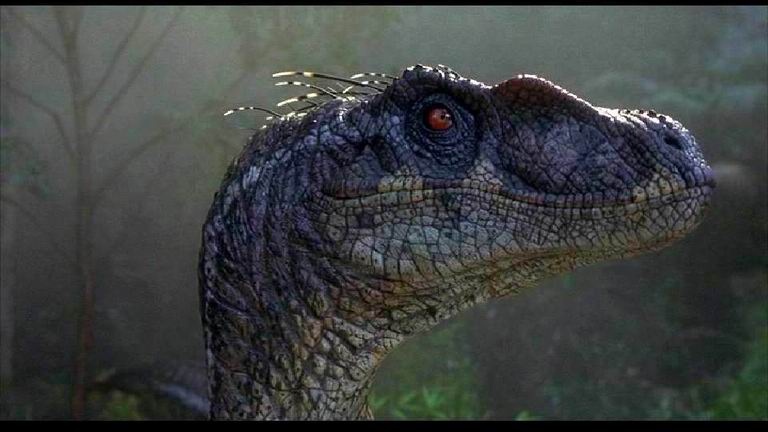
The somewhat amended JP3 raptor.
In 1991, another related American genus was discovered: the Utahraptor, an even bigger dromaeosaurid with proportions more similar to the raptors already being developed for the first film. Utahraptor gave the JP raptors a credibility boost and has become one of the most popular dinosaurs itself. Dromaeosaurids are considered some of the most intelligent dinosaurs, characterised by pack behaviour and large brain cases for their body size. However, it's all relative; raptors probably weren't much more intelligent than an average bird species today.

The most significant difference between the real Velociraptor and the JP raptors is in their appearance. When Jurassic Park was being filmed, the appearance of the dinosaurs was, with some dramatic licence, close to contemporary scientific knowledge. Over the following few years, however, a rush of excellently preserved fossils has shown that most coelurosaurian dinosaurs had feathers for warmth and/or display, with some, including the dromaeosaurids, having well developed feathers akin to modern flight feathers. Dr. Alan Grant had to confront a kid whining about the Velociraptor skeleton looking more like a six-foot turkey. He was more right than he knew (and a six-foot turkey sounds pretty terrifying to me). By 2000, the feathered dinosaur was becoming recognised enough that some limited quills were added to the heads of the scaly raptors of JP3, but they've been returned to a fully scaled look for Jurassic World. Part of this is for easier audience recognition, and mostly just because the filmmakers think it looks cooler. There is a handy line in JW covering the discrepancy, though: Dr. Wu points out that all the dinosaurs at the park are hybridised with other species, and that in nature they would "look quite different." Plenty of fans have theorised that the frog DNA used to patch the codes, which was such a major plot point in the first story, made the raptors bald. It would have been a nice touch if, by the time of Jurassic World, they'd started using duck DNA instead because it was a closer match. And it would have stopped them changing sex...

Another myth to be busted: the terrifying image of the Velociraptor slashing open its prey's belly, leaving the guts to flop out. No one is certain, but simulations with sculpted claws and pork bellies make it unlikely that the claw was sharp enough or curved correctly to slice open flesh that way. What seems more likely is that packs of raptors would team up on larger prey, using their sickle claws to pierce the flesh and hang on while they used their razor-sharp teeth to viciously bite at the flesh. The prey would most likely have died of blood loss even if they had managed to shake the raptors off. Much of the time, Velociraptors would have preyed on smaller animals, either around their own size (such as with the famous battling dinosaurs fossil of a Velociraptor and Protoceratops in a clinch), or much smaller, and they would also have scavenged. Not that this makes a pack of raptors any less of a terrifying prospect.

A classic shot from the first JP


For all the changes made for the books and films, one thing Crichton was dead right on was stressing how bird-like the Velociraptor was. It's clear now that the dromaeosaurids were very closely related to the earliest birds; indeed, some definitions include them as birds (it's very much a matter of semantics). Early dromaeosaurids were tiny animals, extremely bird-like, some of them, such as the abundant Microraptor, with feathers sufficiently adapted for gliding or posibly even powered flight. The sickle claw seems to have initially evolved as a climbing aid for aboreal species, later being becoming weaponised as some branches of the family re-adapted to a terrestrial, predatory lifestyle.

Finally, I'm afraid that the wing-like forelimbs of the Velociraptor mean that it most certainly would not be able to move its hands in such a way to open a secured door.


Sunday, 14 June 2015

REVIEW: Jurassic World

Nostalgia may rose-tint our spectacles, but it also increases their focus. I was nine when Jurassic Park was released in 1993; I saw it on release and firmly believe it to be an absolutely classic film. Naturally, I was tremendously excited to finally get to see a fourth instalment in a franchise I have followed from the beginning (movies, original novels, junior novelisations, toys, games and all). However, Jurassic World had a hell of a lot to live up to.

There are clear weaknesses in the finished film, even after a decade of script revisions in development hell. The characters are walking clichés, and while the Jurassic Park cast were hardly given the most original characters to work with, they at least felt rounded, and at the time, reasonably new. The rock and roll mathematician and teenage hacker are cheesy as hell now, but in fairness, it was the Nineties. Jurassic World gives us a man's man gamekeeper, and an ice queen career woman who just needs a real man to break down her walls. I have to agree with Joss Whedon's comments regarding the sexual politics of the film; this was par for the course in the Seventies.

But then, I'm not going to see a Jurassic Park film for high art. This is a monster movie, and a very good one. I'm on the fence regarding the inclusion of the genetically hybridised dinosaur, Indominus rex. On the one hand, I agree with Chris Pratt's character, Owen: dinosaurs are “wow enough.” Actual dinosaurs are incredible, there's no need to make up new ones. Yet, it's hard to argue that this allows some spectacular set pieces and pushes the plot into interesting territory. It's hard to swallow a dinosaur intelligent enough to trick the keepers into letting him out, let alone one that virtually has the power of invisibility. The Indominus is an absurdly pimped up beast, from her quills to her gnarly teeth, but as producer Colin Trevorrow has said, this isn't a documentary. It's a sci-fi monster movie. Also, it's not like the rest of the dinosaurs are scientifically accurate, and although I'd rather see feathery Velociraptors charging about, the creatures here all look fantastic. And I do appreciate a brief line from Dr. Wu (BD Wong, the only actor from the first film to return), pointing out that all the dinosaurs are hybrids to a degree, and would have looked quite different in nature.


Jurassic World is an allegory for corporate excess and the commodification of natural resources. This is, to be fair, hard to accept coming from a Hollywood blockbuster with a budget of $180 million. The Indominus was created to tempt moviegoers who have been spoiled by a slew of big budget sci-fi action movies, just as it was created in universe to keep happy the tourists who have become bored with ordinary dinosaurs. Nonetheless, it makes its point, and a subplot regarding the weaponisation of dinosaurs – something that earlier treatments of the film were said to focus on – provides a strong thread, as well as clearly setting up the direction for a fifth film. The movie's plot is completely predictable, every beat signposted, even the final fate of the mighty Indominus obvious almost from the outset. However, sometimes a little predictability works in a story's favour. This is a movie where you just need to sit back and wallow in the spectacle, and spectacular it is. It's a CGI overload, of course, and will age far quicker than the original, which still stands up extremely well today; although it's good to see that puppetry still has a place for scenes of physical interaction.


Pratt is as charismatic as ever as gamekeeper and raptor trainer Owen Grady, even if the role does sometimes come across as an extended audition for Indiana Jones. Bryce Dallas Howard is pretty perfect in the role of Claire Dearing, the park's operations manager. She's fundamentally unlikeable to begin with, until Pratt's character melts her heart and breaks through to the real woman within. Every independent woman just needs a bit of rough with a big weapon, right? Her two nephews, played by Nick Robinson and Ty Simpkins, are both great, although it might have been fun to make the older brother the enthusiastic dinosaur fan and the youngster the disdainful one who needs to be amazed. Vincent D'onofrio does what he does best – the charismatic villain, in this case, the security chief and champion of weaponisation. Smaller roles for Omar Sy, Irrfan Khan, Jake Johnson, Lauren Lapkus and Katie McGrath are all essential, and the entire cast acquit themselves well. Plus, there's a couple of fun little cameos to watch out for, although some kind of inclusion of the late Richard Attenborough would have been welcome.


At the end of the day, though, it's the dinosaurs who are the stars. The Velociraptors, always the heart of the series, have not lost the development they received in Jurassic Park III, and the four trained raptors have plenty of personality, especially the beta, Blue, with her special relationship with Owen. There are some thrilling moments with the tank-like Ankylosaurus, a huge flock of pterosaurs, and the new addition, the sea lizard Mosasaurus. The dino petting zoo is the cutest. The best moments, though, are reserved for everyone's favourite, the T. rex herself. Although it isn't mentioned in the final film, this is intended to be the original T. rex from Jurassic Park, twenty-five years old and not about to let the Indominus usurp her as queen of the park. (And for everyone who complains that no zoo would keep a known man-eater as an attraction, I can tell you from experience that you are wrong.) For all the mediocre writing, throwback sexism and unoriginal characters, this is simply great fun. Any film that end with the biggest and best dino-on-dino fight ever committed to screen is going to leave me satisfied.


Thursday, 28 May 2015

2015 in Palaeontology (so far)

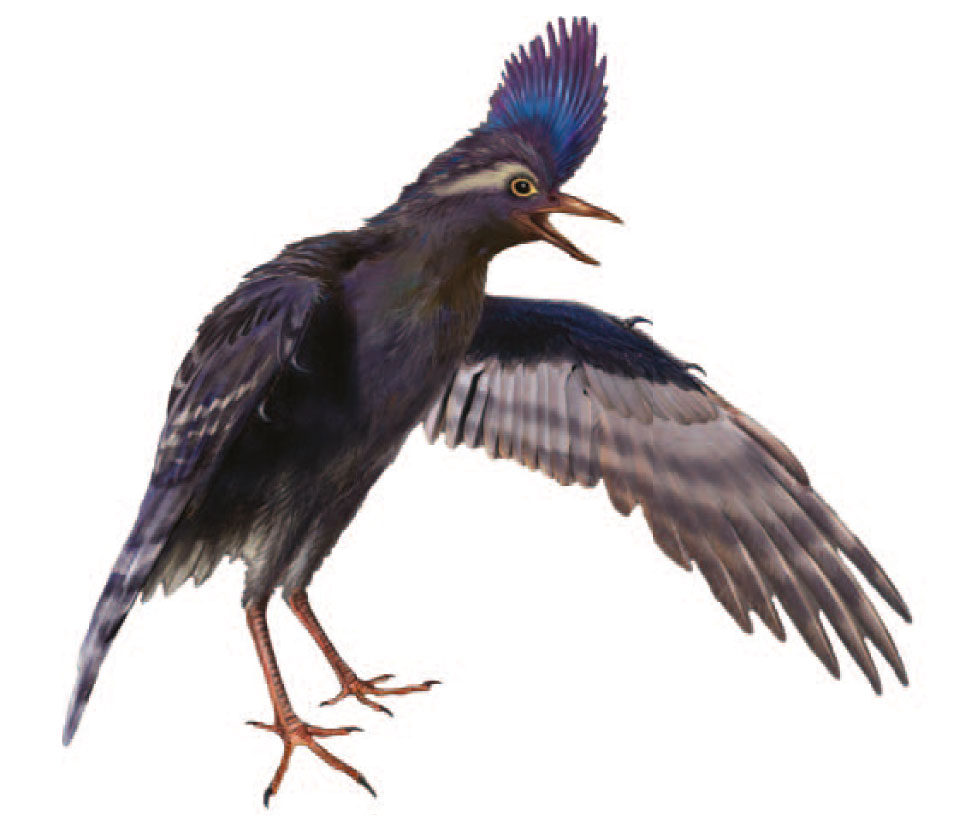
Yi qi

This is the most fantastic discovery this year. Yi qi is a frankly bizarre flying dinosaur that displays features of both birds and bats, an entirely new method of flight adaptation to anything seen before. A member of the scansoriopterygidae, or epidendrosauria, Yi's relatives are extremely birdlike, with complex feathers, but with extended fingers that suggested, at first, that they were arboreal animals, adapted for climbing. Yi is so well preserved, however, that the fossil has revealed skin impressions, including webs of thin skin between the fingers. At first glance, illustrations of Yi look like archaic illustrations of pterosaurs, but this is a genuinely new form of dinosaurian flight - a combination of batlike wings with birdlike feathers. It's unknown if fellow epidendrosaurs shared this feature, but it seems quite likely. It's a fascinating sideline on the evolution of the flight of modern birds.

Microscopic analysis of the Yi fossil has revealed the presence of melanosomes - pigmentation organelles. The dinosaur was mostly coloured black, with yellow or brown feathering to its head. Yi is thought to have inhabited a subtropical environment, and shared it with pterosaurs such as ChangchengopterusArboroharmiya, a tree-dwelling mammal, and archaic salamanders. Yi also has the distinction of having the very shortest generic name of any dinosaur; indeed, its full specific name, Yi qi (meaning "strange wing"), is as short as is permitted by taxonomic rules.

Chilesaurus

This is an odd one. Supposedly, Chilesaurus is a basal tetanuran, roughly ancestral to the group that led to carnosaurs, coelurosaurs and megalosaurs. And yet, it has features from all sorts of different dinosaurian groups. While its features are mostly theropodal, its teeth clearly indicate herbivory. Its pelvis points backwards, as in the Ornithischia, another adaptation for herbivory - more room for a big, fermentory gut. Several theropod families adapted to that lifestyle and developed the bird-like pelvis, including therizinosaurs and, of course, birds themselves. Chilesaurus had strong arms with a large, sharp primary claw, which is found in many "prosauropods." In fact, just looking at it, I'd guess it was a basal sauropodomorph, which are very similar to basal theropods, but the timing is wrong. It's a Tithonian species, late Jurassic... all most odd.

Archaeornithura


An ancient bird, Archaeornithura existed 130 million years ago in the early Cretaceous, and is the earliest example of the Ornithura, the clade of "true birds" that includes all modern birds and many extinct lineages. Although it retained many archaic features, such as clawed fingers, it also displayed several modern characteristics including fan-shaped tail feathers, a familiar wishbone, and an alula - the highly adapted thumb that aids in avian flight. Indeed, it seems to have been an adept flyer, while its long legs and foot structure suggest it also lived as a wader. The discovery of the beautifully preserved fossils of Archaeornithura has necessitated another rethink of bird evolution, since such advanced characteristics were not thought to have arisen so early.

Nebulasaurus

A rather lovely name for a dinosaur, Nebulasaurus. A basal eusauropod, albeit only represented by a partial skull, there's not a great deal it can tell us about early sauropod development. However, it does increase the diversity of sauropod findings in China, the Yunnan region being a particularly fossil-rich part of Asia. Nebulasaurus lived around 170 million years ago in mid-Jurassic.

Carnufex

With a cracking name (meaning "butcher"), Carnufex was a beast of a croc, ten feet long and five feet tall (and not even fully mature at that size). An near-complete skeleton was found in North Carolina, in the Carnian stage of late Triassic rock. An early crocodylomorph, Carnufex is more advanced than the brutish rauisuchians that ruled the early Triassic, but still basal to true crocodilians. It had a long, narrow snout full of serrated teeth, with a skull covered in bumps and grooves that may indicate some kind of horns or other adornment.

Cartorhynchus

An early marine reptile, ancestral to the icthyosaurs, that lived in shallow waters in the early Triassic. Unlike later, true icthyosaurs, Catorhynchus was a small, probably amphibious animal with legs adapted into flippers not unlike those of seals. It had dense bones, that would have helped weigh it down and allowed it to feed on the bottom of shallow coastal waters. It is surmised that it was a suction feeder, hoovering up soft-bodied prey from the seabed. The most primitive animal that can confidently be called an icthyosaurimorph, it helps shed light on the development of the Icthyosauria, which otherwise appear out of nowhere in the fossil record following the catastrophic Permian extinction event.

Yoshi garevskii

In spite of the name, this is not a dinosaur. It's not even a reptile. They used the name Yoshi for a fossil and they didn't keep it for a dino? There should be a rule against that. Yoshi garveskii was a big cat, a Metalurine felid, one of the "false sabretooths" like the more famous Dinofelis. Previusly included in the genus Metalurus, Yoshi was a mid-sized animal, larger than a lynx but not as big as a cheetah, so fairly diminutive for the family. Unlike true sabretooths, which had oversized, blade-like teeth, Metalurines had what might be called medium-sized fangs, conical like modern cats' but significantly larger. The best thing to imagine would be a particularly toothy clouded leopard.

Aegirocassis

I love anomolocarids. Half a billion years ago, the lands were empty but the seas were full of bizarre creatures which have left no descendants. The anomalocarids might have been related to arthropods, like insects and crustaceans, but have so many weird features that no one is really sure what they are. One thing we do know is that they dominated the oceans of the Ordovician period, gigantic predators for their time. Aegirocassis lived 480 million years ago, descended from earlier hunters like Anomalocaris itself and had adapted itself to filter feeding. At over two metres long, it may not sound like a particularly huge beast (although I wouldn't want to meet one on the beach), but it was probably the biggest animal in the world at the time. It was essentially the Ordovician equivalent of the blue whale, only with a shell and tentacles. What a wonderful creature.


Wednesday, 8 April 2015

Bring Back Bronto?

Hitting the science news pages this week is the proposal, by Emanuel Tschopp of Lisbon University and his team, that Brontosaurus be reconsidered as a valid taxon, independent of Apatosaurus.

The story of Brontosaurus, and how it no longer technically exists, is one of the most well-known palaeontological tales. Back in the late 19th century, the so-called Bone Wars raged between rival scientists hoping to make names for themselves in the developing field of palaeontology, particularly with regards to the Dinosauria. As part of this, numerous genera were discovered, but many were in fact duplicates - multiple specimens of the same genera, granted several names. In taxonomy, with some very rare exceptions, the names of taxons are given seniority by publication order. The great bone pioneer Othniel Charles Marsh discovered Apatosaurus ajax in 1877, only for him to rediscover it two years later from a slightly different fossil, which he named Brontosaurus excelsus. Neither specimen was complete, although the second fossil was quite substantial, and both lacked a head. Over time, analysis of the two specimens concluded that, in spite of some differences, they were similar enough to be considered part of the same genus, albeit granted separate species. Apatosaurus was named first, so it had priority, and so Brontosaurus excelsus became Apatosaurus excelsus.


A modern reconstruction of the Apatosaurus, showing Diplodocus-like skull and spines.


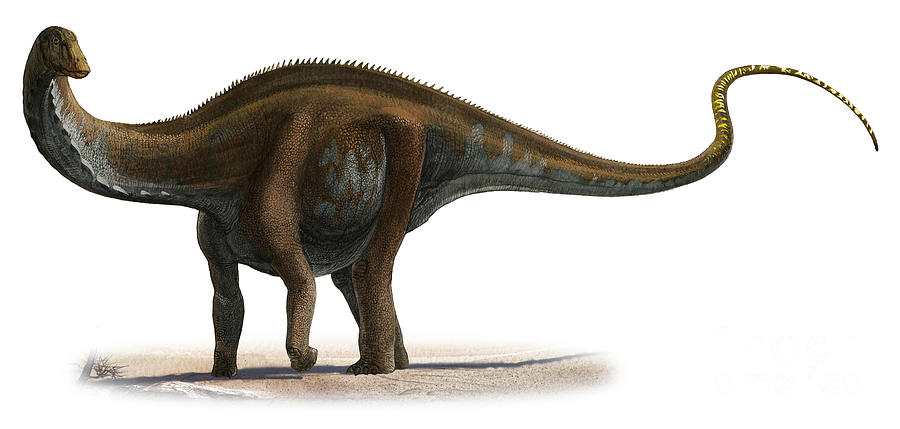
However, Brontosaurus is by far the superior name for a dinosaur, and it is not surprising that it caught on in a way that Apatosaurus never has. Aside from the simple sound of it, the meaning is far more stirring. Apatosaurus has the rather wishy-washy translation of "deceptive lizard," while Brontosaurus has the far more fitting meaning of "thunder lizard," as befits such a mighty beast. When mounting the second specimen at the American Museum of Natural History, Henry Fairfield Osborn labelled it Brontosaurus, perpetuating the name. Brontosaurus became a hugely famous dinosaur, appearing in many textbooks and popular media, in spite of the fact that, according to scientific consensus, it never technically existed. The lack of a skull also caused problems. The creature was far stockier than its close relative Diplodocus, and was reconstructed with a heavy, boxlike skull based on that of the more distantly-related sauropod Morosaurus (itself later recognised as a junior synonym of Camarasaurus). It was years before the correct skull was considered to be similar to the gracile, almost snakelike head of the Diplodocus. Over the years, three more species have been reliably assigned to Apatosaurus: A. louisae, A. parvus and A. yahnahpin.


An outdated reconstruction of the Brontosaurus


Nonethless, Brontosaurus, boxy head or no, has remained a hugely recognisable dinosaur, far more so than the correct name. It even maintains an influence in palaeontological circles. The genus Eobrontosaurus, meaning "dawn thunder lizard," was suggested as an ancestral form, but has itself been absorbed into Apatosaurus (and now Brontosaurus). The Diplodocoidea, the sauropod clade that contains the families most closely related to Apatosaurus, is often referred to as "the brontosaurs" by palaeontologists, purely colloquially. It's an evocative name, and everyone can imagine a brontosaur.

After all this time, however, Tschopp's team's analysis has suggested that there are indeed enough differences between A. ajax and A. excelsus that the latter be removed from the genus and reassigned to its own, resurrecting the name Brontosaurus for scientific use. A similar move occurred a number of years ago when the species Brachiosaurus brancai was removed from the genus and assigned to its own, Giraffatitan. Under the proposal, A. louisae remains, while the other two species are reassigned to become B. parvus and B. yahnahpin.

I remain on the fence; as I've stated before, I'm not keen on the tendency to split similar fossils into dozens of genera, when modern animals feature many species, often with major differences, in the same genus. As this article states, it's really an issue of semantics rather than science. Tschopp's paper is available here and does list a number of differences between the species, and exhaustive analysis that should be applauded. Wiipedia, while never the most reliable of sources, has already moved the species concerned to a new Brontosaurus article, which is a good indication of the direction popular opinion will go. 

Friday, 5 September 2014

Laniakea and Dreadnoughtus

Blimey, this is an exciting time for science geeks. Two pretty amazing discoveries were published in the last couple of days that I have to share here. BIG discoveries.

Firstly, a whopper of a dinosaur. Dreadnoughtus schrani is the newly named BIGGEST DINOSAUR EVER. Well, at least, the largest dinosaur for which we have decent remains. Most of the truly gigantic sauropods leave only a few bones, from which size is estimated based on other, better skeletons. This can, of course, lead to some major disagreements and arguments and a bit of extreme guesswork. However, the skeleton of the new dinosaur is remarkably complete, and palaeontologists are able to estimate its length and mass far more reliably than usual. And they've picked a fantastic name - Dreadnoughtus. Just yells "I am a big dinosaur!" Much data here.

Dreadnoughtus was a titanosaur, which weren't always as vast as they sound but did include some of the most enormous dinosaurs of all. The sample appears to have been 26 metres long (85 feet), and according to the bone growth patterns, it wasn't even fully grown. While some slenderer genera such as Diplodocus grew longer, and some such as Antarctosaurus may have been larger overall, Dreadnoughtus, being so well documented already, gets the crown as the big, fat king of the dinos.


But if that isn't big enough for you, check out Laniakea. Astronomers at the University of Hawaii have charted the distribution of matter throughout the universe and used this data to map the large-scale structure of the universe. Amazingly, they've actually managed to map the galactic supercluster in which our galaxy lies. We've identified distant superclusters before, but charting the part of the universe we're actually in is naturally more difficult. Yet now the bods at Hawaii have done so, and identified precisely where we are in the supercluster, which they have named Laniakea, from the Hawaiian words for "immeasurable heaven." Vaka rangi.

The Local Group is attracted to the nearby (in supergalactic terms) Virgo Cluster, and it and the many other galactic clusters spiral around the Great Attractor, aka the Norma-Hydra-Centaurus Cluster. Laniakea is estimated to contain 100,000 galaxies and is over 500 million light years across. It's gradually drifting towards the Shapley Supercluster, in the whole gigantic system of galaxies stretching across billions of light years. IFL Science has a rundown of the discovery and a gorgeous video of our place in the supercluster.

Sunday, 24 August 2014

WHO REVIEW: 8-1) Deep Breath

There's a moment in Deep Breath where the Doctor, still settling into his new body, faces down the sinister Half-Faced Man and questions its continual replacement of body parts. The desperate droid has maintained its existence for millions of years, but every single part of its body has been replaced, time and again. “There's not a trace of the original you left,” says the Doctor. “You probably can't even remember where you got that face from.” Realisation dawns on the Doctor's own face, the thirteenth he's worn and one that looks strangely familiar to him. He might as well be talking about himself.


The Doctor's comparison of the Half-Faced Man – and by extension, himself – to a broom that has had its handle and brush continually replaced is an apt one, albeit one that brings to mind a classic scene from another long-running BBC series, Only Fools and Horses. The Doctor has changed so many times that it's hard to see how much of the original character is left, even though, in age and character, Peter Capaldi's version is closer to William Hartnell's than any of the eleven in-between. While it can be argued that the Doctor remains the Doctor, underneath the surface trappings, it's harder to say the same about the series itself. In its thirty-fourth season and approaching its fifty-first birthday, Doctor Who has moved far beyond its original conception. There are, however, always links to the past, tying the long history of the show together.


Deep Breath is, simultaneously, a restating of the series' goals and a reassurance to fans of Matt Smith's episodes that this is the same show. Much has been made of this being Capaldi's version of Robot, and much as Tom Baker's first episode reassured viewers by essentially having him guest in Jon Pertwee's series, Deep Breath provides the same service for Capaldi. As well as carrying over Clara as the Doctor's companion, the subsidiary team of Jenny, Vastra and Strax are there to underline the point that yes, this is still Doctor Who, and that strange, angry man is still the Doctor. In fact, Deep Breath goes considerably further than Robot in this regard, providing viewers with something of a greatest hits catalogue of Moffat tricks. The tyrannosaur in the Thames is a visual treat to open the season, and brings to mind the similarly visually rich 2012 episode Dinosaurs on a Spaceship, even up to the scene of the Doctor mourning the senseless death of animal. The villain is a rejigged version of the clockwork robots from The Girl in the Fireplace, Moffat's celebrated 2006 story for David Tennant, simplified to become a straightforward monster for the Doctor to square up against. Favourites like Amy and Handles are mentioned.


Most significantly, there is the special cameo from the previous Doctor himself. Clara receives a phone call from the Doctor during their previous adventure (literally so, since Matt Smith's scene was recorded during the filming of The Time of the Doctor). While for some this may feel like shoe-horning in the series' previous star, for others it is a reassurance that this is the same character and series. There's a touching video that has spread across the web, in which Capaldi speaks to a young girl and lets her know that Matt Smith has said it's alright for him to be the Doctor. Smith's appearance in the episode does the same, settling the many children who will have watched the episode unsure what to make of this grey-haired Scotsman who has replaced their hero. That is comes after Capaldi's similarly unannounced appearance in The Day of the Doctor is perfect. As fans, we're used to the series having clearly demarcated eras. These days, eras overlap.


However one takes the familiar trappings of the episode, Capaldi's performance can only be praised. This odd, spindly man, stalking around on wobbly legs like a newborn gazelle, arrives in a wave of manic post-regenerative confusion. So far, so familiar, and while it's easy enough to imagine the previous couple of Doctors speaking these lines, Capaldi does something quite different with them. His bitching at the terrestrials as “pudding-brains” and gawkers comes across not as mild irritation or eccentricity, but genuine, fiery anger. The mania is there, but it's an ill, tired mania, the madness of a distressed mind. He dismisses his friends and escapes into the wilds of London's alleys. The Doctor terrifies a poor homeless man with his ramblings, before persuading him to part with his coat. He's wonderfully, vehemently Scottish. This is our third Scot in the role, of course, but while Sylvester McCoy's accent was barely commented upon in the series, and David Tennant disguised his, Capaldi and Moffat, proud Scots both, celebrate it. “I'm Scottish, I can complain about things!” Just like his weathered face, the accent is a mysterious acquisition that the Doctor cannot explain, but one that he revels in.


Once he's settled down, of course, the Doctor gives us a much better idea of what he will be like from now on. While Capaldi definitely has the comedy chops for the silly parts, his real skill is at the angry, the mysterious, and the unnerving. His scene with Clara in the restaurant sees him at his best, inhuman, bizarre and inquisitive. It's distinctly Sherlock-like, with Moffat crossing his style fro series to series; it's very easy to imagine Cumberbatch and Freeman reading Capaldi and Coleman's lines. Indeed, with the Victorian setting and Vastra's “The game is afoot!” line, there's a definite Sherlockian vibe to the whole episode. While the episode takes much of its material from its Matt Smith precursors, the style is slowed down considerably. Scenes are longer and wordier, giving the actors time to truly impress us with their performances. The aforementioned restaurant scene in particular is one of the longest we've had since the series returned nine years ago. Combined with the longer running time of this opening episode, this more sedate style is a benefit. It allows the manic parts to truly stand out, and the plot to take a breath between.


As much as I love both Tennant and Smith in the role, there's a feeling for me, as an old-school fan, that the Doctor is finally back. Capaldi has a gravitas and severity that we haven't seen in the Doctor since Christpher Eccleston's series. While The Day and The Time of the Doctor both allowed Moffat to play with an older Doctor, these were very much a warm-up for the new incarnation. Yet, both from Capaldi's peformance and Moffat's script, there's a more alien feel to the Doctor now. This Doctor thinks nothing of slipping a severed human face onto his own or his companion's, and when the Doctor abandons Clara, we can believe he really isn't coming back. Sure, we know that Clara will be OK and that the Doctor will save the day eventually, but for a moment we can honestly believe that the Doctor doesn't give a damn about his companion.


For her part, Clara comes into her own here. Finally she has begun to feel as if she really has some character of her own. Seeing her square up to the Doctor, Lady Vastra and the Half-Faced Man shows that she has some real spirit and conviction, and finally given some strong material, Jenna Coleman shines. There's the feeling that, given a less cuddly Doctor to work with, Clara has a chance to be more interesting. Smith's Doctor liked her too much; Capaldi's version keeps her on her toes, and forces her to be more independent as a character. One of the most interesting parts of a regeneration is seeing how the companion reacts to the new Doctor, and this is something that was missing in the complete revamp of the series that accompanied Smith's debut. While Clara has some experience dealing with other and older Doctors, her handsome young Doctor always came back, even after he'd grown into an old man on Trenzalore. This time, he's gone, and the old man is here to stay, and the only female he's flirting with is a Tyrannosaurus rex.


The supporting cast all do well. It's gratifying to see Catrin Stewart get some stronger material, since Jenny has previously felt somewhat overlooked in favour of Vastra and Strax. For their part, Neve McIntosh and Dan Starkey have so completely settled into their characters that they can't put a foot wrong. Brian Miller has a lovely scene as the tramp, and it's a nice touch having him in the series again. Quite exceptional though is Peter Ferdinando as the Half-Faced Man, quite terrifying and convincingly inhuman. His scenes with Capaldi are electrifying; two alien beings with steel wills and no idea of compromise.


Equally worthy of praise is the work of the effects team. While the Half-Faced Man is a reuse of the clockwork droids from the Madame de Pompadour, the effects used to create it are far in advance of what we saw then. The villain is a quite astonishing combination of performance, prosthetics, propwork and CGI visual effects. And the exposed eyeball is just revolting. It's not only the professionals who deserve praise however. The fans have been more involved than ever in this new series. The new title sequence is marvellous, created by Billy Hanshaw and discovered on YouTube before Moffat employed him to recreate it professionally. Also wonderful are the sonic devices used by the Paternoster Gang, designed by young Blue Peter contest entrants and realised by the talents of the visual effects team. Not only are these elements beautifully visualised, but they also feel perfectly fitting in the episode and, if it hadn't been publicised before, there would be no way of knowing that they were children's fan designs.


After the climax of the episode, the Doctor has fully arrived. He's settled on a new outfit and revamped his console room. He is ready to adventure and Clara is finally fully on his side. It's not quite business as usual, but it is time for adventure again. Moffat, of course, can't leave it at that, and for better or worse there has to be a mystery. Michelle Gomez is a favourite, quite wonderful at kooky and disturbed performances, and having her on board as a new villain is exciting. Quite who she is, of course, is subject to wild speculation. My own completely unfounded suggestion is that she's the ghost of Cameca from The Aztecs.


As with the fiftieth anniversary special, Deep Breath was simulcast into cinema theatres worldwide. It was shown in 450 theatres throughout the United Kingdom and more besides. On the big screen it is quite astonishingly effective, especially the displaced dinosaur (the lesson is: if you can have a dinosaur, do so. Always). Cinema-goers were treated to a special introduction by Strax himself, giving us a rundown of the Doctor's previous incarnations that was quite hilarious. (“The first Doctor, as you can see, was a woman.”) The main feature was followed by the first edition of Doctor Who Extra, the new, shorter, breathless replacement for Confidential, which was quite pointless but mercifully brief. Then we were treated to a live feed from a post-broadcast Q&A session with Capaldi, Coleman and Moffat. While Zoe Ball is a student of the shouting-and-pulling-faces style of presenting, this was an entertaining and interesting meeting with the people behind the series. And, when it comes right down to it, I'm with Capaldi on the ongoing argument about the Mondasian Cybermen.


And so, the first episode was a resounding success. The Doctor is on a mission to solve his mistakes and Daleks, Cybermen and Robin Hood await. A whole series of adventures are coming. Deep breath everyone.


Doctor Data: He doesn't know where he gets his faces, and although he does recognise this one, he can't place where from. He accepts that he wanted to be Clara's young, handsome boyfriend but that this isn't him, and thinks his subconscious is telling him something by giving him an older body. He can't quite rememebr where he's seen the clockwork robots before, and even the name SS Madame de Pompadour doesn't tip him off. I doubt Reinette would take kindly to that, but it has been 1200 years for him since that adventure.

Links: Vastra says, "Here we go again" when she sees the new Doctor, just like the Brigadier did after his third regeneration in Planet of the Spiders. Strax's thorax comment brings to mind Linx, Sarah-Jane and The Time Warrior. Clara gets to use the old "You've redecorated. I don't like it," line. She and the Doctor go for chips at the end, much like he did with Rose at The End of the World. The Doctor's appearance and collapse bring to mind the post-regenerative opening of The Christmas Invasion. The last time we saw a T. rex in London in Doctor Who was 1974's Invasion of the Dinosaurs. Moffat claims in the post-broadcast interview that no other series can do that. Well, no other series except Primeval, maybe.

Threads: The Doctor is, naturally, in his predecessor's clothes to begin with, and despite the fact that the waistcoat is too short, he suits them better than Smith ever did. After that he spends much of his time in a nightshirt, before acquiring a stinking old coat and fingerless gloves from a tramp. He looks just right in the Victorian funeral clothes that he steals from a droid, even if he is covered in dust. Finally he wanders off and returns in his new modern retro ensemble. For her part, Clara changes into her green Victorian dress, although who laces her up and does her hair is anyone's guess. Strax wears a beret when he's driving the coach.

Hanky Panky in the TARDIS: As mentioned above, the only recipient of the Doctor's eye this time is the dinosaur. Jenny and Vastra flirt both with each other and with Clara to an extent. Jenna Coleman and Catrin Stewart are both very beautiful - as is Neve McIntosh, although it's harder to see that through all the latex. I also have a big crush on Michelle Gomez, but then I've always liked funny women.

Best Line: "Who frowned me this face?"
or
"Don't look at that mirror, it's absolutely furious!"