Showing posts with label Jurassic Park. Show all posts

Tuesday, 21 June 2022

REVIEW: Jurassic World Dominion


I don't really get the poor reviews Dominion is getting. I can absolutely agree that a sixth film in the franchise was unnecessary, but then, no sequels were ever really necessary or could hope to match the original Jurassic Park. Even Chrichton's The Lost World struggled to justify its existence in that respect, and the film version even more so. Dominion is about making a comment on the modern world and the commodification and exploitation of science, and the lengths to which those on the top of the capitalist world will go to to ensure their own dominion. That's what it's about, but it's not what it's for. It's there because we want to see characters we like running away from dinosaurs, because that is entertainment.

So no, I don't get the vitriol, because Dominion kept me thoroughly entertained throughout. On a purely visual level, there were elements here that surpassed anything that has gone before in the Jurassic Park saga. The raptor chase through Valetta – utilising the Atrociraptor mainly, I feel, for the cool name – is a fantastic juxtaposition of visuals and a truly breathtaking action sequence. Sights of dinosaurs sloping into town, a Brontosaurus blocking a highway because it just doesn't know where it's found itself, are beautiful (and far more effective than the T. rex-does-Godzilla attempt of The Lost World). The impossibly vast Quetzalcoatlus – inflated beyond even the giraffe-sized creature's natural scale – providing a hazard to aircraft is what this series is all about. Plus, we finally had proper feathered dinosaurs, the imaginary science of the films catching up with the real science of palaeontology, which has revolutionised our understanding since the novel was originally published.

It was fitting for the film to bring back the original three leads of Jurassic Park. I've said it before, but it's never really, truly a Jurassic Park film without Sam Neill as Dr. Alan Grant (one of the reasons I have a soft spot for the much maligned Jurassic Park III). Some viewers disliked that Grant, now old, bearded and solitary, is a rather lost figure at the beginning of the film, but it's absolutely fitting that he would gravitate back to the familiar world of fossil hunting, the last bastion of the world before dinosaurs walked again. He retains strong chemistry with Laura Dern's Ellie Satler, who gets to shoulder most of the trio's half of the film. Satler was always the most impressive of the characters when it came to surviving in the Park, and it's only right that she gets much of the limelight here.

Having been wasted in a cameo in Fallen Kingdom, Jeff Goldblum gets to play Dr. Ian Malcolm for real again. While he does, as always, play himself, Goldblum is able to make Malcolm into a character again with a genuine reason to be involved, instead of just a celebrity stop-off of quirky delivery. This half of the film, which stays resolutely away from the other side for much of the runtime, gives the old guard a chance to shine, without the newbies overshadowing them. There's able support from Mamoudou Athie as Ramsay Cole, the turncoat PA and communications head at Biosyn, who puts in a classy performance. Making Lewis Dodgson the villain was a clever idea. While it was a shame to have to recast him (but look, no one is going to work with Cameron Thor, if he was even out of prison in time to film it), Campbell Scott makes for a suitably nefarious billionnaire. Linking him back to the character who was barely seen but was ultimately behind the chaos of the first film is a great touch, especially since Dodgson was such a major character in the novels. Here, he comes across as less of a scientist than in the books, and more an evil Jeff Bezos or Elon Musk. Which is to say, a Jeff Bezos or Elon Musk.

Frankly, the classic characters overshadowed the Jurassic World crew. Chris Pratt still remains a likeable presence as Owen Grady, but by now his Velociraptor whisperer schtick is getting a bit old. Still, he handles the action scenes excellently and has great chemistry with Isabella Sermon. As the teenaged clone Maisie Lockwood, Sermon steals her scenes: a gobby, angry posh girl with an entirely justifiable chip on her shoulder due to her unique and unexplained past. Bryce Dallas Howard does well as Claire Dearing, especially in her action scenes where she portrays a tangible desperation (the slow escape from the Therizinosaurus is one of the most nail-biting moments in the franchise), she lacks chemistry with Sermon and, surprisingly, with Pratt.

DeWanda Wise, on the other hand, has palpable chemistry with Pratt. So much so, in fact, that the only way to keep her character Kayla from falling into Owen's arms is to make her gay. Kayla could be a stock action film character – she's a daredevil pilot, a criminal finding her principles again, etc. – but Wise has enough charisma to carry the part off and make her a success.

Are there problems? Of course there are. While keeping their storylines linked but separate for so long helps, the film does feel overstuffed two sets of heroes: six adult leads and one child is a lot to juggle. This means some elements feel a little cut short: Grant and Satler's revival of their relationship seems a bit forced, and Maisie's discovery of her mother is swamped by the many other elements jostling for attention. The monstrous locusts work as an immediate threat, but not a world-ending catastrophe. Surely even a company as powerful as Biosyn would be investigated if their crops were the only ones not being threatened by this sudden and impossible strain of genetically-engineered insects?

The fight between the Giganotosaurus and T. rex is presented as being a climactic moments, but neither has had much impact on the film by that point, and so feels unearned. While there's something more to it if you know that this is the same T.rex Grant, Satler and Malcolm faced in the original film, nothing is made of this in the film itself. In the end, I was cheering more for the poor, blind, herbivorous Therizinosaurus than either apex predator, but the final fight fell flat. The similar battle between T.rex, Indominus rex and the Mosasaurus, that this was clearly meant to evoke, worked far better, even if it was more far-fetched (even the utterly mismatched Spinosaurus vs. T.rex fight in JPIII was better).

There are some huge logistical problems with the set-up, of course. Supposedly, all these dinosaurs are roaming loose after they escaped from the house at the end of Fallen Kingdom – really, all of them? Even the Brontosaurus that clearly couldn't have fit in there? Even the Mosasaurus that lives in the bloody sea? Dr. Wu's redemption is nice, but far too easy, with the final end of the film feeling anticlimactic.

In spite of those hard-to-swallow pieces, this was a cracking dinosaur movie. Anything that presents a dinosaur black market, complete with dinosaur smugglers and trained raptor attack dogs, in the bowels of the Maltese capital, with a truly gorgeous, beaten-up old Carnotaurus as the main attraction, is a winner in my book.


Saturday, 30 June 2018

REVIEW: Jurassic World: Fallen Kingdom

Finally got round to catching the fifth Jurassic Park film, and it was very good fun. I can't pretend that it brings much to the franchise that Jurassic World didn't, although the final scenes hint at a possible game change for the Jurassic universe. So, spoilers within, pretty much straight away.


Colin Trevorrow said that he couldn't keep the series confined to theme parks, and this is exactly the right decision. Jurassic World revamped the concept of the original Jurassic Park by going back to the theme park, only bigger and better, making it a success so that it would come crashing down all the louder. While nothing beats the original film and novel, Jurassic World was a brilliant update. The Lost World followed Jurassic Park by both letting the dinosaurs have the run of their island environment, and then dragging them back to civilisation (although the novel which is superior, remains confined to the island). Fallen Kingdom follows this development closely, albeit with new twists.

Left to their own devices at the end of the previous film, the dinosaurs are now threatened as Isla Nublar is about to erupt in a volcanic cataclysm. The complete re-extinction of the Dinosauria is imminent (someone may have to remind me what happened to the B-site, Isla Sorna, and why there are no dinosaurs left there). Revealed is Sir Benjamin Lockwood (James Cromwell - always god value), the little known partner behind John Hammond's genetic experimentation. He now plans a rescue operation for the dinosaurs. Naturally, it's up to Claire and Owen, that plucky pair from Jurassic World, to go bring in Blue the last Velociraptor and the other dinosaurs to safety. Lo and behold, there are others who want the dinosaurs for less noble reasons: the trade in dinosaur soldiers is a potential goldmine.

Bryce Dallas Howard and Chris Pratt retain the fun chemistry they had in the previous film. They fit the classic pattern of couples from action movies: obviously into each other, plenty of sexual chemistry, but blatantly incompatible. They need life-or-death situations to make a relationship work. Claire has developed between the films, now part of a dinosaur rights group. Owen, on the other hand, is building a house and not spending much time with anyone. It's their mutual concern for the dinosaurs that they bred, trained and displayed that takes them back to the island, and the script isn't afraid to point out the hypocrisy.

There's a solid cast at work here. Owen and Claire get a new pair of sidekicks, Zia the palaeoveterinarian (Daniella Pineda, exceedingly cool, very sexy) and Franlyn Webb, IT guy and hacker (Justice Smith, geeky, nervous and relatable). Kind of disappointed they didn't bring Lex back from the first film to be their computer person and get some retro 90s graphics in there, but still, I liked these two. Rafe Spall is excellent as Eli Mills, Lockwood's right hand man and a happily ruthless and ambitious bastard. Toby Jones does his usual sterling work of playing a slimy creep, appearing as a sort of arms dealer who sells the dinosaurs Mills has secured. Ted "Buffalo Bill" Levine fulfils the tough commando role, and we have a cute spunky kid in the form of Lockwood's granddaughter Maisie, played by Isabella Sermon. 

Linking back to the original trilogy are B.D. Wong as Henry Wu, still designing dinosaurs for profit and falling on the wrong side of scientific ethics, and Jeff Goldblum back as Ian Malcolm in much publicised appearance which ends up being little more than a cameo. It's completely in character that he should be calling for the dinosaurs to be left to die, given that he was vocally against their creation to begin with. Nonetheless, he's essentially wasted in his appearance here.

It all works very nicely, and marches along much as you'd expect until the dinosaur auction. Taking place in Lockwood's mansion and estate late at night, there's a gothic vibe not present in the previous films. The franchise's newest monster, the Indoraptor, stalks the corridors in a way that's far more evocative of horror films than the usual action adventure style of the Jurassic films. On the subject of the newest mega-dinosaur, I rather prefer it the over-the-top I. rex, although given that she was meant to be part raptor anyway I'm not sure this new one stands out conceptually. Still, a maddened raptor monster trained to kill with maximum efficiency makes for a potent threat, and is kept under wraps long enough to maintain interest. 

Still, I was more excited to see the proper dinosaurs, especially as my two favourites finally make an appearance on the screen. First a Baryonyx emerges from a tunnel within the disintegrating island, and then a Carnotaurus comes barrelling along mere moments later. No match for the T. rex, of course, but I love Carnotaurus, the ugly bastard. Blue, the last raptor, is a fully fledged character here, gaining as much sympathy as any of the human characters, and the T. rex, still the very same old girl from the first film, owns all her scenes. I'm pleased that the sixth film is said to have no more mutant dinosaurs, and that it will be focusing on dinosaurs living in the wild as they escape and spread across America. No doubt humanity's time as the dominant life form is meant to be the fallen kingdom of the title, but I'm not quite sure how long term and drastic this change will be, given that the dinosaurs are all female (although they've circumvented that before), and most species are represented by a single individual. Nonetheless, it's a change in direction that should make for an interesting (final?) installment. 


Wednesday, 17 June 2015

Park Attractions: Velociraptor

The first in a series of articles on the animals featured in the Jurassic Park franchise. The JP films are monster movies and not intended to be wholly accurate, but it's fun to look at the real dinosaurs that inspired them and see how they compare.

Appearances: Jurassic Park, The Lost World, Jurassic Park III, Jurassic World
Mounted skeleton of the Velociraptor

While T. rex is the big draw of the franchise, the Velociraptors are the real stars. Not terribly well known before Jurassic Park, Velociraptor is now one of the most notorious and popular dinosaurs. The word "raptor," originally an old Greek word meaning thief, predator or plunderer, used to be used primarily to refer to birds-of-prey. Nowadays, when someone says "raptor" they're almost invariably referring to Velociraptor or one of its close relatives.

The raptors in the films are particularly exaggerated for dramatic effect. The real Velociraptor was a medium-sized predator, about two metres/seven feet long and half a metre/a foot-and-a-half tall. The raptors in the films are over twice the size of this, standing eye-to-eye with humans. The movie versions are in fact more similar to Deinonychus, a related genus (both are part of the dromaeosaurid family). The Deinonychus was larger, although not quite as large as the JP raptors, and had a deeper muzzle more akin to the movie versions. Part of this is down to when Crichton wrote the original novel; at the time, Deinonychus was considered another species of Velociraptor. The iconic fossil being excavated at the beginning of the story is found in Montana, in the range of Deinonychus fossil sites, while the Velociraptor is only found in Asia. So really, what we're seeing in the JP films is a Deinonychus, not a Velociraptor.

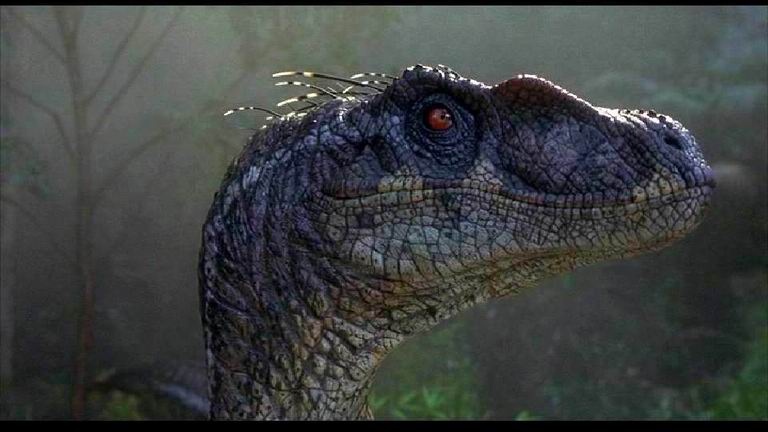
The somewhat amended JP3 raptor.
In 1991, another related American genus was discovered: the Utahraptor, an even bigger dromaeosaurid with proportions more similar to the raptors already being developed for the first film. Utahraptor gave the JP raptors a credibility boost and has become one of the most popular dinosaurs itself. Dromaeosaurids are considered some of the most intelligent dinosaurs, characterised by pack behaviour and large brain cases for their body size. However, it's all relative; raptors probably weren't much more intelligent than an average bird species today.

The most significant difference between the real Velociraptor and the JP raptors is in their appearance. When Jurassic Park was being filmed, the appearance of the dinosaurs was, with some dramatic licence, close to contemporary scientific knowledge. Over the following few years, however, a rush of excellently preserved fossils has shown that most coelurosaurian dinosaurs had feathers for warmth and/or display, with some, including the dromaeosaurids, having well developed feathers akin to modern flight feathers. Dr. Alan Grant had to confront a kid whining about the Velociraptor skeleton looking more like a six-foot turkey. He was more right than he knew (and a six-foot turkey sounds pretty terrifying to me). By 2000, the feathered dinosaur was becoming recognised enough that some limited quills were added to the heads of the scaly raptors of JP3, but they've been returned to a fully scaled look for Jurassic World. Part of this is for easier audience recognition, and mostly just because the filmmakers think it looks cooler. There is a handy line in JW covering the discrepancy, though: Dr. Wu points out that all the dinosaurs at the park are hybridised with other species, and that in nature they would "look quite different." Plenty of fans have theorised that the frog DNA used to patch the codes, which was such a major plot point in the first story, made the raptors bald. It would have been a nice touch if, by the time of Jurassic World, they'd started using duck DNA instead because it was a closer match. And it would have stopped them changing sex...

Another myth to be busted: the terrifying image of the Velociraptor slashing open its prey's belly, leaving the guts to flop out. No one is certain, but simulations with sculpted claws and pork bellies make it unlikely that the claw was sharp enough or curved correctly to slice open flesh that way. What seems more likely is that packs of raptors would team up on larger prey, using their sickle claws to pierce the flesh and hang on while they used their razor-sharp teeth to viciously bite at the flesh. The prey would most likely have died of blood loss even if they had managed to shake the raptors off. Much of the time, Velociraptors would have preyed on smaller animals, either around their own size (such as with the famous battling dinosaurs fossil of a Velociraptor and Protoceratops in a clinch), or much smaller, and they would also have scavenged. Not that this makes a pack of raptors any less of a terrifying prospect.

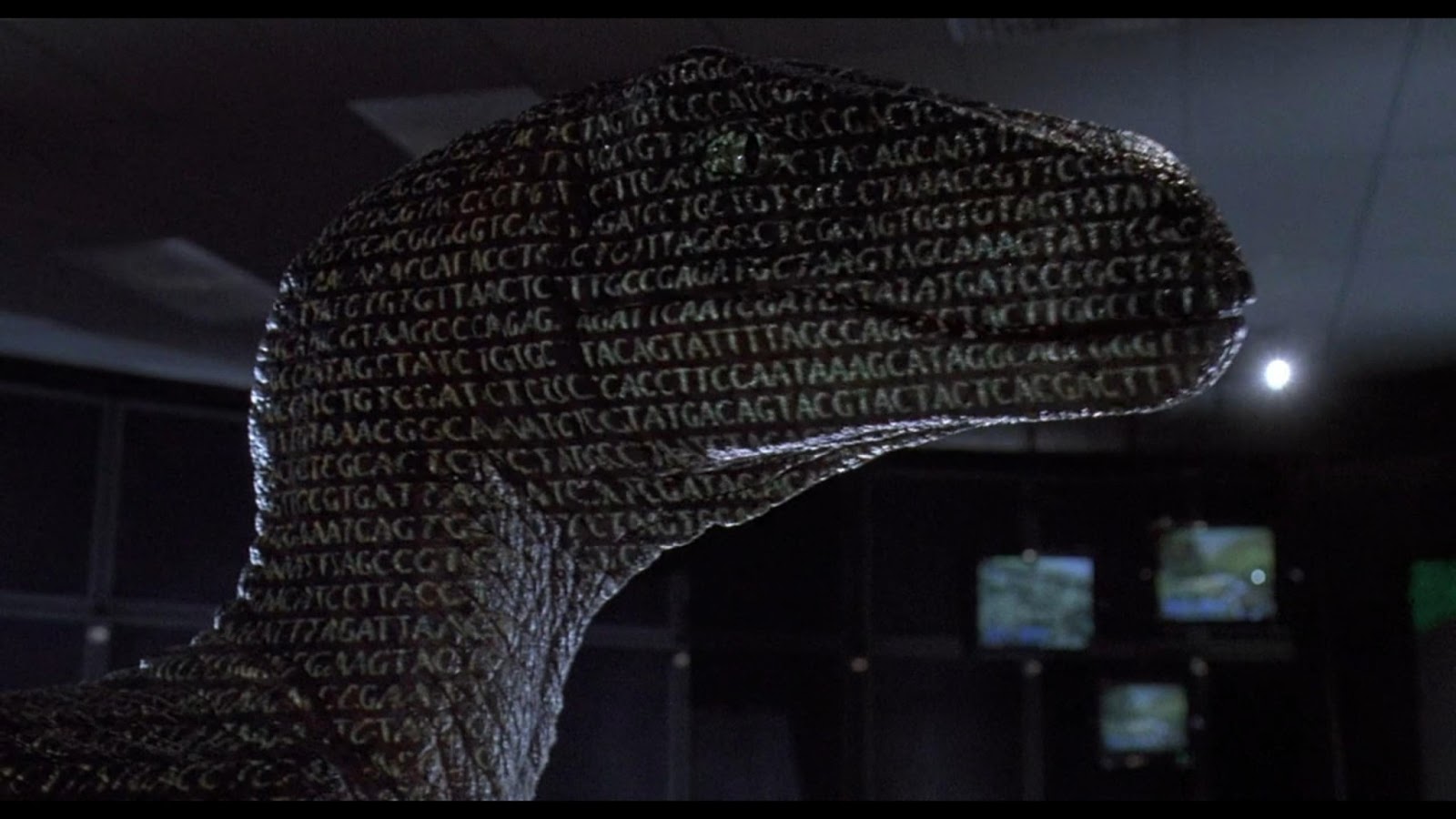
A classic shot from the first JP


For all the changes made for the books and films, one thing Crichton was dead right on was stressing how bird-like the Velociraptor was. It's clear now that the dromaeosaurids were very closely related to the earliest birds; indeed, some definitions include them as birds (it's very much a matter of semantics). Early dromaeosaurids were tiny animals, extremely bird-like, some of them, such as the abundant Microraptor, with feathers sufficiently adapted for gliding or posibly even powered flight. The sickle claw seems to have initially evolved as a climbing aid for aboreal species, later being becoming weaponised as some branches of the family re-adapted to a terrestrial, predatory lifestyle.

Finally, I'm afraid that the wing-like forelimbs of the Velociraptor mean that it most certainly would not be able to move its hands in such a way to open a secured door.


Sunday, 14 June 2015

REVIEW: Jurassic World

Nostalgia may rose-tint our spectacles, but it also increases their focus. I was nine when Jurassic Park was released in 1993; I saw it on release and firmly believe it to be an absolutely classic film. Naturally, I was tremendously excited to finally get to see a fourth instalment in a franchise I have followed from the beginning (movies, original novels, junior novelisations, toys, games and all). However, Jurassic World had a hell of a lot to live up to.

There are clear weaknesses in the finished film, even after a decade of script revisions in development hell. The characters are walking clichés, and while the Jurassic Park cast were hardly given the most original characters to work with, they at least felt rounded, and at the time, reasonably new. The rock and roll mathematician and teenage hacker are cheesy as hell now, but in fairness, it was the Nineties. Jurassic World gives us a man's man gamekeeper, and an ice queen career woman who just needs a real man to break down her walls. I have to agree with Joss Whedon's comments regarding the sexual politics of the film; this was par for the course in the Seventies.

But then, I'm not going to see a Jurassic Park film for high art. This is a monster movie, and a very good one. I'm on the fence regarding the inclusion of the genetically hybridised dinosaur, Indominus rex. On the one hand, I agree with Chris Pratt's character, Owen: dinosaurs are “wow enough.” Actual dinosaurs are incredible, there's no need to make up new ones. Yet, it's hard to argue that this allows some spectacular set pieces and pushes the plot into interesting territory. It's hard to swallow a dinosaur intelligent enough to trick the keepers into letting him out, let alone one that virtually has the power of invisibility. The Indominus is an absurdly pimped up beast, from her quills to her gnarly teeth, but as producer Colin Trevorrow has said, this isn't a documentary. It's a sci-fi monster movie. Also, it's not like the rest of the dinosaurs are scientifically accurate, and although I'd rather see feathery Velociraptors charging about, the creatures here all look fantastic. And I do appreciate a brief line from Dr. Wu (BD Wong, the only actor from the first film to return), pointing out that all the dinosaurs are hybrids to a degree, and would have looked quite different in nature.


Jurassic World is an allegory for corporate excess and the commodification of natural resources. This is, to be fair, hard to accept coming from a Hollywood blockbuster with a budget of $180 million. The Indominus was created to tempt moviegoers who have been spoiled by a slew of big budget sci-fi action movies, just as it was created in universe to keep happy the tourists who have become bored with ordinary dinosaurs. Nonetheless, it makes its point, and a subplot regarding the weaponisation of dinosaurs – something that earlier treatments of the film were said to focus on – provides a strong thread, as well as clearly setting up the direction for a fifth film. The movie's plot is completely predictable, every beat signposted, even the final fate of the mighty Indominus obvious almost from the outset. However, sometimes a little predictability works in a story's favour. This is a movie where you just need to sit back and wallow in the spectacle, and spectacular it is. It's a CGI overload, of course, and will age far quicker than the original, which still stands up extremely well today; although it's good to see that puppetry still has a place for scenes of physical interaction.


Pratt is as charismatic as ever as gamekeeper and raptor trainer Owen Grady, even if the role does sometimes come across as an extended audition for Indiana Jones. Bryce Dallas Howard is pretty perfect in the role of Claire Dearing, the park's operations manager. She's fundamentally unlikeable to begin with, until Pratt's character melts her heart and breaks through to the real woman within. Every independent woman just needs a bit of rough with a big weapon, right? Her two nephews, played by Nick Robinson and Ty Simpkins, are both great, although it might have been fun to make the older brother the enthusiastic dinosaur fan and the youngster the disdainful one who needs to be amazed. Vincent D'onofrio does what he does best – the charismatic villain, in this case, the security chief and champion of weaponisation. Smaller roles for Omar Sy, Irrfan Khan, Jake Johnson, Lauren Lapkus and Katie McGrath are all essential, and the entire cast acquit themselves well. Plus, there's a couple of fun little cameos to watch out for, although some kind of inclusion of the late Richard Attenborough would have been welcome.


At the end of the day, though, it's the dinosaurs who are the stars. The Velociraptors, always the heart of the series, have not lost the development they received in Jurassic Park III, and the four trained raptors have plenty of personality, especially the beta, Blue, with her special relationship with Owen. There are some thrilling moments with the tank-like Ankylosaurus, a huge flock of pterosaurs, and the new addition, the sea lizard Mosasaurus. The dino petting zoo is the cutest. The best moments, though, are reserved for everyone's favourite, the T. rex herself. Although it isn't mentioned in the final film, this is intended to be the original T. rex from Jurassic Park, twenty-five years old and not about to let the Indominus usurp her as queen of the park. (And for everyone who complains that no zoo would keep a known man-eater as an attraction, I can tell you from experience that you are wrong.) For all the mediocre writing, throwback sexism and unoriginal characters, this is simply great fun. Any film that end with the biggest and best dino-on-dino fight ever committed to screen is going to leave me satisfied.