Showing posts with label prehistorica. Show all posts

Friday, 26 July 2024

Television Heaven update

Evening all,

I've a bunch more reviews over at Television Heaven this week.

First, we have the adventures of sleuth, magician technician and all-round know-it-all Jonathan Creek.

Then we join Michael Kitchen as Hastings' finest in WWII crime drama Foyle's War.

Then, having been just announced for a relaunch, I revisit the groundbreaking prehistoric documentary Walking with Dinosaurs.

You may also have missed some classic Tom Baker Doctor Who reviews. Gothic classic Pyramids of Mars introduced the terrible Sutekh, who returned to plague the Doctor in the latest series. A few years later, the Doctor was recruited by another godlike entity to search for the cosmic Key to Time, a season-long quest I've divided into part one (featuring The Ribos Operation, The Pirate Planet and The Stones of Blood) and part two (featuring The Androids of Tara, The Power of Kroll and The Armageddon Factor).

That's it for the moment, while I knuckle down to some fiction.

Tuesday, 21 June 2022

REVIEW: Jurassic World Dominion


I don't really get the poor reviews Dominion is getting. I can absolutely agree that a sixth film in the franchise was unnecessary, but then, no sequels were ever really necessary or could hope to match the original Jurassic Park. Even Chrichton's The Lost World struggled to justify its existence in that respect, and the film version even more so. Dominion is about making a comment on the modern world and the commodification and exploitation of science, and the lengths to which those on the top of the capitalist world will go to to ensure their own dominion. That's what it's about, but it's not what it's for. It's there because we want to see characters we like running away from dinosaurs, because that is entertainment.

So no, I don't get the vitriol, because Dominion kept me thoroughly entertained throughout. On a purely visual level, there were elements here that surpassed anything that has gone before in the Jurassic Park saga. The raptor chase through Valetta – utilising the Atrociraptor mainly, I feel, for the cool name – is a fantastic juxtaposition of visuals and a truly breathtaking action sequence. Sights of dinosaurs sloping into town, a Brontosaurus blocking a highway because it just doesn't know where it's found itself, are beautiful (and far more effective than the T. rex-does-Godzilla attempt of The Lost World). The impossibly vast Quetzalcoatlus – inflated beyond even the giraffe-sized creature's natural scale – providing a hazard to aircraft is what this series is all about. Plus, we finally had proper feathered dinosaurs, the imaginary science of the films catching up with the real science of palaeontology, which has revolutionised our understanding since the novel was originally published.

It was fitting for the film to bring back the original three leads of Jurassic Park. I've said it before, but it's never really, truly a Jurassic Park film without Sam Neill as Dr. Alan Grant (one of the reasons I have a soft spot for the much maligned Jurassic Park III). Some viewers disliked that Grant, now old, bearded and solitary, is a rather lost figure at the beginning of the film, but it's absolutely fitting that he would gravitate back to the familiar world of fossil hunting, the last bastion of the world before dinosaurs walked again. He retains strong chemistry with Laura Dern's Ellie Satler, who gets to shoulder most of the trio's half of the film. Satler was always the most impressive of the characters when it came to surviving in the Park, and it's only right that she gets much of the limelight here.

Having been wasted in a cameo in Fallen Kingdom, Jeff Goldblum gets to play Dr. Ian Malcolm for real again. While he does, as always, play himself, Goldblum is able to make Malcolm into a character again with a genuine reason to be involved, instead of just a celebrity stop-off of quirky delivery. This half of the film, which stays resolutely away from the other side for much of the runtime, gives the old guard a chance to shine, without the newbies overshadowing them. There's able support from Mamoudou Athie as Ramsay Cole, the turncoat PA and communications head at Biosyn, who puts in a classy performance. Making Lewis Dodgson the villain was a clever idea. While it was a shame to have to recast him (but look, no one is going to work with Cameron Thor, if he was even out of prison in time to film it), Campbell Scott makes for a suitably nefarious billionnaire. Linking him back to the character who was barely seen but was ultimately behind the chaos of the first film is a great touch, especially since Dodgson was such a major character in the novels. Here, he comes across as less of a scientist than in the books, and more an evil Jeff Bezos or Elon Musk. Which is to say, a Jeff Bezos or Elon Musk.

Frankly, the classic characters overshadowed the Jurassic World crew. Chris Pratt still remains a likeable presence as Owen Grady, but by now his Velociraptor whisperer schtick is getting a bit old. Still, he handles the action scenes excellently and has great chemistry with Isabella Sermon. As the teenaged clone Maisie Lockwood, Sermon steals her scenes: a gobby, angry posh girl with an entirely justifiable chip on her shoulder due to her unique and unexplained past. Bryce Dallas Howard does well as Claire Dearing, especially in her action scenes where she portrays a tangible desperation (the slow escape from the Therizinosaurus is one of the most nail-biting moments in the franchise), she lacks chemistry with Sermon and, surprisingly, with Pratt.

DeWanda Wise, on the other hand, has palpable chemistry with Pratt. So much so, in fact, that the only way to keep her character Kayla from falling into Owen's arms is to make her gay. Kayla could be a stock action film character – she's a daredevil pilot, a criminal finding her principles again, etc. – but Wise has enough charisma to carry the part off and make her a success.

Are there problems? Of course there are. While keeping their storylines linked but separate for so long helps, the film does feel overstuffed two sets of heroes: six adult leads and one child is a lot to juggle. This means some elements feel a little cut short: Grant and Satler's revival of their relationship seems a bit forced, and Maisie's discovery of her mother is swamped by the many other elements jostling for attention. The monstrous locusts work as an immediate threat, but not a world-ending catastrophe. Surely even a company as powerful as Biosyn would be investigated if their crops were the only ones not being threatened by this sudden and impossible strain of genetically-engineered insects?

The fight between the Giganotosaurus and T. rex is presented as being a climactic moments, but neither has had much impact on the film by that point, and so feels unearned. While there's something more to it if you know that this is the same T.rex Grant, Satler and Malcolm faced in the original film, nothing is made of this in the film itself. In the end, I was cheering more for the poor, blind, herbivorous Therizinosaurus than either apex predator, but the final fight fell flat. The similar battle between T.rex, Indominus rex and the Mosasaurus, that this was clearly meant to evoke, worked far better, even if it was more far-fetched (even the utterly mismatched Spinosaurus vs. T.rex fight in JPIII was better).

There are some huge logistical problems with the set-up, of course. Supposedly, all these dinosaurs are roaming loose after they escaped from the house at the end of Fallen Kingdom – really, all of them? Even the Brontosaurus that clearly couldn't have fit in there? Even the Mosasaurus that lives in the bloody sea? Dr. Wu's redemption is nice, but far too easy, with the final end of the film feeling anticlimactic.

In spite of those hard-to-swallow pieces, this was a cracking dinosaur movie. Anything that presents a dinosaur black market, complete with dinosaur smugglers and trained raptor attack dogs, in the bowels of the Maltese capital, with a truly gorgeous, beaten-up old Carnotaurus as the main attraction, is a winner in my book.


Tuesday, 19 April 2022

Doctor Who: The Fossilist

 If you like Doctor Who adventures featuring the Sea Devils and remarkable women from history, why not try this story written by James P. Quick and myself for The Doctor Who Project?


Wednesday, 1 July 2020

2020 Dinosaur News (May/June)

TROODON NO MORE?


I'm clearly behind the times, because it look like Troodon, a well known and beloved genus of theropod, has been declared an invalid genus. And this was deduced back in 2017, apparently! Still, it only seems to be making its way into public consciousness now. While it's a stinger, it's not really too surprising. Troodon has been a mess since it was first named in 1856, based on nothing but a serrated tooth. Originally classified as a lizard, then a megalosaurid (like almost every predatory dinosaur at one time or another), in 1924 it was considered that Troodon was a carnivorous pachycephalosaurid. I'm old enough to remember books still calling it a unique meat-eating ornithischian, even though this was pretty much thrown out by 1945 (books on dinosaurs tended to take a long time to bring themselves up to date). Of course, now omnivorous ornithischians are accepted in the early development of the order. 

Stenonychosaurus was a quite well known theropod in the 80s and 90s, before being considered a junior synonym of Troodon (the same thing happened with the family Saurornithoididae and Troodontidae). In 2017 it was suggested that the original specimen of Troodon being just a tooth, was undiagnostic, and referred all species back to Stenonychosaurus, although since, some have been pulled to a new genus, Latenivenatrix. This has been challenged, though, by others stating that Troodon formosus, the type specimen, should be the valid name, considering that Stenonychosaurus went unused for so many years. In either case, it seems that the family Troodontidae, and even the subfamily Troodontinae, are going to remain the favoured names.

ARCTIC EDMONTOSAURUS


Edmontosaurus (formerly also Anatosaurus and Anatotitan) is one of the best-known ornithopods from the late Cretaceous, known from two species: the earlier E. regalis and the end-of-Cretaceous E. annectens. Now, an international team has concluded that the Alaskan genus Ugrunaaluk is a third species, E. kuukpikensis. Edmontosaurus was already known to have ranged far and wide across North America, but this pushes it further north than generally supposed, into what was already the Arctic north. While it wasn't as cold in the Arctic in the late Cretaceous as it is now, it still shows that Edmontosaurus was able to adapt to a variety of different habitats. The Japanese genus Kamuysaurus is a closely-related hadrosaur that spread into Asia on similar latitudes, showing that Edmontosaurus and its closest relatives were a hugely successful group of herbivores and among the most common dinosaurs of the period. "The caribou of the Cretaceous" at SciTech Daily

TRANSITIONAL CERATOPSIDAE

Two transitional genera of chasmosaurine ceratopsids have been identified from fossils in New Mexico, bringing light to the evolution of this branch of late Cretaceous dinosaur diversity. The two new genera show a clear pattern of development from the well-known Pentaceratops known from 75.3 million years ago, which had notably tall frill with a distinct, deep notch in its centre. An as-yet-unnamed example from 100,000 years later shows the frill notch deepening, while 100,000 years later still the new Navajoceratops sees the frill close up over the notch. By 74.6 mya, Terminocavus sees the frill begin to close up fully, and it finally heals over in Anchiceratops at 71.5 mya.

The precision of dating the genera is remarkable and illustrates a clear lineage. I wonder, though, it the new genera will be folded into Pentaceratops and Anchiceratops following further analysis. Sci-News.com


RUNNING IN CROCS


South Korea, the prehistoric tracker's heaven, has revealed an array of fossil tracks over the years, but a recent discovery has upturned established facts about crocodylomorphs. A group of tracks that clearly show bipedal locomotion - and were originally hypothesised to be from a large pterosaur - have been re-identified as the ichnogenus Batrachopus, a genus reserved for crocodile-related tracks. While there are many bipedal genera of croc relatives known from the fossil record, they all date back to the Triassic period, dying out in the mid-to-late Triassic in a major extinction event. Before this, crocodylomorphs were the dominant reptile group, with a huge variety of forms, but after the max extinction most were replaced in their niches by dinosaurs. 

These tracks however date back 113 million years to the early Cretaceous, over 100 million years after we'd expect to find them. While the exact genus of croc that left the tracks isn't known, it shows that more diverse crocs survived in some regions far later than originally thought. Scientific American Nature (for more detail)

MONSTER EGGS

Back in 2011, Chilean scientists discovered a strange, ovoid fossil in the Antarctic rocks. It was nicknamed  The Thing, but after years of analysis, it has been conclusively identified as the egg of a marine reptile. Julia Clarke of the University of Texas was the one who finally deduced it was a soft-shelled egg, of the type lain by lizards and snakes. At 11.4 by 7.9 inches it's absolutely huge and the first fossil egg to be unearthed in Antarctica. It's larger than any dinosaur egg save for that of the elephant bird, and even that was only slightly larger and much thicker-shelled. Clarke and her fellow palaeontologists has deduced it's egg of a mosasaur, a gigantic marine lizard, which explains the similarity to modern lizard and snake eggs, but it's far larger than nay soft-shelled egg ever seen before. It's also a surprise since it was hypothesised that mosasaurs gave birth to live young, an idea now thrown into doubt. The formations where the egg was found have previously turned up fossilised mosasaurs and plesiosaurs of various stages of development, so it seems it may have been a sort of marine reptile birthing ground and nursery. 

The mosasaur egg has been given the taxonomic name Antarcticoolithis bradyi. Syfy Wire

Saturday, 22 February 2020

Dinosaurs of the Museum fur Naturkunde


This is what you see when you enter the Hall of Dinosaurs. The size of the thing.


The Allosaurus fragilis with his head through a window.


I pegged this as a Dryosaurus, but it's a close relative, Dysalotosaurus


The Elaphrosaurus, a relative of my favourite dino Carnotaurus, as shown by his stumpy arms.


Diplodocus carnegii


Brachiosaurus keeps his head down here so you can actually see it properly.


Because getting the whole thing in is a bit of a challenge.


Because Brachiosaurus brancai aka Giraffatitan is just enormous.


The comparatively small Dicraeosaurus


Kentrosaurus also shares the central display


And the skull of Stygimoloch (perhaps a young Pachycephalosaurus?)

Berlin it to win it

I got back this morning from a short trip to Berlin, my birthday present from the lovely Suzanne. We spent three nights on Turmstrasse in Moabit, not far outside the Mitte neighbourhood. We had a brilliant time, it was only a pity we couldn't stay longer. We arrived on Wednesday afternoon and chilled out for a bit, before heading out for some snacks and beers in the local cafes and bars. We might have had a few too many of the beers, in retrospect, as we didn't manage to get up until midday. However, we did have an excellent night, especially once we found our way to a craft beer place run by a barmaid who could somehow keep fifteen tabs straight in her head. We made some friends and crashed a Tinder date, and sampled some very good beers. A couple of shots, too. That might explain the missed morning as well.

Once we managed to get ourselves out of bed, we walked along Alt-Moabit to Mitte to visit the Museum fur Naturkunde, one of my main reasons for wanting to visit the city. One of the best natural history museums in the world, the Berlin museum is famous for holding the largest mounted fossil skeleton in the world: the great Brachiosaurus brancai. Also known as Giraffatitan (respect to the museum for sticking with the traditional classification), this gigantic beast was uncovered in Tendaguru, Tanzania and is 13 metres tall. It shares its central podium with a Dicraeosaurus and a Diplodocus carnegii, the latter a cast from the Carnegie Museum specimen. That's the same as Dippy, currently on tour from the London NHM, and its incredible that the huge dinosaur that usually dominates that museum's entrance hall is dwarfed by the brachiosaur. Dippy is longer, but doesn't have the sheer size of the brachiosaur.

I got plenty of snaps - I'm not photographer, so not everything came out well - including the Allosaurus, Elaphrosaurus, Dysalotosaurus and Kentrosaurus. I got too excited explaining the significance of the Berlin specimen of Archaeopteryx lithographica to remember to get a pic of it. Plus there were some plesiosaurs and sundry pterosaurs (Flugsauria!), a huge gallery of taxidermied animals, including extinct species such as the thylacine and quagga, some alarmingly large models of insect and spiders and a gigantic display of organisms preserved in jars of ethanol.

Other than the dinosaurs, which I got far too excited about, the best part of the museum was the Earth and Space room, which had a huge display unit projecting the evolution of the universe, suspended over a sort of sofabed. The excitable kids made it, although my back didn't survive quite intact, it was a lot of fun. Plus I learned that the German for Crab Nebula is Krebsnebbel, which is not only hilarious itself but when run back through Google Translate comes out as Cancer Fog. (Also, German for seal is seehund, which is adorable.)

This wasn't the only bit of culture we took in. Friday was our sightseeing day, thanks to a hop-on/hop-off tour bus which took us right into the heart of Mitte. We got off to see Checkpoint Charlie and the Berlin Wall Museum that sat at the old site, which provided a brilliant multimedia experience that really brought the bizarre situation in Berlin in those days too life. It's weird to think that was just over thirty years ago, well within living memory of many people in the city. We were, appropriately enough, staying in the old British Zone, but nowhere in the western part of the city is far from the line with the east. Suz and I can just remember the Wall coming down, but we were very young indeed and the significance we pretty lost on us back then. It certainly looks pretty American around there now, with KFC and McDonalds immediately dominating the road across from the museum. We focused on currywurst, kebabs and waffels while we were in town. (We also accidentally ordered a mixed grill for four at McDarwich, but we salvaged the remains for later snacking.)

We followed the Wall with the Spy Museum, which wasn't very secret at all, but was fascinating and a lot of fun. The dressing up area was a bit poor, since the spy look seems to be just my normal hat and coat (I thought about swapping my hat for a less well-worn one, but they were all tagged.) The history of spies and cryptography is astonishingly long, though, and there was a lot to learn among the kid-friendly activities.

It's a shame we didn't have more time for a few more museums, but we also wanted to get in plenty of restaurant and chilling out time as well. We're definitely planning on going back, now that we vaguely know our way around and have a better idea of where else we want to see. There's enough museums to keep us busy for a couple of weeks at least. And plenty of beers and currywurst still to try.

(Photosauruses to follow)

Thursday, 11 May 2017

There is no dino, only Zuul

How's this for a news item that combines my interests? Palaeontologists in North America have released their newest discovery, an astonishingly complete ankylosaurid dinosaur fossil that they have named Zuul in honour of the monstrous Terror Dog from 1984's Ghostbusters. The find is exciting because complete dinosaur fossils are rare enough, but a complete ankylosaur is virtually unheard of. Zuul has the first complete skull and tail club ever found for an ankylosaurid, and includes many osteoderms - the lumps of bone that were embedded in the skin and used as armour. These usually wash away over time due to being disconnected from the main skeleton.

Given the resemblance of the ankylosaur's skull to the horned face of the Ghostbusters monster, the discoverers named the species Zuul crurivastator. The specific name does not mean "ankle biter," as some outlets are reporting (for a start, this thing was huge), but "shin destroyer," in reference to that great tail weapon. 

The LA Times has a video of Dan "Ray Stantz" Aykroyd with the fossil.


Thursday, 28 May 2015

2015 in Palaeontology (so far)

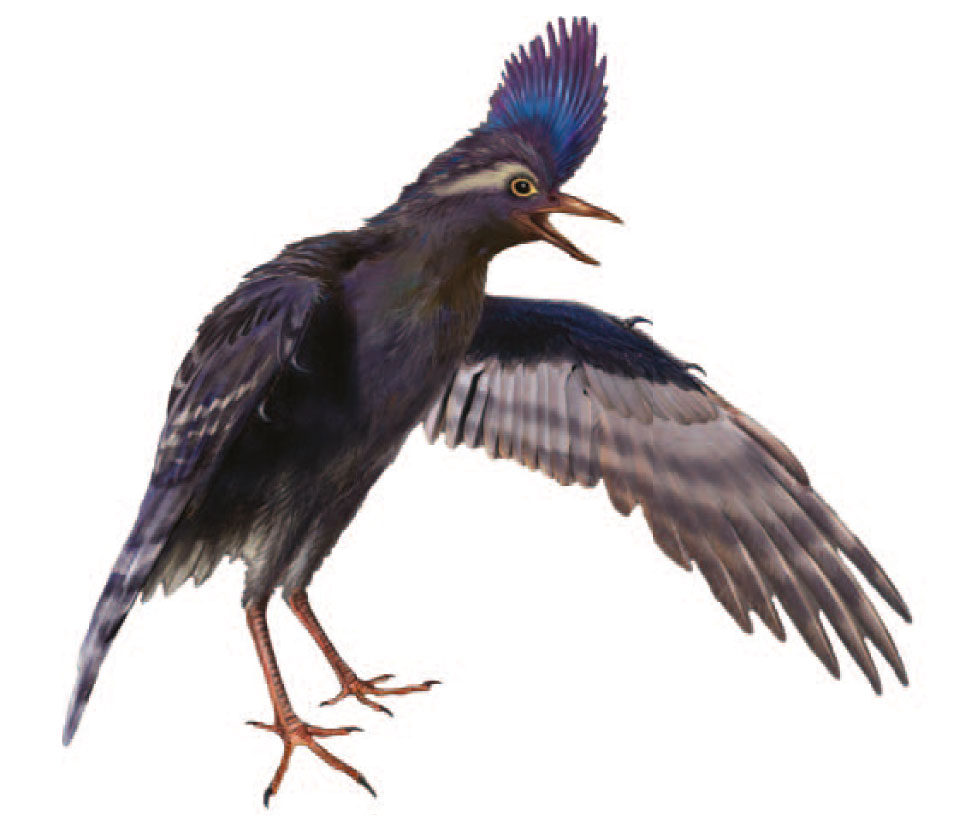
Yi qi

This is the most fantastic discovery this year. Yi qi is a frankly bizarre flying dinosaur that displays features of both birds and bats, an entirely new method of flight adaptation to anything seen before. A member of the scansoriopterygidae, or epidendrosauria, Yi's relatives are extremely birdlike, with complex feathers, but with extended fingers that suggested, at first, that they were arboreal animals, adapted for climbing. Yi is so well preserved, however, that the fossil has revealed skin impressions, including webs of thin skin between the fingers. At first glance, illustrations of Yi look like archaic illustrations of pterosaurs, but this is a genuinely new form of dinosaurian flight - a combination of batlike wings with birdlike feathers. It's unknown if fellow epidendrosaurs shared this feature, but it seems quite likely. It's a fascinating sideline on the evolution of the flight of modern birds.

Microscopic analysis of the Yi fossil has revealed the presence of melanosomes - pigmentation organelles. The dinosaur was mostly coloured black, with yellow or brown feathering to its head. Yi is thought to have inhabited a subtropical environment, and shared it with pterosaurs such as ChangchengopterusArboroharmiya, a tree-dwelling mammal, and archaic salamanders. Yi also has the distinction of having the very shortest generic name of any dinosaur; indeed, its full specific name, Yi qi (meaning "strange wing"), is as short as is permitted by taxonomic rules.

Chilesaurus

This is an odd one. Supposedly, Chilesaurus is a basal tetanuran, roughly ancestral to the group that led to carnosaurs, coelurosaurs and megalosaurs. And yet, it has features from all sorts of different dinosaurian groups. While its features are mostly theropodal, its teeth clearly indicate herbivory. Its pelvis points backwards, as in the Ornithischia, another adaptation for herbivory - more room for a big, fermentory gut. Several theropod families adapted to that lifestyle and developed the bird-like pelvis, including therizinosaurs and, of course, birds themselves. Chilesaurus had strong arms with a large, sharp primary claw, which is found in many "prosauropods." In fact, just looking at it, I'd guess it was a basal sauropodomorph, which are very similar to basal theropods, but the timing is wrong. It's a Tithonian species, late Jurassic... all most odd.

Archaeornithura


An ancient bird, Archaeornithura existed 130 million years ago in the early Cretaceous, and is the earliest example of the Ornithura, the clade of "true birds" that includes all modern birds and many extinct lineages. Although it retained many archaic features, such as clawed fingers, it also displayed several modern characteristics including fan-shaped tail feathers, a familiar wishbone, and an alula - the highly adapted thumb that aids in avian flight. Indeed, it seems to have been an adept flyer, while its long legs and foot structure suggest it also lived as a wader. The discovery of the beautifully preserved fossils of Archaeornithura has necessitated another rethink of bird evolution, since such advanced characteristics were not thought to have arisen so early.

Nebulasaurus

A rather lovely name for a dinosaur, Nebulasaurus. A basal eusauropod, albeit only represented by a partial skull, there's not a great deal it can tell us about early sauropod development. However, it does increase the diversity of sauropod findings in China, the Yunnan region being a particularly fossil-rich part of Asia. Nebulasaurus lived around 170 million years ago in mid-Jurassic.

Carnufex

With a cracking name (meaning "butcher"), Carnufex was a beast of a croc, ten feet long and five feet tall (and not even fully mature at that size). An near-complete skeleton was found in North Carolina, in the Carnian stage of late Triassic rock. An early crocodylomorph, Carnufex is more advanced than the brutish rauisuchians that ruled the early Triassic, but still basal to true crocodilians. It had a long, narrow snout full of serrated teeth, with a skull covered in bumps and grooves that may indicate some kind of horns or other adornment.

Cartorhynchus

An early marine reptile, ancestral to the icthyosaurs, that lived in shallow waters in the early Triassic. Unlike later, true icthyosaurs, Catorhynchus was a small, probably amphibious animal with legs adapted into flippers not unlike those of seals. It had dense bones, that would have helped weigh it down and allowed it to feed on the bottom of shallow coastal waters. It is surmised that it was a suction feeder, hoovering up soft-bodied prey from the seabed. The most primitive animal that can confidently be called an icthyosaurimorph, it helps shed light on the development of the Icthyosauria, which otherwise appear out of nowhere in the fossil record following the catastrophic Permian extinction event.

Yoshi garevskii

In spite of the name, this is not a dinosaur. It's not even a reptile. They used the name Yoshi for a fossil and they didn't keep it for a dino? There should be a rule against that. Yoshi garveskii was a big cat, a Metalurine felid, one of the "false sabretooths" like the more famous Dinofelis. Previusly included in the genus Metalurus, Yoshi was a mid-sized animal, larger than a lynx but not as big as a cheetah, so fairly diminutive for the family. Unlike true sabretooths, which had oversized, blade-like teeth, Metalurines had what might be called medium-sized fangs, conical like modern cats' but significantly larger. The best thing to imagine would be a particularly toothy clouded leopard.

Aegirocassis

I love anomolocarids. Half a billion years ago, the lands were empty but the seas were full of bizarre creatures which have left no descendants. The anomalocarids might have been related to arthropods, like insects and crustaceans, but have so many weird features that no one is really sure what they are. One thing we do know is that they dominated the oceans of the Ordovician period, gigantic predators for their time. Aegirocassis lived 480 million years ago, descended from earlier hunters like Anomalocaris itself and had adapted itself to filter feeding. At over two metres long, it may not sound like a particularly huge beast (although I wouldn't want to meet one on the beach), but it was probably the biggest animal in the world at the time. It was essentially the Ordovician equivalent of the blue whale, only with a shell and tentacles. What a wonderful creature.