Showing posts with label sea monsters. Show all posts

Monday, 18 April 2022

WHO REVIEW: Legend of the Sea Devils

 Legend of the Sea Devils is only the second Easter special for Doctor Who, which is an oddity since it seems even more suited to that holiday than to Christmas. The last three regenerations have aired on Christmas, yet surely the day marking death and resurrection would be more appropriate?

The last Easter special, 2009's Planet of the Dead starring David Tennant, was an enjoyable but unremarkable adventure that boasted a fun central concept and some lovely location shooting. Legend of the Sea Devils leaves a similar impression, and like Planet of the Dead it is rather overshadowed by the impending climactic regeneration story it foreshadows.

It stands out more thanks to its returning monster. The Sea Devils, making only their third appearance on the programme and fifty years since they first appeared in the appropriately named The Sea Devils. That serial, starring Jon Pertwee, was a contemporary(ish) story, while the belated follow-up Warriors of the Deep (starring Peter Davison and broadcast in 1984) had a futuristic setting. It seems quite right, then, that the aquatic creatures return for a historical adventure, and it suits them well. Warriors of the Deep reworked them as a samurai-like warrior caste, and this seems to have inspired the Eastern setting of this new adventure.

They look fantastic. Like the Zygons and the Ice Warriors before them, the Sea Devils have been updated but kept fundamentally in line with their original appearance. Of course, they look faintly ridiculous, with their bulbous eyes and too-long necks, but if you can't handle a bit of ridiculousness then Doctor Who probably isn't the show for you. Their new outfits are perfect. They combine the pseudo-orientalist look of their eighties reworking with the string vests of their seventies originals, and make them into something actually feasible, while griming them up with an encrustation of barnacles. These old-but-new Sea Devils are gorgeous.

There's not much in the way of character for the Sea Devils, though. Their leader (referred to by IMDB as Marsissus, but nowhere in the episode itself) gets to be suitably scheming and nefarious, but otherwise the reptiles are little more than generic monsters there to swish swords then fall down. They also seem significantly more technologically advanced than the previous clans we've seen, with the macguffin doing all sorts of near-magical things, but then neither the Sea Devils nor Silurians have ever been very consistent in their background or abilities. I did love how they refer to the humans as “land crawlers,” but it was a bit daft that the Chinese was translated as “ocean demon,” which really means exactly the same as Sea Devil.

The human characters fare better, but even there we're a bit short-changed. Crystal Yu is excellent as Madame Ching, the pirate queen who dominated the seas around China in 1807. She's convincingly confident and ambitious, yet has a humility and quiet thoughtfulness as well. She's, quite correctly, devoted to her family, but the real Ching Shih was also the de facto commander of a huge pirate confederation. There's no mention of her husband Zheng Yi, so this is presumably late in 1807 after he died and she'd taken his place as leader. It was only a few short years before pirate dominance in the region was ended, but at this time she was at the height of her powers. Fine, her crew has been captured before this story, but where are the other crews?

Of course, I assume the budget (and Covid conditions) precluded a huge army of Chinese pirates, but in that case why isn't there more focus on Madame Ching herself? She deserves to dominate the plot more than she does. In reality Ching was a formidable and ruthless opponent, and we just don't see enough of that. There just doesn't seem much point using her in a story if it's not going to use her to the fullest extent.

There's the impression that the episode has been cut down from a much longer edit. Some things are minor, but nigglingly missing: where exactly were the TARDIS team going dressed up like in Chinese clothing or, in Dan's case, a pirate costume, in the first place? Others are more significant. When the episode jumps back to 1533 for no reason than to fill in a bit of the plot that could have been covered in the show's usual heavy-handed exposition, there's the impression that this side trip was originally longer and added more to the story. Still, it's a lot more fun seeing Ji-Hun battling a Sea Devil than having him turn up in the main section and explain it all. There are other points where it looks like a scene has been chopped out to streamline things, which makes it pacey but not always entirely clear what's going on.

The floating ship looks fantastic and, pleasingly, even the Chief Devil himself admits it serves no purpose other than to look menacing and impress people. As for the gigantic sea serpent, the huasen, it certainly puts the myrka to shame, but that's another element left outstanding: is that thing still swimming around out there?

Where the episode works best, other than spectacle, is the personal drama between its characters. While I'm not so convinced by the pseudo-parental relationship between Madame Ching and Ying-Ki, the young warrior is well played by Marlowe Chan-Reeves and actually has some decent chemistry with John Bishop. Ying-Chi and Dan make a fun double act and, again, really deserved a little more time on screen. However, it's pretty hard to believe in Dan's sword-fighting skills. Arthur Lee brings gravitas to the out-of-time warrior Ji Hun and works well alongside the Doctor in a touchy but respectful alliance.

However, it's the quiet moments between the Doctor and Yaz that really stick in the memory. The feelings that Yaz openly admitted to, and the Doctor merely hinted at in Eve of the Daleks are thankfully not forgotten. The Doctor, at first, is her usual awkward self, but this passes and there are some honest and tender moments between them. The Doctor's reluctance to allow herself to become that close to someone again is perfectly understandable and in character, and now that we've seen her shoulder some of the stories her impression of Yaz makes sense. Whittaker gives a strong performance in this scenes, but Mandip Gill really stands out.


Although not without its flaws, Legend of the Sea Devils is a fun romp with real heart. It's never going to appear on a list of the series' classics, but it's a decently entertaining way to spend fifty minutes.

Saturday, 15 September 2018

Now available - "The Fossilist"

My latest bit of fanfic is now available at The Doctor Who Project. The Fossilist is my third short for the site, the second written with my talented friend James P. Quick. I'm really rather pleased with this one.

The Fossilist features the TDWP Ninth Doctor and Silver, along with the noted amateur palaeontologist Mary Anning. I previously wrote for the Basil Rathbone-inspired Ninth Doctor in City of the Dragon - his penultimate adventure and my first contribution to TDWP. Anning is something of a hero of mine and I hope we did her wonderful story some justice with this silly adventure.

If you enjoy it, there are some notes at the end which give you a little insight into how James and I work together and how the story developed.

Also, there are dinosaurs in it. Lots of them.


Thursday, 28 May 2015

2015 in Palaeontology (so far)

Yi qi

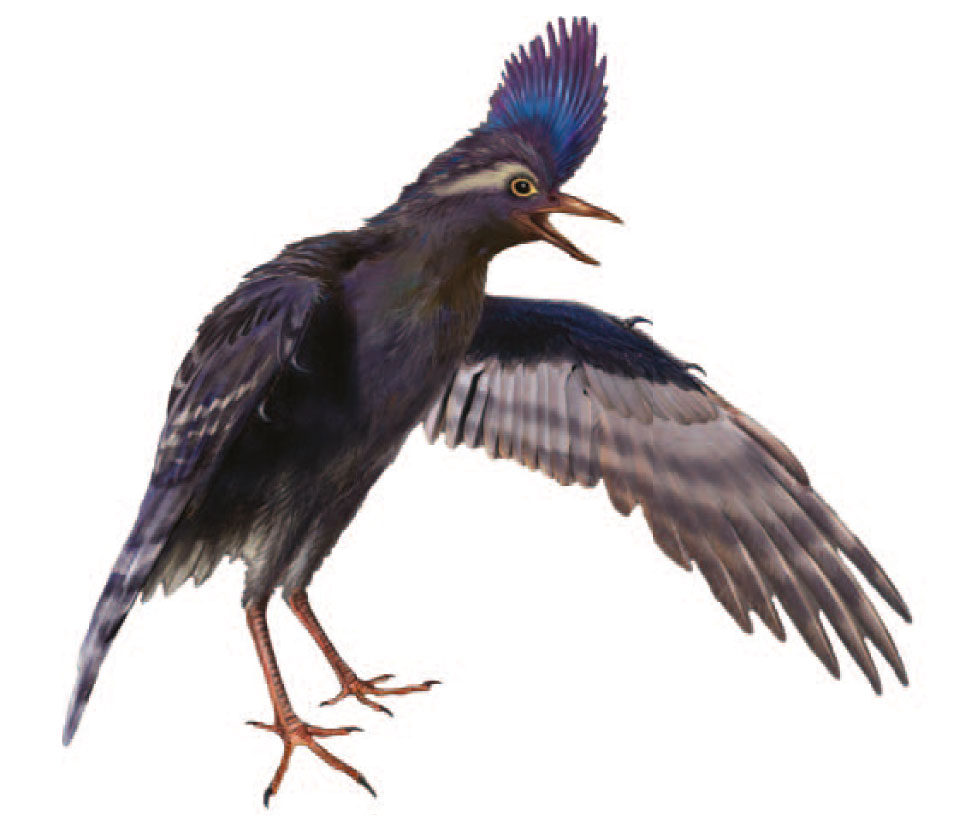
This is the most fantastic discovery this year. Yi qi is a frankly bizarre flying dinosaur that displays features of both birds and bats, an entirely new method of flight adaptation to anything seen before. A member of the scansoriopterygidae, or epidendrosauria, Yi's relatives are extremely birdlike, with complex feathers, but with extended fingers that suggested, at first, that they were arboreal animals, adapted for climbing. Yi is so well preserved, however, that the fossil has revealed skin impressions, including webs of thin skin between the fingers. At first glance, illustrations of Yi look like archaic illustrations of pterosaurs, but this is a genuinely new form of dinosaurian flight - a combination of batlike wings with birdlike feathers. It's unknown if fellow epidendrosaurs shared this feature, but it seems quite likely. It's a fascinating sideline on the evolution of the flight of modern birds.

Microscopic analysis of the Yi fossil has revealed the presence of melanosomes - pigmentation organelles. The dinosaur was mostly coloured black, with yellow or brown feathering to its head. Yi is thought to have inhabited a subtropical environment, and shared it with pterosaurs such as ChangchengopterusArboroharmiya, a tree-dwelling mammal, and archaic salamanders. Yi also has the distinction of having the very shortest generic name of any dinosaur; indeed, its full specific name, Yi qi (meaning "strange wing"), is as short as is permitted by taxonomic rules.

Chilesaurus

This is an odd one. Supposedly, Chilesaurus is a basal tetanuran, roughly ancestral to the group that led to carnosaurs, coelurosaurs and megalosaurs. And yet, it has features from all sorts of different dinosaurian groups. While its features are mostly theropodal, its teeth clearly indicate herbivory. Its pelvis points backwards, as in the Ornithischia, another adaptation for herbivory - more room for a big, fermentory gut. Several theropod families adapted to that lifestyle and developed the bird-like pelvis, including therizinosaurs and, of course, birds themselves. Chilesaurus had strong arms with a large, sharp primary claw, which is found in many "prosauropods." In fact, just looking at it, I'd guess it was a basal sauropodomorph, which are very similar to basal theropods, but the timing is wrong. It's a Tithonian species, late Jurassic... all most odd.

Archaeornithura


An ancient bird, Archaeornithura existed 130 million years ago in the early Cretaceous, and is the earliest example of the Ornithura, the clade of "true birds" that includes all modern birds and many extinct lineages. Although it retained many archaic features, such as clawed fingers, it also displayed several modern characteristics including fan-shaped tail feathers, a familiar wishbone, and an alula - the highly adapted thumb that aids in avian flight. Indeed, it seems to have been an adept flyer, while its long legs and foot structure suggest it also lived as a wader. The discovery of the beautifully preserved fossils of Archaeornithura has necessitated another rethink of bird evolution, since such advanced characteristics were not thought to have arisen so early.

Nebulasaurus

A rather lovely name for a dinosaur, Nebulasaurus. A basal eusauropod, albeit only represented by a partial skull, there's not a great deal it can tell us about early sauropod development. However, it does increase the diversity of sauropod findings in China, the Yunnan region being a particularly fossil-rich part of Asia. Nebulasaurus lived around 170 million years ago in mid-Jurassic.

Carnufex

With a cracking name (meaning "butcher"), Carnufex was a beast of a croc, ten feet long and five feet tall (and not even fully mature at that size). An near-complete skeleton was found in North Carolina, in the Carnian stage of late Triassic rock. An early crocodylomorph, Carnufex is more advanced than the brutish rauisuchians that ruled the early Triassic, but still basal to true crocodilians. It had a long, narrow snout full of serrated teeth, with a skull covered in bumps and grooves that may indicate some kind of horns or other adornment.

Cartorhynchus

An early marine reptile, ancestral to the icthyosaurs, that lived in shallow waters in the early Triassic. Unlike later, true icthyosaurs, Catorhynchus was a small, probably amphibious animal with legs adapted into flippers not unlike those of seals. It had dense bones, that would have helped weigh it down and allowed it to feed on the bottom of shallow coastal waters. It is surmised that it was a suction feeder, hoovering up soft-bodied prey from the seabed. The most primitive animal that can confidently be called an icthyosaurimorph, it helps shed light on the development of the Icthyosauria, which otherwise appear out of nowhere in the fossil record following the catastrophic Permian extinction event.

Yoshi garevskii

In spite of the name, this is not a dinosaur. It's not even a reptile. They used the name Yoshi for a fossil and they didn't keep it for a dino? There should be a rule against that. Yoshi garveskii was a big cat, a Metalurine felid, one of the "false sabretooths" like the more famous Dinofelis. Previusly included in the genus Metalurus, Yoshi was a mid-sized animal, larger than a lynx but not as big as a cheetah, so fairly diminutive for the family. Unlike true sabretooths, which had oversized, blade-like teeth, Metalurines had what might be called medium-sized fangs, conical like modern cats' but significantly larger. The best thing to imagine would be a particularly toothy clouded leopard.

Aegirocassis

I love anomolocarids. Half a billion years ago, the lands were empty but the seas were full of bizarre creatures which have left no descendants. The anomalocarids might have been related to arthropods, like insects and crustaceans, but have so many weird features that no one is really sure what they are. One thing we do know is that they dominated the oceans of the Ordovician period, gigantic predators for their time. Aegirocassis lived 480 million years ago, descended from earlier hunters like Anomalocaris itself and had adapted itself to filter feeding. At over two metres long, it may not sound like a particularly huge beast (although I wouldn't want to meet one on the beach), but it was probably the biggest animal in the world at the time. It was essentially the Ordovician equivalent of the blue whale, only with a shell and tentacles. What a wonderful creature.