Showing posts with label Seventh Doctor. Show all posts

Friday, 11 April 2025

Television Heaven roundup

It's been quiet here of late, but I have been a busy person elsewhere, including writing up a bunch of stuff for Television Heaven.

Having discovered the truly remarkable Severance just before the second season began, thereby rather deftly missing the three-year hiatus by being slow off the mark, I've given both seasons a spoiler-lite review.

Twenty years after it aired, and with a new, fifteenth series just round the corner, I've written an in-depth, episode-by-episode review of Series One of Doctor Who, starring Christopher Eccleston and Billie Piper.

We've also got some classic Doctor Who with the bizarre Sylvester McCoy serial Paradise Towers, Chris Boucher's three Tom Baker stories The Face of Evil, The Robots of Death and Image of the Fendahl, and the Jon Pertwee classic Doctor Who and the Silurians.

I've gone even more retro with my old favourite Mike & Angelo, that CITV classic that might just have been inspired by Doctor Who (well, let's be honest, it was.) Both incarnations of Angelo get their moment in this overview.

All three of Sky One's adaptations of Terry Pratchett's Discworld novels now have reviews, including the Christmas-themed Hogfather, the first adventure The Colour of Magic, and the superb Going Postal.

And, of course, there's more to come.

Sunday, 7 November 2021

Spooky Season

This October and into early November I cranked up the spookiness and wrote a bunch of reviews and a little fiction to celebrate Hallowe'en and the drawing in of the winter nights.

I've submitted a new, very short story to Vocal's Foggy Waters competition. You can read "Ginny" here. I also reposted my old story "Don't Drink the Water" as part of the contest since it coincidentally fit the criteria. 

Review-wise, I've written a bunch of new pieces for Television Heaven. As well as my regular installment of The X-Files (now onto the underrated eighth season) I've got Nigel Kneale's Beasts, What We Do in the Shadows (already a little out-of-date since season three has just been released in the UK) and children's classic The Trap Door. Plus we have two vampiric 1980s Doctor Who serials, State of Decay and The Curse of Fenric.

Please go an check them out, and I hope you enjoy. Spooky season isn't over, of course, as the new Ghostbusters film is out very soon and this has led to a surge in psychokinetic activity, so look out for more 'busters stuff soon too. Plus more Buffy, Doctor Who and a little bit of Trek.

Saturday, 20 February 2021

WHO REVIEW CATCH-UP: Emperor of the Daleks

The Seventh Doctor comics aren't the greatest era of Doctor Who Magazine's strips, but they definitely improved during the New Adventures period, when Benny Summerfield joined the TARDIS crew in the strips as well as the novel line. The strips collected in this volume appeared in issues 193 from late 1992 to 211 in early '94, plus one special and one strip cribbed from issue 227.

It must have been a bit of a surprise for readers when Benny suddenly popped up in the strip without introduction, but then, the DWM strips always reflected developments in the TV series even when it made little to no sense within the confines of the comic itself. The strip was often at its strongest when there was no series to line up with and it was able to go in its own direction, but the decision to stick with the template of the NAs meant there was a clear direction for Doctor Who at the time (compare to the Eighth Doctor era, when there were three competing media with their own continuities, causing no end of debate but also resulting in easily the best run of strips in the magazine's history). 

The first story in the collection is "Pureblood," by the now prolific Dan Abnett, who's written prose and comics for everything from Star Trek to Warhammer. Although completely at odds with The First Sontarans (proposed earlier but produced much later), "Pureblood" proposes a fascinating origin for the Sontarans, showing that their early warrior culture developed into the Sontarans we see today through a reductive process of genetic engineering. Abnett puts this across in an action-packed interstellar war serial, ably realised by Colin Andrew. Abnett''s script makes the Sontarans far more three-dimensional than they'd see in mainstream Doctor Who for decades. I also agree with Abentt's commentary - the Pureblood Sontarans do look like they're related to the Ogrons...

Next up is the one-shot from the 1992 Winter Special, from the normally reliable Scott Gray. It's not great, but to be fair, it was speed-written to fill a gap in the scheduling. A flimsy story that sees the Seventh Doctor and Ace run a holo-program of the First Doctor's time on Gallifrey - back when he was going by "Thete," as per Drax's stylings - there's not much to it. The main talking point is wondering whether the mustachio'd Magnus is really the Master, or the War Chief, or both, but really, it's such a throwaway story it seems hard to care.


Next up is the big title story, "Emperor of the Daleks!" itself. It's a co-op between the magazine's editor John Freeman and much lauded writer Paul Cornell. Cornell is one of the best writers in the franchise, and at this point had made his name as basically the bet writer on the New Adventures. Plus he created Benny, so you'd expect he'd give us something special with this strip. However, the story is hamstrung by trying to do way to much at once. It's a follow-up and retcon of the previous Dalek strip, "Nemesis of the Daleks," plus a linking story between the last two Dalek TV serials, Revelation and Remembrance of the Daleks. It also provides an unexpected sequel to Planet of the Daleks and introduces Cornell's pet project of setting up a weird semi-antagonistic relationship between the Sixth and Seventh Doctors. As such, it opens with a Sixth Doctor strip that sees him rescue Davros from the Daleks at the end of Revelation, and ends with a follow-up, the rather good "Up Above the Gods!" which sees them conversing in the TARDIS (this one from #227, almost two years later).

The rest of the six-part story is a rollicking adventure yarn with more Daleks than you can shake a stick at, but the insistence of doing yet another Abslom Daak story is really a problem. Frankly I don't think Daak become a usable character until Titan Comics brought him back in 2015, when they were able to appropriately take the piss out of him. For all that he's a pastiche, he's still taken far too seriously in "Emperor" and the dickish machismo of the character drags everyone else down, resulting in some of the worst character dialogue Cornell ever put to paper. It's still better than half of what was in the strips in this period but it's a pity to see Cornell put out something so shallow.

Warwick (later Scott) Gray gives us "Final Genesis," a solid four-parter that sees the Doctor take Benny and "New" Ace to a parallel Earth where the events of Doctor Who and the Silurians turned out rather differently. As Gray points out in his commentary, this clashed with the NA Blood Heat, but since they both involve parallel universes they could both be valid. As such Gray posits the events of The Silurians are a nexus point branching into many realities. This one is the one where the Doctor actually won the day and ushered in a new era of peace between humanity and the reptile people, but it's now in jeopardy. Anyone expecting a two Doctors team-up will be disappointed, as both the alt-Doctor and alt-Brigadier have recently been killed.

It's a decent story, let down by some scruffy artwork by Colin Andrew that doesn't suit the tone at all. The monsters of the story, hybrids of human and Silurian, don't look remotely like either and look pretty rubbish. The writing's solid though, raising interesting questions about the Doctor's motivation in visiting a parallel world.

"Time & Time Again" is a silly but fun one-off. Like the third part of "Emperor," which landed in the 200th issue, this one is in colour to celebrate the series' 30th anniversary, and like the earlier one, it's looks like it's by someone who's not used to working in colour. It's a daft story which sees the Doctor and co. assigned by the White Guardian to undo the Black's interference in time, which has left the universe in peril due to the Doctor staying on Gallifrey and becoming president. Now that everyone in the universe has invaded Earth, they've got to put reality right by collecting the six segments of the Key to Time again. The first time round this required a 26-episode season, but this time they manage it in ten pages. It's really just an excuse for a whistle-stop tour of classic stories with cameos by all the previous Doctors. Cornell manages to include a tense Sixth-Seventh Doctor scene, which is the highlight of the strip.

"Cuckoo" is of a highlight of the collection. Another one by Abnett, this three-parter sees the Doctor and his two no-nonsense female companions go back to the 19th century and face that sexist society head-on. Subtle as a brick but really not bad at all, it also features some lovely palaeontology at the hands of a transparent Mary Anning-pastiche. Quite why Abnett bottled it at the last minute and decided not to use real figures and instead use fictionalised versions I'm not sure. When James Quick and I wrote a similar story we used Anning herself and focused on details of her remarkable life. Big Finish are now going to feature her in a story as well. Given how much Abnett is clearly into this in his commentary, I wonder why he didn't just go all the way with it. (He talks about the Mantell's finding the first Iguanodon fossil - that was in my town of birth, Cuckfield, but unlike his native Maidstone, they don't have one on their coat of arms. I have suggested it.)

"Cuckoo" features an excellently realised monster by Jo Ridgway, and a clever contrast between the Doctor's priorities in this story and those of Benny and Ace. It's easily the best story in the collection for me. Finally there's Gray's one-shot, "Uninvited Guest," which sees the Doctor crash a party of Eternals and mete out his own brand of inhuman justice. It's here that I feel we see the real Doctor of the New Adventures, the one who worked to his own morality and was echoed in the television adaptation of perhaps the greatest NA, Cornell's Human Nature. We're reminded that this silly little man is someone you never want to be on the wrong side of. And with that, just when they seemed to get the hang of him, DWM dropped the Seventh Doctor and the NA links and went with a rotating series of past Doctor adventures.

Placement: The strips begin shortly after Love and War and continue up to around the time of Legacy. The Sixth Doctor strips take place at some point not long after Revelation of the Daleks.

Monday, 18 May 2020

The Sixth Doctor regenerates


This is absolutely excellent. YouTube user The Confession Dial has incorporated the last moments of the Big Finish audio The Last Adventure (very much worth listening to) to footage from The Trial of a Time Lord, Time and the Rani and more to create a new regeneration scene for Colin Baker's Sixth Doctor. It's almost a shame that the lunacy of Time and the Rani has to follow it.

Spoilers for said audio adventure, of course, but there's far more to it than just the regeneration. I’d recommend listening to The Last Adventure if you haven’t. Although I imagined the Sixth Doctor looking closer to how Colin Baker looks now (after all, we saw in The Time of the Doctor that a Time Lord can revert to a youthful state just before regeneration completes).


Apropos of nothing, I now have a Tumblr. I tumbl.

Sunday, 26 April 2020

Doctor Who Lockdown - More Shadows

Doctor Who alumni continue to spoil us with new stories and performed texts to accompany the watch parties that have been running throughout the lockdown. As I said before, new Doctor Who by Paul Cornell is a good thing, and he has followed up "The Shadow Passes" with two narrated stories, "Shadow of a Doubt" and "The Shadow in the Mirror", to form a "locked-in" trilogy.

When Human Nature was published back in the 1990s, it made a huge splash among fans, as did most of Cornell's New Adventures novels, and its reputation was such that it became one of the novels made available for free on the BBC website. It was no surprise when Cornell adapted his own book into the script for the episodes "Human Nature" and "The Family of Blood" in 2007 for the Tenth Doctor and Martha. The original got a new lease of life in the last few years with Lisa Bowerman - Bernice Summerfield in the Big Finish audio series - narrating the BBC audiobook release off the back of the 50th anniversary.

The two versions of the story, one with Ten and Martha, the other with Seven and Benny, had a lot in common but also some huge differences, being written for different central characters, different media and a different century. To those of us who like our Doctor Who to fit together into a seamless whole - which is impossible, but never mind - it was hard to see how both versions of events could have happened to the Doctor. The new stories not only follow up the Doctor's inhumanly harsh judgments in the TV version, but also nod at how both versions can still be "real" in Doctor Who's multiverse.

The Tenth Doctor's punishment of the Family of Blood was his most alien moment in the series, and the whole story saw him act both cruelly and cowardly. Perhaps, though, this wasn't his inhuman side, but his most human nature coming to the fore. It depends how you look at it. Either way, his imprisonment of Daughter/Sister-of-Mine in the realm of mirrors was both fantastically evocative and horrifying, and has inspired multiple incidences of fan fiction (all still valid in this storyline) to see the Doctor coming to terms with their actions. "Shadow of a Doubt" sees Benny encounter the alien girl in the mirror, with Bowerman performing, and "The Shadow in the Mirror" sees the Thirteenth Doctor, a more compassionate incarnation, fresh from her own isolation in "The Shadow Passes," finally take pity on the girl. Lor Wilson reprises her role as Daughter-of-Mine almost thirteen years on to read the story.

They're both excellent, and I love the little nods at other versions of the Doctor - future, past or parallel - that hint at every story being a valid as every other. The girl mentions both the Seventh and Twelfth Doctors, but also a "thin, white aristocrat" (I want to say Lance Parkin's 42nd Doctor, but it could be any number of versions, most probably the Shalka Doctor since it's Cornell); "the one who couldn't walk" (the child-like version in a wheelchair glimpsed in RTD's novelisation of Rose) and "the one with red hair who thought he was the last." That final incarnation being the Doctor who will become known as Merlin, whose presence was felt throughout the New Adventures and hinted to be the Doctor's ultimate future.

As Parkin once wrote for the Doctor to say: "...one of the things you'll learn is that it's all real. Every word of every novel is real, every frame of every movie, every panel of every comic strip."

Sunday, 22 December 2019

Things that Marc Platt and Ben Aaronovitch predicted for the future in Battlefield, but failed to occur:


  • Five pound coins in general circulation
  • Widespread use of car phones
  • A king on the British throne
  • Adoption of kilometres on all British road signs
  • The ongoing presence of the Soviet Union

Things that Marc Platt and Ben Aaronovitch predicted for the future in Battlefield that came to pass:

  • Cauliflower cheese flavoured crisps

Monday, 16 December 2019

Ace

This is a little something for my sister Rebecca on her birthday. Bec's always loved the Seventh Doctor/Ace TARDIS team, so when I saw the "Ace Returns!" to promote the blu-ray release of the 26th season of Doctor Who, I thought of writing a little story for her. It follows on directly from the video.


The shape was a question mark. The unmistakeable question-mark shape of an umbrella handle. The umbrella of a man with a mania for that specific punctuation.

Dorothy's heart rushed. Had he really come back?

The umbrella tapped on the window.

“Come in,” she answered, before remembering that the door was locked.

There was a high-pitched whine from the other side, and the door clicked open. Of course, a locked door wouldn't bother him, would it?

Dorothy waited for the little man in the Panama hat to poke his head round, flashing that goofy grin. Instead, she found herself confronted with the face of a young woman, framed by straight, blonde hair. The face broke into a broad smile.

“Hello Ace,” she said, in a voice touched by a soft Yorkshire accent. “Mind if I stop by?”

“Who the hell are you?” demanded Dorothy. “And who do you think you're calling Ace?”

“Why, don't you like that name anymore?” The woman stepped into the room fully. She wore a long pale coat over a rainbow T-shirt and blue culottes. She clutched the familiar black-and-red umbrella in her hands, turning it over slowly as she paced around the room.

“Only my friends call me Ace. Friends I've had for a long time. Now who are you and why have you got that?” She reached out and grabbed the umbrella from the woman's hands, snatching it like she was jealous of another child's toy.

“You don't recognise me?” asked the woman, her face falling. “I know I've changed a bit, but I thought the umbrella would give it away. I should've worn the hat, shouldn't I? That would've done it.” She paused, and looked thoughtful. “Hold on a sec, let me give this a try.” Reaching into the bumbag that hung off her waist, she pulled out a pair of spoons. She rattled off a tune of sorts, before bowing and dropping them back in the bag with a flourish. The smile returned. “Yeah, still got it.”

The impossible truth dawned on Ace.

“Oh, you have got to be joking,” she muttered.

“Nope,” she beamed, “not this time!”

“Mel told me about this,” said Dorothy, returning the smile in spite of herself. “She said when she met you, you were this big bloke with curly hair, and then you turned into the proper Doctor.”

“Oi!” snapped the Doctor, for that was who she was. “I am the proper Doctor!”

“You know what I mean,” replied Dorothy. “The little guy with all the question marks.”

“Regeneration!” exclaimed the Doctor, as if that explained everything. “How is Mel, anyway? Can't remember the last time I saw her.”

“She's fine,” said Dorothy. “Works for me sometimes on the IT side of things. Set up a load of schools in Tanzania with equipment. Can we get back to what you're doing here, and why you're a woman now?”

The Doctor wandered around the office, inspecting the fittings. “Nice place you've got. Very posh. Bit Spartan.” She hung up the umbrella on the hat stand, next to Dorothy's jacket. “I actually met the Spartans. Not too bad once you got to know them, really -” The Doctor stopped, snapping her head back in a double take. “The Ace jacket!” she exclaimed. “You've still got it!”

“Doctor,” said Dorothy in a warning tone. This version of the Doctor was almost as bad as the old one.

“You know about regeneration,” said the Doctor, “I've had a few faces since I last saw you. This time I'm a woman. Just for a change.”

“To be honest, it's the accent that's bothering me. Why aren't you Scottish anymore?”

“Funny thing,” said the Doctor, still pacing the room, “turns out I'm Scottish once every seven regenerations. You just missed my Glazzy phase.”

Dorothy shook her head. This was too much.

“I need a drink,” she said. “Are you coming? Or do you still only drink ginger pop?”

The Doctor looked thoughtful. “Not sure,” she said. “Only one way to find out.”


It was a Wednesday night. There were only half a dozen people in the bar when Dorothy and the Doctor walked in, including the barman. It was the sort of high class place that was so unnecessarily spacious and sparsely furnished that even at capacity it looked empty.

“Not the sort of place I expected you to take me to,” noted the Doctor, eyeing the cocktail menu. “What's a slow comfortable – oh. Never mind.”

“What did you expect? A spacer dive? A Parisian basement?”

“I dunno,” admitted the Doctor. “Somewhere with a bit of character, I guess. This place isn't very Ace.”

Dorothy ordered two large glasses of white wine and sat the Doctor down at a corner table. The alien sniffed the wine, scronching her face up.

“Don't like wine then?” sighed Dorothy.

“I'm sure I do,” said the Doctor, “I'm just a bit out of practise. I used to be brilliant at wine. If I can still do Venusian aikido, I'm sure I can still do wine.” She sipped the drink, but her face didn't look like the face of someone enjoying herself.

“How long has it been, then?” asked Dorothy. “I mean, it's been thirty years for me, but how long's it been for you?”

“Has it though?” said the Doctor. “Think about it. You were sixteen when I met you, but how old were you when you came home?”

Dorothy tried to think about it, but the harder she pushed at the memories, the cloudier and more elusive they became. A jumble of images coalesced in her mind, then faded again.

“I'm not sure,” she admitted. “I've been thinking about him a lot lately – I mean, you – I mean, the TARDIS and the travelling and the adventures. But it's hard to keep it all clear in my head.”

The Doctor looked her square in the eye.

“What's the last thing your clearly remember? The last sharp memory of the old me?”

Dorothy sipped her wine, and thought. There were memories, clear as video, replaying in her head, somehow clearer than ever before now the Doctor was back in her life.

“The Cheetahs,” she said. “Holding Karra as she died. The Master killed her. I thought he'd killed you too.”

“Nah, she never manages that,” sneered the Doctor.

“She? The Master's a she too? Is there anyone else I should know about who's suddenly a woman now?”

“The TARDIS was for a bit,” said the Doctor, as an angry buzz emanated from her pocket.

“Screwdriver?” asked Dorothy.

“Phone,” said the Doctor, making an apologetic face. “Sorry, one sec.” She answered the call. “Hi Graham, not the best time right now, alright if I call you back?”

A blokey Essex voice replied, loud enough to be heard even without being put on speaker.

“Sorry Doc, but we've got a bit of a problem 'ere. There's fifteen of those things now, and every time I count them there's more. We're gonna be overrun soon.”

“Look, I'll be back in an hour, tops.” said the Doctor. “Just don't let them eat anything else, OK? Right. Bye.”

“I'm not even going to ask,” said Dorothy. “Hang on, did he call you 'Doc?' You'd never have let me call you 'Doc.'”

“You didn't even all me Doctor! You insisted on calling me Professor.”

Dorothy frowned. “I'll accept that you're the Doctor. I've seen enough weird stuff to buy that. But he was the Professor.”

“What else do you remember Ace?” asked the Doctor, quietly. “Think hard. What happened after Cheetah World?”

“We went back to the TARDIS, and then...” The Doctor's eyes pierced her own, and a mad tangle of memories flooded her mind. She remembered fighting Daleks on the star frontier. She remembered travelling through time from her base in 19th century Paris. She remembered hopping between universes, sideways in time. She remembered learning about the dimensions of time on Gallifrey. She remembered getting engaged, she remembered screaming for her life, completely alone, she remembered dying in the Doctor's arms.

“Bloody hell!” she gasped, breaking away from the Doctor's gaze. “What was that?”

“Your memories,” said the Doctor. “All real, every one of them. But they might not make sense all together.”

“Too right they don't. No wonder I can't remember what happened clearly. It's like... living a dozen lives, all at the same time.”

“Exactly. You were with me at a complex point in my personal timeline. There was a discontinuity, multiple timelines overlapping. Some more likely than others, I guess – you remember that time in Albert Square? Even I can't believe that one. But they all happened, somewhere out there. In the end, though, we got you back to Earth, straightened things out a little so you could get on with your life, but I never got the chance to straighten things out with you. I'm sorry.”

Dorothy swallowed the last of her wine.

“That might be the first time I've actually heard you apologise. It's taken long enough.”

“I just thought, as I was nearby, space/time speaking, I should set things straight. And look, you're doing brilliantly! Everything turned out fine.”

Anger welled up in Dorothy's chest – thirty years of emotions surging forward.

“Yeah, I did turn out fine, and I am doing brilliantly! And you should have apologised to me a long time ago, Doctor. This timeline thing isn't the half of it. God, I can remember it all so clearly now. You manipulated me, again and again, getting me to do your dirty work. Not just me, either. You dumped Mel in the year one million, you let people die. You didn't care who got in your way, as long as you finished your little missions.”

“That's not true!” protested the Doctor. “I always cared. Whatever I had to do, I always cared what happened to people, especially to you.” She stood up, too uncomfortable to look Dorothy in the eye. “And it was the year two million, actually,” she added, quietly.

“That doesn't matter! The point is, you used people Doctor. You used me.”

The Doctor still didn't look at her.

“I know. I'm sorry. But I promise you, everything I did I did because I thought it was the right thing.” She turned back to Dorothy. “And listen, a lot of stuff's happened since then. I've grown up a lot, I've had to.”

“So have I, Doctor. I was just a kid, remember? And you, you took me on this wild ride with no idea what it would do to me, you toerag.”

The Doctor looked briefly crestfallen, then burst out laughing.

“Oh my god, I can't believe you still say toerag! That's brilliant!”

Dorothy tried hard to keep her face serious, but couldn't help laughing herself.

“Oh shut up, I work with kids, alright? I've trained myself not to swear, even at Time Lord gits like you.”

The Doctor sat down again.

“Come on, Ace. Was it really that bad? Did you not love it, any of it?”

Dorothy smiled.

“Course I did. I saw things I never dreamed of. I did things I never thought anyone could do. It was mad and it was terrifying but it was brilliant.”

“And now you're running the biggest charity success of the century,” said the Doctor. “Helping kids, making a difference. It's fantastic. I bought this in one of your shops, you know,” she continued, pointing thumbs at her outfit.

“Well, I'm not taking responsibility for that.”

They sat in silence for a moment, collecting their thoughts.

“Did you really just come here to say sorry? After all this time?”

The Doctor looked sheepish. “Well... there is this thing I need blowing up, and you were always the expert at that, so...”

Dorothy flung her head back in exasperation. “I knew it! I knew there'd be something! It really is you, isn't it?”

“'Fraid so,” said the Doctor. “What do you say? One last adventure, for old times' sake? Meet my new mates, get your hands dirty for a change? Don't you miss that?”

“Of course. But I've got a whole other life now Doctor. I can't just drop everything.”

“And your life is brilliant, but sometimes, don't you just want to run headlong into it all again, just to see what happens? You were the bravest person I ever knew. I know that's still got to be true, or you wouldn't have done everything you've done. And I've missed you.”

Dorothy closed her eyes, the flood of memories sweeping over her again.

“OK, Professor. One last time.”

The Doctor smiled her huge smile again. She stood up and held her hand out.

“Come on, Ace. We've got work to do.”

Ace smiled.


“Wicked.”

Thursday, 19 September 2019

Who Novelisation Quest 7: "Battlefield" by Marc Platt

After a bit of a breather, we're finally back in time far enough to reach the original Target novelisations (kind of spurred back onto it by DWM's excellent Target Books special, which is out now).

Battlefield was the first story of the final season of Doctor Who in its original run. The choices this time were going to be between this and the previous season's opener, Remembrance of the Daleks, both of which are fascinating steps towards the New Adventures line that would continue the Doctor's adventures in print once the novelisations dried up. (The Curse of Fenric, the series' penultimate story, is also a good choice in this regard.) This was a time when televised Doctor Who was trying new things, sketching in a new mythology for the Doctor and his universe, hinting at unrevealed adventures in both his past and future. The novelisations, often by the same writers as the TV series, took the opportunity to explore these ideas further. While Ben Aaronovitch novelised his own script for Remembrance and hinted further at the Doctor's origins on ancient Gallifrey, Marc Platt took on the novelisation of Aaronovitch's other script and looked in the other direction.

The TV serial Battlefield was an unusual adventure, where the seventh Doctor was manipulated by his own future self. He discovered that, one day, he was destined to become known as Merlin in a sideways dimension of high-tech knights and alien sorceresses, and the adventure he was now experiencing had been stage managed by Merlin to ensure the right outcome. The novelisation took this a step further, opening with a prologue featuring the Merlin incarnation of the Doctor. This red-headed, hippy-ish regeneration was a rare glimpse to a future for the Doctor at a time when it looked like Doctor Who might not even have a future. It's a little extra something to the story that marks it out as being something a bit special.

Battlefield is a lovely example of one of my favourite sci-fi tropes: a lost future. The serial, broadcast in 1989 but set around ten years later, had lots of cute little futuristic dressing, such as car phones and five pound coins, which would be superseded or fail to materialise before the real nineties were out. The novelisation is full of such things too, my favourite being the futuristic crisp flavours such as cauliflower cheese, exactly the sort of ridiculous flavour you get these days. (I'd definitely give them a try.) There's a clear impression that Platt is having a lot of fun playing in Arronovitch's toybox. The book includes a number of scenes that were cut from the broadcast version, and not seen until the much later video release reinserted them. This includes the Clarke's Law scene: "Any sufficiently advanced technology is indistinguishable from magic." "The reverse is also true." It's an essential moment for the themes of the story.

Other reintroduced elements were never filmed, most notably the original concept of the Destroyer, beginning as an ordinary-looking man anachronistically dressed in a business suit before gradually transforming into the big, blue demon we saw on screen. The book goes further than the broadcast serial in setting up the new UNIT team run by Bambera, while Lethbridge-Stewart receives a job offer and sets to leave for places, and dimensions, unspecified. Battlefield was the last of the traditional format Target novelisations, with the last few being longer, more detailed novels that would evolve into the New and Missing Adventures. Surprisingly, less was made of the new UNIT set-up in the subsequent New Adventures than would be expected. Even Merlin makes more cameo appearances than Bambera does. Battelfield is an important stepping stone to the next stage of Doctor Who's literary incarnation, but not as influential as might have been expected.

Data: 
First published by W. H. Allen (Target imprint) in 1991
Based on Battlefield, first broadcast in 1989
Audiobook: unreleased at time of writing

Tuesday, 6 August 2019

WHO REVIEW: The Legacy of Time


While Big Finish Productions started producing audioplays in 1998 (with the adaptation of the Bernice Summerfield New Adventure Oh No It Isn't!), it was in July 1999 that the released their first Doctor Who production, The Sirens of Time, on CD and audio cassette. Twenty years later, when even CDs seem a bit archaic and most people download their purchases, BF has released their own anniversary celebratory box set featuring a spread of Doctors, companions, favourite characters and time-twisting shenanigans. SPOILERS will follow in this review of the gigantic six-hour collection.


I've been a bit disappointed in BF's reliance on the same handful of writers and recurring cast, it makes sense for an event project to be placed in reliable hands. Ken Bentley directs all but one episode and by its nature, this features a host of recognisable voices playing familiar characters. The set involves six very separate stories which are linked by a general theme of things going wrong with time, all of which are eventually linked together in a just-about coherent fashion. The overall plot is basically irrelevant, though – the fun is in the individual adventures and the cross-pollination of various Doctors and spin-off casts.

LIES IN RUINS by James Goss

The set kicks off, appropriately enough, with Bernice Summerfield hard at work in the field. She's joined by River Song, who has of late been enjoying her own series of adventures in The Diary of River Song, where she has encountered various incarnations of the Doctor, and latterly, the Master, in flagrant defiance of continuity or logic. Given that River is essentially a combination of the two great heroines of the Wilderness Years, Benny Summerfield and Iris Wildthyme, it makes sense that she should finally meet one of them. (River meets Iris is one story that I'm dying to hear.)

Having two time-travelling archaeologists could have been an exercise in redundancy, but Alex Kingston and Lisa Bowerman have a great chemistry that balances finely between catty one-upmanship and bawdy companionship. It's a bit like when Rose and Sarah Jane fought over the tenth Doctor, only to bond over their mutual experiences of travelling with him. River has one up on Benny, having actually married the Doctor rather than simply been very good friends indeed, but they rub along together surprisingly well once the Doctor turns up.

The eighth Doctor is the version who arrives in the story, but he's not the version either Benny or River remember. Benny, of course, mostly encountered this Doctor in the earlier days of his life, while River, while meeting him in the latter years, still found him in generally good spirits. This is a tired, angry Doctor, though, one who's very, very close to becoming the Doctor of War. When confronted by a very personal threat, he comes closer than ever before to turning the corner from hero to warrior. It's not merely their shared affection for the Doctor that brings River and Benny together though, but also their mutual dislike of his new companion, the impossibly bubbly Ria (named for the companion in the old, pre-BF Audio Visuals range, and played with rambunctious energy by Alexandria Riley).

As good as the ladies are, though, it's Paul McGann's performance that really blows the competition away. This is a Doctor who's lost his faith in the universe after seeing it torn apart in the Time War, who, in the words of River, has lived a very long time indeed. It's a funny thing that the Doctor we saw the least of on TV (of the main incarnations) is the one whose borne one of the longest and most traumatic lives.

THE SPLIT INFINITIVE by John Dorney

The second story jumps back an incarnation for a story that sees characters from the eighties during the sixties and seventies. BF's Countermeasures series – one I haven't explored much, unlike The Diary of River Song – has featured the special operations team from 1988's Remembrance of the Daleks, in their natural home of the 1960s, and latterly regrouped in the 1970s. “The Split Infinitive” hedges its bets by being set in both decades, utilising the running concept of time anomalies to tie the two periods together in ingenious fashion. Cue lines along the lines of “meanwhile, ten years earlier...” as events in one period influence the other and vice versa.

Sly McCoy rrrrollls and rrroarrs through the adventure, while Ace hops back and takes care of events in the further past. They're both completely at ease in their characters after all these years, although McCoy's performance is still as idiosyncratic as ever. The Countermeasures team are a solid troop of characters, but it's Pamela Salem's Professor Jensen who stands out for me – she's an actress of pure class. Dorney's script brings in the Rocketmen, BF's own brand of recurring space gangsters, who work perfectly in the retro setting, although they are a bit too similar to the also-ran baddies that appear in the first episode. There is, however, a gorgeous joke put in just to explain the unending nonsense around UNIT dating.

THE SACRIFICE OF JO GRANT by Guy Adams

Episode three is an exercise in nostalgia, one that could have been saccharine but is actually rather beautiful and moving. BF's UNIT series is another one that's been going for donkey's years, on and off, and lately has been updated to include not only the Moffat-era UNIT team of Kate Stewart and Osgood, but also Katy Manning as Jo Jones. This (slightly misnomered) episode sees Mrs Jones and Ms Stewart pulled back in time to the Pertwee era.

As with “The Split Infinitive,” this episode involves a story split across two points in history, this time on the Jurassic coast. Yes, there are great sea dragons wrenched from prehistory by the temporal disturbances (good idea, that). Plot is secondary here, though, with this story hinging on the emotional interplay between the characters. I certainly didn't expect a highlight of this box set to be the Doctor and Jo chatting over a pub lunch.

I've been a bit sniffy about Tim Treloar's turn as the third Doctor, but it sounds like he's lately really gotten a hold of the role. There are moments in this episode where he's absolutely dead on Pertwee, although there are others where he drifts pretty far away. Regardless, hearing Jo catch up with her Doctor is a beautiful thing. Nevertheless, the most affecting moment is Kate taking a brief but moving phone call from her late father (recreated here by Jon Culshaw), and god, that was beautiful.

RELATIVE TIME by Matt Fitton


“The Doctor's Daughter” was a dreadful episode, but it did introduce a character who clearly had more potential than the episode explored. “Relative Time” brings back Jenny Anomaly, fresh from her own BF series about a year ago. Georgia Tennant (nee Moffett) is of course the real life daughter of Peter Davison, and having the sort-of daughter of the Doctor share a story with her actual father is, of course, irresistible. They have, in fact, appeared together in a BF Doctor Who before, 2000's Red Dawn, Georgia's first acting role I believe.

In “Relative Time,” she plays Jenny as a lively, adventurous, exciting character, heavily drawing on the performance of David Tennant as the Doctor. So, we basically have someone working with her dad while playing her husband. Still, it works, and the interplay between the more fuddy-duddy fifth Doctor and the boisterous Jenny is a lot of fun. It's always good to hear the snarky side of the fifth Doctor come out, as well, and he's in a dreadful mood for a lot of this story.

The episode see the insane Time Lord known as the Nine attempt a grand heist. This is, of course, an earlier version of the Eleven, the villain of the Doom Coalition box sets with McGann. While I'm not entirely sure if a character who continually reverts to his own earlier incarnations needs to be portrayed in earlier regenerations, I really enjoyed John Heffernan's posh kleptomaniac. He's got his own sidekick in the form of Thana, an immortal ne'er-do-well played by Ronni Ancona. It's a bit of silliness that has time for a few poignant moments between father and daughter, but mostly, it's just a lot of fun.

THE AVENUES OF POSSIBILITY by Jonathan Morris

The fifth instalment of the set was originally to have been a Jago & Litefoot story, but the death of Trevor Baxter necessitated a major rethink. Jonathan Morris has come up with an ingenious idea, of alleyways that lead from the past to variant futures, and as he says in the behind-the-scenes interview, it's something that could spawn a ten-part epic. Here, though, it's mostly used as a way to up the ante as the time anomalies threaten to turn British history into a fascist nightmare, and remind that there by the grace of god we go.

In place of the Victorian sleuths, the sixth Doctor is accompanied by Charley Pollard, formerly companion to his next-incarnation-but-one, and DI Patricia Menzies. These characters first appeared together in the 2008 release The Condemned, and it's bizarre to think that this radical mix-up of a later companion and an earlier Doctor happened over a decade ago. It's still a lot of fun to hear Anna Hope's broad Mancunian police officer join forces with India Fisher's posho Edwardian adventurer.

Acting as pseudo-companions are John and Henry Fielding, (Richard Hansell and Duncan Wisbey), who ground the story in some kind of rationality. I knew Henry Fielding as the author of Tom Jones and was only peripherally aware of his role as the founder of the first modern police force, but I was completely clueless as to his brother John. This was a man who revolutionised social justice and became a respected magistrate after he was blinded as a teenager. He could even, it is said, recognise the criminals of London by the sounds of their voices. This is someone who deserves far more exploration than this relatively short adventure can allow.

COLLISION COURSE by Guy Adams
The final story in the set has to pay double duty as both the fourth Doctor adventure and the obligatory multi-Doctor knees-up. Respect to BF for not making this another full-on multi-Doctor story with the Daleks and the Master causing trouble, as might have been expected. The eventual meeting of all the Doctors to save the day is only the climax to the story, and Tom Baker gets a fairly decent story to himself, but it's easy to overlook it in all the subsequent excitement. We do, however, get a rather lovely celebration of the varied nature of the fourth Doctor era, with both Louise Jameson and Lalla Ward returning as Leela and Romana respectively. The unlikely pairing have become a great double-act over the years in the Gallifrey series, and here we have them both remembering a trip with the Doctor to the planet Henlen; however, the details of their journeys are heavily at odds.

The overarching story reaches its head with temporal anomalies and jostling timelines running out of control. It's all down to the nefarious Sirens of Time, returning from the very first BF Doctor Who adventure, something that feels quite right and proper. Tied into this is the vital journey of the first ever TARDIS, a turning point for the history of the entire universe and a moment ripe for pardoxes and cosmic catastrophe. It's fannish as hell but there's nothing wrong with that in anniversary story, and the climax, while silly in the extreme, is punch-the-air good fun. While it's a trifle hard to swallow Benny being dragged into it again, seemingly just because she's so important to BF rather than any sensible story reason, it's a good excuse to have her meet Leela and Romana plus multiple other Doctors. (At the end of this story and including all media I think she's clocked up eleven distinct incarnations, even more than River.)

It's all an excuse, really, to get as many Doctors together in one room as possible. The proto-TARDIS needs six Gallifreyan pilots, so Romana needs a crew, and all six incarnations of the Doctor from earlier in the set turn up. What's even more indulgent, yet tremendously welcome, is a drop-in cameo from three more. I won't say the actors involved, but one played a villain on the series, one played a companion, and one is married to another star of this box set. It's all rather joyous and sends this very pick-and-mix release out on a high.

Saturday, 18 May 2019

WHO REVIEW: Audio Adventures of Paul Magrs

Next, in my overdue review catch-up: an audiobook and audioplay from the wonderful, whimsical Paul Magrs, one from Big Finish and one from the Beeb.

MUSE OF FIRE


First is the long-awaited reunion between the Doctor and Iris Wildthyme. Part of the Big Finish main range - a very occasional pick for me these days - this came out at the very end of last year. Muse of Fire sees the transtemporal adventuress meet the seventh Doctor at last, something which I've been waiting to hear ever since she bitched about the portentous little sod back in her first full length Doctor Who appearance, the 1998 novel The Scarlet Empress. We don't get very many Iris audios these days, and she hasn't been in a Doctor Who one for an age, so this was one to look forward to.

Muse of Fire sees both Iris and the Doctor arrive in 1920s Paris. Beautifully recreated with some excellent scene-setting from Magrs and very effective sound design by Benji Clifford, this is the perfect setting for Iris. It's a time of parties, sophisticated drinking, socialites and artists of all stripes. It's the latter which drives the plot, as it becomes apparent that someone or something is pushing the greatest, most important upcoming artists of the time away from Paris. Magrs displays his marvellous imagination in a story that includes a truly bizarre alien being that fits the themes and settings of the story perfectly. Katy Manning is as adorable as ever as Iris, especially when she is partnered with Philip Olivier's Hex, a rarely used companion these days. The team of Seven, Ace and Hex is one of the best in the audios, but it's Hex's enamoured friendship with Iris which works best.

For his part, the Doctor often takes a dim view of Iris's involvement with history, but he is particularly belligerent and judgmental here. It's good to see this most all-knowing and inscrutable of Doctors taken down a peg or two when he realises that he hasn't made the right call this time. However, the biggest treat of all is Iris's own companion, David Benson's Panda, fulfilling his life's dream as an influential art critic and finally appearing in a Doctor Who story. Panda is such a wonderfully silly idea for a character - a walking, talking stuffed animal with the voice and manners of an inebriated Noel Coward - that his adventures with Iris seemed destined to be consigned to some parallel universe, away from the main Doctor Who narrative. Finally, he meets the Doctor, who even provide an origin story for the little chap, although, as with Iris's various origins, you'd best not take it as the gospel truth.

Muse of Fire is a joy throughout, mixing humour and drama as only Magrs can, although a mark off for not calling it "Destiny of the Dali."

THE WINGED COVEN


Sadly, Big Finish are apparently not interested in further scripts from Magrs, a foolish decision since his unique voice is a breath of fresh air amongst the same tiny stable of regular writers they rely on these days. Indeed, if it wasn't for his scripts for the BBC's Nest Cottage series, Tom Baker would never have become enamoured with Doctor Who on audio and never have joined Big Finish after years of asking. However, BF's loss is the Beeb's gain, since the month gone saw the release of The Winged Coven, the latest audiobook in the linked Nest Cottage series of adventures, which began with Hornet's Nest back in 2009. Magrs tells the story of writing for and meeting Tom Baker here, and it's clear he enjoys writing these stories as much as I enjoy listening to them.

The Winged Coven is the second audio to be read by Susan Jameson in character as Mrs Wibbsey, the Doctor's housekeeper and occasional companion in this strange and special sideline of adventures. It's an odd little corner of the Whoniverse and one to cherish, where a seemingly older version of the fourth Doctor (the Curator, perhaps?) lives in a house in Sussex, when he's not off on his adventures. Magrs gas always had a thing for middle-aged ladies and their eccentric, parochial view of the world, and the fun that can be had juxtaposing this with the fantastic and cosmic. Jameson's conversational delivery is perfect for this gossipy story of witches and aliens, where she has to contend with a secret society, a to-do in the minimart and the usual difficulties with Deidre Whatsit. It's less a Doctor Who story, really, than a Wibbsey adventures, and I'm fine with that. The perfect listening for a cosy night in.

Sunday, 19 June 2016

WHO REVIEW: The Two Masters Trilogy

AND YOU WILL OBEY ME

VAMPIRE OF THE MIND

THE TWO MASTERS


Big Finish has been especially open to fan demand over the last year or so, and one thing that many fans - including myself - have often hoped for is a "multi-Master" adventure, to compliment the many multi-Doctor stories on the roster. Now that BF have two regular actors in the role, at different points in the character's history, they've finally been able to craft this story. Rather than a one-off, the concept has been used for the latest trilogy of main range releases, with the fifth, sixth and seventh Doctors each taking a chapter. Initially, it seems a straightforward structure, with Geoffrey Beevers portraying his calcifying version of the Master in the first release, followed by Alex Macqueen as his campier, later incarnation, before they team up for the finale. However, these temporally complex stories make it a little more complicated than that.

The trilogy starts with And You Will Obey Me, written by BF stalwart Alan Barnes and tightly directed by Jamie Anderson. Pitting Peter Davison against Geoffrey Beevers, it gives us a combination of hero and villain that we never experienced on television, with Beevers making his one screen appearance as the Master one serial before Davison took over as the Doctor. They work well opposite each other, with the most mild-mannered of Doctors providing stark contrast to this exceedingly sinister and cruel Master.

The story starts on a surprisingly light note, with the Doctor attending an auction for a mysterious but familiar grandfather clock. This begins a sequence of events that leads him to team up with Annie (Sheena Bhatessa), before becoming involved in a plot that stretches from the 1980s to the 21st century, as the Master manipulates three youngsters in a terrible plot. The story takes both Time Lords in unusual directions, with the Doctor put through the moral wringer and the Master becoming a deeply twisted father figure. While he is as sadistic and callous as we've ever seen him, Beevers's Master displays a little more flair and humour here than we're used to. Nonetheless, his final actions are quite horrific; this is the Master at his most coldly evil. It's a strong adventure, with some emotional clout, the only weak element being the alien hunters pursuing the villain. They're rather too cliched and uninteresting to make much impact.

Vampire of the Mind provides a solid middle adventure that pushes the overall story along with some intriguing questions. Once again, the combination of Doctor and Master works well. Both Baker's Doctor and Macqueen's Master are toned down a tad from their usual level of bombast, but their respective egos are enough to create a storm. The Master is somewhat more vulnerable here than we've known him in this incarnation; his memory is full of holes and he is somewhat desperate, but this only serves to make him more ruthless and cruel than ever.

Justin Richards pens the script, and while he's never going to be known for experimental material, he's always good for a straightforward and effective adventure. Vampire of the Mind gives the Doctor another one-off companion - Dr. Heather Threadstone, played very well by Kate Kennedy, and someone I'd be keen to hear return. The Mind Leech - the vampire of the title - is both a pitiful and frightening creature, and once more the Master has taken on an ally/slave that is more than he can fully handle. There are some fun pokes at the cliches of Master stories here, and it ends with a believable, albeit possibly unnecessary, reason for the Doctor to forget about this out-of-sequence encounter with his enemy.

The final instalment, The Two Master itself, is the strongest and most enjoyable of the lot. It's hard to explain just why without spoiling the plot, but some elements are too good not to gush over. Bringing the Master together in two incarnations had the promise to be a Doctor-Doctor encounter turned up to max, and this is just what we have, with the two versions of the villain butting heads as much as they admire each other, double crossing as often as they work together. The Master's cruelty and callous disregard for life reaches new heights here. It seems the Master cannot be trusted by even himself. Hilariously, the dying Master, who is here being manipulated by a lunatic cult, manages to steal his own body. Thus, for much of the runtime we have Macqueen playing the Beevers Master and vice versa. This is just one element of a time-bending storyline that involves whole sections of the timeline vanishing and a threat to the entire universe. It's bizarre and pretty ambitious; suitably apocalyptic for the clash of Masters.

The time-tearing shenanigans also give the trilogy the perfect get-out clause for out-of-sequence meetings and continuity quandarie, and although we finally get to learn what happens to the Master to leave him in the terrible state he was when found on Tersurus (leading into The Deadly Assassin), the nature of the story makes everything questionable enough to ignore this going forward if so wished. As with both previous stories, this is ably directed by Jamie Anderson, although he does overuse the dialogue-free sound in certain sequences. The weakest elements of the story are, sadly, the heroes. Lauren Crace is fine as Jemima, but she's a completely generic companion role to perform, while Sylvester McCoy becomes hard to understand in some of the more dramatic scenes. He does, however, nail the final victory over his doubled-up foe. The Two Masters is a highly effective finale to a very enjoyable series.

Wednesday, 9 March 2016

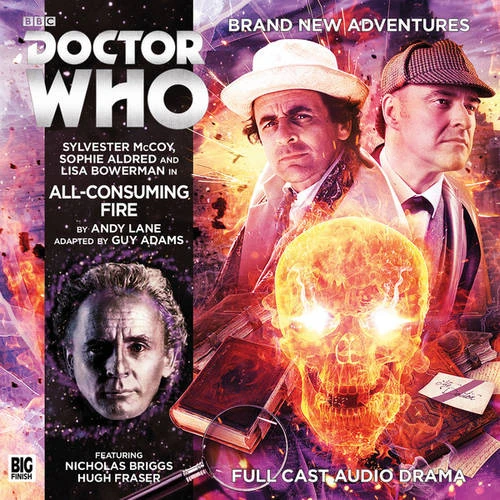
WHO REVIEW: All-Consuming Fire

Big Finish have begun to listen to the overt requests from fans when planning their Doctor Who releases. This isn't necessarily a great idea, since fans like me can come up with truly terrible ideas, but I'm pleased that we're getting a "Two Masters" story, and a return for the David Warner incarnation of the Doctor, both requests I added my voice to. And then there's this: perhaps the most obvious choice for a novel adaptation, and one that I, among other fans, have suggested.

Big Finish have already adapted several of the New and Missing Adventures, the popular Doctor Who novels released by Virgin Books in the nineties. They also have a successful range of Sherlock Holmes adventures, starring (Big Finish top bod) Nick Briggs as the great detective. So All-Consuming Fire, Andy Lane's excellent Doctor Who/Sherlock Holmes/Cthulhu mythos crossover is an obvious choice.

The original novel was split into three sections, each with a different setting. The first sees Holmes and Watson in their natural environment of smog-bound London, assigned a mission of vital importance by none other than the Pope himself. The second sets them further afield, into India, where the otherworldly elements of the plot become more overt. Finally, they travel through a rift in space to another planet in another dimension entirely, in full-on science fantasy territory. The adaptation follows this quite solidly, with two episodes set in London, followed by an episode each in the subcontinent and the alien realm.

I like that the audioplay opens with BF's marvellous Holmes theme, introducing the setting through the words of Richard Earl's perfectly cast John Watson. It's only then that the late eighties Who theme rolls out, juxtaposing with the Victorian setting in a suitably weird way. Both Briggs and Earl are on fine form, and the guest cast - which includes the wonderful Hugh "Captain Hastings" Frazer as Sherringford Holmes - are uniformly good. The third episode brings focus onto Bernice Summerfield, the Doctor's hard-drinking archaeologist companion, who is now so completely inhabited by Lisa Bowerman that there doesn't seem to be anything else to say on the matter. She's spot on. Her rapport with Earl's Watson is one of the highlights of the story.

The original novel, although very good indeed, loses its way somewhat in its final section, with Lane seeming more comfortable writing the Victoriana than the sci-fi stuff. (He's actually written many Doctor Who stories, and while there's some peculiar stuff in there, his period writing is generally his best. Indeed, he's since gone on to become the author of the Young Sherlock Holmes novel series.) Part of this is down to the focus on Ace. I never much enjoyed reading "new Ace," the hard-bitten space marine, and I don't much enjoy hearing her either. One of the strengths of the novel, though, was the intelligent examination of Holmes. Within London, his abilities and knowledge are so finely honed that he is almost invincible; in India, he's out of his element but still remarkably capable. On another world entirely, however, he's almost adrift, his knowledge next to useless. This is mostly lost in the adaptation, and the story is less interesting for it.

On the whole, the adaptation is highly successful, and remains a very enjoyable adventure. The weakest element is, sadly, the Doctor himself. While it's a joy to hear the Doctor and Holmes squaring off and teaming up, Sylvester McCoy gives a weak performance that detracts from the fascinating version of his character the novel range developed. Nonetheless, I'm looking forward to hearing further adaptations of classic Doctor Who novels.

Tuesday, 23 June 2015

The Sleeping Ones

Everyone, this is my five hundredth post! When I started this blog four years ago, it was little more than a collection of vague musings and unnecessarily convoluted analyses of Doctor Who, Star Trek and Marvel productions. Now it's still just like that, only with a backlog of posts with broken links and missing images! To celebrate, here's a Doctor Who short story that I wrote for DWIN's Mythmakers Presents: Golden Years magazine back in 2013. Given that said publication is now about two years old and the expected downloadable version doesn't seem to have materialised (or is already long gone), it seems as good a time as any to make this available. Of course, the original magazine is still available to buy (all proceeds go to charity, after all).

This story features the seventh Doctor and Ace. Enjoy.


A feeble light in the endless blackness of space, the star drifts on an eternal journey of many thousands of light years. From time to time, once every ten thousand years or so, the star had passed within a few parsecs of another, briefly bathing in its light and warmth.

The star supports s single, lonely planet, a tiny, grey-green rock. The planet is no paradise. Once, it had enjoyed a native ecosystem, but little of that now remains. Yet, still there is life. A smattering of settlements, centred around a single city, huddling on the planet’s equator for the maximum amount of the star’s gentle warmth. The city is populated by small, feeble bipeds, a young species that had migrated out from their own planet and onwards to worlds such as this.

The city is busy. Thousands of these little creatures cling to the surface of this world they have tamed and made their own. They are celebrating. Music, laughter, conversation and song intermingle, creating a hubbub of joyous, raucous sound. If someone were to drop down from the sky, and to walk amongst the simple creatures populating this little world, they would be met by a barrage of noise. If they listened carefully, they might just make out one particular sound. An erratic, metallic, clicking sound. The sound of a pair of spoons…


So, what’s the big deal with this festival?” asked Ace, sipping her boldly blue beverage through a twirling pink straw. It was tasty enough, but she’d have preferred something with a little more kick to it. The Doctor had insisted she stick to the “mocktail” menu, though.

She glanced over to the stage, a flimsy, hastily erected plastic structure, in a garish purple. It was clearly only intended to be there for the duration of the festival, and only for minor events like the talent show. Ace swallowed more of her drink, shaking her head in a mixture of disbelief, amusement and embarrassment. The city square thronged with people; men, women, children and the occasional alien chattered away, played games, and watched the Doctor make a fool of himself.

“I love a party as much as the next girl,” she continued, struggling to take her eyes off the sight of the Doctor. He sported his goofiest grin while rattling away with his spoons, in a duet with a seven-foot-tall grass green caterpillar. The creature blinked its single, huge eye in time with its playing, grasping a triangle with one set of limbs and a pair of maracas with another.

“But is it really all because of some bit of astrology?” Ace tore her gaze away from the bizarre spectacle and back to her companion.

Quin shook his head. “It’s not astrology, not really. Some people believe that the pass is going to herald all sorts of momentous events, but that’s just superstition. It’s an astronomical event, that’s all. It doesn’t really mean anything, but it’s still worth marking.”

“So, explain it to me. The Professor tried, but he went on about astrometrics and radical velocity and stuff. I lost interest.” Plus, I’d much rather listen to your voice, she added to herself.

“I think maybe that’s radial velocity.” He smiled. “I’m no expert, though; I’m an archaeologist, not an astrophysicist. But, as I understand it, this is the closest that Barnard and Sol are ever going to get to each other. The actual closest pass happens in a day or two, but the festival is going to run for a little while. Plus, it sort of marks the history of the colony – nearly two-hundred years since Vanderkamp was founded and seven thousand since the first manned ships landed. There’s a lot of history here.”

“Which is why you became an archaeologist,” said Ace, watching Quin closely as he sipped his beer. They still had beer, thousands of years in the future, she thought. Some things never change.

“Well, yeah,” he replied. “Humans have been travelling to other worlds for a long time now. There’s a lot of history everywhere. But you can’t choose where you’re born. Maybe I’ll go to Earth someday, but for now, there’s enough on Polyxo to keep me occupied.”

“There was one other thing I was wondering,” said Ace, keen to keep the handsome archaeologist in conversation. “Why’s the star here called Bernard?”

Quin laughed. Damn, that’s a sexy laugh, thought Ace.

“It’s Barnard, and it’s thought that it was named after the man who discovered it, back on Earth.”
“Actually, it wasn’t Barnard who discovered it,” said a confident voice with a soft, Scots’ burr. The Doctor strode over to the table, swinging his umbrella. “Although it’s unclear just who did. Old Eddie Barnard did pinpoint its proper motion through space, though. It was his observations that enabled astronomers to calculate its eventual close pass by the Solar System way back in the twentieth century. It was named Barnard’s Star in his honour.”

“You’ve finished your show then?” said Ace, none too pleased to have her conversation gate-crashed.
“Clearly you were not a rapt audience.” He turned to Quin, doffing his straw hat. “How impolite of me. I’m the Doctor, Mister..?”

Professor Quin Medenwald.” Quin held his hand out for the Doctor, who shook it enthusiastically.
“Aah, the xenoarchaeologist. I read your paper on the development of ferrotechnology by the second phase Polyxo aborigines.”

“You have an interest in the Stickmen then?” replied Quin, pulling over an extra seat for the Doctor. Ace sighed and returned her attention to her drink. The Doctor was back – the ultimate gooseberry.
“Well, a passing interest, yes,” said the Doctor, taking the seat. “No doubt you share my view that, while the human history on Polyxo is interesting, it’s the native remains beneath the earliest colonies that are the most fascinating.”

“Oh, absolutely. I’d be happy to discuss—”

“Why are they called Stickmen, then?” interjected Ace. She was not going to let this conversation run away from her.

“Well, it’s the remains, you see,” said Quin. “They’re skeletal, of course, but almost comically so. Tall, thin creatures with oversized heads. Hence Stickmen.”

“Well adapted to Polyxo’s lower gravity,” added the Doctor. “However, they all died out rather a long time ago. The reason why is a bit of a mystery.”

“That’s not the popular view,” added Quin. “Most authorities are happy to accept that the stellar flares did for them.”

“Yet you remain unconvinced?” asked the Doctor.

They were advanced. Too advanced to be simply wiped out by stellar flares. They lived as much under the ground as above it, and would have been well aware of the impending flares. They would have had ample time to move underground, and the rock above would have protected them from the worst of the energies. There’s even evidence that they had developed the basics of antimagnetism. It wouldn’t have been easy on them, but they could have survived. But for some reason they didn’t, and were wiped out practically overnight.”

“Yes, it does pose some questions, doesn’t it?” mused the Doctor. “I understand that you’ve been excavating some of the natives’ ruins recently.”

“That’s right,” replied Quin. “Although it’s been put on hold for the festival. The site isn’t far though. Vanderkamp was built practically on top of what we think was the Stickmen’s original capital. Makes digging for it a bit of a mission, of course.”

“But at least the commute isn’t too bad,” added Ace, before slurping down the last of her drink. “Weren’t you planning on meeting someone, Doctor?”

“No, no, I don’t think so…” he teased through a smirk. “Oh yes! I do recall mentioning a passing interest in the local astronomical institution,” he continued, enunciating the syllables with deliberate care.

Quin stood up. “The ADI? I can take you there if you like. It’s not that far. Nowhere’s really that far – there’s not a whole lot of city here.”

“That’s very kind of you, Professor Medenwald,” said the Doctor. He got to his feet, as Ace fixed him with her most intense glare. “However, I’m sure I’ll find it on my own. Perhaps you’d like to give Ace a quick look at the site? She has something of an interest in ancient history, you know.”

“Really?” asked Quin, finally returning his attention to Ace.

“Oh yeah!” The young woman leapt to her feet, knocking her seat backwards and over into the dust. “I’m practically ancient history myself.” She grabbed Quin’s beer, downing the last of it for effect, before slipping her backpack onto her shoulders. The Doctor frowned at her, stooping to right the toppled chair. “Come on then. I’ll see you back at the TARDIS, Professor.”

“Make sure you’re back in time for the starship manoeuvres. They’re sending a fleet from Earth!”
“Will do! See you later, Professor!”


Beneath the surface of Polyxo, sheltered from the rays of the red dwarf star, something began to stir. Something ancient. It twitched in its sleep, as it slowly returned to consciousness…


Blimey, Quin, it’s not that near, is it?” Ace stomped down the dirt track, kicking up plumes of dust that reached high above her head in the weak gravity. She suppressed a cough.

“We’ve got a carrier out at the site,” said Quin. “We can ride that back if you like. We generally walk to and from the city, though, unless we’re bringing artefacts back with us.”

“Do you feel that?” asked Ace, turning to the archaeologist. “It’s weird. I feel kind of light-headed. And light-stomached.”

Quin laughed. “You really are an Earthgirl, aren’t you?”

“What do you mean?”

“There are graviton generators under Vanderkamp. They keep the local gravity close to Earth-normal, but only within the city. You see, Polyxo is a small planet, with a weak gravitational field.”

“Like the Moon?”

“Yeah, I guess the Moon would have been like that.”

Would have been? thought Ace, but kept it to herself. Travel into the future still threw up surprises. “I thought you weren’t an astrophysicist?”

“I’m not, but there are some things you just know. Everyday things, like why the sky is purple.”

The ground had begun to break up, straight lines faintly visible in its surface. The unmistakeable mark of artificiality.

“You can see the edges of the Stickmen’s capital here,” said Quin, gesturing at the lines. “These are the remains of the city walls, which were excavated by earlier generations. We had to uncover most of this again ourselves.

“We’re so close to Sol. People have been coming here since at least the twenty-third century."

“Mmm. The twentieth century’s more my field.”

“I’m a bit rusty on pre-interstellar human history - doesn’t quite spark my interest.”

“Sorry to be boring. Didn’t realise I was a historical footnote.”

Quin gave her a quizzical look, but was quickly distracted. “Here, we’re coming up to the main site. We need to enter through that aperture.” He pointed out a square hole, neatly cut into the stone.
“I need to switch off the forcefield. Keeps out the dust and kids and rockhoppers.” He produced a black disc the size of a keyring and pressed it. It emitted a flash of light and the forcefield deactivated.

The archaeologist stepped up to the hole, kicking the dust away from the edge. It was just big enough for two people to squeeze down together.

“After you,” he said. Shame, thought Ace. Could have done with squeezing down together. Quin retrieved a torch from his pocket, handed it to her and she hopped into the darkness.

“Urgh, well grim!” she said, coughing into her sleeve. “I thought you said that thing kept the dust out? It’s like the cupboard under my nan’s stairs. Even cobwebs!”

Quin dropped down beside her. “Cobwebs?”

Ace flashed the torch into the corners of the passage in which they stood. White webbing, coated in dust, adhered to the walls and ceiling.

“Those things. Does that mean you’ve got spiders on this planet?”

“Probably just something a local life form left. What are spiders?”

“Never mind. What’s so cool about this place then?”

Quin’s face, lit by torchlight, broke into a smile.

“I’ll show you.”


Astronomical Defence Institute,” read the Doctor aloud, effortlessly translating the local script, an eccentric mix of Tellurian alphabets.

The building was vast, significantly bigger than anything in the main square. A bulbous metallic structure, perched on the edge of the city, its surface broken by a grid of windows and radiation collection panels. Powered by the very thing it was set up to investigate.

The Doctor proceeded to the cuboid booth that protruded from the front of the dome. Its single occupant, a middle-aged male of impressive height and girth, was seated within, squeezed into a black uniform and matching hat. Even three light years from Earth, at the tail end of the ninety-eighth century, security guards looked the same.

“Hello, my good man,” said the Doctor, doffing his hat and cracking a broad smile. “I was wondering if you could tell me what the necessary documentation would be if I wished to enter this establishment?”

The guard looked down at the Doctor over his greying moustache. “If you were allowed in, you’d know what was required.”

Very good point, thought the Doctor. He rummaged in his copious pockets.

Ah, here we are. Hopefully this should be more than sufficient.”

He passed the guard a battered pamphlet bound in a leather case. The official frowned as he unfolded the crackling paper.

“Special Delegate of the Galactic Federation, to be accorded all ambassadorial privileges,” he read aloud.

“You’ll see that it’s stamped and signed by the Galactic President’s office and lists the Martian Ambassador as a character reference. I also…” – he rummaged further – “…have…” – frowning, he tried his trouser pockets – “… a membership card for the United Earth Space Probe Agency and documentation authorising my presence from the Foreign Hazard Duty.” He reluctantly gave up, showing empty hands. “Somewhere.”

The security guard sighed, and tapped the intercom unit clipped to his collar.

“Professor Asgar, there’s a Doctor John Smith here requesting entrance. Yes, he’s got documentation, looks official, never seen it before though.” He paused, listening to the response. “I dunno, sir, he looks like one of those loonies here for the festival. You should see his trousers…”

“Oh, tell him that I wrote the Octember 9784 paper on ‘Quasi-magnetism in pin galaxies,’” added the Doctor for good measure.

Another sigh, deeper this time, expressing years of pent-up frustration and barely concealed apathy. 

“Did you hear that, sir? Yes? Are you sure? All right, sir, whatever you say.” He looked down at the Doctor in resignation. “Go on then, but be aware that they are currently engaged in some very important work.” He pressed a button, and a door slid open in the surface of the dome.

The Doctor replaced his hat.

“Thank you. Don’t let me keep you from your busy work any longer.”


Quin brought Ace to a cavernous chamber. The walls were covered in symbols, etched into the rocked and smooth to the touch. In the centre of the room stood an object shaped not unlike a mushroom. It stood at about waist height and shone in the torchlight.

“What is it?” asked Ace.

“We think it’s an antimagnetic device,” said Quin. “I’m not the tech head, but our experts reckon the Stickmen were building something to interact with electromagnetic fields. It might have been designed to help shield them from the effects of the flares.”

He pointed at the symbols that festooned the walls.

“We’ve only recently excavated this part of the city. There’s probably more under Vanderkamp itself, but reaching that is even more difficult. There’s evidence that the city was buried due to seismic activity.”

“You mean an earthquake?”

“That’s right. There’s more of the city further along, but the entrance is well buried. We can’t risk forcing our way through; it could damage what’s on the other side. Once we’ve finished in this section, we’ll look at beginning the process of excavation further in. It’ll be a slow process.”


Ace shone her torch over the etchings.

“Well cryptic,” she whispered. “What does it mean?”

“The Stickmen used ideograms in their written language. This entire display is designed to tell us what happened to them. It’s scrappy though, unfinished. Their inscriptions are usually methodical. This was done in a hurry.”

“What does it say?”

This part we’ve translated. It refers to the ground itself. Something underground. And this means animal, or beast, which when combined with this would be… monster? Killer? I’m not sure.”

“Nothing good then?”

“Well, I can’t read all of it, but it’s definitely telling us what happened. They must have inscribed this as a warning to people who would come later. Something came up from under the ground, a beast, that killed them all.”

“What about the earthquake?”

“That came earlier. Perhaps it was even the cause of it. The beast… no, beasts, plural… the ground shook and they came up from beneath.”

“What’s down there?” asked Ace, flicking her torch in the direction of the tunnel.

Quin straightened up from the inscription. “It’s a dead end. We need to excavate further. It’s blocked, probably due to a collapse during the tremors that heralded the end for the civilisation.”

Ace took a short walk down the passageway. The way was blocked all right, a slab of rock barring entry. The floor of the tunnel sloped downwards – wherever it led, it was deeper underground. 

Whatever had killed the Stickmen, the answer was bound to be down there.

“We haven’t got time for that. You want to see the rest of this place? Leave it to me.”

She slipped off her rucksack and unzipped it, fishing out two metallic cans. They rattled together in her hand as she broke their seals.

“Cover your ears and get your head down!” she cried, lobbing the cans in the direction of the wall of rock.

“Ace! What the hell do you think you’re —”

She grabbed him, pushed him back towards the opening of the tunnel and dragged him down onto the ground. Pressing one side of her head against his broad chest, Ace covered her exposed ear with her free hand. Seeing this, Quin did the same.

“BOOM!” cried Ace as the explosion ripped through the air. The walls shook, flecks of stone falling from the stone ceiling.

Gingerly, the two of them stood up, brushing off the copious amounts of grey dust.

“Ace... what did you do?”

“Oh, you archaeologists are all the same. Too much patience, not enough action. Come on – let’s see what’s down there!”


The Doctor happily pottered around the entrance hall of the Institute, studying the displays. He stood ensconced in the details when he received a tap on the shoulder. He spun round to find himself face to face with an older man.

“Doctor Smith, I presume?” asked the stranger in a deep baritone.

The Doctor doffed his hat and smiled. “Professor Asgar, a pleasure to make your acquaintance.”

“You too, Doctor, although I must admit I’m unfamiliar with the paper you mentioned.”

“Are you?” the Doctor’s face fell momentarily, before brightening just as quickly. “Perhaps it hasn’t been published yet. It’s so hard to keep track of these things. It is 9799, isn’t it?”

Professor Asgar gave the Doctor a puzzled look, but nodded.

“If you insist on using the Earth calendar, yes. I take it you’re here for the festival?”

“Well, yes, although I’m more interested in the work you’re doing here. It’s all well and good getting excited about star systems passing by one another, but what’s the point if we don’t take the chance to study the effects? How will the proximity of Sol to Barnard’s Star affect the planets of each system, for instance?”

Asgar smiled. “Indeed, Doctor. Exactly our sentiments here at the Institute. However, we are rather preoccupied with a related matter, so I fear that a tour of the facility must wait.”

“Ah, yes, the upcoming stellar flares,” said the Doctor, nodding enthusiastically. “I presume you’ve been working on an electromagnetic defence system, to deflect the worst of the radiation away from the planet?”

“You’re well informed, Doctor Smith.”

“Well, it is rather an obvious direction to be going in,” he said, grinning. “Perhaps I could take a look at your methods? I’d be most interested.”

Asgar shook his head. “I’m afraid not, Doctor. Work is at a delicate stage and must be ready for full activation by tonight. The flare activity is expected to begin tomorrow and we must perform the final tests.”

Putting on his most disappointed face, the Doctor sighed.

“Is there no way you could bend the rules a little? I have reason to believe that there is a very great danger threatening this planet. A danger from the ancient past – something that will make the stellar flares seem no more serious than a mild case of sunburn.”

“Doctor, there is nothing that is more of a threat to this planet than the flares. Whatever you believe you may have discovered, I suggest you approach the institute with it through the proper channels. I have no time for spurious amateur theories.”

“I assure you, Professor, that this planet is facing a deadly threat and must be evacuated!”

“Evacuate?” laughed Asgar. “In the middle of the festival? Come now, Doctor.I assure that this planet is in safe hands. Everything is under control.”

“Very well,” sighed the Doctor. “Might I be allowed to mill around here for a little longer? I was enjoying reading about the work you have displayed.”

“Of course,” replied the Professor, impatiently. “Take your time. Now, if you’ll excuse me?”

The Doctor smiled, doffing his hat once more for good measure, before returning to his perusals. After a moment, he marched briskly after the scientist.

It wasn’t difficult to locate the Professor’s project. While scientists could be peculiar in their organisation, academic architecture was rarely unpredictable. The core project would be in the most prestigious laboratory. Sure enough, the Doctor soon found himself watching Asgar and his assistants through a viewing window in the lab’s main doorway.

The Doctor fished around in his jacket pocket and produced his sonic lance. He ducked around the corner, pointing the device at a tiny red alarm box on the wall. The howling siren blasted his eardrums, forcing him to plaster his hat down on his ears. Sure enough, though, Professor Asgar and his assistants stormed out of the lab, complaining noisily about the disruption, and left the section. The Doctor ducked into the laboratory, smiling to himself.

The system before him was large and overly complex, with all manner of vital functions to perform. It took the Doctor almost three minutes to work out precisely what did what and how he needed to damage it. A simple control system, at the heart of it, he thought, linked to a magnetic array in orbit.
Wielding his sonic lance, he got to work.


Torchbeams scattering in the dust, Ace and Quin pushed on into the buried city of the Stickmen. Compressed remains of buildings lay on either side of the roadway, walls crushed inwards under the weight of rock. Millennia of decline had left the buildings broken, a civilisation crushed under the foot of a devastating catastrophe. A jagged fissure had broken the roadway into two uneven halves. Ace watched her step carefully.

“You see,” said Quin, “this isn’t the result of the stellar flares. They must have hidden underground to survive the radiation, and then the quakes came and they were destroyed. Odd thing is, we don’t get a great deal of seismic activity on Polyxo. It’s an old planet.”

“Then why did the quakes even happen?”

Quin kept silent, unable to answer. He moved on ahead, flashing his torch over the destroyed buildings that surrounded them. Ace recognised the look of his face. It was the same look the Doctor had when he found something that would hold him in rapt fascination for the next hour – be it a weird space insect on some distant planetoid or dusty old jazz records in Camden market.

She pushed on ahead, passing yet more crumbling structures, barely distinguishable in the gloom, until the light from her torch settled on something altogether more interesting.

“Quin! Come here, you’ll want to see this!”

The archaeologist came rushing up to her. He pointed his torch alongside hers, fully illuminating the scene in front of them. Beneath a dense layer of sediment lay the skeletal remains of three Stickmen, and… something else.

“I see what you mean about them being skinny,” said Ace. Each of the three creatures would have been a good eight feet tall. Their bodies, roughly human in shape if not proportion, were bent and broken. Their spindly fingers held the handles of jagged bladed weapons. Ace focussed her torch light on the one nearest to her. The creature’s head, tall and narrow, sloped backwards to a point. A deep crack was visible where his skull had made contact with the ground.

“Poor old boney,” she said. “Picked the wrong fight there.”

Between the three Stickmen, its carapace scratched and ripped open, lay a hideous animal. Insect-like, with ten long, spindly legs, its domed shell was ringed with hemispherical bulbs, underneath which were spindly mouthparts. Quin brushed away some of the dust covering the relic, and gave it a gently tap with his torch. It reverberated with a metallic clang.

“It’s an animal, alright,” he said, “but it’s metallic.”

“The beast?” queried Ace.

“Could be,” said Quin, not taking his eyes off the scene. “These three natives and the creature must have died fighting each other.”

“Better than a few old buildings, eh?” Ace smiled.

Quin looked up at her at last, and smiled.

“I guess it is. There’s enough here to keep my lot busy for years.”

“And you doubted my excavation techniques,” pointed out Ace. “I say, if something’s worth doing, it’s worth doing—”

A sudden tremor cut her off. The ground shook beneath their feet – gently, but it was enough to bring yet more fragments of grit and dust down on their heads.

“I thought you said you didn’t get quakes here?” said Ace, after coughing up dust.

“We don’t,” said Quin. There was a tremor in his voice that worried Ace far more than the one she had just felt. Even in the bleached torchlight she could see he had turned pale. “We should get out of here. Just in case.”

Another tremor. Far stronger this time. Ace stumbled, almost losing her footing. Quin grabbed her. They held each other for a moment, as a third tremor rippled through the ground beneath them.

“Let’s go,” she said.


They piled into the two-seater carrier, a tiny cab attached to a padded box for the safe removal of archaeological samples. They rattled towards Vanderkamp, the ground shaking beneath their feet. It wasn’t violent, but it was worsening. How long till a full-fledged quake hit? wondered Ace.

“Can’t this thing go any faster?” complained Ace. “We’d make better time in a milk float!”

“It’s not really designed for high speed getaways!” replied Quin, putting his foot down.

The edge of Vanderkamp was visible up ahead. “That bug thing down there wouldn’t have been enough to kill off a whole civilisation,” she yelled behind her. “There must have been more. And that crack in the ground… the creatures had to come from somewhere.”

“You mean, they came up through the ground?” Quin yelled back in panic.

“I’ve seen stranger things,” admitted Ace. “We need to find the Doctor.”


The Doctor slipped silently from the laboratory. As he exited the Institute, he spotted Asgar and several of his colleagues exchanging heated words with the sour-faced security guard. The Doctor quickly made his way to the main square.

The TARDIS stood at the far corner of the square, its blue surface rendered mauve in the ruddy light of the dim sun. Festival goers milled around happily, paying no attention to one more unusual object amid a sea of stalls and floats. Simple, old-fashioned fun, thought the Doctor, as he entered his ship.
At the control console, he activated the subspace communications. After a short interval of static, he isolated the correct Sub-Etha frequency.

“Hello, hello, Earth Central Control?” he ventured. “This is a mayday call from Polyxo in the Barnard system. We require immediate evacuation, repeat, immediate evacuation. The Astronomical Defence Institute has encountered a catastrophic systems failure that will now increase the effects of the stellar flares. Please respond.”

As the Doctor awaited a reply, Ace burst through the doorway, Quin stumbling in behind her.
“What… how…” babbled Quin, taking in the gleaming white control room.

“Never mind that,” said Ace. “Doctor, we’ve got a problem. We know what killed off the Stickmen, and we think it’s coming back!”

The communications system crackled into life.

“Message received, Polyxo. This is Earth Central Control. Fleet is heading your way for manoeuvres. Will be diverted to evacuation in time for stellar flare activity once we have confirmed the situation with the relevant authorities. Please stand by.”

“What’s he talking about?” demanded Quin, snapping out of his bemusement.

There’s not time to explain,” grumbled the Doctor. “I know about the Stickmen, Ace. The stellar flares are coming and there’s no way to stop them now. I’ve rigged the defence system. We need to get off this planet before someone finds out!”

Quin bolted from the TARDIS.

“Leave him, Ace,” the Doctor warned, his voice low. “We have to get out of here.”

Ace stood in the doorway, holding the Doctor’s gaze. Then she turned and ran after Quin.

“Ace!” shouted the Doctor, “Come back! I’ll explain everything, just as soon as we’re on our way.” He stormed out after her.

Quin hadn’t gone far. The main square was busy with people, and law officers were never far.

“Him,” he said, pointing at the Doctor. “He’s done something to the defence array. You’ll need to question him.”

A particularly large, bulky officer in a grey uniform slapped his meaty hand on the Doctor’s shoulder.

“Captain Grant, sir. You are under arrest for sabotage.”


The Doctor sat on an uncomfortable metal stool in a small, poky office that had been left abandoned in the current chaos at the Institute. Captain Grant loomed over him.

“So then, ‘Doctor Smith,’” growled Grant, “we have an accusation of sabotage from Dr Quin Medenwald. We also have a statement from Professor Nurian Asgar, describing how you enquired about the workings of his vital new defence array. Asgar and his colleagues are still trying to work out what you did to the array control system. He will be here shortly, and it would save a lot of time, and a lot of lives, if you would just tell us what you did and how to fix it.”

The door swung open, both Quin and Asgar entering.

“I’ll leave him with you, Professors,” said Grant. “I need to speak with his young friend.”

“Ace was with me the whole time,” said Quin. “She has nothing to do with this.”

“Nonetheless, she’ll need to make a statement. Gentlemen.” He slammed the door behind him.

Asgar and Quin took their seats in front of the Doctor. Asgar leaned forward, so that his face was mere inches from the Doctor’s.

“I’ll say this for you, Doctor,” he hissed, “you’ve done a damned good job on that array. I’ve been working on it with my best people, and none of us can make head nor tail of what you’ve done to it. So, I’m going to ask you to show us what you did and how to reverse it, and maybe I can prevent Grant from handing you over to Earth Central.”

“I’m afraid I can’t do that, Professor.”

“And why is that?”

The Doctor took a deep breath.

“Polyxo is an ancient planet. Once, it was an entirely different biosphere, based on iron, gold and semimetals. Metallic life forms whose bodies were held together by magnetic fields.”

“That hardly seems feasible,” said Asgar.

“There were the equivalents of plants, drawing energy from the light of Barnard’s Star, and herbivores that fed on them. And, of course, there were predators. One species evolved into a particularly effective predator, devouring the life energies of other creatures, draining them of their very life force.”

“Actually,” interjected Quin, “I have just uncovered some… unusual remains at the site which bear the Doctor out on that matter.”

The Doctor continued. “ The biosphere couldn’t withstand such an efficient predator . There was a devastating mass extinction. The creatures went into hibernation beneath the surface, protected from Barnard’s stellar flares. Life arose again on Polyxo, in time.”

“Yes, yes,” snapped Asgar, “organic complexes, probably carried on here on a comet. This, at least, agrees with theory.”

“Eventually, the beings you call the Stickmen arose. They built up an advanced civilisation, and may have become aware of the periodic mass extinctions that occurred when the protean predators awoke. They certainly had legends, of Sleeping Ones that arose from beneath the ground.” The Doctor looked to Quin. “What did you find in the ruins, Professor Mordenvald?”

“There were inscriptions that could describe what you’re saying, yes.”

“Eight-thousand years ago, Barnard’s Star experienced a flurry of activity, the Stickmen retreated underground to sit out the stellar flares. The Sleeping Ones would have been stirring anyway, but that intrusion on their domain would have jolted them into action. The poor Stickmen didn’t stand a chance.”

“I see,” said Asgar. “So, what we have is yet another fairy story about the wondrous Stickmen.” He sneered at Quin. “Honestly, he’s worse than you.”

“I still believe that the stellar flares weren’t what killed off the Stickmen,” said Quin, “but that doesn’t mean I support what the Doctor is saying. Still, if perhaps you’d listen to someone else for once - ”

“Mordanveld, what matters here is not the history of your precious Stickmen.” Asgar returned his attention to the Doctor. “I fail to see how it relates to your little act of sabotage, and your wilful endangerment of the lives of everyone in this settlement.”

“You don’t understand,” implored the Doctor. “It isn’t just this world that’s at risk. The Sleeping Ones were waking anyway. The proximity of the Earth, and its rich bioenergy, would have shook them from their slumber. I needed to deal with them before that happened, but I couldn’t do it while they were buried beneath the surface. They are waking up as we speak. I had to find a way to destroy the creatures once they reached the surface of Polyxo, but before they escaped and travelled to Earth. So I rigged the stellar defence system to reverse its effect .”

“Doctor,” said Quin, “what would happen when the creatures began to wake up? Would there be some kind of seismic activity?”

The Doctor nodded. “Something of the sort, I should think. The Sleeping Ones’ hive is located deep beneath the city.”

“I’ll accept what you’re saying about the creatures, but I still don’t understand what possessed you to damage the array,” added Quin.

“When Barnard’s Star becomes active later tomorrow, the flare will hit the antimagnetic field and become supercharged. Prolonged exposure will destroy the magnetic fields that hold the creatures’ bodies together. They’ll be forced to retreat back into hibernation, and they’ll stay there for thousands more years, until long after your people have abandoned this planet .”

“And this was your best method of dealing with this supposed problem?” said Asgar.

“He’s right,” said Quin. “Why didn’t you just tell someone about the creatures?”

“I did try to raise the subject with you Asgar, but you dismissed me, as I suspected you would. It is quite a tall tale, I’ll accept. There’s a fleet of ships heading from Earth as we speak, ready to evacuate the colony. Once the flares have died down, you can all return to your homes. If you hadn’t made your rather clever advances with magnetic manipulation, you’d all have had to evacuate anyway and you’d never have been any the wiser to the creatures’ existence.”

“Frankly, Doctor,” scoffed Asgar, “I have no idea if you’re messing with us or simply delusional. You have put the lives of thousands at risk and you will tell us how to fix that array.”

The building shook. Both Asgar and Quin jumped to their feet.

“What the hell was that?” said Asgar.

The Doctor frowned.

“Ahead of schedule, that’s what. That’s not good, gentlemen, not good at all.”

A second tremor ripped through the building, throwing the Doctor off his chair. He stumbled to his feet.

“I think we’d better find out what’s happening out there,” he said.


Now then, Miss McShane,” said Captain Grant, “you’re not in any trouble. I just need to talk to you about Doctor Smith.” He settled into a plastic chair that creaked under his weight, at the outer edge of the food court that straddled the gap between the Institute and the main square. He motioned for Ace to join him. She sat heavily into another plastic seat.

A Denebolan waitress shuffled up to them, her fur ruffling as she moved. Grant ordered the sandwich of the day, but Ace merely shook her head sullenly.

“Now miss, I would appreciate it if you could tell me a little about your friend the Doctor and your relationship.”

“He’s a friend. We travel together. He’s a good bloke.”

“Oh yes? This ‘good bloke’ has damaged a cutting-edge system that is essential for the survival of this settlement.”

“I know. But the Doctor wouldn’t do something like that for fun. If he did something to the defences, you can bet he had a damn good reason for it.”

“Maybe. We’ll find out. Professors Asgar and Mordanveld are speaking with the Doctor now.”

“What about the tremors?” asked Ace.

“Your friend Mordanveld mentioned these, but no one here felt them. They clearly weren’t very strong. And I fail to see how they have any bearing on the Doctor’s little act of sabotage.”

The Denebolan trundled back over to their table, and deposited an extremely full sandwich in front of Captain Grant. He slipped her a credit gratefully.

As he lifted the sandwich up to his lips, the ground shook gently.

“What was that?” he whispered.

Ace stood up. “Oh no,” she muttered. “I told you – tremors! They must have got stronger!”

Another sudden vibration, this time strong enough to send plates and cups flying. The various patrons of the food court rose to their feet in alarm. The next tremor sent tables over, and was enough to cause Grant to finally drop his sandwich. He and Ace looked out into the square. People were beginning to panic.

With one final, vast convulsion, the ground ripped open. Vast cracks appeared across the square. The panicked crowd erupted into screams.

Dozens of spindly, metallic legs protruded from a large fissure in the centre of the square, followed by three dome-shaped carapaces. Three creatures clambered out from under the ground. Then six. Then eighteen. And they kept coming…

“What the hell are they?” snarled Grant, slipping his ion pistol from its holster.

Ace pulled some cans of Nitro-9 from her rucksack. Never leave the TARDIS without some, she thought.

Three of the insectoids had a group of young men cornered against a building, their compound eyes coldly scrutinising them.

“Stay away from them!” Ace shouted.

With a sudden lunge, the foremost creature pinned one of the men to the ground with its claws. A long, thin tube protruded from its craw, snaking around its victim’s neck. With a soft, crackling spark, it drew out his life. He convulse as the life ebbed from him. His friends screamed, as his body withered to a lifeless husk.

The creature then turned to Ace.


From the foyer of the station, they could see dozens of creatures swarming over the city, their metallic carapaces glinting in the red light of the setting star.

“They are what I’ve just spent the last half hour telling you about! Now do you see that I am telling the truth?”

Asgar protested. “Very well, Doctor, but you said that these creatures would be at the mercy of the flares tomorrow. What are they doing crawling through our city now?”

“I admit, I may have made a slight miscalculation.”

“The fleet is on its way,” added Quin. “We might be able to hold these things off until it gets here.”

“I fear that won’t be enough, but you’re right, we must get out there, do what we can.” He frowned. “Ace is still out there.”

They surveyed the carnage from the relative safety of the Institute. There were enough people out in the open for the creatures to feast upon, before they had to start breaking their way into the buildings. The Doctor watched, his brow furrowed.

Sure enough, there was Ace, lobbing cans of Nitro-9 at the attacking creatures, while Grant unleashed bolts of energy from his own sidearm.

“I’ve got to get out there. I trust you will allow me to aid my friend? I’ll happily allow Captain Grant to re-arrest me later.”

Asgar scowled at him, but nodded.

“You’d best stay here, Professor. Look after anyone who makes it into the Institute. We’ll do what we can out there.”

The Doctor and Quin fled the building.

“Doctor!” cried Ace, popping another can of Nitro, and lobbing it at a creature. Its carapace cracked open with a flash of energy, and it collapsed. “What took you so long?”

“I was a little tied up,” he quipped. “Figuratively speaking.”

“Doctor, we’ve found the Stickmen’s city. I Nitro’d my way in.” Even in the chaos, Ace flashed a quick grin. “We think these things killed them off. They were underground – they must have tunnelled under Vanderkamp.”

The Doctor was aghast. “You did what?! Ace, I wanted you do investigate the ruins, not blow your way into them. No wonder the Sleeping Ones are awake – you’ve just given this planet’s personal apocalypse an early morning alarm call!”

Ace’s smile fell. “Oh.”

“At least the explosives are doing the trick,” said Quin.

“Sure are,” agreed Grant. “A bit of brute force is all it takes!”

“You think so?” said the Doctor. “Watch.”

The creature that Ace had just felled began to twitch. With a low, electrical hum, the two halves of its fractured body fused together, leaving just a hairline fracture in its shell.

“How are we supposed to fight that?” Ace exclaimed.

“Enough energy can disrupt their electromagnetic fields and cause them to collapse permanently,” said the Doctor. “But without the flare we have no way of providing that energy. Perhaps, with enough time, I could use the antimagnetic properties of the array against them directly, but to rework it so completely would take far too long…”

“What can I do here?” growled Grant, finally accepting that his gun wasn’t going to get hit very far.
“Get as many people as you can away from here and into the Institute. At least they’ll be relatively safe there.” He turned to Ace and Quin. “We need to get back to the site.”


There we go,” said the Doctor, “one short hop. Not bad, if I do say so myself.”

Ace, Quin and the Doctor stepped out of the TARDIS and into the gloom of the Stickman site.

“The device is over there, Doctor. We found some Stickmen, dead with one of these creatures.”

“Perhaps they got lucky,” said the Doctor. “Or perhaps this thing was close enough to finished for a low level test. Just enough to kill off a few of the Sleeping Ones in the immediate vicinity. Though I can’t imagine it was very healthy for the Stickmen either.”

The Doctor examined the mushroom-shaped object, wiping the latest deposit of dust from its scarred surface. He reached into his pocket, removing his sonic lance.

“Hmm… a little judicious tweaking, and it might just be possible… there!”

The device slowly hummed into life, a soft, blue glow emanating from its rotund crown.

“That’s what I call a long-life battery,” said Ace.

“It won’t be enough,” said the Doctor, frowning. “They never developed a powerful enough system.”

He turned to Ace and Quin.

“There is a possibility.The Sleeping Ones are ruled by a queen. She’s the centre of their hive mind, linked to all of them through electromagnetic pulses. If we can knock her out, the others will have no direction. They’ll become helpless.”

Quin smiled. “Then the flare will come along and finish them off for good.”

The Doctor’s frown grew deeper. “No, Professor. Then I’ll do what I can with the Queen. If I can convince her to fully return to her hibernation, the Sleeping Ones can stay sleeping until this planet has been abandoned by humanity.” He paused. “We need to get into the core of the hive. There should be a central cavern.”

“Which will be full of creatures?” asked Ace.

“I’m afraid so. How much Nitro-9 do you have left?”

“Two cans.”


“Well, we’d best get moving,” said the Doctor.

Between them, Quin and Ace had little trouble carrying the antimagnetic device, its construction proving surprisingly lightweight. The Doctor carried nothing more than his umbrella. The three of them pushed further on into the gloom, the broken ground of the Stickmen’s city tilting downwards into the depths of the planet’s crust.

“Are you sure we’re heading in the right direction?” Ace asked the Doctor, pausing in the descent as she and Quin maneoveured the device down a jagged incline.

“Yes, they’re down there. I can feel them. One vast mind, spreading outwards in all directions. It’s still waking up, but we need to hurry.”

The twisting passageway opened into a shallow cavern. The Doctor held out his arms, his umbrella blocking the way forward.

“Wait,” he ordered. “We’re here.”

The cavern ahead was crawling with Sleeping Ones. Hundreds of the creatures piled over one another. The sound of scraping metal reverberated through the enclosed space.

“Oh cripes,” Ace breathed.

In their centre sat a vast, swollen mass, featureless but for a huge, gaping maw. It pulsed with energy, glowing faintly in the darkness. Ace watched in revulsion as the worker creatures attended the queen. Sparks of energy shot from their mouthparts as they gorged their queen on bioelectric power.

“How do we activate this thing?” said Quin.

“And how near do we have to get?” added Ace.

“I can activate it,” said the Doctor, “but due to its low-level pulse, we’ll have to get very close.”

“I was afraid you’d say that.”

“What about the rest of them?” said Quin. “They’re not going to let us get very close.”

Ace handed him a can of Nitro-9.

“One can each. We can distract them, give the Doctor a chance to get to the queen.”

Ace nodded. “Go!”

She and Quin ran into the swarm of creatures, Ace ducking left, Quin dashing right. The insectoids shifted their attentions from the service of their queen, swivelling to face the two humans running at them. Claws raised, feeding tubes ready, they lunged towards the attackers. Ace popped her can of Nitro-9 and lobbed it into the oncoming mob. The explosion through them backwards, the foremost few creatures ripped apart by the force, others thrown against the wall. Ace herself was thrown backwards by the force, landing painfully on her backside.

“Quin, now!” she cried.

The archaeologist struggled with the can, finally succeeding in ripping it open as the creatures advanced. They were almost on top of him.

The Doctor took his chance. He threw his umbrella to the ground. Heaving the antimagnetic device forward, he charged towards the queen’s gaping mouth. He dropped the device into her maw, then leapt back, landing on his backside. He grabbed his sonic lance from his pocket, and triggered the device.

A blast of white-blue light burst from the device. The queen’s bulk absorbed much of it, yet she shuddered as the pulse passed through her. With a final, violent convulsion, she collapsed, her mandibles drooping slackly.

The creatures paused, quivering over Ace and Quin.

“Doctor!” cried Ace.

“Shhh!” he hissed. “Quiet. They’re stunned, but we don’t want to wake them, do we.” Gingerly, he edged right up to the queen’s body, until he was able to press his fingers right up against the gleaming metallic exoskeleton.

“That’s it,” he whispered. “Sleep. Call back your children. There’ll be time to feed again in the future. A long time from now.”

The twitching creatures surrounding them began to shift, sluggishly, back towards their queen.
The Doctor stooped to pick up his umbrella.

“I think,” he said quietly, “that we’d best not outstay out welcome. Besides, I’ve got an array to fix.”


The dust was, at last, settling. Medical crews were attending the many injured. Quin had found Captain Grant, and was assisting him in dressing a vicious-looking wound on his right arm, no doubt caused by one of the creature’s razor claws. In the distance, the last of the Sleeping Ones was shambling back in the direction of its home.

The Doctor swung his sonic lance in his hand, before dropping it into his pocket. Asgar had agreed to overlook events as long as he put the array back as he’d found it.

“I suppose you’ll be wanting to say goodbye to the young Professor Medenwald?” he asked Ace.

“I’m not sure it’s a good idea,” she replied. “We’d be better off slipping away. That’s more your style, isn’t it?”

“Sometimes,” nodded the Doctor, solemnly.

“He’ll have plenty of new research to do,” said Ace. “The thought of asking him to come with us did cross my mind.”

“Come with us?” scoffed the Doctor. “An archaeologist in the TARDIS? Whatever next?”

“What did you do in there? With the queen?”

“She’s a telepathic creature, Ace. It’s all a matter of making the right sort of contact.”

Ace turned and fixed him with a hard stare.

“Of course, if you’d let me know about the Sleeping Ones in the first place, and your plan to use the flares to fry them, then this whole thing would have gone a lot more smoothly.”

The Doctor bowed his head.

“You’re right, Ace. I try to keep you out of trouble, you know, but somehow I always manage to get you into more danger than I’d bargained for.”

“No more complicated, classified missions, eh, Doctor? No more secrets?”

“Don’t worry, Ace. No more secrets.”

The Doctor and Ace turned and entered the TARDIS, their feet leaving the surface of Polyxo for the last time. She didn’t notice the fingers crossed behind his back.