I caught
Wonder Woman on its opening weekend, but it's taken me this long to get round to reviewing it. Primarily this is because picking holes is often the most enjoyable part of reviewing a film, and
Wonder Woman has very little wrong with it. I think we can all agree that it's by far the best of the DC Expanded Universe movies that have come so far, standing head-and-shoulders above
Man of Steel (which I enjoyed more than most),
Batman vs. Superman (which had its moments but was dreadfully flawed) and
Suicide Squad (which started reasonably well but went rapidly downhill).
Wonder Woman had, very unfairly,two things to prove: that a female-centred superhero movie could work, and that the DC movieverse wasn't doomed to collapse. Both of these it managed with aplomb, by being a brilliantly fun movie and showing just how fantastic Wonder Woman is when done right.
If you haven't seen it yet, I suggest you go out and watch it forthwith. And then come back and read this, because there will be SPOILERS.
So, the last time anyone attempted a movie focused on a female superhero was, what,
Catwoman? That was thirteen years ago, and thanks to a complete misunderstanding of the character combined with cheap production and an almost offensively poor script, essentially killed off superheroine movies before they started. Sure, we've had plenty of superpowered and costumed women in comicbook movies over the last few years, but none have been allowed to headline. Even so, it's hard to lay the blame at the feet of DC and Warner Bros. because of
Catwoman, however much of an easy target it is. There has been a huge reluctance to give superheroines their own films. This is apparent from the fact that, in her 76-year history, no one has made a live action
Wonder Woman movie before (excepting a rather dismal 1974 TV movie). She's one third of DC's top tier trio, standing shoulder-to-shoulder with Batman and Superman. They've had, respectively, eight and six live action films, more if you count their recent crossover and the old monochrome serials. Batman got his first big screen outing in 1943; Wonder Woman had to wait till 2017.
So, yes, there was a lot riding on this release, and much of that was squarely on the shoulders of Gal Gadot. Fortunately, not many people were worried that she might not carry the film; she was by far the best thing about
Batman vs. Superman, outdoing the big boys in charm, style and bad-assery. In terms of physicality, she is perfect for the role, having been both a model and a soldier in her already storied career, but it's her performance that carries the film. Gadot's Diana is strong-willed, intelligent, noble, idealistic and naive, traits that are portrayed through confident writing and a powerful and believable performance. It would be easy for the film to fall into cheesiness as Diana strides into cabinet meetings and demands to know why she can't be heard along with the old white men, but both Allan Heinberg's script and Gadot's performance sell it perfectly.
Steve Trevor is understandably bowled over by Diana's physical beauty, but it's her courage and conviction that make her someone that he will follow into a warzone, along with his mismatched gang of sidekicks. I really enjoyed Chris Pine's performance as Steve, with great charisma, wit and heroism, but never overbearing or too arrogant - bravery, not bravado. The times when he stands against Diana are when he is genuinely right, borne out by his greater experience in "Man's world" and a real modern war. Diana and Steve's relationship illustrates the core theme of the movie, the dichotomy between humanity's compassion and beauty, and its capacity for destruction and cruelty. Diana is overly enamoured with humanity, unable to believe that their warring is anything other than the influence of Ares, while Steve has grown cynical and war-weary. They both affect each other, coming closer to each other's worldview for a more rounded perspective.
The choice of a World War One setting is inspired, miring the narrative in the very worst of humanity's warmongering. It's not surprising that Diana is convinced that it is Ares who is responsible for this horror. Patty Jenkins's direction is excellent throughout, but it's in the battle scenes that it's exceptional, in the valiant defense of Themyscira on horseback, the real-world horror of the trenches, and the liberation of the besieged village. In all these, Diana is the most remarkable element, quite rightly the centre of events, particularly once she has accepted her destiny and left for the wider world. This is the big difference between
Wonder Woman and the other DCEU films. While they're set in the same grimdark world of cruel tyrants and the worst of humankind, in
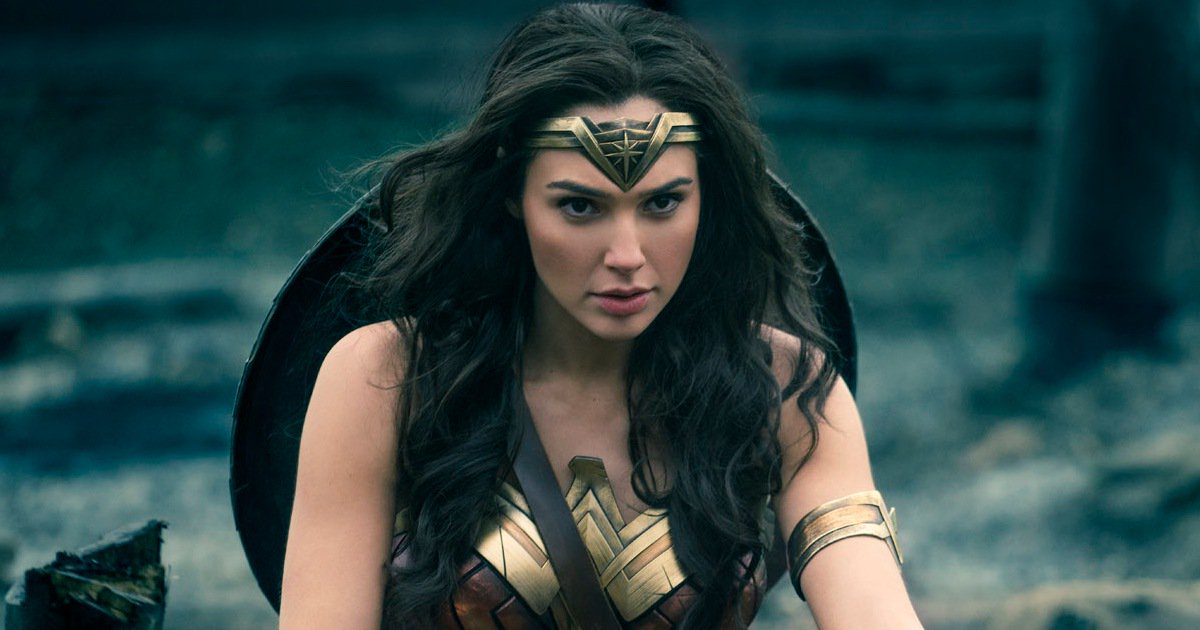
Wonder Woman there's a true ray of hope in the form of Diana. She strides through the battlefield on the front, a golden figure cutting through the dismal greys of No Man's Land. She represents something better than humanity, a warrior for honour rather than a fighter for war's sake, and that's refreshing after the stolid brutality of the recent versions of Batman and Superman.
It would be very easy to focus solely on Diana and Steve, but the supporting cast are also excellently cast. A special shout out to Lilly Aspel and Emily Carey as the younger versions of Diana, with young Lilly being especially adorably spunky. Connie Nielson is powerful and intimidating as Queen Hippolyta. Perhaps the character who most needed more screentime is Etta, played by Lucy Davis, exactly the sort of actor you wouldn't expect to see in a film like this and yet somehow absolutely perfect when placed opposite Gadot's Diana.
On the villainous side, both Danny Huston as General Ludendorff and Elena Anaya as Dr. Poison are suitably monstrous in their roles, although they are unquestionably second-tier villains throughout. I particularly like the use of Dr. Poison in the story, although it might have been interesting to have her, as in the early comics, disguised herself as a man in order to further her advancement in her nefarious choice of career. What I really love, however, is the casting of David Thewlis as the Big Bad of the movie. It was inevitable that Ares would eventually turn up to battle Diana, although it might have thematically worked better if it really had just been humanity's evil alone that was dooming the world. Still, it's made very clear that Ares' hatred of humanity is down to their inherently flawed nature, and that they are casually monstrous even without his influence. Thewlis is one of those actors I love to watch in anything, and his initial role as Sir Patrick is exactly the sort of role an aging British actor can walk through. It's his true identity as the God of War that's inspired. Underneath his ridiculously overblown armour he's still a thin Englishman, not the hulking brute that you'd imagine Ares to be. It's extremely appropriate; the real warmongers of our history, from Hitler to Assad to the blindly cruel generals of WWI have always been scared little men rather than mighty warriors.
And that's the crux of the movie: that heroism, and the cowardice of evil, can be present in anyone, in any guise, from any origin. While it's another film that trots out the Germans as a villainous force, there's a more balanced portrayal than most, with the young German soldiers portrayed as terrified and relieved when the carnage of the finale is averted, and their commanders are desperate to stop yet more of them being killed. Human beings can be cruel or compassionate, just like the gods of Greek myth. It's a noble sentiment for a popcorn movie about a warrior woman with a magic lasso. You'll leave feeling that Diana represents the best of us, or at the very least, a little in love with Gal Gadot.