Showing posts with label monsters. Show all posts

Sunday, 11 November 2018

REVIEW: Slaugherhouse Rulez


It's a strange one, this. The first film to come from Stolen Picture, the new production company created by Simon Pegg and Nick Frost, Slaughterhouse Rulez is very much channelling the spirit of the Cornetto Trilogy. Shaun of the Dead came out a whole fourteen years ago and the belated third movie The World's End was back in 2013, and so a relaunch of the skewed universe of Pegg and Frost is perhaps overdue.

Except this isn't quite the same thing as the Cornetto films. Edgar Wright is not involved; Slaughterhouse Rulez is directed by Crispian Mills, formerly of Kula Shaker, who also co-wrote the script with Henry Fitzherbert. There are multiple shots that seem to deliberately reference well-remembered moments from the trilogy, but while Mills is a skilled director, he hasn't the sketchy flair of Wright. Credited as executive producers, Pegg and Frost's fingerprints are all over the script, but this no two-man adventure for the best buds. In fact, they barely interact during the run of the film.

No, this film belongs to the youngsters (I won't say kids, since the cast are mostly in their twenties, as is traditional for films set in schools). Set in the fictional country school of Slaughterhouse, named for its legendary founding by the slaughterer of a monstrous beast, this is a merciless send-up of the nightmare world of the British public school system, where children are sent by parents who either desperately want to better their standing, or simply have more money than familial love. It's a time honoured institution, where children are separated from their families and bullied mercilessly by their elders, earning the right to eventually bully the newbies should they survive into the Upper Sixth. At least Slaughterhouse admits girls, which is better than Eton College (although fagging officially no longer exists in modern public schools, and Eton employs a lot of female staff – Slaughterhouse only manages to have two women on its staff, one of whom has already quit and the other, the terrifying matron played by Jane Stanness, barely seems to qualify as human).

Young Don Wallace, played with considerable charm by Peaky Blinders' Finn Cole, is the unfortunate kid who gets drafted into Slaughterhouse by his well meaning mum (Jo Hartley). On the plus side, he shares a room with a decent chap named Willoughby Blake, played by the excellent Asa Butterfield (Hugo, The Boy in the Striped Pyjamas), and takes about ten minutes to fall madly in love with queen of the school Clemsie Lawrence (Hermione Corfield, terribly posh and all that). On the downside, he's sleeping in the bed of a boy who committed suicide, Willoughby insists on calling him Duckie, Clemsie is the definition of unattainable and the school corridors are stalked by the psychotic House God Clegg (Tim Rhys Harries – extremely posh, kind of sexy, utterly terrifying). Clegg wastes no time in making Don and Willoughby's lives a living hell. Don is the wrong sort of boy to be allowed into Slaughterhouse, while Willoughby dirties the school by being gay (public school life being at once intensely homoerotic and deeply homophobic, because only good straight boys can wank each other off).

Pegg plays Meredith Houseman, the terribly proper housemaster of Sparta, the specific prison of Don, Willoughby and Clegg, ageing cricketer and heart-broken ex-lover of former school nurse Audrey (appearing only on videophone and played by screen goddess Margot Robbie, a bit of a coup for Stolen Picture but chums with Pegg since Terminal). Martin Sheen is the school's headmaster, known by the boys as the Bat, for his florid swirling of his cape. Slaughterhouse Rulez could have been a perfectly good examination of the horrors of public school life, but is also a horror film and the most unsubtle environmentalist parable since Fern Gully. It's an outspoken anti-fracking script, which is absolutely correct of course, but god this is in your face. The Bat's connections and lust for extra cash and champagne lead him to inviting TerraFrack onto school grounds, led by an old Slaughterer played by Alex MacQueen (is it a coincidence that one of the actors to play the Master for Doctor Who is always accompanied by a theme involving four steady drumbeats?) A commune sets up camp in the woods in protest, led by Nick Frosts' ageing, drugged-up Slaughterhouse drop-out Woody, has little effect on operations, and before long, the lake is one fire and a gigantic sinkhole has opened up.
It's about halfway through the film that events lurch into horror mode, as demonic creatures living in caverns beneath the school escape to the overworld and begin noshing on students and teachers alike. The story becomes a race for survival, in which quite a lot of characters bite it, and while the focus is now on fear and desperation, these are actually the funniest scenes of the film. To be honest, the film as a whole isn't that strong as a comedy; there were no moments in the cinema when the audience broke out into a big laugh. It's more a film of little chuckles and sniggers than big belly laughs, but when hell breaks loose, the over-the-top massacre strikes a fine balance of horror and comedy. It's gory, but not too gory, so it stays on the right side of it. The monsters themselves are pretty well designed, although they'll never make it into the horror hall of fame: hairless hellhounds with huge, vicious teeth, sensibly kept mostly in the dark for maximum effect.
The romance between Don and Clemsy is nicely told, and once the horror begins, both their characters really come into their own: Don gets to be properly heroic, and Clemsy gets to be ballsy as hell. (It's always fun to hear a posh girl swearing, although Don can keep Clemsy; genius kickass chessmaster Kay (Isabella Laughland) is the girl for me.) It's Willoughby who's the heart of the story though, living with guilt and heartbreak and almost giving in.
Altogether, Slaughterhouse Rulez is a belting horror adventure, but a qualified success as a comedy. It might have benefited from being less obviously a descendant of the Cornetto films, but without the visibility of Pegg and Frost, would it have got the attention it deserves?

Sunday, 25 March 2018

Monster in My Pocket - The LOST Monsters

Now, here's something exciting for MIMP fans.

Back in the beginning, 96 monsters were listed as part of the Monster in My Pocket range. All 96 were designed and appeared on Latin American card and sticker collections, but only 81 were ever made into figures. The remaining fifteen monsters - Achelous, Ankou, Banshee, Catarenha, Djinn Shapeshifter, Genie, Grendel, Hairy Boggart, Headless Man, Hieracosphinx, Hodag, Jabalius (Beast of Gevaudan), Sciapod, Talus and Troll - were never made into toys, although some did make appearances in the MIMP comicbook or on posters. A sixteenth monster, Bash Tchelik, also appeared on the posters revealing "upcoming monsters" for later series, but nowhere else.


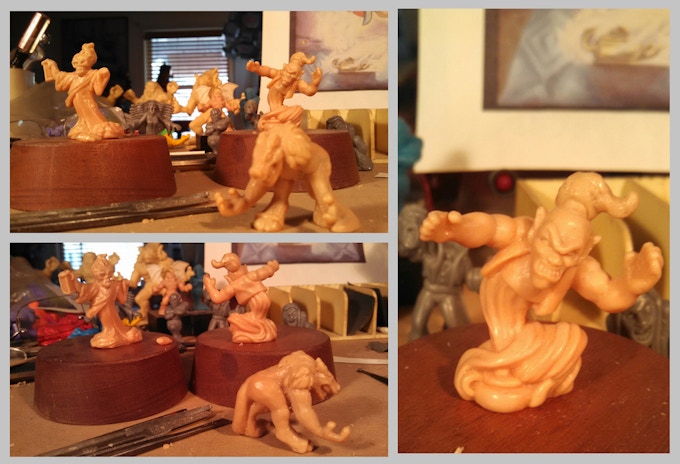
Fede Mazz, a big name collector, has spent the last few years working on creating the "missing" sixteen MIMP figures. He has recruited the talents of master artist and sculptor Rich Roland, the man who sculpted the original figures back in the day. Initially, the costs of the project looked to put the toys well out of my price range, but thankfully Fede has now turned to Kickstarter to raise funds to bring this project to fruition. The first four figures - Banshee, Catarenha, Sciapod and the Headless Man - are ready to go into production, and work has begun on the next four.

Backers can pledge different levels and receive anything from a set of four cards and a poster, to the set of the first four figures, to a set of collectable golden casts of the first four in a decorative display box. Fede's also joined with the creators of the most recent OMFG line to offer extra collectable figs for upper band backers. Should he raise enough, the first four monsters will be put into production.


Don't they look gorgeous? You can pledge here.

Saturday, 17 March 2018

REVIEW: Tremors 5-Movie Anthology


For my birthday I received the Tremors box set, something that only recently appeared on my radar when I read that a sixth film in the series is due for release this year. I hadn't even realised that there was a fifth one, although having seen the first, second and fourth, I had deduced that there was likely a third. There was also a short-lived TV series, which follows on directly from the third movie, which I shall now have to add to my watchlist.

The original Tremors (1990), is a classic monster movie with a brilliant central concept. The sandworm class of monster isn't wholly original to Tremors – Beetlejuice had sandworms on Saturn in 1988, and legends of the Mongolian deathworm date back to at least the 1920s. Tremors, though, is the first film I'm aware of to use the idea of an underground worm as the central monster. Brent Maddock and S.S. Wilson, the writers of the franchise, really thought about how the creatures could make sense. The Graboids, with their wonderfully ludicrous name, are brilliantly realised with physical props and animatronics – state of the art techniques in 1990, and they look so much more real than even the best CGI work. Cleverly, the Graboids aren't revealed in full until a fair way into the film. To begin with, we see the results of their attacks, followed by the attacks themselves. Then we get a glimpse of a snake-like creature that is killed trying to drag off the heroes' truck. Only later is it revealed that this is just one tongue/tentacle of a much bigger monster, a thirty-foot beaked worm that emerges from beneath the ground, hunting its prey by listening to the vibrations made by movement on the surface. The final revelation is that there are three more of the creatures, weaving their way under the ground of the valley in which the town of Perfection is situated. It still bothers me that the monster on the poster barely resembles the creature in the actual film, instead being a modified and hugely inflated version of one of the tentacles.

Aside from the brilliant monster, it's the characters that make Tremors work so well. There's one thing the original has that all the sequels lack: Kevin Bacon. Some of the dialogue in Tremors is risible, but when you have someone with Bacon's charisma delivering it, it works. Bacon is one half of double act Val and Earl, along with Fred Ward, a couple of odd job men who have a relationship of mutual disrespect. There's a lovely father-son relationship between them, with Earl as the elder straight man and Val as the cocky kid. They're part of a community in the town of Perfection, mostly lifelong locals but also Walter Chang (Victor Wong), the owner of the only store in town and the man who names the Graboid, planning to use it as a moneymaking attraction before he gets eaten, and the Gummers. The Gummers are characters that, by right, I shouldn't be able to stand; a pair of right-wing gun nuts who relocated to Perfection for its complete geographic isolation and set up a self-sufficient bunker in case of World War Three. Yet somehow they're the most likeable and funny characters in the franchise, with Burt Gummer (Michael Gross) becoming the single linking character throughout all the films and the TV series, although his wife (Reba McEntire) doesn't return after the first film.

The final outsider is Rhonda LeBeck, played by Finn Carter. She's a hugely likeable leading lady, and it's surprising that she didn't appear in more films after this. A seismologist studying the strange geological activity in the area, she becomes the catch-all scientist for the film, a nice send-up of sci-fi monster movies where scientists are treated as jack-of-all-trades all-rounders instead of the specialists they usually are. There's another nice pop at the conventions when Rhonda, Val and Earl take guesses at the origins of the creatures, going for space aliens, genetically engineered weapons, radioactive mutations and prehistoric monsters (the latter turns out to be true in the next movie). Rhonda and Val have a sweetly awkward romance, another character dynamic that makes the film work so well. The relationships and humour, along with the combination of a killer central monster and the nature of the setting (both expansive and isolated), make Tremors work so very well.

A sequel was a pretty obvious, given the success of the original as a popular and cult hit (even if Kevin Bacon initially hated it). Nonetheless, it didn't arrive until six years later, and went straight to video. Tremors 2: Aftershocks (1996) has a brilliant tagline: “The worms have turned.” Fred Ward returns as Earl, hired to help capture or kill Graboids that have overrun a plot in Mexico. He's joined by Grady Hoover (Christopher Gartin) as his new young plucky sidekick, but fake Bacon is no substitute for the real thing. There's also a new female scientist, a geologist named Kate “White” Reilly (Helen Shaver), who provides the scientific exposition (although she doesn't know what the word “hermaphrodite” means). She's also the romantic interest for Earl, and having an older woman to match the older hero is a nice touch. Still, it's hard to escape the impression that these are weaker stand-ins for the original team.

To expand the idea enough to carry another film, the writers introduce a new form for the creatures. After spending some time polishing off Graboids, recruiting Burt Gummer to assist (literally bringing in the big guns), there's a risk that the monsters are going to be reduced as a threat (just like the Alien before them, or the Borg, or Godzilla, or any one of a hundred recurring monsters). With this in mind, having the Graboids transform, hatching into new creatures, keeps things fresh. Still, the new life stage, the Shriekers, are nowhere near as effective as the original Graboids. The influence of Jurassic Park can be felt here, and not only with the talk of a Graboid theme park; the Shriekers look a lot like piggy Velociraptors. Other than the beaked face, there's little to identify them as part of the same species as the Graboids. They now run around above the ground, and their most frightening feature, hunting people by the tiniest sound they make, is removed. Instead, the creatures are deaf and essentially blind, hunting by the infrared radiation produced by body heat, much like a rattlesnake (or the Predator). They also have a peculiar method of reproduction, hacking up a fully formed Shrieker after they've eaten enough food. Aftershocks is good fun, but it's a poor comparison with the original.

Tremors 3: Back to Perfection (2001), as the title suggests, goes back to the setting of the original, bringing back all the surviving minor characters from that film: Ariana Richards as Mindy (all growed up), Charlotte Stewart as her mum Nancy, Tony Genaro as Miguel, even Robert Jayne as Melvin, no longer a teenager but still an obnoxious creep. The writers have finally realised that Michael Gross is the star of their franchise, and Burt Gummer has now been promoted to lead hero, still living in Perfection and completely equipped for a Graboid incursion, in spite of the creatures being extinct in the area for the last eleven years. He's even got a new house that is built into an impenetrable concrete shell. In some of the best exposition I've ever heard, Burt lays out the life cycle of the Graboid as known so far in the opening moments, happily covering the developments of the second film. Back in Perfection, Chang's niece Jodi (Susan Chuang) runs a rebuilt store in his honour, selling Graboid merchandise alongside all the essentials (the comics look pretty cool, even if they do consistently misspell Shrieker as “Shreiker”). Meanwhile, up-and-comer Jack Sawyer (Shawn Christian) is making money by conning stupid tourists into shelling out for Graboid tours. Of course, hilarity ensues when the Graboids turn out to be less-than-extinct in Perfection.

Technically speaking, this is the weakest of the three films so far. By this stage, CGI had gotten cheap enough to render the bulk of the effects. This is the beginning of the era of low-budget CG monster movies, with shonky CGI horrors en masse. It's just not as effective as physical effects though, and while there are some puppets used for human-Graboid interaction, the best shots are reused footage from the first film (with a completely different texture so that they stand out like a sore thumb). The increasingly unlikely Graboid life cycle gets a third and final stage, as the Shriekers turn out to be surprisingly short-lived, sloughing off their skins to become Ass-Blasters. I'm not keen on the Ass-Blasters, although I love the idea that they use internal propellants to fart themselves into the sky. I guess it makes sense that the creatures go from underground, to above ground, to the skies, and they are revealed to lay eggs, which goes some way to making the life cycle make sense. I'm just not a fan of the design though. They're even more dinosaur-like than the Shriekers, and with the safari park elements, there's a definite Jurassic Park riff going on here. Even the ending has the same predatorial twist. However, they don't quite go as far as having Ariana Richards recreate her classic Velociraptor scene in the kitchens.

Still, this is fun and overall more enjoyable than Aftershocks, and this comes down to the characters. They can't save the worst parts of the dialogue and they recycle old jokes, but the interaction of likeable characters, along with the sense of community from the original, make this a pretty successful follow-up. Very, very silly, but a lot of fun, and we get to see Gummer swallowed by a Graboid and still come out fighting.

After three films and a follow-up TV series, things were beginning to get pretty stale in Perfection, so for the fourth film a new direction was taken. Tremors 4: The Legend Begins goes back a century to the old West, when Perfection was still the poorly marketed town of Rejection. This provides a shot in the arm to the franchise and results in the best of the spin-off films. In many ways, The Legend Begins goes back to basics, cutting out Shriekers and Ass-Blasters and bringing the focus back to the Graboids themselves. A slight new twist on the creatures is provided by giving us little Graboid hatchlings that rocket through the soil and leap out at their prey. The larvae are recognisably Graboids – or Dirt Dragons as they're dubbed here – but they're a somewhat different threat, requiring sharp shooters rather than heavy munitions. Good thing it's the sort of place a sharp shooter can be called upon to rid the town of varmints. Of course, the full grown Graboids aren't far behind. Much of the film takes place in and around a silver mine, giving us the unsettling prospect of Graboids attacking as easily from above as from below, and without ever giving them jet-propelled anuses.

Michael Gross is the star once again, but this time playing Hiram Gummer, Burt's ancestor and the owner of the silver mine. In a very funny twist on the character, Hiram is an avowed pacifist who has never used a firearm. It's great fun seeing him gradually embrace the life of a paranoid gun nut. Gross is just brilliant, making the most of the chance to play an uptight new character who's still very recognisably a Gummer. History is rewritten in this instalment, with not only Burt but Chang's ancestor settled in pre-Perfection. Sara Botsford plays the rather Heather-like hotellier Christine, while August Schelleberg is Tecopa, a young Native American who becomes Hiram's default sidekick. Billy Drago has a memorable turn as laconic gunslinger Black Hand Kelly. There's a lot of fun to be had with this idea, and The Legend Begins rattles along nicely to an inventive finish.

It was a whopping eleven years before the fifth and to-date-latest movie was released. Tremors 5: Bloodlines (2015) follows on from the 2003 TV series, which itself follows on from Back to Perfection. Burt Gummer, now getting on a bit, is making a tenuous living in the deserts around Perfection as a celebrity survivalist, filming himself in the wild living off snakes, like a less annoying Bear Grylls. This gives Gross plenty of chances to talk directly to the camera and exposit for all he's worth, bringing up any new viewers (or anyone who's come straight from the original) on the Graboid life cycle once again. So far, not so different from Back to Perfection, until two new characters arrive: Travis Welker, replacement cameraman (Jamie Kennedy) and Erich van Wyk (Daniel Janks), a dodgy South African who recruits the pair of them to come back to the RSA with him to take care of their Ass-Blaster problem. Of course, as Gummer says, “If you've got Ass-Blasters, you've got Graboids.”

The new setting works really well, finally taking the franchise out of Perfection and shaking up the threat a little with it. Setting it in a safari reserve gives the opportunity for some beautiful landscapes and wildlife shots (plenty of stock footage usage here), and there's a different feel to the movie than the wall-to-wall Americana of the previous films. Gummer once more finds himself without the required need-to-know information when facing a new, African species of Graboid. Introducing them via the Ass-Blasters first is a different approach too, so we're kept waiting for the eventual Graboid reveal. There's some interesting use of southern African folklore,with the Ass-Blasters likened to the impundulu, the legendary vampiric lightning bird. They also have sickle claws, proving, in a well-executed kitchen scene, that what Back to Perfection was missing was indeed a Velociraptor tribute scene. By this stage, CGI had advanced to the point where the monsters look bloody good, and there's no longer that huge gulf in quality between physical and visual effects. The redesigned monsters look gnarlier and more vicious than ever – the Ass-Blasters are much better than the BtP version – and while the Queen Graboid isn't as reworked, it's significantly larger and nastier, and to top it off, the tongue/tentacles can detach and go hunting on their own. While nothing beats the original Graboid design and concept, the African version is just different enough to keep things interesting.

Gross is still the star as Gummer, now completely embodying the role, while Jamie Kennedy makes a good foil as the young and overly confident Travis. Kennedy always skirts a line between likeable and annoying, and that's no different here, but he manages to fall mostly on the right side of that line. With a whole new cast of characters to introduce, the writers take advantage of the uncertainty by bringing in potentially significant figures and then killing them off, so no one ever feels safe. Well, except for Travis's unrequited love interest Nandi, played by the gorgeous Safrican actress Pearl Thusi. Brandon Auret plays her on/off suitor Johan, who vies for the main action role with Gummer.

Bloodlines was a long-time coming, so it's not surprising I'd thought the franchise dead. The original creative team had little to do with it, with W. Truesmith and M.A. Deuce taking up writing duties, and a bit of new blood does the franchise no harm. Early developments suggested an Australian setting, but the decision to use South Africa works so well that I'm pleased they changed their minds. Reportedly, Kevin Bacon expressed interest in returning early on, taking time out from his EE adverts, but this wasn't to be. In the event, we got a fifth film that revives the franchise with some great humour and action. I'm looking forward to the sixth film, the Arctic-set Tremors: A Cold Day in Hell, which is due in the coming months, and there are rumblings of a Bacon-filled Netflix series. Still, Bloodlines ends with Burt and Travis touring the world as monster hunters, and this is a spin-off that surely we deserve to see.


Sunday, 11 March 2018

REVIEW: The Cloverfield Paradox


So, this one has gotten a bad press, and to be fair, I can see why. It's a bit of a mess, narratively speaking, and the shoehorned in link to Cloverfield, while it no doubt helped get the thing made, works really poorly. Nonetheless, I enjoyed the film. It's a schlocky sci-fi horror in the vein of Event Horizon, with a dash of Alien, a touch of Gravity, and plenty of derivative but mostly effective nonsense. Spoilers follow.

The Cloverfield Paradox started life as The God Particle, a spec script by Oren Uziel, until it was picked up by J.J. Abrams, who rewrote it to become part of his Cloverfield mythos. The original Cloverfield, which came out way back in 2008, was good fun and a new take on the Daikaiju genre, before the fake found footage style had become overused and stale. This was followed up, unexpectedly, by 10 Cloverfield Lane in 2016, which I haven't seen but is reportedly another movie which was rewritten to tie into the Cloverfield universe. The God Particle focused on a particle accelerator experiment that still forms the core of the finished movie. (Presumably it was somehow about the Higgs boson, and there's a line about that fundamental particle in the finished script, that doesn't really tie into anything.)

The finished film is set in 2028, when an major energy crisis has put the world on the brink of all-out war. Germany and Russia, in particular, are at each other's throats, but seemingly the whole of Europe is a tinderbox. To find a new source of perpetually renewable energy, Space Station Cloverfield has been set up in Earth orbit, to begin experiments with a gigantic particle accelerator which will potentially unlock infinite energies from space/time. The search for energy combined with unknown perils is common enough in sci-fi now that it's almost become a subgenre in itself. The space station is the modern day haunted house, or in Doctor Who terms, an isolated base under siege. Tensions are high among the international crew after two years locked up together without results, and then, finally, the accelerator works and produces a stream of powerful energy. Unfortunately, it runs out of control, damaging the station and knocking everyone for six. When they recover, there's no sign of the Earth.

It takes these top tier scientists a long time to realise that they've moved along Earth's orbit and that their view is being blocked by the sun, and longer still to realise that they've actually passed into a parallel universe. Increasingly bizarre horror situations occur for under-explained reasons. It mashes together a number of sci-fi ideas that don't work terribly well together logistically. In fact, none of the plot really makes much sense, so I can entirely understand why some commentators had such a hard time with it.

On the other hand, I think they made the mistake of taking it too seriously. While it sets itself up a scientific drama, it very rapidly becomes clear that this is anything but, and it's best watched as the melodramatic nonsense it is. There's a lack of tonal consistency, but this can work if taken far enough, and it just about does here, with outright horror mixing with earnest futurism, conspiracy theorism mixing with heartfelt family speeches and extreme danger mixing with bizarre moments of humour. Again, the Doctor Who comparison works: just like DW, the film throws together a bunch of ideas and genres and sees what it can get away with. The best moments are the most out-there: the shifty Russian guy goes crazy and then explodes into a shower of worms; Chris O'Dowd's laconic engineer gets his arm bitten off by a wall, only for it to crawl back to him and write him a note. (“My arm saved us!”) Neither of these events is met with any real explanation, other than that having two dimensions in contact produces weird results.


So, it's nonsense, but creepy, entertaining nonsense. It wouldn't work nearly as well if it weren't for a really excellent cast. Gugu Mbatha-Raw is the star of the ensemble, as believable and likeable as ever as Hamilton, a woman who has lost her children and so endures separation from her husband, using her mission as a way to cope and atone for her sense of responsibility for the tragedy. She's an excellent lead and holds the film together, but the whole cast are pretty great here. Daniel Bruhl plays the German physicist Schmidt, who is the target of some conspiracy theorising himself, which turns out to be true in one universe but not the other. David Oyelowo is the rugged station commander, Kiel, the beautiful Zhang Ziyi is Tam, the Chinese chief physicist (who speaks only in Mandarin throughout). Completing the crew are Aksel Hennie as Russian engineer Volkov, John Ortiz as Monk, the medic, and the aforementioned Chris O'Dowd as Mundy, although I still see him as Roy from The IT Crowd. One of the nest turns comes from Elizabeth Debicki, who plays Jensen, the chief physicist of the other reality, who is discovered almost fused with the station itself after it materialised in place of its counterpart. She acts as a rational but dangerously unknowable element throughout.

A weaker element of the script is that it continues to jump back to events on Earth, as Hamilton's husband (played well by Roger Davies) learns of the station's disappearance while trying to deal with catastrophe all around him. To begin with this works with the narrative, as we're not always sure which reality we're following, but once it's clear that the wartorn Europe seen on news reports is Jensen's home, it's clear that something stranger is happening in the primary reality. Helpfully, some nutcase has already appeared on TV earlier in the film, spouting his own conspiracy theories about how the experiment will tear open the universe and unleash demons into the past, present and future. It's a terribly hackneyed piece of exposition that robs the eventual reveal of any mystery.

I mean, we know it's linked to Cloverfield so we expect the final reveal that the great big monster from that film (or another great big monster rather like it, the timing is askew here and the two films don't even necessarily occur in the same reality). The script is never sure whether it's meant to play this as a surprise or ass an origin story, and it falls between the two stools. The link to Cloverfield is the weakest element in a confused production, but there's still a lot of fun to be had with this silly film, as long as you don't take it too seriously.

Tuesday, 27 February 2018

REVIEW: The Shape of Water

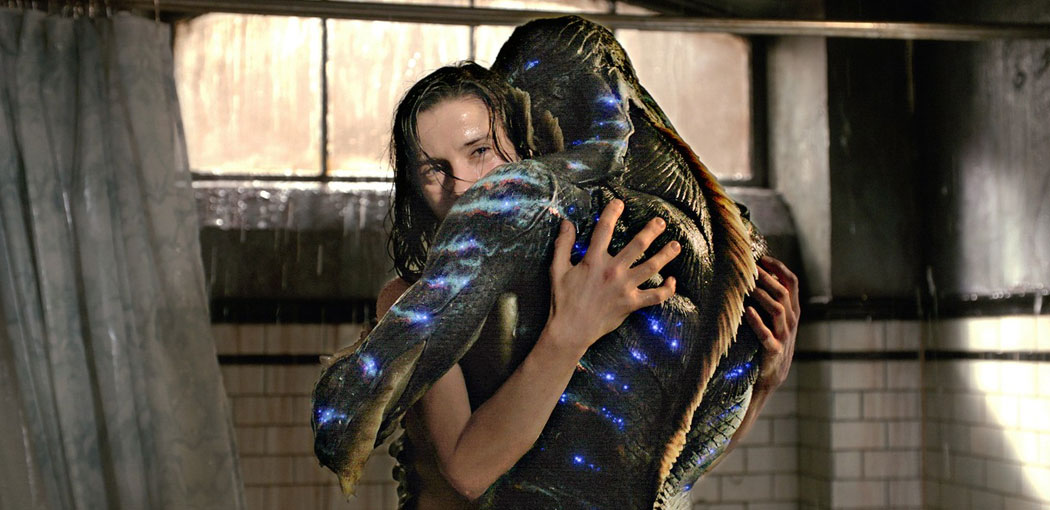
The trailers for this, the latest film by Guillermo del Toro, got a lot of his fans excited. For some, it looked like a return to the universe of Hellboy, featuring as it does an amphibious being with more than a passing resemblance to Abe Sapien. For others, it was a return to the aesthetically and emotionally strange worlds he had previously explored in El laberinto del fauno (Pan's Labyrinth) and El espinazo del Diablo (The Devil's Backbone), only this time in an English language film. For del Toro, however, it was a chance to finally make his own follow-up to The Creature from the Black Lagoon.

Del Toro was involved with Universal in early talks to direct a remake of Creature, but he insisted on a version of the film told largely from the Gill-man's perspective and wanted to see the heroine succeed in her romance with the monster. Universal weren't keen, and, well, you've seen the state of the Universal monster-verse. Perhaps they should have listened. This is the latest of many films that del Toro has made inspired by wonders and horrors from his childhood. However, unlike El laberinto and El espinazo, this is not an exploration of childhood fears but of adult concerns such as love, sex, allegiance and ambition. It's also one of his best and most beautiful films yet.

As with previous del Toro's films, The Shape of Water stars Doug Jones as its primary monster, following his roles as Abe in Hellboy and Hellboy II: The Golden Army, plus the Chamberlain and the Angel of Death in the latter; the faun and the Pale Man in El laberinto del fauno. Although the physical similarity to Abe is obvious, Hellboy's right hand fish is an especially verbose character. The Creature of The Shape of Water, shackled, wounded and mute, is more similar to the generally villainous characters for which Jones has portrayed through movement only (including the Pale Man, and the leader of the Gentlemen in Buffy the Vampire Slayer). Both visually and conceptually, the Creature here might be best described as the missing link between the bestial but passionate Gill-man and the cultured and magical Abe.


The true star of the film, though, is of course Sally Hawkins, who has rightfully been showered with praise for her performance as Elisa Esposito, the similarly mute cleaning woman who lives a life of subdued drudgery at the military facility in which the Creature is contained. While she communicates through sign language – a mix of ASL and BSL I am informed, and helpfully subtitled and/or interpreted for those of us who do not sign – some of the most illustrative moments in the film are without language whatsoever. Delicately directed moments explore a life that is unique yet ordinary: furtive masturbation during her morning bath, excitable moments of dance in front of the television, calmly eating her packed lunch between shifts. It's an achingly beautiful performance, with which Hawkins portrays a character trapped by her difference from those around her but surrounded by love, from her friends, neighbours and the mysterious Creature in the tank.

Which is not to say the rest of the cast are not given the chance to shine. The brilliant and under-appreciated Richard Jenkins plays Giles, Elisa's next-door neighbour and best friend, an ageing advertising artist who struggles to live a closeted life during the crushingly conservative America of 1962. Octavia Spencer is Zelda, Elisa's workmate and her closest confidante in the daylight hours, who serves as her voice in the workplace. While very different characters, they are linked in their clear love for Elisa, and by the marginal place they have in the society of the time. Indeed, it's a powerful statement to have the two main voices in the film – save the antagonist – be those of a gay man and a black woman.

That antagonist is Michael Shannon's Colonel Strickland, a loathsome creation and a pitch-perfect, pitch black portrayal of impotent white-man ambition. Strickland's desperate need to prove himself worthy to his superiors drives the film's plot, as he tortures the Creature and plans to tear him apart in a desperate attempt to learn something – anything – that he can present to his commanding officer to use in the fight against those damn dirty commies. He's thrown into sharp relief by his chief scientist Bob Hoffstetler – aka Dimitri Mosenkov – played with anguished heart by Michael Stuhlbarg. Again, making a Soviet spy one of the most heroic and sympathetic characters marks the film as a deliberate attack on the conservative right – a direct counter-narrative to the usual heroic square-jawed American point of view.

Indeed, this is the core of the film. As much as the story is about the plight of the outsider, the need to find someone to be alike and with, it's clear that del Toro really desperately wanted to follow up The Creature from the Black Lagoon (actually veering off partway through the sequel, Revenge of the Creature) by making it plainly clear once-and-for-all that the Western interlopers are the villains. Still, for all del Toro's sympathy for the original Gill-man, he was an aggressive being who tried to abduct the object of his desires. The Creature of Shape of the Water is an idealised version, capable of violence and clearly a wild animal, but far more intelligent, sensitive and compassionate.


Beautiful, strange, lyrical and sensual, The Shape of the Water is a remarkable film. Although the final twist is signposted clearly from the beginning, it nonetheless makes for a just and satisfying climax to a moving adventure.

Thursday, 7 September 2017

MONSTER IN MY POCKET

Boys' toys in the 90s featured many fantastic ranges. It was a golden era for grotty gross-out toys and monsters. Action figures of The Real Ghostbusters, Teenage Mutant Hero Turtles and even questionable tie-ins to films like Aliens and Spawn could be found in Woolworths and Right Price. Then there were Mighty Max, Boglins and a host of other oddities. It was a great time to have pocket money. By far my favourite toy series, though, was Monster in My Pocket, a series that I have solidly loved since I was a tiny boy and have utterly failed to grow out of.

Monster in My Pocket, or MIMP for short, kicked off, along with MUSCLE, the collector-mania in kids' toys. Small, mass-produced figurines that came in a range of colours, with continuous releases of new sets to encourage further collecting, swapping and an almost religious devotion. The figures are often mixed up with MUSCLE, which was more commonly found in the States, plus subsequent lines like Mini Boglins, Dino Brites and Bad Eggz Bunch, all of which had great collectability but none of which matched my love for MIMPs (although Boglins came close for a while). Although pushed in Canada and the US, the original MIMP line was created by the UK-based Matchbox, part of Morrisson's Entertainment Group, and was most popular here and in Europe. There were, however, releases of figures and tie-ins all over the world, with significant waves released throughout Latin America, and while I'm a bit of a Matchbox purist, the variations, of varying quality, from other countries are an interesting sideline.

The idea behind MIMP was straightforward but ingenious: small figures in malleable plastic that represented monsters picked from mythology, legend and literature. Anything that was in the public domain was fair game, from well-known horrors such as a werewolf, a vampire and Frankenstein's monster to Greek mythological figures such as the Hydra and Medusa, through to obscure things that no six-year-old was ever likely to have heard of, such as the Aztec goddess Coatlicue.

The first series was released in 1989 on both sides of the pond. The adverts came first; joyfully naff TV ads with smirking little boys scaring their sisters. The monsters were "squishy!" apparently, although in reality that meant slightly bendy plastic, and initially came in four colours: red, yellow, purple and a pale green. A rerelease a year or so after reproduced these in brighter, "neon" shades, and premium figures exist in other colours, such as pine green, magenta and that lovely, off-white glow-in-the-dark colour. These are the ones that go for the bigger bucks among collectors, and came in special playsets, the board game (what happened to my copy of the board game?) and cereal boxes in the States. The straightforward, bold block colours of the figures is simple and appealling, more so than the flashier, more complicated stuff later on.

There were 48 monsters in Series I, although the precious checklist, in its tiny script, claimed there were 96, so immediately we young collectors knew there more to look forward to. Each monster was given a "points value," which was stamped on the back of the figure and supposedly indicated both the monster's power and its rarity. The monsters were granted five, ten, fifteen, twenty or twenty-five points, with the fivers being the endlessly common ones that came in blind bags and four-packs on blister cards, while "rare" 25-point monsters were the big draw of the "secret twelve-packs." Or you could shell-out for a 24-pack and get fully half the series in one swoop. Endless debates were had in playgrounds and classrooms over which of the monsters was the greatest, and whether the points system had any real merit. Seriously, a ghost gets ten points but the Winged Panther only five? It's a fricking panther with wings, you can't tell me that's not worth at least fifteen.

There were also Battle Cards, which allowed you to play a Top Trumps-style game. The cards broke down the monsters' PV's into four elements: intelligence, strength and weaponry, speed, and weaknesses/limitations (a negative score). For instance, the Kraken has intelligence 4, strength 10, speed 10 and weakness -4, giving an overall PV of twenty, while Vampire has intelligence 10, strength 6, speed 4 and weakness -10, giving a PV of ten (presumably due to his weaknesses to garlic, sunlight and running water). If this didn't increase the collectability enough, there were art cards exploring the monsters' background in excruciating 90s style, and a bloody excellent Panini stickerbook. And socks - really excellent socks.

The checklist pamphlet stated that Series I would be "history" once Series II arrived, but this was rubbish - these little guys hung around forever. Still, the introduction of the Monster in My Pocket comic series from Harvey in 1991 stoked the excitement for the second set of toys. The comic (which I will read through in more detail for a future post) pit the "good monsters" led by Vampire againt the "evil monsters" led by Warlock, who notably was not part of the existing run. Immediately the comic put unavailable monsters at the forefront, and promised more to come, even some that never actually made it to being figures. Series II arrived, in "hot neon" colours of blue, green, orange and magenta, to great excitement. They showcased weirder designs and more horrific creatures than Series I, and whacked up the Points Value, with the most powerful monsters achieving thirty points. There were also some classic monsters included, such as a dragon and the Minotaur, that were sorely missing from that first series.

There were twenty-four monsters in Series II, leaving a further two dozen still unaccounted for. Hot on the heels of Series II came Super Scary Series III, at least in the UK, and this is where it gets fiddly. The sheer excitement of Series III was tempered in my young mind by the fact that the monsters were numbered from 97 to 120, missing out a full twenty-four monsters, which bothered me for years until, finally, I discovered that the "real" third series had only been released in North America. Monsters 73 to 80 were available in cereal boxes and in Big Boy restaurants kids' meals, while #81, Blemmya, was only available packaged with the Nintendo Monster in My Pocket game. That still left a full fifteen monsters that were designed but never made it to being figures, and we only know about them because a full set of 96 were released as stickers and cards in Argentina. There are plans afoot by a private collector to create these, with the original sculptor producing the prototypes, and so far, gold premium figures of four of these are available on eBay at a whopping $60 each. Something for the serious collector there, well out of the price range of someone like me. (Actually, there are sixteen sculpts planned for this collection, because another monster popped up in the comics and wasn't listed anywhere else, but is just begging to be sculpted.)

Still, the Super Scary line, series three or four depending on preference, was beyond exciting for the seven-year-old me. The Super Scary monsters were bigger, multicoloured and just better to my childish eyes. Nowadays, the poor paint jobs and less detailed designs aren't as appealling, and the monocoloured variants that were released in boxes of Weetos (presumably being cheaper to produce that way) just look better. Still, Matchbox were selling to kids, not collectors who should be old enough to know better, and these were just fantastic. On the other hand, the Points Value system completely went to pot, with the monsters now being overpowered with fifty to a hundred points apiece, making it impossible to fight them properly against Series I and II monsters. It was also around this time that a terrible cartoon pilot was released, which made Vampire the leader of the baddies and the Invisible Man the leader of the goodies. A group of oversized figurines were released, called Super Scary Howlers, with ligh-up LED eyes and gruesome sound effects, showcasing the four classic monsters of the series: Vampire, Werewolf, Swamp Beast and the Monster (aka Frankenstein's Monster).

During the first three main series, Matchbox had their share of controversy from various religious groups. For starters, the first monster in the series was the Great Beast from the Book of the Revelation, and kicking off a toy line with the avatar of Satan himself, unsurprisingly upset some of the more conservative American quarters. In the UK, however, it was the inclusion of no fewer than four Hindu deities in the line that caused offense. There is a much larger Hindu community in the UK than in the States, and the far-right Hindu group the Vishva Hindu Parishad kicked off at the inclusion of Kali in Series I and Ganesh in Series II. This led to the pulling of Ganesh from Series II packs, making it one of the harder figs to find (later still, Herne the Hunter was also pulled, for obscure reasons). Matchbox failed to the learn their lesson, though, and the Super Scary line included both Hanuman and Yama. Again, Hanuman was pulled from later sets, although Yama merely renamed as Fire Creature, part of a wholesale reworking which gave about half the figures dumbed-down names.

The next series is probably the least fondly remembered by fans, but as a kid, my god these were brilliant. I had hoped Super Scary would be followed by a ghostly Super Spooky line (although most of the monsters in the Super Scary line were ghosts or similar), but instead, Matchbox completely changed track and gave us the Super Creepies. I can still remember going to Woolworths with the family and my mum coming to find me to tell me that she'd seen new Monster in My Pockets and they were insects. The Super Creepies chucked out the "real monsters" idea and instead gave us twenty-four hard plastic creepy crawlies, supposedly created by the insane "Dr. Zacheria Wolfson in his ultra high-tech lab." The figures were all terrible, terrible puns: the wolf spider was a spider with a wolf's head, the bedbug was a bed with legs, the ladybug wore lipstick. Sophisticated humour, I'm sure you'll all agree. I loved them, even though the Points Value was cranked up to a whole 200 points, because apparently a spider with a moustache is more powerful than Hanuman, the divine devotee of Rama who can balance the world on his tail.

More exciting still was the next series, promised to be "the orignal monsters." Yes, the next run were the dinosaurs. After a short trial with simpler figures called Dinoaur in My Pocket in the States, of which only four were released, the full MIMP Dinosaur series was released: solid, hard plastic prehistoric creatures based on, admittedly outdated, scientific reconstructions. They were awesome. By this stage, the US range had almost died out, and these were mostly found in the UK and Europe. The dinosaurs were rereleased later with new paintjobs, as the Secret Skeleton Dinosaurs - dip them in cold water, and a poorly painted set of bones appeared. These were virtually impossible to find, with only the occasional blind bag turning up, and they go for a penny or two now. While the Battle Cards had continued through the other series, the Dinosaurs had fact cards detailing their size, weight and the era in which they lived. Although the figures were identical, the Secret Skeleton Dinosaurs were presented on the cards as a further series, continuing the numbering and upping the Points Values by ten, which is a maddening inconsistency.

The classic Matchbox run essentially came to an end with the Space Aliens. These were original characters, although some were vaguely based on aliens from pop culture, and although they were pretty fun, there was surely a good opportunity here to go back to the series' roots and use "real" aliens from ufology. That would have been extremely cool. Still, the Space Aliens worked, and although there were only sixteen of them, they looked good and had a fun new gimmick. On each alein's back was a heat-sensitive sticker which revealed the Points Value and the alien's affiliation: a sun and sword for the good aliens, and skull-and-crossbones for the evil aliens. The PV (now called Battle Points) was inflated to utterly ludicrous extremes, though, now ranging from 150 all the way up to 500 points for the leaders of each side. The Battle Cards were also revived, albeit simplified. There were apparently plans for further dinosaurs to follow this, although in the end, only four were produced, numbered #223-226, which came boxed up with a wristwatch (which I almost won on eBay, damn it). These buggers go for insane prices.

The original line fizzled out after the Space Aliens, but in 1995, Vivid Imaginations took over manufacture for Matchbox and completely revamped the line with the release of Monster Wrestlers in My Pocket. These were a completely new variant on the series, cashing in on the 90s wrestling craze. Each figure was an original character, about half being based on classic monsters, the other half being grossly muscular humans. There were forty-five Monster Wrestlers, including coaches, referees and a monstrous medical team, although some of these were released exlusively in playsets. The series' long-standing relationship with breakfast cereal reached new heights, as the Monster Wrestlers were introduced with ten exclusive figures with Frosties. Weirdly enough, these included Tony the Tiger himself (I guess he is pretty grrrrrreat).

The Monster Wrestlers were tough, rubbery plastic, fully painted with a few variant paint jobs. They had Points Values, on the feet this time, ranging in 25-point jumps from zero points for the referees to the all-star 100-pointers. (There was one anomalous thirty-pointer, the gleefully racist Kongo King.) There were also "Grapple Cards" and a similar range of milkcaps, because this was also the era of the Pog. There was even a Monster Wrestlers in My Pocket comicbook, whcih lasted an even shorter time than the original comic series, plus jigsaw puzzles and other sundry tat. The series was followed by two more similar lines, Monster Sports Stars in My Pocket and Monster Ninja Warriors in My Pocket. Never a lover of sports, I can't say I'm a fan of the Sports Stars, who were only released in Frosties packets and included Tony the Tiger again, but the Ninja Warriors were pretty awesome, and they had weaponry accessories which had their own Points Values, which was a fun idea. They came with their own Pogs as well.

That was it for the original run of MIMP. There were a couple of attemtps to relaunch in the years to follow, and European rereleases (the Italian lines have some particularly cool colours). I ended up giving away or selling a lot of my little monsters, before a strong pang of nostalgia made me get onto eBay and buy a whole lot of them back. The instigator of this nostalgia was the unexpected relaunch of Monster in My Pocket in 2006. Now owned by Corinthian, this was a complete revamp of the line, going back to the original concept of tiny figures of "real" monsters. Once again, there were forty-eight little monsters, drawn from myth, legend and literature, or to put it another way, from the four series of MIMP. These were fully detailed, hand-painted figurines and were really excellent pieces of work, although they lacked that simplistic appeal of the classic series. Some of the designs were closer to the mythological basis for the monsters, others further removed. Having almost learnt a lesson from Matchbox, Corinthian produced a Monkeyman figure instead of Hanuman, and a version of Kali thinly-veiled as "Six-Armed Sorceress." The Invisible Man figure was particularly excellent - made from clear plastic that showed through any gaps in the paintwork.

The new series was split into eight categories: the Ancients, the Beasts, the Humanoids, the Winged, the Ghosts, the Dead, the Sea Monsters and the Maniacs. In some territories, such as Australia, they were split into two series of twenty-four. Similar to the Points Values, these monsters had a power level that could be revealed with an infrared decoder light, although this feature didn't really work. There were new playsets, and a new Battle Cards set, with points sections that I think represent intelligence, strength/weaponry, speed and scariosity, plus an element for each monster. Interestingly enough, the numbering on the back of the cards was out of 230, suggesting a much larger run was planned; perhaps the number being based on the original list that included some extended run of dinosaurs and so on? In the end, only forty-eight were relased, and although I don't love these as much as the classic line, they are very cool indeed.

You may have gathered that I'm a huge fan of Monster in My Pocket, and they are the one toy line from my youth that I still actively collect (pocket money permitting). I plan to talk more about these little monstrosities a lot over the coming months - what better way to explore my love of mythology and literature than through the classic run of MIMPs? And maybe one day I'll finally create my Big Book of Monsters, inspired, in no small part, by the little plastic thingies that we traded on the playground.


To learn a great deal more about Monster in My Pocket, check out Jud's exhaustive collectors' site


Sunday, 15 November 2015

WHO REVIEW: 9-9: Sleep No More


It's not fashionable to like Mark Gatiss's Who scripts, but I'm keen on most of his episodes, the exception being series six's Night Terrors. Like that episode, though, Sleep No More is a case of style over substance, blessed with strong visuals but without the heft of a decent story to back them up. There are some excellent ideas here, but very little exploration of any of them. The compression and elimination of sleep, the distressing notion of genetically engineered "grunts" for combat, the potential of a video to infect its viewers with a malevolent force; all of these could form the basis of an intriguing, potent science fiction story, but none of them are used to any real effect here. There are hints at an interesting future world, where there's idealogical conflict between "Wideawakes" and "Rip van Winkles"," and where civilians are conscripted into the military to serve alongside both career soldiers and indentured servants. So little of this explored at all. Who holds the power here? Who is this army fighting? Why do people willingly give up their sleep to get ahead, and who are they working for? Nothing is elaborated upon beyond soundbites.

I'm not generally a huge fan of the found footage school of film. I struggle to see past the artificiality of it all. One of the more effective elements of the script is that it embraces this artificiality, not simply using the cobbled together footage as a visual conceit, but as a storytelling one. The drawbacks of the approach, however, are the same as they ever have been, from Blair Witch to Cloverfield. The storytelling lacks coherence. We need to be told what has happened to characters who die offscreen, and have incidences explained to us because we can't fully make them out. It's goes to far into a "tell, not show" method of storytelling.

The characters fall foul of the sketched-in nature of the story. Capaldi is as watchable as ever as the Doctor, even he seems to be lacking interest in proceedings. Jenna Coleman might as well not be present, so minimal is Clara's contribution to the story. This episode has received some coverage for its casting of Bethany Black, the first openly transgender actor in the series, and this is rightly praised. However, her character, the aforementioned grunt designated 474, gives her virtually nothing to work with. Is she a good actress? I honestly couldn't say, based on what she has to do here. None of the other guest actors, bar Reece Shearsmith, gets much better. I can only praise the episode for continuing this series' trend for diverse casting, but only the white cis guy actually get anything decent to work with. Although presumably that's more because he's old mates with the author.

In fairness, though, Shearsmith is great here, doing what he does best: a shifty, slightly unsettling character. Rasmussen's villainy is blatant from the start, and it's not intended otherwise. He stands by in his Dastari specs and a monochrome suit straight out of a Pertwee serial, every inch the Doctor Who villain. The monstrous Sandmen are also very effective, a revolting concept well rendered, their ill-defined formes well suited to the found footage format. However, they make no sense at all, either scientifically (we're used to that, of course), or narratively. There's so much that could be done with the concept of removing sleep from human life, but all we get is eye-gunk monsters with dubious and poorly explained origins. The final scene, with Rasmussen (or is it a copy of Rasmussen? I was left confused), crumbling away as he speaks to the audience is creepy as hell, but it's lost in a script that has no real impact overall. When the story makes absolutely no sense, it's probably not a good idea to have the Doctor point it out.

Sleep No More boasts arresting visuals and a potentially interesting central idea, and has the guts to leave things open-ended, with the Doctor escaping but crucially not stopping the villain's plans. However, this is lost in the general confusion of the finished product. An interesting experiment, but one that was scuppered by poor handling.

Continuity Corner: 

This episode is set in the 38th century, during which time the Indo-Japanese nation is a major force in the Solar System. According to the Doctor, a tectonic realignment occurred merging India and Japan, which was part of the Great Catastrophe. He says to Clara that she has this to look forward to, which suggests it might be something in her personal future, although he could just be speaking figuratively. If he does mean it's shortly to come, it's tempting to suggest that the Great Catastrophe is the same as the Great Cataclysm, an event that saw a huge rise in sea levels and major environmental change, and formed the backstory of the Australian K-9 TV series, which was set around 2050. However, it's quite likely it's an event further into the future and closer to the time of the episode. Interview's with Mark Gatiss in the latest DWM have him make the link with the event that led to the evacuation of the Earth mentioned in the serial Frontios, something normally cited as being much, much further in the future, while Bethany Black thinks it might be linked to The Sun Makers, in which humanity relocates to Pluto, and is apparently also set in the 38th century (but I've no idea where she got that date from). So make up your own head canon on that one, I guess.

We've not seen the 38th century before (barring possibly Sun Makers), but the Peladon/Galactic Federation serials featuring the third Doctor are generally accepted to take place in the 39th century, although there's absolutely nothing in the episodes themselves to suggest that. According to The Daleks' Masterplan, in the year 4000, Uranus is a planet of some importance in the Solar System, but Neptune is hardly mentioned. Here, though, it's a hub for the Indo-Japanese culture, with a major population living on its satellite, Triton.

The Doctor says people don't put "space" in front of things, like "space restaurant." I'd suggest the takes a look back at some of his old serials.

"When I say run, run!" is, of course, a bit of a second Doctor catchphrase.

Most pertinent line: "It doesn't make sense! None of this makes any sense!"


Monday, 10 August 2015

Bestiary Alphabetum

A reblog here of a gorgeous piece of work by artist Nathan Sanderson. Bestiary Alphabetum is an A to Z of mythical monsters, illustrated beautifully (and horrifyingly). I've long had a mind to get some talented types to join me in creating something similar. There are even some creatures here that I was unfamiliar with, which doesn't happen too often. Wonderful stuff.


Tuesday, 14 October 2014

WHO REVIEW: 8-8) Mummy on the Orient Express

Like Kill the Moon, Mummy on the Orient Express boasts a lurid title and an absurd premise that bely the seriousness of its approach. The set-up is fun and promises certain things, which are delivered. The beautiful but claustrophobic setting of the Orient Express itself; the shambling Mummy, excellently realised; and a murder mystery, albeit a mystery of the hows and whys, rather than the whos. However, the monster mash and the initial jokey atmosphere are as much a facade as the period trappings of the eponymous train. This is a science fiction story, albeit one with Doctor Who's usual shakey grasp of actual science, and one in which the monster is another victim and the true villain hide behind the scenes.


Even the sci-fi story, with its professorial troubleshooters, is just the setting for the core story, that of the Doctor and Clara, as they deal with the emotional fallout of the previous episode. The decision to set this episode some weeks after Kill the Moon, allowing Clara enough time to cool down sufficiently to concede to one last trip with the Doctor, grants the characters a chance to explore their relationship further. There's some great mileage to be had here, and while we hardly believe the possibility that Clara will stop travelling with the Doctor after this, watching her move from reluctant associate of the Doctor to fully endorsing his lifestyle once more is at the centre of the episode's story. Coleman and Capaldi are on fine form here, their chemistry better than ever. The Doctor's obvious discomfort when talking about emotions covers a clear and obvious affection for Clara, and her own anger with his methods belies her love of the danger and the problem-solving adventuring. This “space dad” dynamic works very well between them, and while there's still the hint of something more romantic under the surface, this aspect of their relationship suits the characters and actors very well.


It's a pity then that, due to the structure of the story, the Doctor and Clara are separated for so long. Conversations over the phone don't have the same televisual appeal or chemistry that face-to-face encounters have, and much of their interplay suffers due to this. Thankfully, each character is given someone new to bounce off. Daisy Beaumont is a fine foil for Clara as Maisie, an ordinary woman, albeit one from an unpleasant family background, who can relate to Clara's relationship with a very difficult, very old guardian. Maisie, however, contrasts sharply with Clara, for there is little affection between her and her grandmother, and she feels nothing but fear at her experiences in this episode, while Clara, despite herself, is exilirated. Their interplay makes for some good scenes, even if there is a rather clunky moment where the characters suddenly realise they're failing the Bechdel test and comment upon it.


The Doctor is paired for much of the episode with Perkins, played by comedian and Doctor Who fan Frank Skinner. While it's fair to say that Skinner is not the strongest actor to grace the series, he fits the part well, and is really quite good as the intriguingly well-informed chief engineer. Indeed, so competent is Perkins that for a time he is an easy suspect for the man behind the manipulations, but he turns out to be a fine ally for the Doctor. It's also a joy watching Skinner and Capaldi on screen together, knowing that we are seeing two huge fans of the series loving their work. Being a fan of a show is not enough to warrant a place on its cast, but nonetheless, it does add a little something.


It's a beautiful production, with the train itself well-realised and filled with an impressive cast of suitably classy extras (including the obligatory scientist who looks like Albert Einstein). The inclusion of Foxes singing “Don't Stop Me Now,” very appropriate considering Clara's eventual decision, is a lovely touch. Period settings are far better with the addition of such verisimilitude, and the choice of a well-known song covered in a retro-style helps sell that this is a slightly askew version of a familiar setting. In practice, there was little to stop this episode being set on the actual Orient Express, and it wouldn't have required too many rewrites to make the script fit this. In fact, it might have forced Jaimie Mathieson to use some actual science in his convoluted explanations for the Mummy's actions. Still, what we get is a visually striking contrast between the sci-fi trappings and the period aesthetic, not least the train itself flying through space.


The Mummy itself is a wonderful creation of make-up and costume. We've had mummies before of course, but this is the finest example by far, exactly what one imagines when thinking of the classic movie monster. In fact, it's almost too well-realised, and was unsurprisingly omitted from early trailers for being too scary. A definite success of monster design. It's bizarre MO, killing its victims after a sixty-six second delay, provides an arresting visual cue and provides some gripping tension. However, there are only so many times it can be used before it begins to feel a bit stale. Indeed, in the latter scenes, it's the Doctor and his own heartless, even cruel interaction with the soon-to-be victims, that provides the tension. While the Doctor's final, desperate deduction of the Mummy's true nature is a fine scene, it comes across less as a calculated realisation and more as a desperate stab in the dark. While the revelation that the Mummy is an unnaturally preserved soldier fits with this season's theme of the military and its criticisms, is doesn't hold up terribly well when analysed. Equally, the Mummy's physical nature is a false mystery, since no one watching can possibly know that the bit of made-up science used to phase out the victims would take sixty-six seconds.


Mummy on the Orient Express is a highly enjoyable story, beautifully realised and with strong central performances, most notably from Peter Capaldi, who makes even the slowest, most expositional scenes tremendously watchable. Like the Mummy itself, it looks incredible and is suitably chilling, but falls apart once you look too closely.


Monday, 13 October 2014

Little Weirdos: Mini figures and other monster toys: Monster in My Pocket: Series 3

Very nice little article on the Little Weirdos blog about the extremely rare third series of Monster in My Pocket. I do not have any of these, and this makes me sad.


Little Weirdos: Mini figures and other monster toys: Monster in My Pocket: Series 3: Since Monster in My Pocket is one of the biggest, most collectible, and arguably one of the greatest lines of little weirdos ever, I thou...

Monday, 22 September 2014

WHO REVIEW: 8-5) Time Heist

The great strength of contemporary Doctor Who is its variety. If you don't like one episode, then there's no need to worry, because next week it'll be something completely different. Each episode riffs on a recognisable genre, be it steampunk, sci-fi adventure, historical humour or existential horror. This week, it was the turn of the hustle and heist. It's a straightforward enough idea: take four unlikely characters with their own strengths, stick them with an underhand mission and follow the twists and turns. It's a popular style, and there are any number of movies and TV series trying it. Doctor Who's gift is to mesh its genre-of-the-week with its own blend of science fiction, fantasy and horror to create something new. At it's best, it creates something truly unique. Sometimes it's a crashing failure. More often than not, it's a qualified success, greatness tantalisingly just out of its grasp. So it is with Time Heist.


The risk with any kind of genre lift is falling foul of the clichés. When you knock two genres together, there are twice as many clichés to avoid. The heist is a plot-heavy story type; forty-five minutes does not leave much room for exploration and originality once each set piece has been resolved. Time Heist is populated by the thinnest of characters, none but the Doctor really getting any but the most perfunctory of characterisation. It is perhaps for the best that the Doctor is front and centre here, one again the leading man in his own show after several episodes in which he was, to a greater or lesser degree, sidelined. There's less focus on the effect the Doctor has on others here – although that is still present – and more on the man himself. Nonetheless, even the Doctor's characterisation is fairly shallow here. There's his “professional detachment,” an excellent choice of phrase there, along with his arrogance, his controlling attitude, and his barely submerged self-loathing. This is all something worthy of far greater exploration, but there just isn't time for it in a single episode story.


Thankfully, Peter Capaldi is more than capable of filling in the gaps here. He can give the shallowest of material depth. Even the necessary expositional scenes, little more than the Doctor standing around explaining things, are a triumph when Capaldi lets rip. The darkness we've been promised is there, an intensity in his gaze that imbues even the flimsiest scene with fire. This Doctor is cold, but it's a shell. He has emotions, but he puts them aside for the mission. Soldiering on, not looking back until the job is done. “He's not really like that,” says Clara, and while there's a sense that the line is there to reassure the viewers still reeling from the loss of cuddly Matt Smith and charming David Tennant, there's a truth to it. The occasional moment, when his awkwardness becomes apparent, or that huge grin breaks through, reminds us that our Doctor is still there underneath.


With the Doctor at the forefront though, it is Clara who is pushed to the sidelines, and with such a paper-thin character to begin with, she can't survive it. Jenna Coleman does what she can with the material, but there's so little of it to go round. Unlike the other two comrades we find ourselves with, Clara seems to have no purpose on this mission. She's just there because she's the companion, so she has to come along. There's no sense that the Doctor actually required her on this mission, save for the desire to risk her life in a huge display of showing off. Perhaps they should have gone to Brighton after all. I might've bumped into them there.


The other two bank robbers, Psi and Saibra, are somewhat better, given the opportunity to at least express reasons for being involved. Unfortunately, it's here that the episode first slips into cliché. A cyborg who can interface with the computer systems and a shapeshifting mutant who's practically dropped out on an X-Men comic (really, she's one part Mystique to two parts Rogue). They're the most likely characters we'd expect to see in a sci-fi bank robbery, save perhaps for some nutter with a blaster gun, and this being Doctor Who, weaponry is kept to a minimum. Thankfully, both Jonathan Bailey and Pippa Bennett-Warner are both capable of holding a scene and give the characters life beyond their two-dimensional concepts. They're likeable enough that it would actually be a pleasure to see them again in the series. Given Psi's exchange with the Doctor towards the end, I feel we might.


Ms, Delphox and her progenitor, Madame Karabraxos, are equally thinly sketched, but somehow it matters less when we're talking about the villains. Staggering greed and sociopathy are precisely what this story needs in its antagonists. Keeley Hawes does a beautiful job in bringing both characters to life. They are naturally similar, but distinct, Ms. Delphox's confident demeanour nothing but a mask compared to Karabraxos's calm self-assurance. Even there, though, the cracks begin to appear when the Doctor faces her down. Under normal circumstances, we'd expect the Doctor to bring Karabraxos's world crashing down around her. This time, however, he is constrained by causality. Her bank may be destroyed, but Karabraxos lives a long life, only to find some sort of redemption at the end of her days, and the Doctor must let it all pass so that the correct chain of events can play out.


We've seen cyborg, shapeshifters and the monstrous corruption of wealth many times, but Time Heist does have some new material. The Teller is a truly exceptional creation, an intriguing concept brought to life by an effects team at the top of their game. While the idea of a psychic protecting a corporate establishment isn't original, in the normal run of things we'd expect some ethereal being or a bald-headed mystic. Something serene, standing, or more likely hovering, apart from the grubby humans around it. Here, though, we get the complete opposite. A leathery-skinned beast howling with anger and pain, its huge body bound in disturbingly Guantanamo Bay-like orange overalls, the Teller is far from the usual sci-fi telepath. The use of a combination of animatronics and costuming is a wise decision, giving the creature a powerful physicality that a CG rendering would lack. The blinking eyes on the end of its slug-like antennae seem alive but alien. It's an excellent addition to the parade of Doctor Who monsters.


Time Heist combines these elements to create an enjoyable romp with a darker edge, but it is somewhat lacking in impact. Perhaps this is down to the sheer predictability of its story. While a little predictability is fine, even entertaining, as the viewer can enjoy spotting what's coming up, the various twists of Time Heist were all so readily signposted that they failed to make any kind of impression. The Doctor reacts with surprise when he realises that “this isn't just a bank heist – it's a time-travel heist!” Yet this is, in the grand tradition of Doctor Who serials of old, given away in the title. The identity of the Architect as the Doctor himself is so obvious that the surprise reveal is nothing of the sort, while the shredders, supposedly deadly disintegration devices, are given a visual effect so reminiscent of a thousand teleporters over the years that this too is no surprise. The only element that may come as a surprise to attentive viewers is the identity of Karabraxos, but even then, Ms. Delphox's comment that her “face fits” hints so heavily at her nature that this was at least guessable.


Perhaps this is missing the point, though. Obvious though the twists are, they keep things moving through the forty-five minutes of airtime and prevent the story from being just a runaround in some corridors. With all the cast giving it their all, even unsurprising revelations have resonance and make for diverting entertainment. All in all, while the ingredients of this story may largely be obvious and old-hat, the recipe as a whole is an enjoyable one. Time Heist is entertaining mid-season Doctor Who, enlivened by some fine performances, particularly from our leading man, who is making his mark as a truly magnificent Doctor.

Links: The Doctor previously used memory worms to wipe people's recollections in The Snowman.

When Psi is browsing the files for data on criminals, he brings up images of various beings, including  The Trickster and Androvax the Veil from The Sarah Jane Adventures, Captain John from Torchwood, Kahler-Tek the Gunslinger from A Town Called Mercy, Abslom Daak from the DWM comic strips, an Ice Warrior, a Slitheen, a Terileptil and, bizarrely, a Sensorite. The idea of a criminal mastermind Sensorite is strangely appealing.

Threads: Nice dark shirt for the Doctor this week. Clara's date outfit is a fun suit-like number, which is handy for looking the part in an off-the-cuff bank heist.

Best Line: "Shut up, everybody. Just shut up! Shut up, shut up, shuttity-up-up-up!"

Friday, 9 May 2014

HAMMERAMA The Abominable Snowman (1957)

Nigel Kneale's best known contribution to science fiction is, of course, Quatermass. However, he also scripted several other tall tales, one of the best of which, The Creature, was aired as a ninety-minute television play by the BBC in 1955. As with The Quatermass Experiment two years earlier, The Creature was well-enough received to catch the eye of Hammer Film Productions, and was remade as a feature film for in release in 1957.


Like many such early productions, The Creature was not recorded, so we can be very thankful that Hammer chose to buy the rights and develop a cinematic version. The Abominable Snowman of the Himalayas, to give it its full US title, could like quite clichéd to a modern viewer. Indeed, the English scientist on the trail of a legendary beast wasn't a new story even in the fifties. Professor Challenger was up to this sort of stuff in 1912, and that was a holdover of the classic Victorian explorer trope. Yes, this is all very Boy's Own Adventure stuff, but it's a solid, well-written and well-made example of that genre.


The film is bound to score points with me because it stars Peter Cushing, who reprises his role as Dr. John Rollason from the original. This is still early in Cushing's movie career, only his second film for Hammer, after his big break earlier in the year, The Curse of Frankenstein. The sturdy, gentle and terribly English naturalist Dr. Rollason is a standard Cushing performance, subtly physical and perfectly proper. He outclasses everyone else in the film. He's in a different league to Forrest Tucker, who plays the brash American entrepreneur Dr. Friend. The only reason he's even in this film is to get the film to sell in America. In return for providing an American name actor, co-producer Robert Lippert received the US distribution rights. It's the same reason we got the woefully miscast Brian Donlevy as Quatermass. Still, he might not be the greatest actor, but Tucker fits the arrogant yeti hunter part well.


Keeping the British end up is Richard Wattis, a well-known face in comedy from the fifties and sixties, as Rollason's fretful sidekick Peter Fox. Maureen Connell gets little to do as Helen, Rollason's wife, except exclaim her worries about her husband, until the revised final act, wherein she and Fox mount a rescue. These characters were not in the television version, and while they are a little surplus to requirements for the early part of the film, they allow for a more rounded cast and more complex relationships than otherwise. Arnold Marle is reasonably dignified as the Tibetan lhama, and there are at least some actors of Asian descent in smaller roles. As an aside, I think it's pretty clear that Mervyn Haisman and Henry Lincoln saw either this or the original. Their Doctor Who story The Abominable Snowmen has almost exactly the same set-up and plot beats as this. They added in the alien intelligence and made the yeti robots, but take that away and they're practically the same story.


Very little alteration was made to the script for the movie version, thanks to its already compact running time, although director Val Guest made some uncredited rewrites to speed things up a little. Guest, who had collaborated with Kneale on the two Quatermass adaptations for Hammer, made a good call. While the film is pretty snappy for one of its vintage, it slows down abominably (sorry) in the middle section. Once the premise and location are set-up, the actual hunt for the yeti goes slowly until the final thirty-five minutes, when the Creature itself finally makes itself known.


Wisely, Guest keeps the yeti in the shadows for most of the film, with the explorers only on the cusp of its discovery. This serves the central theme of the story, that of rapacious humans being the true beasts rather than the noble snowmen, and saves them from the impossible task of making a realistic and budget-friendly monster. We receive only glimpses of the Creature, the most significant for much of the film being the huge, hairy hand that rips through the canvas of a tent. Once Rollason finally comes face to face with the beings, a theorised sideline of hominid evolution, we are treated to a glimpse of a face. It's a subtle design and a powerful moment, selling the strength and intelligence of the apelike beings. It's a strong outing for early Hammer, enough of a chill factor to be recognisably theirs but clearly before they had elected which direction they would be following.