Showing posts with label Borg. Show all posts

Sunday, 23 April 2023

TREK REVIEW: PIC 3-10 "The Last Generation"

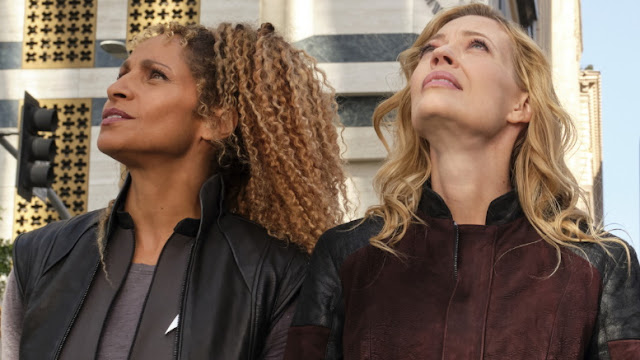
And so, it's the last episode of Star Trek: Picard, or is it the last episode of Star Trek: The Next Generation? Or the first episode of Star Trek: Legacy, or whatever the inevitable spin-off is going to be called. This episode, like the whole season, balances two goals: to tell a good, thrilling story, and to indulge the old school fans in some wholesome nostalgia. It succeeds far better at one of these than the other.

On last time - SPOILERS below, although, to be fair, you can probably guess most of what happens.

Saturday, 15 April 2023

TREK REVIEW: PIC 3-9 - "Vox"

The penultimate episode of Star Trek: Picard proves to be tremendous fun, chock to the gills with fan-pleasing moments. It's also an utter mess, story-wise, guilty of many of the same sins that previous season finales have committed. SPOILERS throughout after the break.

Sunday, 15 May 2022

TREK REVIEW: PIC 2-9 & 2-10


Hide and Seek 

Farewell

An over-the-top, occasionally silly but overall satisfying end to the second season of Star Trek: Picard, this final two-parter fair belts through plot beats like there's no tomorrow. Which, had our heroes not succeeded, I suppose there wouldn't be. As with the first season, and the recent run of Discovery, there have been some major pacing problems with this season, with an awful lot of side-steps and a leisurely pace through the middle of the run, leaving everything to be rushed for the finale. Perhaps this is a deliberate choice to make the end more climactic, but it does make it harder to fully appreciate the finale.

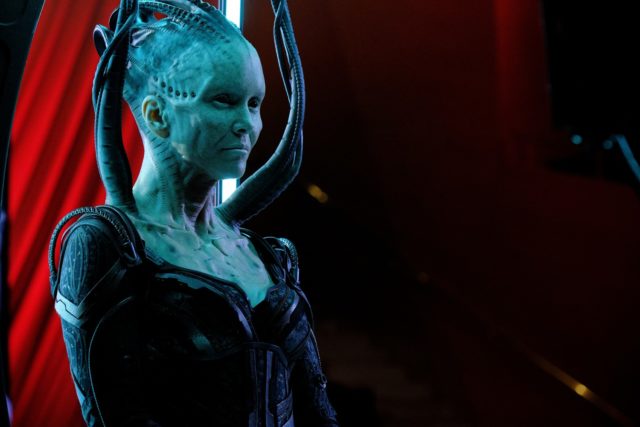
There are a lot of hard-to-swallow elements to this story, and you need to allow a lot of coincidences to make it work. Not everything quite adds up in the end, but for all that, it's so much fun, and the final episode in particular, so touching, that it's hard to be too unhappy about this. Alison Pill blows it away as the new Borg Queen, by now a convincing amalgam of Jurati's character and Wersching's Queen. We've had false dawns for a new kind of Borg before (whatever happened to those self-aware drones with commanding whole cubes from VOY: “Unimatrix Zero?”), but this time it looks like Jurati's new Borg really are a new era. (Although the news that Pill is not returning for season three suggests we won't be seeing them again, at least not anytime soon.)

Seven's rebirth as a semi-Borg (rather unbelievably, given the circumstances, with her implants in exactly the same places as before) was both predictable and disappointing. It would have been a nice culmination of Seven's development for her to finally be fully human. That said, her acceptance, with Raffi's help, of her part-cybernetic nature is satisfying, especially since she helped birth this new strain of Borg and prove that there's potentially another way of forming a collective. (Maybe they'll meet up with the voluntary hive mind from VOY: “Unity”... or maybe not.) Finally, Seven and Raffi get the smooches on, and everything is all lovely.

No surprises at all that Rios decides to stay in 2024, with the beautiful Dr. Teresa and her precocious sprog. Perhaps leaving him there isn't the best idea, given that this guy is a walking butterfly. I'm half-convinced that Chris is staying just for the cigars, but it's the only way this could play out – Teresa couldn't very well travel to the 25th century with her littl'un in tow.

TREK REVIEW: PIC 2.8 - "Mercy"


2-8 Mercy


“Mercy” is the first episode of the season that doesn't really work. There's something to be said for a straightforward adventure, but this side-step into the FBI's least wanted is so unnecessary to the main plot, while also being not terribly interesting in itself.


It's a fun bit of trolling on the part of the showrunners to cast Jay Karnes in this episode. After having so many actors reappear either as their popular characters or someone related to them, casting Karnes in a time travel story immediately makes us think he's reprising his role as 29th century time traveller Ducane. They even name his character Agent Wells, not only suggesting H.G. Wells, father of time travel fiction, but the Wells-class USS Relativity on which he served. (Apparently this all actually a reference to his role in Matalas's Twelve Monkeys series.)

So it's funny when it turns out he's just a regular 21st century agent after all. Unfortunately, having him as nothing more than a Fox Mulder rip-off makes him a fairly uninteresting character, in spite of a decent performance by Karnes. It's a nice touch that he's spent decades looking for aliens after freaking out due to a brief contact with some Vulcans in his childhood, but it's still not enough to make this diversion worthwhile.

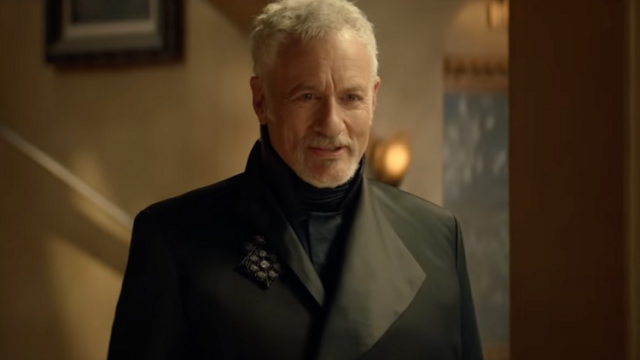
The best material this episode is between Guinan and Q, here meeting for the first time from Guinan's perspective (I love time travel). Aghayere is excellent here, occasionally sounding astonishingly like Goldberg but mostly creating a new version of Guinan. She's terribly creepy when projecting herself to Picard, another previously unseen El-Aurian power. De Lancie gives an amazing performance as Q, now facing the end of his life and waning powers. We've never seen Q so vulnerable before. (It's hilarious to think of Q, unable to teleport, having to make his way to Guinan on the bus.)

Meanwhile, Agnes is going around eating battery acid (I wonder if her stepmother is an alien?) while Seven and Raffi sort out their problems. There are some nice moments between Ryan and Hurd, and Alison Pill looks incredible stomping about LA in her ballgown, assimilating nasty blokes. Eventually, the new Queen joins forces with Soong, who's own life is falling apart thanks to Q deciding to help Kore. Quite how Soong thinks his destiny as saviour of the Earth is going to come about when the Queen wants to conquer humanity is anyone's guess, but baddies gotta be bad, right?


Bits and bobs:

Judging by his age, Wells probably met the Vulcans in around the 1970s. We know from ENT: “Carbon Creek” that they were observing Earth as early as the fifties and there was another one due in about twenty years.

Do the Vulcans even have transporter technology that early? Doesn't seem to quite line up with Enterprise, but then, Enterprise didn't quite line up with what came before either.

Jurati's ballgown-and-boots look brings to mind Harley Quinn in The Suicide Squad, by far her best live action look.


Monday, 11 April 2022

TREK REVIEW: PIC 2-5 & 2-6


FLY ME TO THE MOON 

TWO OF ONE

Picard continues on its way in a muddled but still highly enjoyable couple of episodes that move the season-arc on, giving us as many new questions as answers.

So, who had Gary Seven in their Trek bingo? Not me for one, although there were hints that the mysterious Watcher was linked to that sci-fi secret agent and his unseen “Supervisors.” It's remarkable that Trek has never returned to Gary's employers before (onscreen, at least, they're all over the books and comics), but that's hardly the biggest mystery here. Why does Tallinn look just like a human version of Picard's Romulan ladyfriend Laris? She claims to know nothing about Q, but then, would she be aware even if he had created her as a trap for Picard? It's good to have Orla Brady back, either way. Equally mysteriously, just why is she assigned to watch over Renee Picard, whose importance to the timeline is surely impossible to know in 2022?

Of course, individual people being vitally important to historical events is a common sci-fi trope, even if it does seem to be oversignifying one woman's space mission by making it the crux of future history. We're assuming that Picard is correct in trying to ensure Renee completes her flight to Europa. Could it not be the other way round, and that something she encounters leads humanity to become aggressively anti-alien?

On the other hand, we have Adam Soong, the latest (or rather, earliest) in a long line of Soong men played by Brent Spiner. It wouldn't be Picard without him somewhere, and to his credit, Spiner creates a character who is both reminiscent of his descendants and entirely his own person. It's interesting to see the Soong timeline come together slowly, as Adam's work in human genetics clearly leads to his descendent Arik's work with Augments a couple of hundred years later, before Arik himself switches to artificial life eventually leading his own descendent Noonian to create B4, Lore and eventually Data. All of whom look remarkably similar.

No prizes at all for guessing that his daughter Kore is a flawed clone, and that her genetic disease is the result of some error in her creation. Clearly, the image of this girl is embedded in Data's mind, having been presumably passed down to Noonian, and finally leading to the creation of Soji and Dahj and numerous other synths allied with Inigo Soong. Not a bad way of saving costs – an entire family across four hundred years, all played by two actors. It's a little hard to swallow that Kore has never googled her dad before, although I guess he could have programmed in some kind of aversion to that sort of thing that she's only now breaking. I expect this will be skirted over though.

Now that Q has lost his powers, he's rather wonderfully reduced to putting on silly accents and pretending to be Renee's psychiatrist. He seems dead set on stopping her from joining the Europa mission, but there must be simpler says of doing it. Soong tries to simply run her over, while Q is going about it in a much more Machiavellian way. Are there some kind of rules he has to play by, and if so, why? I'm still not convinced that he's actually in the wrong here – I wonder if he's actually working to prevent the Confederation timeline. Could his alliance with Soong actually be a way to discredit him, to stop him from becoming the influential figure?

The wider team get to have a lot of fun, although the Raffi and Seven storyline doesn't really go anywhere. I like how Raffi has started seeing Elnor's face everywhere. It's first played just after we've met Tallinn, looking inexplicably like Laris, so for a split second we wonder if this really is Elnor recreated. But now, it's seemingly Raffi cracking up. Nonetheless, she and Seven have spent a lot of time getting in and out of trouble just to swoop in and shut down Rios's storyline, although thankfully he reconnects with the good doctor after Picard is injured.

Everyone gives their all to their characters, with Stewart getting to make one of his trademark speeches to Renee, who is portrayed with great character and sympathy by Penelope Mitchell. (Fifty quid says we see her return to play a descendent in the fixed future at the end of the season.) Michelle Hurd gets to bring some real pain to the grieving Raffi, struggling to stay on the wagon, while Santiago Cabrera is at his charming best as Rios becomes ever-more enamoured with the 21st century that Raffi despises. (Got to wonder how he got away with smoking indoors in California though. This really isn't our timeline...)

Orla Brady makes Tallinn into a solid character, even as we kind of just want Laris back, while Spiner, de Lancy and Isa Briones all give excellent work as new players or revised versions of classic characters. The only one of the main cast underserved in these two episodes is Jeri Ryan, who as Seven just doesn't have much to do but react to Raffi and various unlikely plans.

Both episodes belong to Agnes Jurati and the Borg Queen, who are just about one character by the end of it. Annie Wersching continues to impress as a wholly different type of Queen, one who appears to be becoming increasingly human in her attitudes and personality as she spends more time disconnected from the hive and reconnecting with Agnes. After her twitching, insectile performance in episode two, Wersching's Queen has developed into a completely new creature. Stealing every scene she's in though is Alison Pill, who brings new depths and desperation to Agnes. It's no surprise that she'd shoot the Queen – we've seen her murder people she cares about far more – nor that she'd break down under pressure, although her misstep in letting herself get partially assimilated is a bit of a foolish moment.

Pill owns the show during the elaborate gala event, literally when she, under the Queen's influence, channels Pat Benetar and belts out a scene-stopping number. While the logistics are a bit hard to take – she's just been taken in as a gatecrasher, and now the band are supporting her with no instruction – Pill is so great it's impossible not to love the scene. Indeed, sashaying through the party as the advance scout, looking absolutely gorgeous while carrying off a performance as someone gradually losing their identity, Pill's is the standout performance of the season so far.

Links and observations:

All of Kore's deceased sisters are named after figures from Greek myth. In fact, several are named after the same one: Kore is another name for Persephone, the name of the first girl, and there is also a Prosperpina, Persephone's Latin variation.

Two spacecraft make cameo appearances as the gala/expo/party: Nomad, the space probe from TOS: “The Changeling,” launched in continuity in 2022; and Renee's favourite, the OV-165, a fictitious shuttle that appeared in the title sequence for Enterprise.

This, along with references to treaties outlawing certain types of genetic treatment, make it very clear that this is not our timeline, but one that simply looks a lot like it, and otherwise matches (as best can be expected) various events in Trek history.

After directing two episode, Lea Thompson appears in front of the camera as the head of the committee that slams Soong. Jonathan “Riker” Frakes takes over directing duties for these two eps.

Best lines:

“He's had some transplants.”
“Which ones?”
“... all of them?”

Sunday, 20 March 2022

TREK REVIEW: PIC 2-3 - "Assimilation"


Another solid episode which pushes the story onto what seems to be its main trajectory – setting the path of history right back in the 21t century. After a gripping (and pretty bloodthirsty) intro, La Sirena is catapulted back in time in a classic slingshot round the sun, just like in the good old days before Red Angels and tachyonic subspace rifts. It's not as trippy as The Voyage Home, but it's still a pretty cool sequence as the ship heads back in time under the Borg Queen's control.

Time travel episode are, of course, common as muck in Star Trek, and trips back in time to roughly contemporary settings are nothing new either. It's an obvious idea, of course, letting the characters comment on our way of life directly, but Trek has been running so long now that the present is catching up with the future. DS9's classic two-parter “Past Tense” was set in San Francisco in 2024, just a stone's throw from LA. There are hints towards it in the rundown homeless area that Raffi materialises in, and plenty of commentary on how we live in a society on the brink of collapse.

Raffi has a rough episode all through, first seeing Elnor die and then being thrown into, from her perspective, a primitive society. And she's understandably furious at all this, especially as Picard prioritised the Queen's survival over Elnor's. Seven fares better in the 21st century, suddenly “liked” by people she meets instead of being met with fear or awe. Seemingly because she no longer has Borg bits on her face, she's not threatening, by I wonder if she's actually different in this timeline; if not having her implants has changed her physiologically and mentally.

Seeing Raffi and Seven doing the couple-y thing is fun, of course, and aside from some odd lines (“You and 2024 should get a room,”) they have great chemistry in this episode. Among the storylines in contemporary America, though, it was Rios's plotline that I enjoyed the most. Having Chris, a Hispanic man who commands a starship, suddenly thrown into the world of immigration raids and back alley medicine illustrates the brutality and injustice of our society more effectively than having Raffi pass judgment on the homelessness crisis and beat up a mugger. Sol Rodriguez is a great addition to the cast as Teresa. She has excellent chemistry with Santiago Cabrera and will no doubt be our present day point of contact for the story. More of an Edith Keeler than a Rain Robinson though...

It's interesting that the Queen remains as a major character in the series. I was expecting them to just leave her in her self-induced coma. Wersching's Queen, now that she has her marbles back, seems more like Krige's than before, manipulative and insidious, but has a sassy arrogance that's all her own. Alison Pill gives her best performance ever as Dr. Jurati, as she very inadvisably links with the Queen to try to kickstart her and get data off her. There's definitely a lot more to come from this strange pairing. Really, the only character who doesn't come off well here is Picard, who's perhaps proving too single-minded and inflexible for his crew. I'm wondering just what sort of test Q is running him through.

One more niggling element is the inconsistent attitude to their presence in the past. They worry about “butterflies” but simply being present on Earth in their own past is inevitably changing events. I'll be frankly surprised if it doesn't turn out that Picard and co's interference isn't the very thing that sends history down the wrong path. At least Agnes is thinking about causal loops, even if no one else is.

It's a great episode, the pacing settling down a little since the frenetic opening episodes. The direction, by time travel sci-fi veteran (and huge Trek fan) Lea Thompson and strong performances by the cast make this is a gripping instalment.


Monday, 14 March 2022

TREK REVIEW: PIC 2-2 - "Penance"


Picard storms ahead with another belter of an episode that barely gives the viewer a chance to take in what's happening. The episode leaves you breathless, but under the excitement and strong performances, it's not as solid as it appears.

Resolving last week's cliffhanger by barging us into a different reality altogether, “Penance” acts like a second introduction to the season that, on the face of it, has little to do with what went before. “The Star Gazer” set us up with the characters in a new dynamic, and with a mystery surrounding the Borg's strange new behaviour, before essentially blowing it all up and starting over with a new story about Q and his interference in the timeline.

Q's scene with Picard is a highlight of the episode. Stewart and de Lancie have the same great antagonistic chemistry they had back in the TNG days, but overlaid with an angrier, more impatient drive, made fierier by the fact that the streaming platform doesn't need to watch its language for primetime. “I don't have time for your bullshit!” snarls Picard at Q, and you feel him. It's two old men lashing out at each other after years of furious history. Picard insists that Q has gone mad, but perhaps he's just lost his patience as well – who knows what bizarre pressures are playing on him?

This new reality, not a parallel universe like the Mirror Universe but an altered timeline, is well-realised, a dark, fascist state where humanity rules with cruelty and brutality. Some of the details are chilling – First Contact Day replaced by Eradication Day, famous aliens slain by the ruthless General Picard, Romulans as slaves and no ban on synthetic servants – but others are harder to understand. After introducing the Stargazer, Rios is now captain of La Sirena again, now a warship for the Confederation of Earth. Annika Hansen is the President of Earth, never having been assimilated by the Borg and changed into Seven of Nine. It's a bit too neat.

Of course, there's the question. Is this really an altered timeline, or some huge fabrication of Q's? On the other hand, given Q's apparent insanity, is something else going on? Has something else changed history in 2024 (only two years away from our present, but also notably the year of the crucial turning point of the Bell Riots in Trek lore)? If that's the case, Q must be pulling strings somewhere to have put everyone (except the unfortunate Elnor) in positions of power that allow them to escape and travel back.

The bigger question, though, is: just how is this different from the Mirror Universe? Aside from Q pointing out it's not an altered rather than alternative reality, this is the Mirror Universe in all but the details. The Confederation instead of the Empire, Nazi-esque black instead of imperial gold. In the Mirror Universe humanity was overthrown by its subject races, while here its still in power and ready to wipe out Vulcan and execute the last of the Borg. Really, though, that's just pushing things forward by a century or so. We still have versions of the regular characters, however unlikely that would be after centuries of divergence, but twisted to become utter bastards. Why not just make it the Mirror Universe and be done with it if you're going to be that clichéd?

Still, it's hard to worry too much about that when it leads to such a gripping thriller as this. Where this works, while the Mirror Universe episodes of Discovery didn't, is that it keeps things moving and focuses on the “real” characters instead of mincing supervillains. Stewart is impressive, of course, convincingly frightening when he pretends to be the cruel General Picard. The most effective part of the episode, though, is President Hansen waking up, with Jeri Ryan beautifully portraying the slow realisation that she is no longer Borg, testing her reality to make sure she's not dreaming it. It's a shame the trailers spoilt the reveal, because it's a wonderful moment when we finally see she has no implants.

On the Borg side of things, Annie Wersching's new iteration of the Queen is also a triumph. Whereas Alice Krige played her as oily and creepily sexual, and Susanna Thompson with a sort of twisted maternal instinct, Wersching's Queen is the most inhuman, twitching and insectoid and more concerned at the change in time than her own imprisonment. The idea of forming an uneasy alliance with the Borg Queen as she's the only one with the brains to calculate the trip back in time is a brilliant one. Making these scenes even better is Alison Pill as the entirely out-of-her-depth Dr. Jurati. Agnes obviously never got parallel universe training and is terrible at undercover work, but watching her wing it is hilarious.

As fun as it all is, I'm glad that it looks like we're on our way back to the past in the next instalment. Just like the Mirror Universe proper, this new evil empire could outstay its welcome quickly. I'm more interested in seeing how all this ties together than spending time in fascist central.

Observations (and evil observations with sinister beards):

General Picard keeps the skulls of his most high-profile vanquished foes on stands in his trophy room. They include Gul Dukat, General Martok, Ambassador Sarek, an unidentified Ferengi (but probably the Grand Nagus, given the staff included), a Borg and uncertain reptilian species (update - it's a Saurian!)

Brilliantly, we learn that the Ferengi have bones in their ears.

General Sisko is namechecked. I would have loved just a quick cameo from Avery Brooks, if only to punch Q in the face again.

The Queen says Annika was assimilated in 2350. That was actually the year of her birth, and she was assimilated when she was six, so in 2356 or '57. Still, the Queen was having an off day.

Apparently, the Queen can hear her counterparts in other realities through higher dimensions.

Patton Oswalt voices Spot 73, Jurati's cartoonish hologram and homage to Data's cat Spot.

The Magistrate/First Husband is played by Jon Jon Briones, the father of Isa Briones who plays Soji, which may well end up being significant (or not).

Picard even has a synthetic body in this reality, as unlikely as that seems, thanks to a nasty altercation with Dukat.

Monday, 7 March 2022

TREK REVIEW: PIC 2-1 - The Star Gazer


After quite the wait, Picard returns with a storming opening episode. While it's predictable in many ways, due to the main plot points being heavily trailed and the decision to open with an action-packed teaser that takes place in the episode's climactic moments, it's all done with such verve and flair that it's hard not to be swept up in it all.

In the eighteen months or so between seasons, we've reached the 25th century and Starfleet has forgiven all sins. Picard, Raffi and Rios are all back, with promotions and new positions. The venerable admiral is Chancellor of the Academy, Raffi has her own posting on the Excelsior and Rios is now captain of a brand new Stargazer. Meanwhile, Seven has taken La Sirena off his hands to continue her work for the Fenris Rangers, while Soji and Dr. Jurati have both been let off their frankly murderous ways on some pretty flimsy rationalisations (one wonders if Picard has been pulling some strings and bending the truth).

While they're all doing rather well for themselves professionally (Jurati's position as drunken master remaining entertaining but questionable), none of them are managing terribly well in their personal lives. Picard is too uncertain and stuck-in-his ways to allow a romance with his housekeeper Laris (and when Orla Brady comes on to you, you do not make excuses). Raffi and Seven don't appear to be seeign each other anymore, or it they are, it's very long-distance. Jurati and Rios have a tenuous friendship at best. At least we can rely on Guinan to sit down and talk sense to Picard – hopefully she'll have a chance to tell everyone off before the season's out.

The episode is actually rather slow, but punctuated by exciting bursts of action. In between there are very long talky segments, but the occasional exposition dump aside, the dialogue is entertaining enough to keep things moving (in both senses of the word). It helps that we have an absolutely top-notch cast delivering it. Nonetheless, it can't all be awkward chat about feelings: this is Star Trek, so there's an anomaly to explore.

Big swirling subspace anomalies are ten-a-penny in Trek, and it would be no surprise who's behind it even if we hadn't seen them attack in the opening moments. Green is the signature colour of the Borg, after all. Nonetheless, the Borg we meet here aren't quite like anything we've seen before. They ask for Picard by name, send their Queen (visibly unrecognisable) as an emissary, and claim to be interested in peace. The closest we've seen to this before is their tenuous alliance with Voyager, when Seven herself was sent as an emissary, and even then we couldn't trust them. Yet the Queen, even as she assmilated a fleet of starships, continues to only use stun setting with her weapons. Something interesting is going on here, but it doesn't look like we'll get to the bottom of it anytime soon.

Still, if this was Discovery, it would have been a month before we even saw the anomaly and another before we found out who was behind it. This episode introduces a spatial rift, pulls the Borg out of it, gives us both a mystery and a thrilling battle and then up-ends everything. While Q's appearance is, again, well-known to everyone coming in unless they've been very careful to avoid trailers, but it still packs a punch, largely down to John de Lancie's magnetic presence. Doubtless Q is in someway linked to the Borg event – who knows, perhaps this is what he was guiding everything towards when he flung the Enterprise-D into the path of that cube in “Q, Who.” Then again, given that they arrive through some kind of space/time rift, perhaps these Borg, in their bizarre ship, with their even more bizarre Queen, aren't from this timeline at all.

Whatever the answer, I can't wait for the next episode.

References and observations


The gorgeous shot that pans out from Earth, across the solar system, into deep space and finally to the Borg rift, brings to mind the original title sequence of The Next Generation.


Elnor is lauded as the first fully Romulan cadet in Starfleet Academy. Simon Tarses, who was pilloried by Admiral Satie in TNG: “The Drumhead” was a quarter Romulan, but he both kept this secret and enlisted as a crewman rather than attending the Academy. Saavik was originally written as half-Romulan, but this never made it to the finished films.


Raritan IV, visited by Soji and Dr. Jurati, appears to be a Deltan colony. This is the first time we've seen the Deltans on screen since The Motion Picture, save a couple of barely visible cameos in subsequent films.


El-Aurians can age if they choose to, to make others feel comfortable. Q, of course, can appear how he likes on a whim.


The USS Stargazer NCC-82893 is a Sagan-class ship, apparently the first of its class. We also hear mention of a USS Hikaru Sulu, and according to info from the design crew, a USS Uhura. Ships making their live-action debut (if you can call it that when they're all CGI) include the Luna-class (from the novels and later Lower Decks) and the Ross, Reliant, Sutherland and Gagarin-class (from Star Trek Online).


Tuesday, 24 March 2020

TREK REVIEW: Picard 1-8 - Broken Pieces


With only three episodes left to tie things up, Picard's writers deliver an instalment heavy on exposition and low on incident. Surprisingly, though, this approach works well, resulting in an episode that manages to be pacey and entertaining in spite of very little actually happening.

The now-traditional flashback sequence that opens the episode reveals a great deal about the series' backstory, resolving quite a bit of mystery in one go. Oh – who it turns out is half-Vulcan, half-Romulan, which solves that one – assembles a bunch of Romulan women on the abandoned planet Aia, in the midst of the impossible star system the Eightfold Stars. Here, they receive a vision from 200,000 years ago, of a plague of AIs destroying the galaxy. Most of the women go nuts and kill themselves, except Narissa Rizzo, who seems pretty fine, and her aunt Ramdha, who goes nuts but doesn't immediately shoot herself in the head.

It's very entertaining, if not remotely plausible. I just find it impossible to believe that an ancient video of planets blowing up would be enough to make anyone bash their own head in with a rock. At least Rizzo, who's already clearly miserable as hell, isn't affected. That's what you need in an apocalypse: depressed people. We always feel like the world is doomed, so we're used to it and can just carry on.

Still, I love the idea that Ramdha isn't traumatised by her assimilation, as we suspected, but was already so damaged by what she saw that she essentially crashed the Cube and switched off all the drones.

This episode is strung together from coincidences and unlikely events. Elnor calls Seven, and there she is, just like that (although I love that big hug he gives her). They do have some pretty good chemistry together, much as Elnor and Hugh had, and it's a real shame we don't get any interaction between Hugh and Seven in this series, especially as it's implied they have already met. Seven's decision to plug herself into the cube is completely mad, but is the most exciting part of the episode, and her temporary role as the cube's new Queen provides some fantastic imagery. It puts Seven in a hard position too, making her a Borg again and turning the XB's back into drones in order to defeat the Romulans.

It turns out that Rios's dark past, by a massive coincidence, is linked to the coming of the Ais. Commodore Oh ordered his captain to murder to synths, one of whom as the dead ringer of Soji, and Rios covered it up out of fear for his crew's safety. Raffi then goes off on one about how all her conspiracy theories were true, even though she seemingly had no access to any of this information until now. Did she just happen to guess it all? To be honest, having the attack on Mars be a Romulan plot rather than the synths actually fighting for their rights is a lot less interesting.

Nonetheless, as ridiculous as this all is, it still works in a solidly entertaining way, and it's satisfying to get some answers at last. The highlight of the episode, other than Seven's Borgery, is the conference between Raffi and all the emergency holograms. We've got holograms for engineering, navigation, tactical, hospitality and medical, all played by Santiago Cabrera putting ona different accent and personality, all of which make up elements of Rios's own psyche and memory. It's a brilliant concept and a wonderful scene. I said years ago we should have a Star Trek series made up entirely of holograms running a ship. I just imagined they'd be played by Robert Picardo.

Jurati's meeting with Soji is beautifully played, although it has to be said, Agnes has gotten off very lightly after her part-time job as an assassin. She says she'll hand herself in, but that blatantly won't happen. Picard saves the episode emotionally, though, with a nice speech about how the future is theirs to make. They've two whole episodes left to make it.

Thoughts and observations:

Rios's captain, Vandemeer, was previously first officer to Marta Batanides, who was Picard's bzzie mate/love interest back at the Academy, as seen on TNG: “Tapestry.” Picard's first assignment was the USS Reliant (named for the ship in The Wrath of Khan, and previously mentioned in the extended version of TNG: “The Measure of a Man”).

I'm half-convinced that the reason Picard doesn't have a French accent is that he was replaced by a hologram years ago, and this one was set to English.

The ENH mentions Nu Scorpii as a rare septenary star system. This is a real star system, about 470 light years away. There's one more such system known, AR Cassiopeiae, about 650 light years away, but there are no known octonary systems known to science.

They really called the “Grief World” Aia? The AI-planet?

Rizzo's right hand Romulan is called Centurion Tarent. Is Michael Chabon channelling Terry Nation?

Sunday, 22 March 2020

TREK REVIEW: Picard 1-7 - Nepenthe


“Nepenthe” is an episode split between a gentle, reassuring reunion story and an absolutely brutal thriller. On the one hand, the bulk of the focus is on Picard's reunion with Riker and Troi, on what seems to be an idyllic planet, although even this has some darkness beneath the surface story. It's a chance for the characters to take stock and process the events of the preceding episode, and for Picard and Soji in particular to actually get to know each other after very forcefully being thrown together. On the other side, there are the events on the Artefact, including the vicious, and arguably unnecessary, murder of Hugh, and the strained relation on La Sirena, culminating in Jurati's act of near-suicide. It's equal parts assuasive and unsettling.

As a fan, the return of characters of previous iterations of Star Trek is naturally a highlight of Picard, but there's always a risk this will slide into fanwank and cease working as its own story. Catching up with a middle-aged, retired Riker could easily go this way, but the script utilises him well, providing Picard with the comfort of a friend and a much-needed ally, but also someone who'll confront him on his shit. Troi (or Mrs Troi-Riker, rather) gets to use her counselling skills properly, giving Soji someone to talk through her issues with, although it's her daughter who really gets through to the troubled android.


Lulu Wilson absolutely steals this episode as young Kestra Troi-Riker, which is no mean feat given that she's up against the long-awaited reunion of three of The Next Generation's principle characters. Kestra is a cool, fun, adventurous kid, who has clearly thrown herself into the more back-to-basics life that her parents have taken to on the planet Nepenthe. Their stated reason for settling on the planet is the life-restoring properties of the soil, which they had hoped to use to cure their late son of a degenerative disease. In an unexpected link to the overall series arc, it turns out that a positronic net is part of a treatment that would have cured him, but these were blanket banned after the attack on Mars.

There's more to it, though. The late Thaddeus is revealed to have been something of a prodigy, creating entire languages and worlds in his head as part of his desire to belong somewhere after growing up on a starship. While Kestra is clearly just as brilliant, she has a much more grounded lifestyle, which has to be a conscious decision by her parents. It's not like there isn't a more technology-based lifestyle available on the planet, as we hear of a spaceport numerous times. The Troi-Rikers clearly wanted to move back to nature.

Lulu Wilson also shares excellent chemistry with Isa Briones, who gets to give Soji some real character at last. I guess this makes sense, since before much of her character is explicitly maufactured, and at last she is learning who she really is. Understandably she's in a hell of a place, having had her identity thrown into question, and then minutes later her boyfriend try to kill her, and then escape from a Borg cube through a super-teleporter. As helpful as her time on Nepenthe is in settling her character, she has a lot more to go through before she'll really know who she is and what her place is.

The details of Soji's biology are interesting. “Data didn't have mucus,” points out Kestra, and it does seem strange to put so much work into creating an artificial being that seems so human seems almost counterproductive. Yes, she's super-strong and super-intelligent, but she's also extremely biological with all the weaknesses that entails. She almost choked on poison gas last episode. Why build a human? We can already make humans. Nonetheless, her pedigree as a Soong-type android is so clear that all it takes is a characteristic head tilt and Riker and Troi both recognise her as Data's child.

I'm not sure the events on the Artefact really add anything much to the episode, other than to show how ruthlessly evil Rizzo is. It's not like this is ever in question. The villainous characters, particularly the female ones (ie everyone except Narek) have been pretty one-dimensionally evil in this series, in spite of the more complex moral concepts it's going for. Rizzo leaps at the chance to start murdering XB's to show just how much contempt she holds them in, then kills Hugh for good measure. Rather like the murder of Icheb earlier in the series, it seems pretty cynical. On the plus side, Evan Evagora (Elnor) and Jonathan Del Arco (Hugh) work really nicely together. It's a pity we won't see more of them.

The La Sirena crew work nicely in Picard's absence, with the understandable tension already there racking up constantly. Jurati finally snaps under the strain of what she's done, trying to disable the tracker in her blood. Whether she was deliberately suicidal or her near-death was a side-effect is open to interpretation. Allison Pill is excellent in this episode, which sells her character's torn motivations far better than the pretty unbelievable backstory of her mind meld with Commodore Oh. It isn't clear whether Oh is controlling her mentally, or if what she showed her was enough to turn Jurati against all her principles, but either way it doesn't really convince.

Overall, the events on the eponymous planet make “Nepenthe” a memorable episode, while the other developments, although moving the plot forward more, are far less effective. Still a solid instalment in the series, although the sense that we're running out of time is becoming unavoidable.

Thoughts and Observations:

“Nepenthe” is the name of a liquor from Greek myth that took away painful memories. Today it's used to mean “sweet forgetfulness” but can be translated as “amnesia” or “oblivion.” There's a theme developing here.

Kestra is named after Troi's deceased sister, whose story was explored in TNG: “Dark Page,” while Thaddeus is named for Riker's Civil War era ancestor, mentioned in VOY: “Death Wish.”

Are they softening us up for Picard's death? He's in his nineties, and in this episode they remind us that he has an artificial heart and a neurological condition.

The planet Nepenthe has jackalopes! They make good eating, and Riker puts bunnicorn sausage on his pizzas.

The Kzinti are causing trouble in the space near Nepenthe, the first time we've heard the name on Trek since the Animated Series. (Some people have heard “Xindi,” which would also be cool, but the subtitles confirm it's Kzinti.) Larry Niven gave the writers the nod that it was fine for them to drop the reference. This makes the Kzinti's existence in the Trek universe inarguably canonical.

Riker and Troi rack up a fourth Trek series, having appeared on The Next Generation, Voyager and Enterprise previously, although they did not appear together on Voyager. Frakes also appeared as Thomas Riker on Deep Space Nine, who is still technically Riker, so maybe that puts him at five.

Riker completely fails to climb over a chair in this episode, and I find this extremely disappointing.

I've mentioned the possible link to Control from Discovery before, but I hope the reuse of shots from that series isn't setting this link up and is just recycling. While it could potentially tie in, reusing the villain at this stage seems lazy.

There's a cock-up in the battle scene on the Artefact, as Hugh appears with Rizzo's knife in his neck before she throws it at him.

The Romulan snakeheads are pretty cool, but they're no Birds-of-Prey.

Saturday, 14 March 2020

TREK REVIEW: Picard 1-6 - The Impossible Box


After last week's episode, which featured no scenes aboard the Artefact, this instalment spends almost all its time there, as the two storylines finally meet and Picard's search for Soji reaches its culmination. It's surprising that the series has taken so long to bring the two sets of characters together, with Picard's crew and the Romulan-Borg set-up being kept entirely separate until now. While last week's episode was eventful, little of it actually advanced the plot. This week things really kick into high gear, and while I've enjoyed the more languid pace of this series, it's good to have some forward motion at last.

We've been waiting some time to see Picard return to a Borg cube for the first time since “The Best of Both Worlds,” and this episode does not disappoint. Stewart gives us some of his strongest acting ever in this role – I don't think I've seen him put this much into Picard since the torture scenes in “Chain of Command.” In contrast to his barely suppressed rage when confronting the Borg in First Contact – which was almost a quarter of a century ago – Picard is visibly terrified of the prospect of boarding a cube. There's an absolutely beautiful bit of direction where he reviews the reports of his assimilation, and the image of Locutus overlays Picard's own face. It's a simple yet very powerful image, and pushes home how Picard still bears the internal scars of his assimilation. Once he's actually boards the cube, his terror is overwhelming, and Stewart's performance steps up again, as the XBs surround him and he is momentarily convinced they are moving to attack him.

“They don't change,” says Picard, “they metastasize.” It's an exceptional line, and one that reflects his, and most characters', understandable attitudes to the Collective. Of course, we know that the Borg, or at least individual drones, can change. Seven of Nine's guest role reminds of various rehabilitated drones on Voyager, while Hugh himself makes a far more significant contribution to this episode than in his previous brief appearance. In a heart-warming moment, Picard and Hugh embrace, suggesting they must have had some contact since they last met in “Descent,” where they were respectful of each other but certainly not friends. Hugh has developed significantly as an individual, and has helped other former drones become compassionate beings, even if they don't all show much in the way of individuality. When he speaks to Hugh, though, Picard shows a different attitude: “You're showing what the Borg are underneath. They're victims, not monsters.”

On the other end of the story, the incest twins bring their operation to a close, as Narek finally gets Soji to confront her past. The scene where Soji realises that all her memories are fabricated, and that everything about her dates back only thirty-seven months, is powerful. Isa Briones gives an excellent performance here, and shows that she's very good in the role when she's actually given something interesting to react against. With Narek's help, Soji accesses her only real memories, which have hidden in her dreams, and from this discovers the location of her home planet (although surely there must be more than one planet in the galaxy that could conceivably have a similar sky). He then proceeds to try to gas her to death, which is an especially cruel method of execution considering that he could just blast her. He seems genuinely upset as he walks away, suggesting he has real feelings for Soji, which if anything makes his actions even more disgusting.

He really hasn't thought it through, of course, as all this does is activate Soji, just as Dahj's assassination attempt activated her. We get some great action to lead the episode out, as Picard, Elnor and Hugh battle their way to the Borg Queen's chamber and make an escape through a spatial trajector. Picard saves Soji, for now at least, so his mission has been a success, but he's left Hugh and Elnor, plus everyone on La Sirena, deep in Romulan territory with little hope of escape.

On the whole, Picard doesn't actually come of very well in this episode, for all his bravery. He uses Raffi, who is visibly drunk and distressed, to gain entry to the Artefact, forcing her to utilise and endanger one of her few remaining friendships to ease the channels. His rescue of Soji is perfunctory by necessity, but he does little to put the poor girl at ease after her entire worldview has been upended. One gets the impression of someone for whom the mission is the most important thing, never mind what else gets broken on the way.

(Other) best line: Picard is “so Federation, his face is probably on the damn brochure.”

Sexy Trek: Dr. Jurati and Rios get sexy with each other, and while they both say it's a bad idea, you really can't blame either of them.

Thoughts and observations:

So, the poor old Sikarians from Voyager have been assimilated. The Borg have appropriated spatial trajector technology from them, which handily for the plot allows a quick hop through space, to anywhere up to 40,000 light years away. When Voyager tried to use this technology, they were scuppered by the fact that the planet Sikaris itself was essential to its function, but either the Borg or the Sikarians themselves seem to have overcome this. Quite why the Borg Queen needs an escape route, when she can seemingly survive death, is unclear.

I like the line, “The Romulans are in a 250-year bad mood.” Starfleet first made contact with the Romulans in 2152 on Enterprise, 247 years before this episode.

Hugh is a Federation citizen, which is intriguing. 

The hug between Hugh and Picard was apparently not in the script, but was worked out by Stewart and Del Arco. Which is just lovely.

Wednesday, 11 March 2020

TREK REVIEW: Picard 1-5 - Stardust City Rag


Two ex-Borg with snappy eyewear

First off, I've got some issues with the opening part of this episode. Bringing Icheb back just to kill him and give Seven a vengeful backstory is a bit cynical, but fine. It works, though, and to be honest, there isn't really much else to do with Icheb. What I dislike is the level of gore involved. I've a serious aversions to things happening to eyes, and I couldn't watch it at all, so the missus watched it for me, but she ensures me that it was very visceral, and I don't think that's really necessary for Star Trek. I'm fine with some blood and horror in Trek (I just watched “Conspiracy” from 1988, and that's gruesome) but this is over the top, and it really is cynical.

Apart from that though, this episode is great fun. It's a bit of a departure for a Picard-led Trek, the sort of grimy adventure we'd expect from the Kelvin films, or, well Star Wars. Any pretence of Picard being French has no gone completely out the window, with Stewart clearly having a whale of a time camping it up as an eye-patched scoundrel with a raucous French accent. Rios gets to play a ne'er-do-well who's a bit more untrustworthy and flamboyant than his usual style, and is clearly the sort of gun-happy character you want along on a criminal enterprise like this.

I'm really glad hats are back in the 24th century
Meanwhile, Raffi gets some considerable background exploration, as she takes the opportunity to catch up with her estranged son and we get a good idea just how badly her life has derailed since she dropped out of Starfleet. Hurd gives a wonderful, human performance in this episode, and I love that Star Trek is now exploring depression and addiction as ongoing issues, rather than assuming that these are things that will somehow have vanished by the 24th century, or limiting them to one-episode morality tales.

It's still a bit unclear why Raffi's son has gone to Freecloud to look at fertility treatment with his Romulan partner, given that they're clearly not entirely unwelcome on Earth. Then again, it's never really been clear why humans or other Federation subjects would voluntarily go to live on a seedy, cut-throat world like Freecloud in the first place. Maddox is on the run, of course, because his work is now illegal, but so many characters through Trek's history seem to have upped and left the cosiness of the Federation to go work like a dog or take up crime for a living. It's pretty baffling.


Still, Freecloud is a great addition to the 24th century, a wretched hive of scum and villainy that provides a colourful backdrop for the adventure and adds to the ever more richly painted picture of this post-Nemesis future. I dare say we'll visit there again in future Trek productions. Maddox has got himself in with the wrong crowd, of course, being in debt to a nasty crime queen called Vajazzle, or something. Not sure if she's human or not, really, but she's decided that the best way to make a living is to butcher former Borg for parts. It's a horrible concept, but an understandable one, given how advanced Borg tech is and how hated the ex-drones are. The fate of a former drone – even a Starfleet one, like Icheb – doesn't seem to bother anyone in the galaxy at large. While this episode doesn't feature any scenes on the Artefact – and they aren't missed, to be fair – it ties into the contempt with which the XB's are viewed by the Romulans studying them.

All of this, of course, is calculated to give Seven a reason to crash back into Trek. Jeri Ryan is excellent in this episode, displaying remarkable chemistry with Stewart in spite of their characters never having met before. While any number of Voyager characters could be brought back to the franchise, Seven makes sense, not merely due to her popularity, but because she has something in common with Picard. The chance to have the two Borg escapees interact and discuss their trauma is irresistible, and illustrates how different their characters are. This is a very different Seven to the one we knew on Voyager, and I can understand fans who say they don't recognise her, but I can see it. Seven has been back in the Alpha (and now Beta) Quadrants for twenty-one years now, and has naturally evolved in her time away from the Collective. This is a more human, perhaps more flawed Seven, but there's a lot of the old Seven still there: her drive, her resourcefulness, the vulnerability and emotion that she tries to hide under a colder exterior.

There's also been some outcry against Seven's decision to beam back down and exact revenge on the woman who tortured her surrogate son to death (by implication having formed a relationship with her to get to him). Picard bangs on about revenge being different to justice and sticking to their principles just like you'd expect, but this is a completely lawless area of space, where murder and extortion goes unpunished. Even the local militia, the Fenris Rangers to which Seven now apparently belongs, seem to have lost influence. There is no justice coming for this monster of a woman, and Seven's execution of her is completely justified. In any case, Picard, as the captain of a military vessel, has ordered the deaths of probably thousands of people in combat over the years, yet this is always considered to be acceptable and barely even remarked upon. Most of the Klingons, Romulans, Ferengi and Cardassians crewing ships destroyed by Starfleet were doubtless ordinary folk doing their jobs. Yet vapourising a murderer who would clearly otherwise keep on murdering is somehow below the belt.

In other news, Jurati is the murderous spy we all expected her to be, and Alison Pill gives a powerful performance as someone who's mission is clearly tearing her apart. There's a real sense that we can't quite trust anyone on this ship, and that Picard is becoming strangely complacent amongst them. For all that this is a fun and eventful episode, though, it's going to be remembered for the return of Jeri Ryan to Star Trek, still looking incredible and one of the best damned actors in the franchise.

Thoughts and observations:

There were a lot of fan-pleasing references in this episode. It's easy for these things to go too far and create a small-universe situation, but I felt in this episode they made it all feel part of the same future. Quark's Bar is now apparently a franchise, and Quark is famous enough to be name-dropped as part of a faked backstory. Dabo and Orion slave girls are among Freecloud's dubious pleasures. Mr. Mot's Hair Emporium was probably my favourite, though.

There's a lovely moment where a snatch of the Voyager theme plays over Seven's heart-to-heart with Picard.

Boozy beverages available on Freecloud include tranya – the First Federation drink from the TOS episode “The Corbomite Maneuver” - and Temtibi Lagoon, a cocktail named for a feature of the planet Risa. Seven drinks a straight-up bourbon, so clearly she can take her drink a lot better than in Voyager's time.

Neither Maddox nor Icheb are played by the original actor for the role. Actually, it's pretty harsh on Manu Intiraymi, who has spoken in the past how keen he would be to pick up the role of Icheb again, and apparently wasn't even approached for this. He has returned to the role for the fanfilm Star Trek: Renegades, which is set after the character's death here.

The planet where Icheb meets his unpleasant end is called Vergessen, which means “forgotten” or “oblivion” in German, and is located in the Hypatia system, named for the Byzantine physician and philosopher. It is, presumably, in the Beta Quadrant.

Freecloud is the Alpha Doradus system, which is a real star about 170 light years away in Dorado.

Vajazzle's right hand man is a hulking lizardman called a Beta Annari, a species that can apparently smell who you had for breakfast and what you last had sex with.

Sunday, 1 March 2020

TREK REVIEW: Picard 1-4 - "Absolute Candor"


After all these years, are we still pretending that Jean-Luc Picard is actually French? Because he is every inch the Englishman abroad in this episode, striding into the relocation camp on Vashti in the prologue flashback in his white suit and broad-brimmed hat. He's got a serious case of white saviour complex in this episode, and in fairness, he has saved a lot of people, but Christ, does he know it.

While the long pilot ostensibly finished last episode, this instalment is another step in the building of the main cast, with Evan Evagora joining as the Romulan space ninja Elnor. He's basically an elf from The Lord of the Rings, isn't he? Evagora does pretty well as a stoic warrior boy from an advanced martial culture, although the Australian accent is slightly odd coming from a Romulan. Then again, in this series we've had English and Irish Romulans, so why not? Why should all the aliens sound American? I want a Brummie Klingon before the season's out, please.

We learn a lot about Romulan culture in this episode, both on Vashti and on the Artefact. We've never really seen much of it beyond the military, the government and Tal Shiar before, so having new elements to explore sets this series apart from earlier Romulan stories. The Qowat Milat are good fun – a group of warrior nuns with a vow of truth and honesty is just a great fantasy idea and nothing like what we've seen from the Romulans before. Elnor must have had one hell of a childhood, though, with all those women being relentlessly honest with him. I can't help but agree with Jurati – the “way of absolute candor” sounds pretty irritating.

Vashti itself is an interesting location. It seems that it was previously a Romulan/Federation cooperative, which is something that could never have existed in the pre-Nemesis period of the 24th century, and it makes sense that this was a prime location for settling Romulan refugees. It's deteriorated since then, though, and the “Romulans Only” signs seem almost redundant as it looks like all non-Romulan elements have long since pulled out. Some commenters are questioning how poverty can exist in this beautiful future, but frankly, it's pretty clear that neither the Federation for what remains of the Romulan government has the resources to support every planet that needs help. Calling the UFP a post-scarcity society isn't really accurate, but it's certainly on its way to being one, but any society would need a huge infrastructure to keep things functioning. A major crisis – the destruction of Romulus or the attack on Mars – would lead to a huge change in both the availability and distribution of resources. If a colony was let go it would break down very quickly.

It's understandable that there's some bad blood towards the Federation from Romulan refugees, but the characters we meet here are particularly hate-fuelled. The big guy who stands up to Picard seems more pissed off that the Federation offered to help the Romulans in the first place rather than leave them to help themselves. It's a wildly inconsistent attitude, and while that's hardly unusual for someone with a bigoted point of view, it's annoying to see Picard shoulder the blame for that too. Frankly, even together it would have been impossible for the Empire and the Federation to save everyone on Romulus and Remus, but at least Picard's efforts helped save thousands. White saviour complex it might be, but it's gratifying that he'll take none of that shit from the Romulan survivors. He's guilty for not doing more, but he'll never apologise for trying.

Events on the Artefact stretch on, and to be honest they're becoming a little boring. The Incest Twins are becoming irritating in the extreme, and Soji isn't really being afforded much in the way of character. Dajh made more of an impression in her short screen time than her sister has in four episodes, and given that they're played by the same actress, it can only be the writing that's at fault there. It's interesting to learn more about Ramdha, and her insights into Romulan mythology, although the intention seems to be that she is somehow linking Soji with an impending apocalypse. Given that Romulus has been annihilated, you'd think that Romulan Armageddon has rather been and gone.

It's a mostly enjoyable episode, but one whose runtime is overshadowed by its final moments. The La Sirena crew spend a bit too much effort pushing that the pilot of the ship that has saved them from the Bird-of-Prey is a “he,” so it's pretty clear we're going to have the shock reveal they're a woman. Still, it's an effective cliffhanger, even if the reveal does swamp the rest of the episode. But who cares? Seven of Nine's back.

Thoughts: I like that we're explicitly spending some time in the Beta Quadrant, which has been skirted over in most series, even though logically loads of episodes before have to have taken place there, most of Enterprise and Discovery take place there and the USS Voyager, notoriously, should have reached it long before the series ended.

It makes sense that there's a power vacuum since Romulus was destroyed. So far we know that there's a Romulan Free State, possibly residual Romulan Empire, the mysterious Fenris Rangers and sundry petty warlords.

Random thought: what's the status of Nimbus 3 in this period? I can imagine that a lot of Romulan refugees would have made their way there, assuming it's still in neutral territory.

It's a Romulan Bird-of-Prey! Absolute classic starship, how dare Rios insult it?

With Orla Brady, Michelle Hurd and now Jeri Ryan, this series is full of sexy older women. Basically, I want a Trek version of Ocean's 8. (Ooh, my fanfic senses are tingling.)

Saturday, 15 February 2020

TREK REVIEW: PICARD 1-2 & 1-3


MAPS AND LEGENDS

THE END IS THE BEGINNING


Really, the first three episodes of Picard make up a broken pilot episode. Arguably, the three episodes could have been edited down to a single ninety-minute opener, and nothing significant would be lost. However, I like the slow burn of this series, and the extra time it spends exploring this future. The flashbacks to the backstory work really nicely, showing how the future Picard had feared if Maddox had his way in TNG was coming to pass. We get our first glimpse of Utopia Planitia, the much-mentioned Starfleet shipyard, where androids – or synths – are treated with contempt by the human crew. At least, before one of the synths, F8, switches to berserk mode and murders everyone, before dropping the planet's defenses and killing himself.

The event we briefly saw in Short Treks: “Children of Mars” and forms much of the background of this series is a clear 9/11 moment for the Star Trek universe. It's not the first – that was the Xindi attack in Enterprise. While that dealt with the immediate reactions of the public, government and military, Picard takes a longer view. 9/11 was over eighteen years ago, while in the Federation, fourteen years have passed between the synth attack on Mars and the main events of Picard. It's a significant event which has left deep societal scars on the Federation.

The nature of the synths isn't exactly clear at this point. They're clearly based on Data, with the same white-gold skin and golden irises, but they don't appear as sophisticated. How self-aware they are isn't exactly clear as yet, but Trek has shown time and again that intelligent machines can develop awareness when active and learning. It's not surprising that the Federation banned synthetic life afterwards, although it looks like a lot of people were looking for an excuse. An interesting revelation is that the Romulans already despised artificial life, refusing to ever research the possibilities. Whatever the truth of Soji's origins, it appears she won't be welcome in the Federation or Romulan space.

We learn a lot about the late 24th century in these two episodes. Clearly the Romulan Empire exists in some fashion after the destruction of Romulus, although presumably it must have a reduced influence. However, the power running the Borg Artefact Research Institute is the Romulan Free State. Interestingly, Federation visitors are allowed, including humans, Andorians and Trill, so in spite of the bad blood between the two powers, officially they're not on such poor terms. As for the Federation, whatever we might like to think about it being a socialist paradise, there's clearly still privilege and a class divide. Picard has his inherited chateau, even after his fall from grace, and not everyone is so lucky.

All this ties into the two episodes' recruitment drive for the protagonists of the series. Starfleet is not a trustworthy or loyal organisation. Picard goes to them to ask for help, and is shot down. It's hard to argue with Fleet Admiral Clancy that he's displaying incredible hubris. It's later that we learn he went to Starfleet demanding they help with the Romulan evacuation before the supernova, and that he never believed they'd accept his threat of resignation. What's worse is that this apparently led them to dismiss his protege Raffi Musiker, who's now living on the outskirts of society. Rios's former ship, the ibn Majid, was supposedly wiped from the records after a terrible event that led to the death of its captain. Starfleet are not coming off very well in this series.

I love Picard's new crew. Michelle Hurd as Raffi is a perfect foil for Stewart's Picard, very much the McCoy to his Kirk. Some of her lines sound exactly like they could have been spoken by Bones. We only see glimpses of their earlier relationship in Starfleet, but they were clearly very close – she even calls him “J L,” and no one's ever gotten away with that before. It's good to have someone who knows Picard well but won't take any of his shit. Santiago Cabrera is very good as Rios, a character who's dripping with cliché but in a script that knows it and refuses to take him entirely seriously. A Starfleet drop-out who's now a pilot on his own ship, being so manly he refuses medical treatment for a cool-looking wound – it's clear the script is taking the piss out of such character and that it's a very obvious facade for the character.

I absolutely love La Sirena and its suite of holograms. Not only do we have a new generation of EMH, but we have an Emergency Navigational Hologram and such programmes are clearly customisable. Having all the holograms based on Rios, only played by Cabrera with a different accent and haircut is hilarious, as is the fact that they're clearly a lot more pleasant to be around than their captain. However, I really don't understand how or why holograms aren't banned the same way androids are. OK, it's entirely possible that Rios is operating a ship full of holograms illegally, but no one comments on this or looks surprised. They may not be sentient, but as we've seen in the past, holograms can become sentient by being left running too long or simply by programming error. Indeed, it makes me wonder why they're even bothering with androids if they already have holographic technology this sophisticated. I was really hoping that Picard would be following up on the holographic rights issue seen at the end of Voyager, but the writers don't seem to be interested in tackling this.

Lastly we have Dr. Jurati, played adorably by Alison Pill. She clearly has a great deal of respect for Picard, but I'm not convinced we can entirely trust her. Her interrogation by Commodore Oh, the dodgy Romulan plant, was left open-ended, and her apparent fear and eagerness to go with Picard seem overplayed to me. I'd be very surprised if it doesn't turn out that she's been working for Oh ever since she left the Daystrom Institute.

Moving via Oh to the Romulan plot... I still love Picard's ex-Tal Shiar staff, particularly Orla Brady's Liris. Picard must still have some sway if he can employ two not-very-secret ex-agents and have them live on Earth with him. It's a shame they're not joining him on his mission to Freecloud, but I guess someone has to stay behind and tend the vineyard and look after the dog (wherever he's got to). I'm much less enamoured with the Romulan baddies. Harry Treadaway is pretty cute and charming, and I can see why Soji would fall for Narek, but he's not exactly convincing as an operative of the dreaded Zhat Vash secret service. As for Rizzo, or whatever her name is really, she's just awful. The creepy incestuous vibe is incredibly tiresome, and her arch stalking about the place is pretty boring as well.

However, the Borg Artefact scenes are intriguing, as are the ongoing questions about Soji's background. She clearly believes she has a human mother and father, but has some kind of sleep command implanted that knocks her out whenever she talks to her (holographic?) mother. The Romulan survivors, all clearly mentally wounded from their experiences, are a powerful elements, although it isn't clear if their suffering is an after-effect of assimilation or the specific catastrophe that befell their starship, leading to this cube being rendered inoperative. As good as it is to see Jonathan Del Arco back as Hugh, he doesn't get to do very much here, except, rather intriguingly, pull rank on Narek. Lots of questions left to answer.

Still, in spite of a couple of weaker elements, notably the parts that don't directly involve Picard, this series is shaping up to be something rather excellent, and the drip feed of information is tantalising. Now, finally, Picard returns to space. Engage!

Future History: Episode two confirms that dating for the series: the attack on Mars happened in 2385, with the main events happening fourteen years later in 2399. It's twenty years since Star Trek Nemesis.

Observations: The old fan joke about northern and southern Klingons to explain the smooth and crunchy versions gets incorporated into the canon, only to explain the Romulans this time. Apparently, Romulans from the northern provinces have ridges brows. It's also finally confirmed onscreen that Romulus was located in the Beta Quadrant.

This is the first time in Star Trek that we see the iconic Vasquez Rocks actually represent Vasquez Rocks. It's turned up half a dozen times in Trek right back to the first season of TOS, standing for planets such as Vulcan, Capella 4 and Xyrillia and numerous nameless desert planets.

Hugh says the Romulans recovered from the Artefact are the only ones assimilated by the Borg. He's wrong – we saw Romulan ex-drones in Voyager – but it's not like he'll remember everything that ever happened to the entire Collective. Anyway, maybe the others were assimilated after he escaped.

Thoughts: It certainly looks like F8 is taken over by a some outside force, which lessens the impact of the crew's mistreatment of him. It would be a bolder statement if the synths rebelled on their own. Lots to be revealed, yet, though. It does make me wonder if Control will be involved somehow; after all, there has been talk already of tying Picard and Discovery together with shared elements.

Laris calls the Zhat Vash “cheeky feckers,” which is probably the most Irish thing she could say. Lots of planets have an Ireland, I guess.

A bizarre number of fans are complaining that Commodore Oh wears sunglasses when she meets Jurati. As a Vulcan, she shouldn't need them, as she'd have an inner eyelid to protect against the sun. Aside from the fact that this is a ridiculous thing to get worked up about, I assumed this was a clue that she's actually Romulan.

On that matter, how has Rizzo posed as a human in Starfleet for so long? I can buy a Romulan posing as a Vulcan, but wouldn't the first routine medical show up a Romulan posing as a human?

On a vaguely related matter, as soon as Oh's name was revealed, I shouted “It's the Master!” More apropos, this is the first time we've seen a Starfleet officer using the rank of commodore in the 24th century.

It's possibly nothing, but the use of antileptons in the destruction of images might be significant. After all, the most common antilepton is the positron, as in the positronic net.

Is La Sirena a Vulcan ship? It looks kind of similar to 24th century Vulcan ships that were occasionally seen in TNG.


Really, the first three episodes of Picard make up a broken pilot episode. Arguably, the three episodes could have been edited down to a single ninety-minute opener, and nothing significant would be lost. However, I like the slow burn of this series, and the extra time it spends exploring this future. The flashbacks to the backstory work really nicely, showing how the future Picard had feared if Maddox had his way in TNG was coming to pass. We get our first glimpse of Utopia Planitia, the much-mentioned Starfleet shipyard, where androids – or synths – are treated with contempt by the human crew. At least, before one of the synths, F8, switches to berserk mode and murders everyone, before dropping the planet's defenses and killing himself.

The event we briefly saw in Short Treks: “Children of Mars” and forms much of the background of this series is a clear 9/11 moment for the Star Trek universe. It's not the first – that was the Xindi attack in Enterprise. While that dealt with the immediate reactions of the public, government and military, Picard takes a longer view. 9/11 was over eighteen years ago, while in the Federation, fourteen years have passed between the synth attack on Mars and the main events of Picard. It's a significant event which has left deep societal scars on the Federation.

The nature of the synths isn't exactly clear at this point. They're clearly based on Data, with the same white-gold skin and golden irises, but they don't appear as sophisticated. How self-aware they are isn't exactly clear as yet, but Trek has shown time and again that intelligent machines can develop awareness when active and learning. It's not surprising that the Federation banned synthetic life afterwards, although it looks like a lot of people were looking for an excuse. An interesting revelation is that the Romulans already despised artificial life, refusing to ever research the possibilities. Whatever the truth of Soji's origins, it appears she won't be welcome in the Federation or Romulan space.

We learn a lot about the late 24th century in these two episodes. Clearly the Romulan Empire exists in some fashion after the destruction of Romulus, although presumably it must have a reduced influence. However, the power running the Borg Artefact Research Institute is the Romulan Free State. Interestingly, Federation visitors are allowed, including humans, Andorians and Trill, so in spite of the bad blood between the two powers, officially they're not on such poor terms. As for the Federation, whatever we might like to think about it being a socialist paradise, there's clearly still privilege and a class divide. Picard has his inherited chateau, even after his fall from grace, and not everyone is so lucky.

All this ties into the two episodes' recruitment drive for the protagonists of the series. Starfleet is not a trustworthy or loyal organisation. Picard goes to them to ask for help, and is shot down. It's hard to argue with Fleet Admiral Clancy that he's displaying incredible hubris. It's later that we learn he went to Starfleet demanding they help with the Romulan evacuation before the supernova, and that he never believed they'd accept his threat of resignation. What's worse is that this apparently led them to dismiss his protege Raffi Musiker, who's now living on the outskirts of society. Rios's former ship, the ibn Majid, was supposedly wiped from the records after a terrible event that led to the death of its captain. Starfleet are not coming off very well in this series.

I love Picard's new crew. Michelle Hurd as Raffi is a perfect foil for Stewart's Picard, very much the McCoy to his Kirk. Some of her lines sound exactly like they could have been spoken by Bones. We only see glimpses of their earlier relationship in Starfleet, but they were clearly very close – she even calls him “J L,” and no one's ever gotten away with that before. It's good to have someone who knows Picard well but won't take any of his shit. Santiago Cabrera is very good as Rios, a character who's dripping with cliché but in a script that knows it and refuses to take him entirely seriously. A Starfleet drop-out who's now a pilot on his own ship, being so manly he refuses medical treatment for a cool-looking wound – it's clear the script is taking the piss out of such character and that it's a very obvious facade for the character.

I absolutely love La Sirena and its suite of holograms. Not only do we have a new generation of EMH, but we have an Emergency Navigational Hologram and such programmes are clearly customisable. Having all the holograms based on Rios, only played by Cabrera with a different accent and haircut is hilarious, as is the fact that they're clearly a lot more pleasant to be around than their captain. However, I really don't understand how or why holograms aren't banned the same way androids are. OK, it's entirely possible that Rios is operating a ship full of holograms illegally, but no one comments on this or looks surprised. They may not be sentient, but as we've seen in the past, holograms can become sentient by being left running too long or simply by programming error. Indeed, it makes me wonder why they're even bothering with androids if they already have holographic technology this sophisticated. I was really hoping that Picard would be following up on the holographic rights issue seen at the end of Voyager, but the writers don't seem to be interested in tackling this.

Lastly we have Dr. Jurati, played adorably by Alison Pill. She clearly has a great deal of respect for Picard, but I'm not convinced we can entirely trust her. Her interrogation by Commodore Oh, the dodgy Romulan plant, was left open-ended, and her apparent fear and eagerness to go with Picard seem overplayed to me. I'd be very surprised if it doesn't turn out that she's been working for Oh ever since she left the Daystrom Institute.

Moving via Oh to the Romulan plot... I still love Picard's ex-Tal Shiar staff, particularly Orla Brady's Liris. Picard must still have some sway if he can employ two not-very-secret ex-agents and have them live on Earth with him. It's a shame they're not joining him on his mission to Freecloud, but I guess someone has to stay behind and tend the vineyard and look after the dog (wherever he's got to). I'm much less enamoured with the Romulan baddies. Harry Treadaway is pretty cute and charming, and I can see why Soji would fall for Narek, but he's not exactly convincing as an operative of the dreaded Zhat Vash secret service. As for Rizzo, or whatever her name is really, she's just awful. The creepy incestuous vibe is incredibly tiresome, and her arch stalking about the place is pretty boring as well.

However, the Borg Artefact scenes are intriguing, as are the ongoing questions about Soji's background. She clearly believes she has a human mother and father, but has some kind of sleep command implanted that knocks her out whenever she talks to her (holographic?) mother. The Romulan survivors, all clearly mentally wounded from their experiences, are a powerful elements, although it isn't clear if their suffering is an after-effect of assimilation or the specific catastrophe that befell their starship, leading to this cube being rendered inoperative. As good as it is to see Jonathan Del Arco back as Hugh, he doesn't get to do very much here, except, rather intriguingly, pull rank on Narek. Lots of questions left to answer.

Still, in spite of a couple of weaker elements, notably the parts that don't directly involve Picard, this series is shaping up to be something rather excellent, and the drip feed of information is tantalising. Now, finally, Picard returns to space. Engage!